AUDIO AND VISUAL SYSTEM GENERAL
-
OUTLINE
-
Audio System
-
The audio systems shown below are provided:
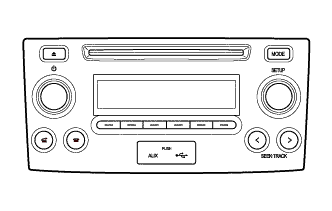
Audio System Audio Head Unit Speaker Base Audio System Radio Receiver Assembly 6 Speakers Display Audio System Radio and Display Receiver Assembly
-
-
Audio Head Unit
-
The radio receiver assembly has an improved design that better matches the interior of the vehicle. A USB/AUX port has also been included.
-
A high-definition Wide Video Graphics Array (WVGA) screen is used for the radio and display receiver assembly. The WVGA screen supports flick operation.
-
Discs containing MPEG audio layer-3 (MP3) files, Windows Media Audio (WMA) files and Advanced Audio Coding (AAC) files* can be played.
-
*: Models with display audio system
-
-
Discs with the marks shown below can be played:
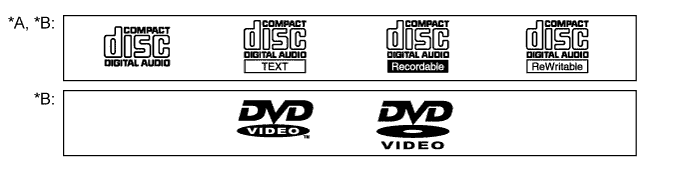
Text in Illustration *A Models with Base Audio System *B Models with Display Audio System
-
-
USB/AUX Port
-
A USB port is provided that enables the use of a USB memory devices, portable audio player (USB type), iPhone, iPod, iPod classic, iPod nano or iPod touch.
-
Videos stored on a video capable device such as an iPod can be displayed on the radio and display receiver assembly by connecting the video capable device to the AUX port using a dedicated 4-pole AUX cable.
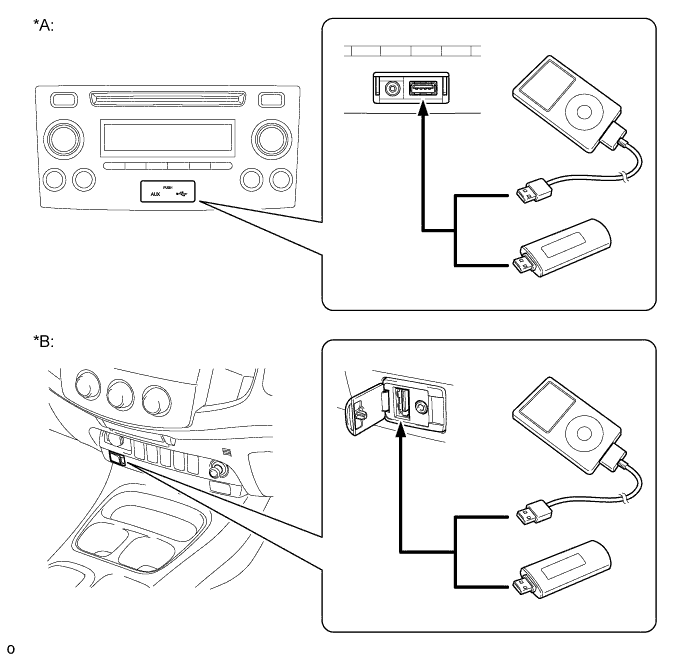
Text in Illustration *A Models with Base Audio System *B Models with Display Audio System Tech Tips
-
In order to display video from an iPod, it is necessary to connect the iPod to the USB and AUX ports using a dedicated iPod video cable or dedicated 4-pole AUX cable and select "video sound input cable" from the "iPod settings" screen.
-
Depending on the specifications of the 4-pole AUX cable used to connect a video cable device such as an iPod or VTR, the video function may not operate correctly. Use a dedicated 4-pole AUX cable when using the video function.
-
iPhone, iPod, iPod classic, iPod nano and iPod touch are trademarks of Apple Inc., registered in the U.S. and other countries.
-
The following iPod, iPod nano, iPod classic, iPod touch and iPhone devices can be used with this audio system.
- Made for
-
iPod touch (5th generation)
-
iPod touch (4th generation)
-
iPod touch (3rd generation)
-
iPod touch (2nd generation)
-
iPod touch (1st generation)
-
iPod classic
-
iPod with video
-
iPod nano (7th generation)
-
iPod nano (6th generation)
-
iPod nano (5th generation)
-
iPod nano (4th generation)
-
iPod nano (3rd generation)
-
iPod nano (2nd generation)
-
iPod nano (1st generation)
-
iPhone 5
-
iPhone 4S
-
iPhone 4
-
iPhone 3GS
-
iPhone 3G
-
iPhone
-
Depending on differences between models or software versions, etc., some models might be incompatible with this audio system.
-
USB memory devices that meet the following specifications are supported:
USB Communication Formats
-
USB 2.0, Full Speed (12 Mbps)
-
USB 2.0, High Speed (480 Mbps)*
File System FAT 16/32 Correspondence Class Mass Storage Class File Formats MP3, WMA, AAC* -
-
*: Models with display audio system
-
-
-
Bluetooth Audio System
-
The Bluetooth audio system enables users to enjoy music played on a portable audio player from the vehicle speakers via wireless communication.
-
The Bluetooth specifications and profiles required for operation are as follows:
Specification/Profile Version Bluetooth Specification Version 1.1 or higher*1/Version 2.0 or higher*2 Required Version 2.1 + EDR*1/3.0 + EDR*2 or higher Recommended Profile Advanced Audio Distribution Profile (A2DP) Version 1.0 or higher Required Advanced Audio Distribution Profile (A2DP) Version 1.2 or higher Recommended Audio/Video Remote Control Profile (AVRCP) Version 1.0 or higher Required Audio/Video Remote Control Profile (AVRCP) Version 1.3 or higher*1 Recommended Audio/Video Remote Control Profile (AVRCP) Version 1.4 or higher*2 Recommended
-
*1: Models with base audio system
-
*2: Models with display audio system
-
-
-
Bluetooth Hands-free System
-
The Bluetooth hands-free system allows users to make or receive a call while keeping both hands on the steering wheel when the system is linked with a Bluetooth-compatible cellular phone.
-
The Bluetooth specifications and profiles required for operation are as follows:
Specification/Profile Version Bluetooth Specification Version 1.1 or higher*1/Version 2.0 or higher*2 Required Version 2.1 + EDR*1/3.0 + EDR*2 or higher Recommended Profile Hands Free Profile (HFP) Version 1.0 or higher Required Hands Free Profile (HFP) Version 1.5*1/1.6*2 or higher Recommended Tech Tips
*1: Models with base audio system
*2: Models with display audio system
-
The operation of the interrupt call function of the Bluetooth hands-free system may vary with the Bluetooth phone or the telephone company that is used.

"Bluetooth" is a trademark owned by Bluetooth SIG, Inc. -
Some profiles described above may not be supported by the system depending on the audio head unit that is equipped.
-
If the specification of the connected Bluetooth phone is lower than recommended or does not support the functions required, the available functions may be limited.
-
-
The user can confirm the Bluetooth connection status, signal strength and remaining battery level of the connected Bluetooth phone by using the status icons displayed on the screen. The status icons are displayed in any mode. (Except models for Egypt)
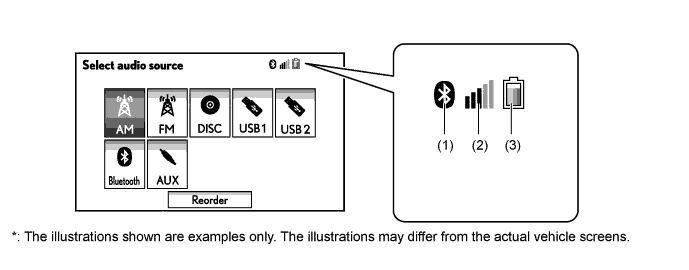
Item Outline (1) Bluetooth connection status Displays the Bluetooth connection status between the audio head unit and cellular phone. (2) Cellular phone signal strength*1 Displays the signal strength received by the cellular phone. (3) Cellular phone battery level*1, *2 Displays the battery level of the Bluetooth connected cellular phone. Tech Tips
*1: May not be displayed depending on the Bluetooth specifications and profiles of the cellular phone.
*2: Models with display audio system
-
-
Automatic Sound Levelizer (ASL)
-
The Automatic Sound Levelizer (ASL) function automatically adjusts the audio system volume level in order to compensate for increased vehicle noise (vehicle noise tends to increase as vehicle speed increases).
-
Vehicle speed signals are received from the combination meter assembly and used for ASL control.
-
-
-
Steering Pad Switch Assembly
-
Switches that the driver often uses are provided on the steering wheel for convenience.
-
-
-
SPECIFICATION
-
Audio System
Audio Head Unit Design Specification Radio Receiver Assembly 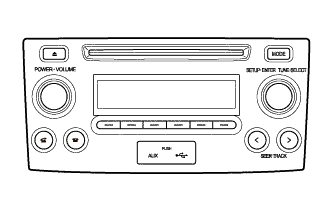
-
AM/FM Tuner
-
CD Player
-
CD-TEXT Display Function
-
MP3 and WMA Playback Function
-
iPod Operation Function
-
USB/AUX Port
-
Bluetooth Audio System
-
Bluetooth Hands-free System
-
6-speaker System
-
Manufacturer: FUJITSU TEN
Base Audio System:
-
AM/FM Tuner
-
Radio Data System (RDS)
-
CD Player
-
CD-TEXT Display Function
-
MP3 and WMA Playback Function
-
iPod Operation Function
-
USB/AUX Port
-
Bluetooth Audio System
-
Bluetooth Hands-free System
-
6-speaker System
-
Manufacturer: FUJITSU TEN
Base Audio System:
Radio and Display Receiver Assembly 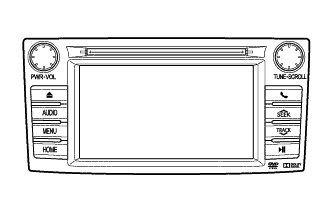
-
6.1-inch Display
-
AM/FM Tuner
-
CD/DVD Player
-
CD-TEXT Display Function
-
MP3, WMA and AAC Playback Function
-
iPod Operation Function
-
Stereo Jack Adapter (USB, AUX Port)
-
Bluetooth Audio System
-
Bluetooth Hands-free System
-
6-speaker System
-
Manufacturer: PIONEER
Display Audio System:
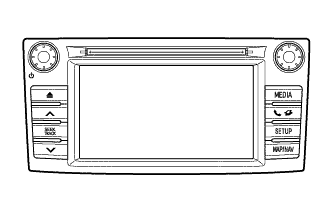
-
6.1-inch Display
-
AM/FM Tuner
-
Radio Data System (RDS)
-
CD Player
-
CD-TEXT Display Function
-
MP3, WMA and AAC Playback Function
-
iPod Operation Function
-
Stereo Jack Adapter (USB, AUX Port)
-
Bluetooth Audio System
-
Bluetooth Hands-free System
-
6-speaker System
-
Manufacturer: FUJITSU TEN
Display Audio System:
-
-
6-speaker System
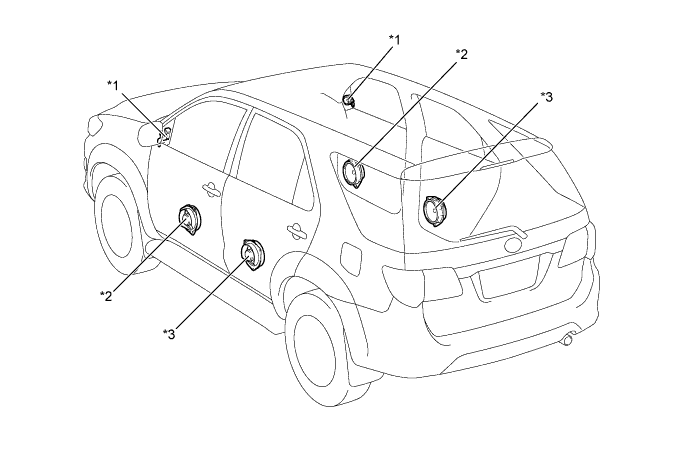
Location Speaker Type Caliber Impedance Input Range *1 Tweeter x 2 25 mm (1.0 in.) 4 Ω 20 W *2 Front Speaker x 2 160 mm (6.4 in.) 4 Ω 20 W *3 Rear Speaker x 2 160 mm (6.4 in.) 4 Ω 20 W
-
-
MAIN FEATURES
-
T-connect (Models for G.C.C. Countries)
-
T-connect is a service that uses an exclusive smartphone* application to offer a variety of information and provide an easy, secure, safe and convenient vehicle ownership experience.
Tech Tips
*: Depending on the type of cellular phone, T-connect may not be supported
-
By using T-connect, users can utilize contents such as a map guide service, operator service and traffic information.
-
For details of the contents available on T-connect, please contact a dealer.
-
By connecting a smartphone with the exclusive application to either the radio and display receiver assembly, the smartphone display can be shown on-screen. Users are also able to operate the smartphone using the screen.*
Tech Tips
*: iPhone and Android phones require different connection methods. For details, please contact a dealer.
To use T-connect, users must register through the exclusive smartphone application. For details, please contact a dealer.
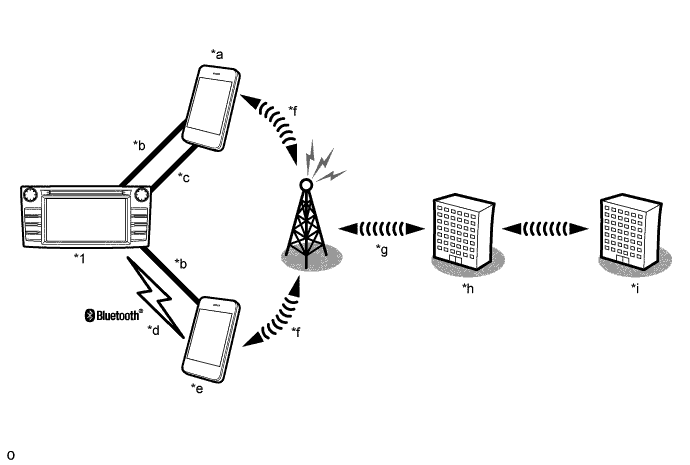
Text in Illustration *1 Radio and Display Receiver Assembly - - *a iPhone *b USB *c AUX *d Bluetooth Wireless Connection *e Android *f Cellular Network *g Internet *h Toyota Smart Center *i Global Data Center - - -
MirrorLinkTMFunction
-
To utilize the MirrorLinkTMfunction, it is necessary to connect a compatible smartphone* to the display and radio receiver assembly using a USB cable.
-
After a connection is established, the screen of the smartphone is displayed on the radio and display receiver assembly. Using this screen, the user can operate applications installed on the smartphone and listen to the audio of the smartphone via the vehicle speakers. Operation via the smartphone is also possible.
Tech Tips
*: This function is not available if the smartphone is not compliant with MirrorLinkTMof the Car Connectivity Consortium.
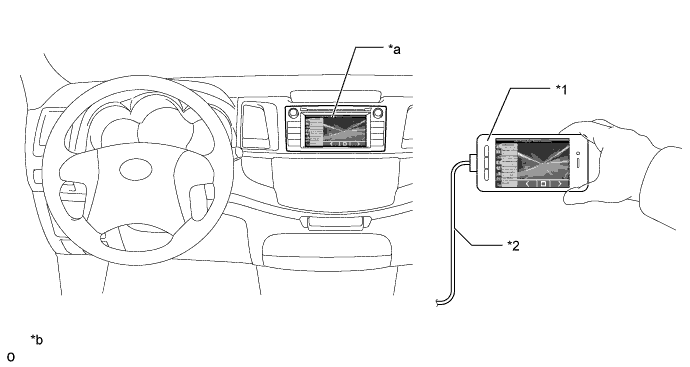
Text in Illustration *1 Smartphone *2 Connection via USB Cable *a MirrorLinkTMScreen
*b The illustration shows an example for Android.
-
-
-