ENGINE UNIT
-
CONSTRUCTION
-
Cylinder Head Sub-assembly
-
The fuel injector assemblies are installed in the cylinder head sub-assembly to reduce the distance from the fuel injector assembly to the intake valve, thus it prevents the fuel from adhering to the intake port walls, and reduces exhaust emissions.
-
The routing of the water jacket in the cylinder head sub-assembly is optimized to achieve high cooling performance.
-
Through the use of the taper squish combustion chamber, the engine's knocking resistance and fuel efficiency have been improved.
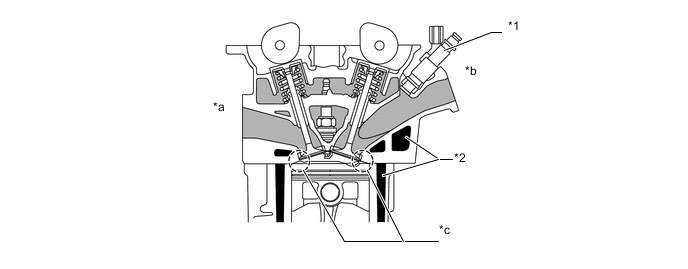
Text in Illustration *1 Fuel Injector Assembly *2 Water Jacket *a Exhaust Side *b Intake Side *c Taper Squish - -
-
-
Cylinder Block Sub-assembly
-
An aluminum cylinder block with a 8 mm (0.31 in.) distance between the cylinder bores is used to achieve a compact and lightweight configuration.
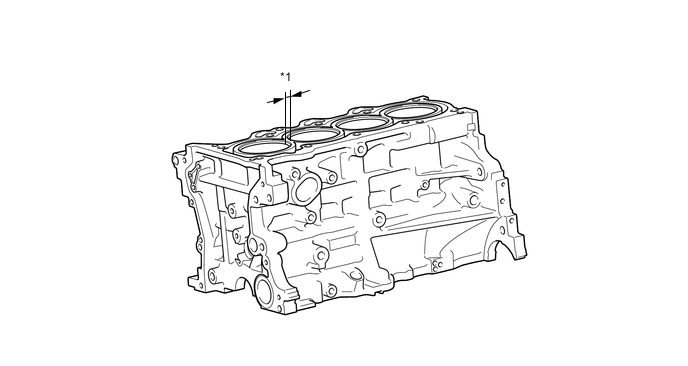
Text in Illustration *1 8 mm (0.31 in.) - - -
Through the use of an offset crankshaft, the centerline of the cylinder bores is shifted 12 mm (0.47 in.) towards the exhaust in relation to the centerline of the crankshaft. Thus, the side force (thrust) applied to the cylinder walls is reduced when maximum combustion pressure is applied. This contributes to fuel economy.
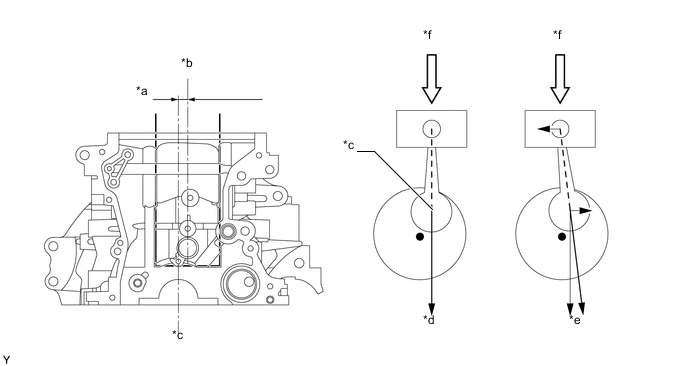
Text in Illustration *a 12 mm (0.47 in.) *b Bore Centerline *c Crankshaft Centerline *d Offset Crankshaft *e Non-offset Crankshaft *f Maximum Pressure
-
-
Oil Pan Sub-assembly
-
A lightweight and high-strength aluminum die-cast oil pan sub-assembly is used.
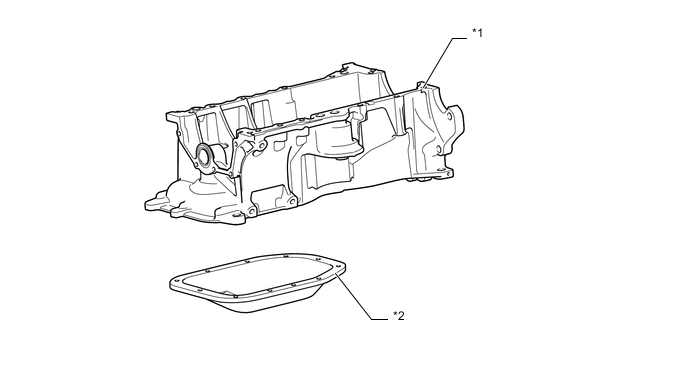
Text in Illustration *1 Oil Pan Sub-assembly *2 No. 2 Oil Pan Sub-assembly
-
-
Piston
-
The pistons are made of aluminum alloy to allow them to be compact and lightweight.
-
The top of the piston uses a taper squish shape to achieve fuel combustion efficiency.
-
The piston skirt is coated with resin to reduce friction losses.
-
Low-tension piston rings are used to reduce friction and achieve excellent fuel economy.
-
The ring width of the No. 1 and No. 2 compression rings has been reduced to just 1 mm, minimizing the overall piston height. As a result, the weight of the piston has been significantly reduced. In addition, the piston ring tension has also been further optimized, resulting in the reduction in friction.
-
The outer surface of both the No. 1 compression ring and oil ring is coated with Physical Vapor Deposition (PVD), and the outer surface of the No. 2 compression ring has been chrome plated, offering wear resistance.
-
The oil ring is a three-piece type, and use of the oil ring contributes higher reliability and lower friction.
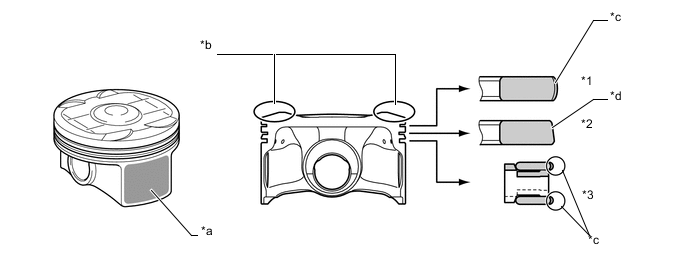
Text in Illustration *1 No. 1 Compression Ring *2 No. 2 Compression Ring *3 Oil Ring - - *a Resin Coating *b Taper Squish Shape *c PVD Coating *d Chrome Planting
-
-
Connecting Rod Sub-assembly and Connecting Rod Bearing
-
The connecting rods are made of high-strength steel for weight reduction.
-
The width of the connecting rod bearings has been optimized to reduce friction.
-
The lining surface of the connecting rod bearing is micro-grooved to provide an optimal oil clearance. As a result, cold-engine cranking performance has been improved and engine vibration has been reduced.
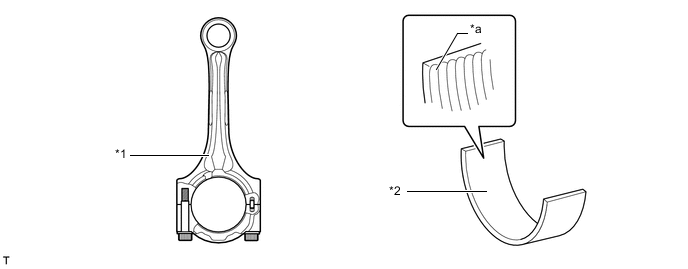
Text in Illustration *1 Connecting Rod Sub-assembly *2 Connecting Rod Bearing *a Micro-grooved - -
-
-
Crankshaft and Crankshaft Bearing
-
The crankshaft has 5 main journals and 4 balance weights.
-
The diameter and width of the pins and journals have been reduced, and the pins for the No. 1 and No. 4 cylinders have been made highly rigid to realize a lightweight and low-friction performance.
-
A crankshaft position sensor rotor is pressed into the crankshaft to realize an integrated configuration.
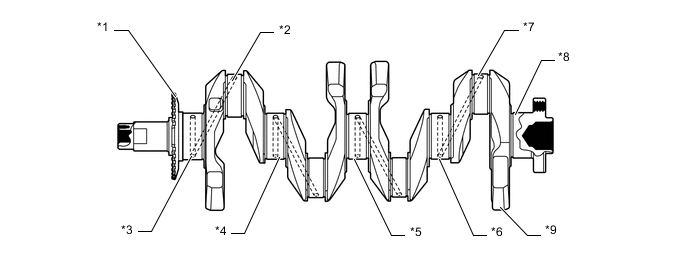
Text in Illustration *1 Crankshaft Position Sensor Rotor *2 Oil Hole *3 No. 1 Journal *4 No. 2 Journal *5 No. 3 Journal *6 No. 4 Journal *7 Crank Pin *8 No. 5 Journal *9 Balance Weight - - -
The width of the crankshaft bearings has been optimized to reduce friction.
-
The lining surface of the crankshaft bearing is micro-grooved to provide an optimal oil clearance. As a result, cold-engine cranking performance has been improved and engine vibration has been reduced.
-
An oil groove is provided on each upper main bearing (crankshaft bearing). The oil groove is deep at the center and is shallow at the edges to reduce the amount of oil that will leak from the crankshaft bearing. As a result, the size of the oil pump has been reduced, thus minimizing friction.
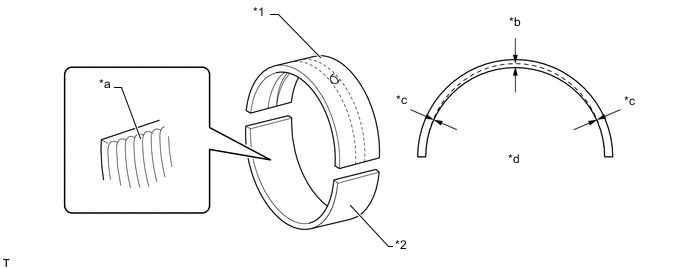
Text in Illustration *1 Upper Main Bearing (Crankshaft Bearing) *2 Lower Main Bearing (Crankshaft Bearing) *a Micro-grooved *b Center *c Edge *d Oil Groove Depth
-
-
Valve Mechanism
-
The shimless type valve lifter is used to increase the amount of the valve lift.
-
The intake and exhaust camshafts are driven by a chain sub-assembly.
-
The VVT-i system is used to realize fuel economy, engine performance and reduce exhaust emissions. For details of VVT-i control.
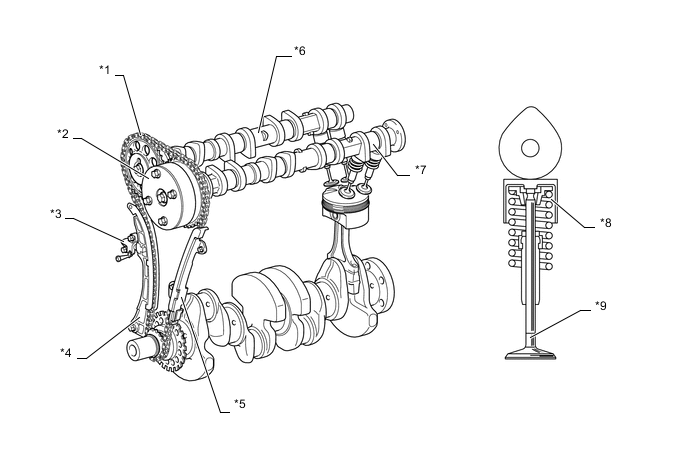
Text in Illustration *1 Chain Sub-assembly *2 Camshaft Timing Gear Assembly *3 No. 1 Chain Tensioner Assembly *4 Chain Tensioner Slipper *5 No. 1 Chain Vibration Damper *6 No. 2 Camshaft (Exhaust) *7 Camshaft (Intake) *8 Valve Lifter *9 Valve - -
-
-
Camshaft
-
Oil passages are provided in the camshaft (intake) in order to supply engine oil pressure to the VVT-i system.
-
A VVT-i controller (camshaft timing gear assembly) is installed on the front of the camshaft (intake) to vary the timing of the intake valves.
-
A timing rotor is provided behind the camshaft to trigger the cam position sensor.
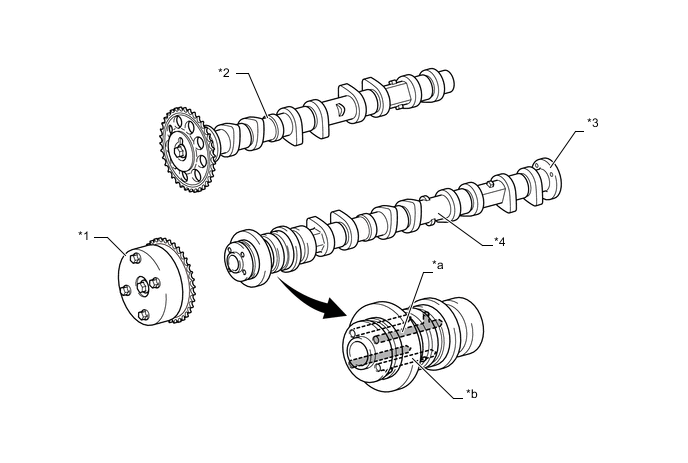
Text in Illustration *1 VVT-i Controller (Camshaft Timing Gear Assembly) *2 No. 2 Camshaft (Exhaust) *3 Timing Rotor *4 Camshaft (Intake) *a Oil Passage (Advance) *b Oil Passage (Retard)
-
-
VVT-i Controller (Camshaft Timing Gear Assembly)
-
This VVT-i controller (camshaft timing gear assembly) consists of the housing driven from the timing chain and the vane coupled with the camshaft (intake).
-
The oil pressure sent from the advance or retard side path at the intake camshaft causes rotation in the VVT-i controller (camshaft timing gear assembly) vane circumferential direction to vary the intake valve timing continuously.
-
When the engine is stopped, the camshaft (intake) will be in the most retarded state to ensure startability.
-
When hydraulic pressure is not applied to the VVT-i controller (camshaft timing gear assembly) immediately after the engine has been started, the lock pin locks the movement of the VVT-i controller (camshaft timing gear assembly) to prevent a knocking noise.
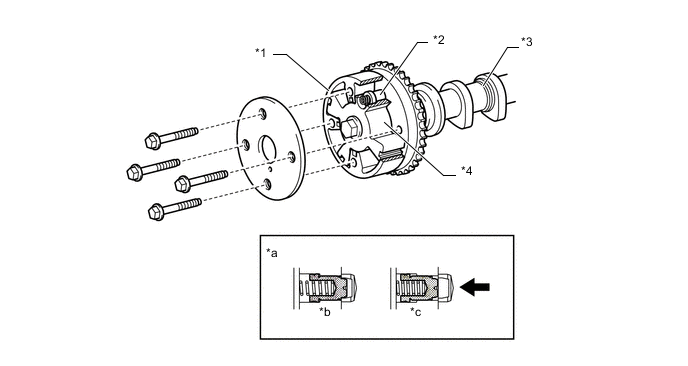
Text in Illustration *1 Housing *2 Lock pin *3 Camshaft (Intake) *4 Vane *a Lock Pin Operation *b Engine Stopped *c Engine Operating - - 
Oil Pressure - -
-
-
Chain Sub-assembly and No. 1 Chain Tensioner Assembly
-
A roller type chain sub-assembly with an 8.0 mm (0.315 in.) pitch is used to make the engine compact and reduce noise.
-
The chain sub-assembly is lubricated by an oil jet.
-
The No. 1 chain tensioner assembly uses a spring and oil pressure to maintain proper chain tensioner at all times. The No. 1 chain tensioner assembly suppresses noise generated by the chain sub-assembly.
-
A ratchet type non-return mechanism is used in the No. 1 chain tensioner assembly.
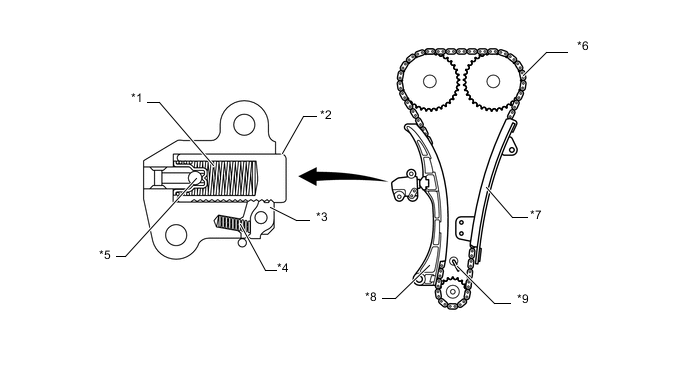
Text in Illustration *1 Spring *2 Plunger *3 Cam *4 Cam Spring *5 Check Ball *6 Chain Sub-assembly *7 No. 1 Chain Vibration Damper *8 Chain Tensioner Slipper *9 Oil Jet - -
-
-
Timing Chain Cover (Oil Pump Assembly)
-
A single-piece, aluminum die-cast timing chain cover (oil pump assembly) that entirely seals the front portion of the cylinder block sub-assembly and cylinder head sub-assembly is used.
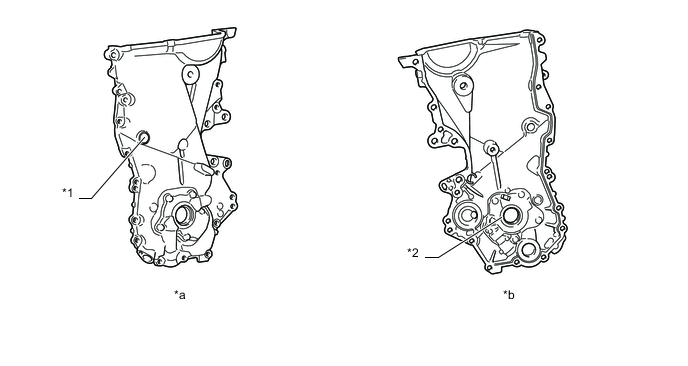
Text in Illustration *1 Service Hole for Chain Tensioner *2 Oil Pump *a Front View *b Back View
-
-