СИСТЕМА ВЫПУСКА ОТРАБОТАВШИХ ГАЗОВ ДЕТАЛЬНОЕ ОПИСАНИЕ
-
CONSTRUCTION
-
Exhaust Manifold Sub-assemblies
-
A stainless steel exhaust manifold converter sub-assembly is used. This achieves a reduction in noise, ensures heat resistance, and realizes quick warm-up of the catalyst immediately after engine start, helping to reduce emissions.
-
The exhaust manifold converter sub-assembly with an integrated three-way catalyst (TWC) is used. This realizes quick warm-up of the catalytic converter, helping to reduce emissions immediately after engine start.
-
The EGR system, which extracts emissions from downstream of the catalyst, is used. For the EGR system, refer to Emission Control System.*
-
*: Models with EGR system
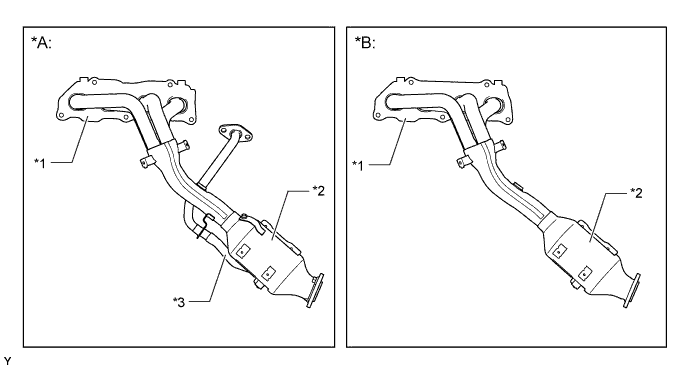
Text in Illustration *A Models with EGR System *B Models without EGR System *1 Exhaust Manifold Converter Sub-assembly *2 TWC *3 EGR Gas Passage - - -
-
-
Exhaust Pipe
-
The exhaust pipes are made of stainless steel for improved rust resistance.
-
A three-way catalyst is used for the front exhaust pipe assembly, helping to reduce emissions.
-
A ball joint is used to join the exhaust front pipe assembly and exhaust tail pipe assembly. As a result, in-vehicle sound has been muffled, vibration has been minimized, and weight reduction has been achieved.
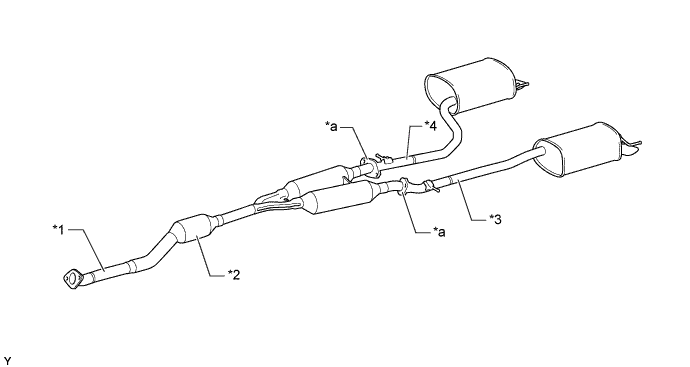
Text in Illustration *1 Front Exhaust Pipe Assembly *2 TWC *3 Exhaust Tail Pipe Assembly LH *4 Exhaust Tail Pipe Assembly RH *a Ball Joint Portion - - -
The ball joint mechanism consists of a flange with a round surface, 2 bolts that support the gasket seal, and a spring. A more compact structure can be achieved than with a flexible pipe, thus enabling the ball joints to be mounted at optimized positions to dampen vibrations.
-
Vibrations caused by the engine and resonant frequency vibrations of the exhaust pipe are absorbed by the ball joints (flanges and rounded parts of the gasket), reducing vibrations and noise.
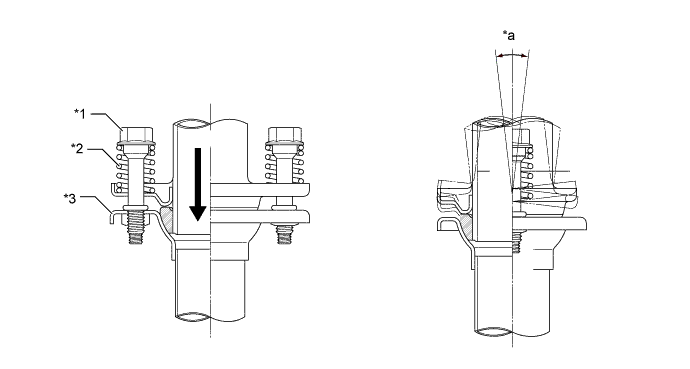
Text in Illustration *1 Flange Bolt *2 Compression Spring *3 Flange - - *a Swing - - 
Exhaust Flow - -
-
-