HYBRID CONTROL SYSTEM DETAILS
-
FUNCTION OF MAIN COMPONENTS
Component Function 2AR-FSE Engine The 2AR-FSE engine is a high-expansion ratio Atkinson cycle engine which is compatible with the hybrid system and which generates drive force for driving and energy for electricity generation. L210 Hybrid Transmission (Hybrid Vehicle Transmission Assembly) Motor Generator 1 (MG1)
-
Driven by the engine and generates high-voltage electricity in order to operate MG2 and/or to charge the HV battery. Also, MG1 functions as a starter to start the engine.
-
Operated to allow the gear ratio of the power split planetary gear unit to optimally suit the driving conditions of the vehicle.
Motor Generator 2 (MG2)
-
Driven by electrical power from MG1 and/or the HV battery, and generates motive force for the rear wheels.
-
Generates electricity to recharge the HV battery (regenerative braking) during braking or when the accelerator pedal is not depressed.
Resolvers
-
MG1 and MG2 are each equipped with a resolver.
-
Send information about the rotational speed and direction of the motor generators to the MG ECU.
Temperature Sensors for Motor Generator
-
MG1 and MG2 are each equipped with a temperature sensor.
-
Measure the temperature of MG1 and MG2.
Compound Gear Unit Power Split Planetary Gear Distributes the engine motive force as appropriate to directly drive the vehicle as well as MG1. Motor Speed Reduction Planetary Gear Reduces the rotational speed of MG2 in accordance with the characteristics of the planetary gear in order to increase torque. Mechanical Oil Pump Driven by the engine or electrical power and lubricates the planetary gear. Shift Lever Position Sensor Converts the shift lever position into electrical signals and outputs the signals to the power management control ECU. Inverter with Converter Assembly Inverter Converts high-voltage DC (HV battery) into AC (MG1 and MG2) and vice versa (converts AC into DC). Boost Converter Boosts the voltage of the HV battery from DC 230.4 V to a maximum of DC 650 V and vice versa (reduces from DC 650 V to DC 230.4 V). Hybrid Vehicle Converter Assembly Reduces the HV battery voltage from DC 230.4 V to approximately DC 14 V in order to supply electricity to body electrical components, as well as to recharge the auxiliary battery. Motor Generator ECU (MG ECU) Controls the inverter and boost converter in accordance with signals received from the power management control ECU, operating MG1 or MG2 as either a generator or motor. Inverter Current Sensors
-
MG1 and MG2 are each provided with 2 inverter current sensors.
-
Measure the current of MG1 and MG2.
Inverter Temperature Sensors
-
Provided for the boost converter, Intelligent Power Module (IPM) for MG1 and MG2, and inverter coolant.
-
Measure the temperature of the boost converter, IPM for MG1 and MG2, and inverter coolant.
Atmospheric Pressure Sensor Detects the atmospheric pressure. Inverter Radiator Cools inverter coolant. Inverter Water Pump with Motor Assembly Controlled in 4 stages by the power management control ECU in accordance with inverter coolant temperatures in order to cool the inverter coolant. Interlock Switches
- Inverter Terminal Cover
- Connector Cover Assembly
- Power Cable Connector
- Service Plug Grip
Verify that the inverter terminal cover, service plug grip and power cable are installed. Power Cable Connects the HV battery to the inverter with converter assembly, the inverter with converter assembly to MG1 and MG2, and the inverter with converter assembly to the compressor with motor assembly. HV Battery Assembly HV Battery (Battery Modules)
-
Supplies electrical power to MG1, MG2 and the compressor with motor assembly in accordance with the driving conditions of the vehicle.
-
Charged by MG1 and MG2 in accordance with the State Of Charge (SOC) of the HV battery and the driving conditions of the vehicle.
-
Has a nominal (approximate) voltage of DC 230.4 V (actual voltage will vary depending on various conditions such as temperature, charge or discharge).
Battery Voltage Sensor
-
Monitors frequency from the battery cooling blower assembly and conditions of the HV battery such as voltage, temperature and current, and transmits this information to the power management control ECU.
-
Monitors the high voltage system for breakdown of the electrical insulation.
Hybrid Battery Junction Block Assembly System Main Relays (SMRs) Connect and disconnect the high-voltage power circuit between the HV battery and the inverter with converter assembly. The power management control ECU controls the SMRs by turning them on or off as appropriate. HV Battery Current Sensor Measures the current of the HV battery. HV Battery Temperature Sensors Detect temperatures in the parts of the HV battery and the intake air temperature from the battery cooling blower assembly. Battery Cooling Blower Assembly Operates under the control of the power management control ECU in order to cool the HV battery. Service Plug Grip Shuts off the high-voltage circuit of the HV battery when this plug is removed for vehicle inspection or maintenance. Auxiliary Battery When the power switch is on (ACC) or on (IG), the auxiliary battery supplies power to the electrical equipment and ECUs. Auxiliary Battery Temperature Sensor (Thermistor Assembly) Measures the temperature of the auxiliary battery to protect the battery. Compressor with Motor Assembly Driven at a speed calculated by the air conditioning amplifier assembly, receives drive requests from the power management control ECU and takes in, compresses and discharges refrigerant. Heater Accessory Assembly Controlled via the power management control ECU in accordance with signals from the air conditioning amplifier assembly and circulates coolant to ensure heater source stability during idling stop control. Speed Sensors Detect the wheel speed of each of the 4 wheels. Steering Sensor Detects the direction and angle of the steering wheel. Yawrate Sensor
-
Detects the vehicle's longitudinal and lateral acceleration.
-
Detects the vehicle's yaw rate.
Accelerator Pedal Position Sensor Converts the accelerator pedal position into an electrical signal and outputs the signal to the power management control ECU. Kick Down Switch Assembly Detects that the accelerator pedal is almost fully depressed. Brake Pedal Stroke Sensor Assembly Directly detects the extent of the brake pedal stroke operated by the driver. Stop Light Switch Assembly Detects the brake pedal depressing signal. Cruise Control Main Switch Turns the cruise control system and dynamic radar cruise control system on and off, and conducts various operations including vehicle speed setting, acceleration, deceleration and control cancellation. Shift Paddle Switch (Transmission Shift Switch Assembly) Detects the shift-up and shift-down operations performed by the driver. Transmission Control Switch
-
Detects that the shift lever is in S.
-
Detects the shift-up and shift-down operations performed by the driver when the shift lever is in S.
Combination Switch Assembly EV Drive Mode Switch Outputs the EV drive mode switch signal to the power management control ECU when operated by the driver. Drive Mode Select
-
Outputs the NORMAL mode signal to the power management control ECU via the ECM when operated by the driver.
-
Outputs the ECO mode signal to the power management control ECU via the air conditioning amplifier assembly when operated by the driver.
-
Outputs the SPORT mode signal to the power management control ECU via the ECM when operated by the driver.
SNOW Mode Switch Outputs the SNOW mode switch signal to the power management control ECU via the ECM when operated by the driver. Power Management Control ECU
-
Performs comprehensive control of the hybrid system. This includes the electric continuously variable transmission and HV battery.
-
Receives information from various sensors as well as from ECUs (ECM, battery voltage sensor, MG ECU and skid control ECU), calculates the required torque and output power based on the information and sends the calculated result to the ECM, MG ECU and skid control ECU.
-
Monitors the SOC of the HV battery.
-
Controls the hybrid vehicle converter assembly.
-
Controls the inverter water pump with motor assembly.
-
Controls the battery cooling blower assembly.
ECM
-
Controls the engine in accordance with the target engine speed and required engine motive force received from the power management control ECU.
-
Transmits the operating condition signals of the engine to the power management control ECU.
Skid Control ECU Assembly
-
Calculates the regenerative braking force that is required and transmits the force to the power management control ECU during braking.
-
Calculates the motive force that is required during the operation of TRC or VSC and transmits the force to the power management control ECU.
Air Conditioning Amplifier Assembly Transmits various air conditioning state signals to the power management control ECU. Center Airbag Sensor Assembly Transmits the airbag deployment signal to the power management control ECU during a collision. Driving Support ECU Assembly* Sends the information about the operation conditions of the dynamic radar cruise control system to the power management control ECU. Multi-media Module Receiver Assembly
-
Displays hybrid system output and charging conditions of the hybrid battery on the energy monitor in the multi-display.
-
Displays drive mode on the multi-display.
Combination Meter Assembly Hybrid System Indicator Indicates the hybrid system output and charging conditions of the hybrid battery to inform the driver. READY Indicator Light Informs the driver that the vehicle is ready to be driven. EV Drive Indicator Light Informs the driver that the EV drive is entered. MIL Turns on when there is a malfunction in the engine control system. Charge Warning Light Turns on when there is a malfunction in the auxiliary battery charging system. Master Warning Light In this context, the primary function of this warning light is to inform the driver of a malfunction in the hybrid system or when the SOC of the HV battery is too low. The light illuminates simultaneously with the sounding of a warning buzzer. Multi-information Display
-
Displays the shift lever position.
-
Displays the shift range.
-
Displays the energy flow.
-
Displays the EV drive mode.
-
Displays the drive mode.
-
Displays the SNOW mode.
-
Displays messages to inform the driver when a malfunction occurs.
-
Shows the system status and appropriate operations to be performed.
Meter Panel Illumination Illuminates in blue or red in response to drive mode. Also, the brightness level changes when illuminated in blue in accordance with driving conditions.
-
*: Models with dynamic radar cruise control system
-
-
OPERATING CONDITION
-
Hybrid System Activation (READY-ON State)
-
The hybrid system can be activated by pressing the power switch while the brake pedal is being depressed. At this time, the READY indicator light flashes until the system check is completed. When the READY indicator light turns on, the hybrid system has started and the vehicle is ready to be driven.
-
Even if the driver turns the power switch on (READY), sometimes the power management control ECU will not start the engine. The engine will only start if conditions such as engine coolant temperature, SOC, HV battery temperature and electrical load require an engine start.
-
After driving, when the driver stops the vehicle and the shift lever is in P, the power management control ECU allows the engine to continue running. The engine will stop after the SOC, HV battery temperature and electrical load reach a specified level.
Note
When the hybrid system is unavoidably required to be stopped while driving, the system can be forced to stop by pressing and holding the power switch for approximately 2 seconds or more or by pushing the power switch 3 times or more in a row. At this time, the power source will turn on (ACC).
-
-
EV Drive Mode
-
When the following conditions in the table below are satisfied, EV drive mode is entered by selecting on using the EV drive mode switch:
Mode Condition EV Drive Mode
-
The hybrid system temperature is not high. The hybrid system temperature will be high when the outside air temperature is high or after the vehicle has traveled uphill or at high speeds.
-
The hybrid system temperature is not low. The hybrid system temperature will be low after the vehicle has been left for a long time when the outside air temperature is low.
-
The State Of Charge (SOC) of the HV battery is approximately 47% or more.
-
The vehicle speed is approximately 45 km/h (28 mph) or less (engine coolant temperature is 40°C (104°F) or more).
-
The accelerator pedal depression amount is a certain level or below.
-
The defroster is off.
-
The cruise control system is not operating.
-
-
If any condition is not satisfied and the EV drive mode switch is selected, a message is displayed on the multi-information display to inform the driver that the attempt to enter EV drive mode is rejected, and the EV drive mode cannot be entered.
-
When EV drive mode has been automatically canceled, a message is displayed to indicate that EV drive mode has been canceled.
-
-
ECO Mode
-
ECO mode is entered by selecting on using the drive mode select.
-
The ECO mode setting is recorded by the power management control ECU. This setting will not be reset when the power switch is turned off.
-
ECO mode will be canceled when the drive mode select is switched to any mode other than ECO mode.
-
-
Inspection Mode
-
Inspection mode is entered by using the Global TechStream (GTS) or the accelerator pedal. For details, refer to the Repair Manual.
-
-
Detection of Insulation Resistance Decrease
-
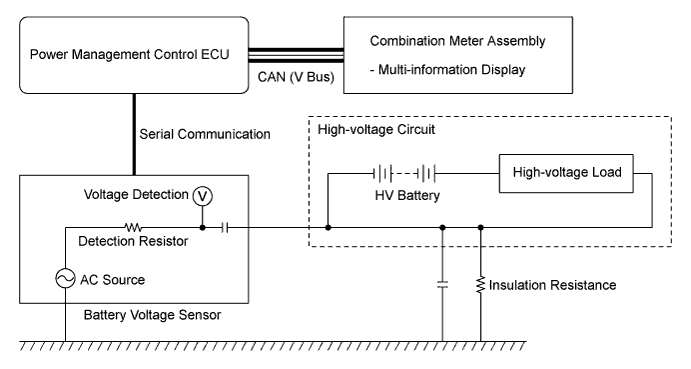
A leak detection circuit is built into the battery voltage sensor. The leak detection circuit constantly monitors that the insulation resistance between high-voltage circuits and body ground is maintained.
-
If the insulation resistance decreases below a specified level, a Diagnostic Trouble Code (DTC) is stored, and the driver is informed of the abnormal condition by the multi-information display.
-
The leak detection circuit has an AC source and causes a small amount of AC to flow to the high-voltage circuit (positive and negative).
-
AC flows as shown in the following illustration. AC flows via a detection resistor, a capacitor and body ground.
-
The more vehicle insulation resistance decreases, the more voltage reduces at the detection resistor and the lower the amplitude of the AC waves. The insulation resistance value (tester data name: short wave highest value) is detected based on the amplitude of the AC waves.
-
-
-
SYSTEM CONTROL
Electronic Control of Hybrid System Control Outline Hybrid Vehicle Control
-
The power management control ECU calculates the target motive force based on the shift lever position sensor, the degree to which the accelerator pedal is depressed, and the vehicle speed. The power management control ECU performs control in order to create the target motive force by optimally combining MG1, MG2 and the engine.
-
The power management control ECU calculates the engine motive force based on the target motive force, which has been calculated based on the requirements of the driver and vehicle conditions. In order to create this motive force, the power management control ECU transmits signals to the ECM.
-
The power management control ECU monitors the conditions of the HV battery and battery cooling blower assembly to perform control using feedback to keep the HV battery at a predetermined temperature.
System Monitoring Control The power management control ECU monitors the State Of Charge (SOC) of the HV battery and the temperature of the HV battery, MG1 and MG2, in order to optimally control these items. Shut Down Control When the shift lever is in N, the power management control ECU performs shut down control to stop driving MG1 and MG2. System Main Relay (SMR) Control To ensure that it is possible to connect and disconnect the high voltage circuits reliably, the power management control ECU controls the 3 System Main Relays (SMRs) to connect and disconnect the high voltage circuits from the HV battery. The power management control ECU also uses the timing of the operation of the SMRs to monitor the operation of the relay contacts. State Of Charge (SOC) Control
-
The power management control ECU calculates the SOC by estimating the charging and discharging amperage of the HV battery.
-
The power management control ECU (HV CPU) constantly performs charge/discharge control based on the calculated SOC in order to maintain the SOC within its target range.
Inverter Coolant Cooling Control In order to cool the inverter with converter assembly, the power management control ECU regulates the inverter water pump with motor in accordance with the signals from the temperature sensor for the inverter coolant. HV Battery Cooling Control In order to maintain the HV battery temperature at the optimal level, the power management control ECU regulates the battery cooling blower assembly in accordance with the signals from the HV battery temperature sensor. Auxiliary Battery Charging Control The power management control ECU uses the auxiliary battery temperature sensor (thermistor assembly) to monitor the temperature of the auxiliary battery. The power management control ECU performs charge control based on the temperature information from the auxiliary battery. ECM Control The ECM receives the target engine speed and required engine motive force sent from the power management control ECU, and controls the Electronic Throttle Control System-intelligent (ETCS-i), fuel injection volume, ignition timing and Dual Variable Valve Timing-intelligent (Dual VVT-i) system. MG1 and MG2 Main Control
-
MG1, which is driven by the engine, generates high voltage (alternating current) in order to operate MG2, and charge the HV battery via the inverter. Also, MG1 functions as a starter to start the engine.
-
MG2, which is driven by electrical power from MG1 and/or the HV battery, generates motive force for the rear wheels.
-
MG2 generates electricity to charge the HV battery (regenerative braking control) during braking or when the accelerator pedal is not being depressed.
-
Resolvers detect the speed and the position of MG1 and MG2 for use by the power management control ECU. Resolver signals are transmitted to the power management control ECU via the Motor Generator ECU (MG ECU).
-
Temperature sensors mounted in MG1 and MG2 detect the temperature for use by the power management control ECU.
Inverter Control
-
The inverter converts direct current from the HV battery into an alternating current for MG1 and MG2, or vice versa, in accordance with the signals provided by the power management control ECU via the MG ECU. In addition, the inverter is used to transfer power from MG1 to MG2.
-
Via the MG ECU, the power management control ECU sends signals to the power transistors on the Intelligent Power Modules (IPMs) in the inverter for switching the U, V and W phases of MG1 and MG2, in order to drive MG1 and MG2.
-
The power management control ECU shuts down the inverter when the ECU receives an overheat, overcurrent or fault voltage signal from the inverter via the MG ECU.
Boost Converter Control
-
The boost converter boosts the HV battery voltage from a nominal voltage of DC 230.4 V to a maximum voltage of DC 650 V, in accordance with the signals provided by the power management control ECU via the MG ECU.
-
The inverter converts the alternating current generated by MG1 or MG2 into a direct current. The boost converter reduces the generated voltage from up to 650 V to approximately DC 230.4 V for the HV battery in accordance with the signals provided by the power management control ECU via the MG ECU.
Hybrid Vehicle Converter Assembly Control
-
Reduces the voltage from DC 230.4 V (nominal) to DC 14 V (nominal) in order to supply electricity to body electrical components, as well as to recharge the auxiliary battery (DC 12 V).
-
This converter keeps the auxiliary battery at a constant voltage.
Battery Voltage Sensor Control The battery voltage sensor monitors the insulation of the high voltage electrical system for leakage. In addition, the sensor converts the feedback signals of the battery cooling blower assembly and the conditions of the HV battery (which are needed by the power management control ECU to perform SOC control and HV battery cooling control) into digital signals, and transmits the signals to the power management control ECU. Shift Control The power management control ECU detects the shift position (P, R, N, D or S) in accordance with the signals provided by the shift lever position sensor and the transmission control switch, and controls MG1, MG2, the engine and hybrid transmission to match the selected shift position. Skid Control ECU Assembly Control Regenerative Braking Cooperative Control During braking, the skid control ECU calculates the required regenerative braking force and transmits a signal to the power management control ECU. Upon receiving this signal, the power management control ECU transmits an actual regenerative braking control value to the skid control ECU. Based on this result, the skid control ECU calculates and executes the required hydraulic pressure braking force. TRC/VSC Cooperative Control The skid control ECU transmits a request to the power management control ECU to limit motive force while the TRC or VSC is operating. The power management control ECU controls the engine, MG1 and MG2 in accordance with the present driving conditions in order to suppress the motive force. During Collision Control During a collision, if the power management control ECU receives an airbag deployment signal from the center airbag sensor assembly, the ECU turns the SMRs off in order to shut off the high voltage power supplied to the hybrid system by the HV battery. Cruise Control System Operation Control When the cruise control ECU that is enclosed in the power management control ECU receives a cruise control main switch signal, the ECU regulates the hybrid system output to obtain the targeted vehicle speed based on the driver's demand. Dynamic Radar Cruise Control System Operation Control*1 Upon receiving a motive force request signal from the driving support ECU, the power management control ECU optimizes the motive forces of the engine and MG2 in order to obtain the target vehicle speed. EV Drive Mode Control When the EV drive mode switch is manually operated by the driver, the power management control ECU operates to run the vehicle using only MG2 if the required conditions are satisfied. Drive Mode Select Control Optimally controls the outputs of MG1, MG2 and the engine in accordance with the following drive modes: NORMAL, ECO, SPORT*2 and SPORT S/S+*3 modes. SNOW Mode Control When the SNOW mode switch is manually operated by the driver, the power management control ECU controls motive force for the acceleration operation, achieving a smooth start-off on slippery roads such as snowy roads. Indicator and Warning Light Control Illuminates and blinks the warning lights, or shows messages on the multi-information display to inform the driver of the vehicle conditions or system malfunctions. Brake Override System The driving torque is restricted when both the accelerator and brake pedals are depressed. (For the Activation Conditions and Inspection Method, refer to the Repair Manual.)
-
*1: Models with dynamic radar cruise control system
-
*2: Models without AVS
-
*3: Models with AVS
-
Hybrid Vehicle Control
-
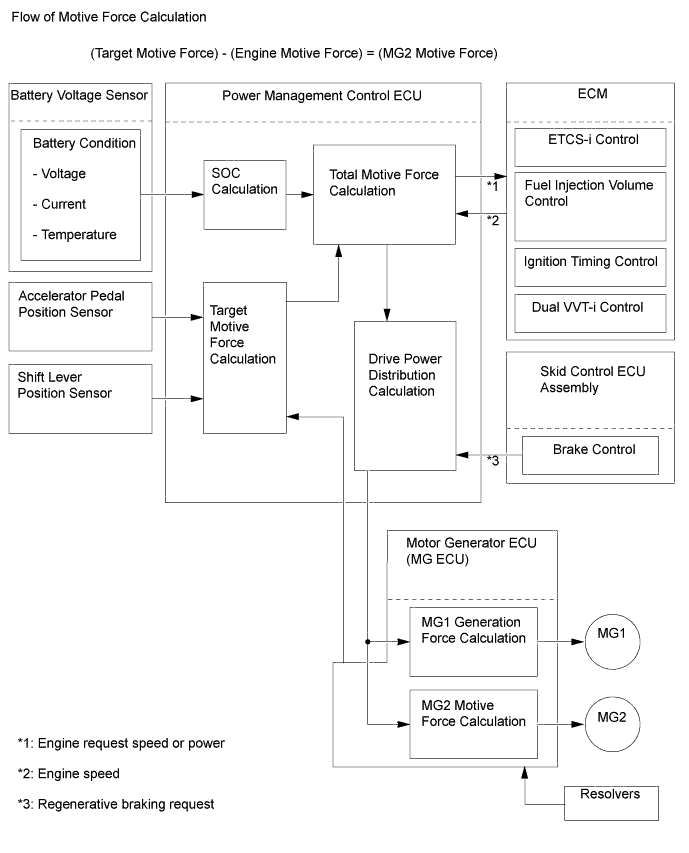
The power management control ECU detects the amount of accelerator pedal depression using the signals from the accelerator pedal position sensor. The power management control ECU receives vehicle speed signals from the MG2 resolver and detects the shift position signal from the shift lever position sensor. The power management control ECU determines the vehicle operating conditions in accordance with this information, and optimally controls the motive forces of MG1, MG2 and the engine. Furthermore, the power management control ECU optimally controls the output and torque of MG1, MG2 and the engine in order to achieve lower fuel consumption and cleaner exhaust emissions.
-
The power management control ECU calculates the engine motive force based on the calculated target motive force, the State Of Charge (SOC) and the temperature of the HV battery. The value obtained by subtracting the engine motive force from the target motive force is the MG2 motive force.
-
The ECM appropriately performs ETCS-i control, fuel injection volume control, ignition timing control and Dual VVT-i system control based on signals sent from the power management control ECU in order to achieve the required engine motive force. Furthermore, the power management control ECU appropriately operates MG1 and MG2 in order to achieve the required MG2 motive force.
-
-
System Monitoring Control
-
The power management control ECU constantly monitors the State Of Charge (SOC) of the HV battery. When the SOC is below the lower level, the power management control ECU increases the power output of the engine to operate MG1, which charges the HV battery. When the engine is stopped, MG1 operates to start the engine. Then, the engine operates MG1 to charge the HV battery.
-
If the SOC is low or the temperature of the HV battery, MG1 or MG2 is higher than a specified value, the power management control ECU restricts the motive force applied to the drive wheels until the value of the abnormal item returns to normal.
-
-
Shut Down Control
-
Generally, MG1 and MG2 are shut down when the shift lever is in N. In order to stop providing motive force, it is necessary to stop driving MG1 and MG2, because MG2 is mechanically joined to the rear wheels.
-
During driving, if the brake pedal is depressed and a wheel locks up, the ABS function is activated. Afterwards, low torque is requested from MG2 to provide supplemental power in order to restart the rotation of the wheel. Even if the shift lever is in N at this time, the shut down function is canceled to allow the wheel to rotate. After the wheel rotation has been restarted, the system resumes its shut down function.
-
When the vehicle is driven with the shift lever in D or S and the brake pedal is depressed, regenerative braking occurs. At this time, if the driver moves the shift lever to N, the brake hydraulic pressure increases while the request torque of the regenerative braking decreases gradually so as not to create a sluggish brake feel. The system then performs the shut down function.
-
When the speed of MG1 and MG2 is above a specified threshold, the shut down function is canceled.
-
-
System Main Relay (SMR) Control
-
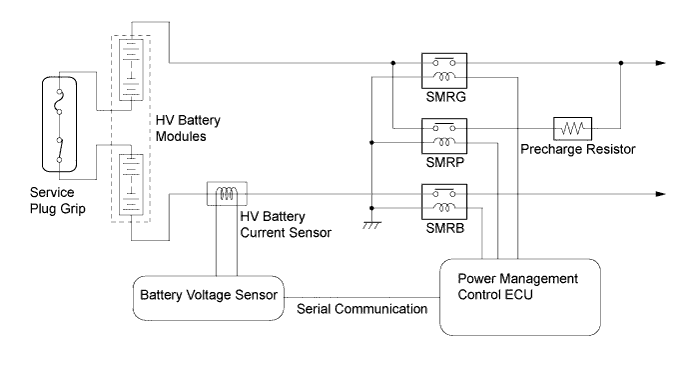
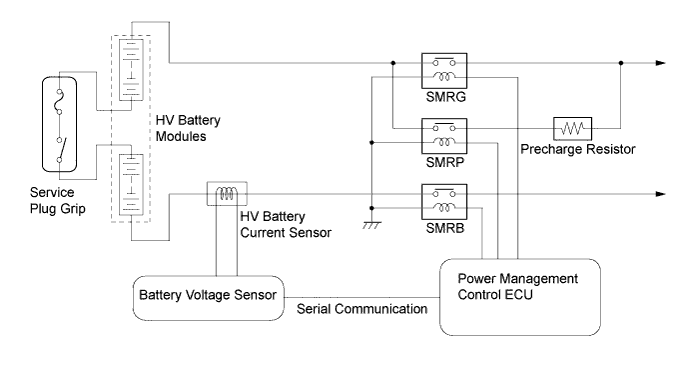
The System Main Relays (SMRs) are relays that connect and disconnect the power source of the high-voltage circuit upon receiving a command from the power management control ECU. A total of 3 relays, 1 for the positive side (SMRB) and 2 for the negative side (SMRP, SMRG), are provided to ensure proper operation.
-
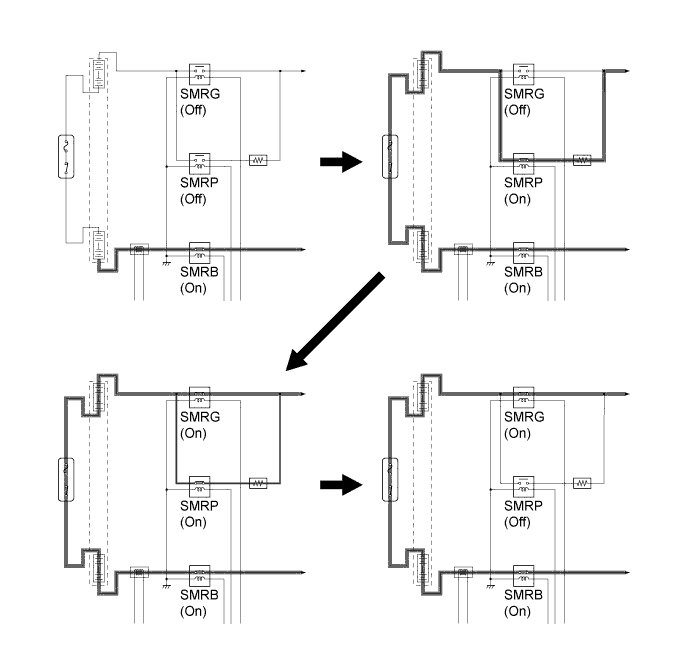
The power management control ECU turns the SMRB on, and then turns the SMRP on. After the power management control ECU has turned the SMRG on, the ECU turns the SMRP off. As the controlled current is initially allowed to pass through a resistor in this manner, the contact points in the circuit are protected from damage that could be caused by a rush current.
-
First, the power management control ECU turns the SMRG off. After the ECU has determined whether the contact points of the SMRG are stuck, it turns the SMRB off. Subsequently, the ECU turns the SMRP on in order to determine whether the contact points of the SMRB are stuck. Then, the ECU turns the SMRP off.
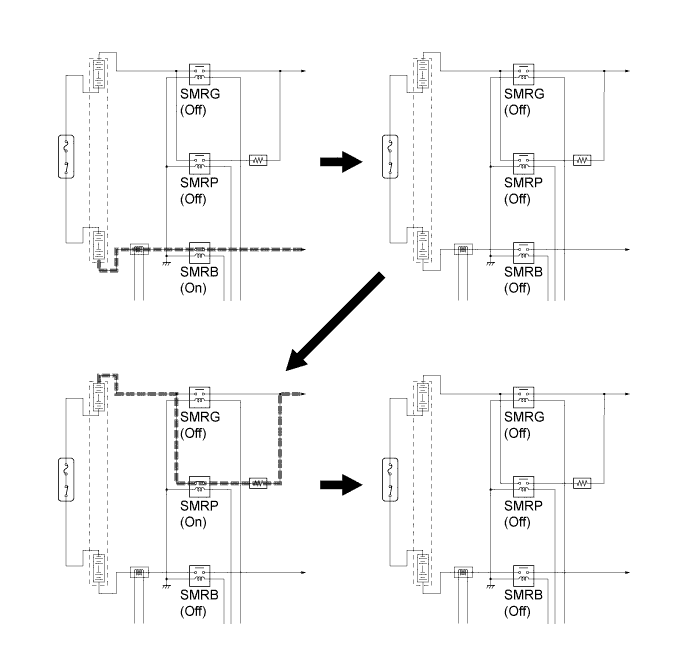
-
If the power management control ECU detects that the contact points are stuck, the ECU illuminates the master warning light, indicates "Check Hybrid System" on the multi-information display and stores a Diagnostic Trouble Code (DTC) in memory.
-
-
State Of Charge (SOC) Control
-
The power management control ECU calculates the State Of Charge (SOC) of the HV battery by estimating its charging and discharging amperages, in order to control the SOC. This allows the hybrid system to make control decisions based on the power stored in the battery.
-
While the vehicle is in motion, the HV battery undergoes repetitive charge/discharge cycles as the battery becomes discharged by MG2 during acceleration and charged by regenerative braking during deceleration. The power management control ECU calculates the SOC based on the amount of HV battery charge/discharge detected by the HV battery current sensor. The power management control ECU constantly performs charge/discharge control based on the calculated SOC value in order to maintain the SOC within its target range.
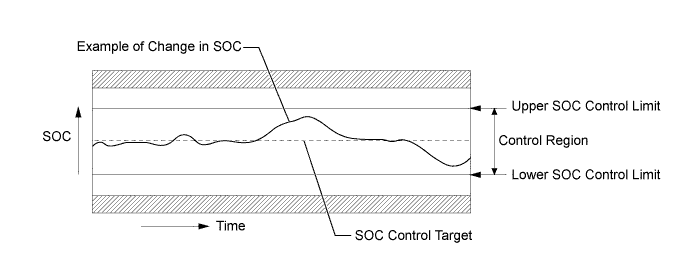
-
-
Inverter Coolant Cooling Control
-
The power management control ECU receives the signal from the temperature sensor for the inverter coolant. Then, the power management control ECU actuates the inverter water pump with motor assembly in 3 levels using duty cycle control, in order to cool the inverter coolant.
-
When the inverter coolant temperature rises above a certain level, the power management control ECU transmits a radiator fan drive request signal to the cooling fan ECU via the ECM. In response to the signal, the cooling fan ECU actuates the radiator fan to restrain the increases in the inverter coolant temperature, ensuring the cooling of the inverter with converter assembly.
-
The MG ECU converts the temperature sensor signal into digital signal, and transmits the signal to the power management control ECU via serial communication.
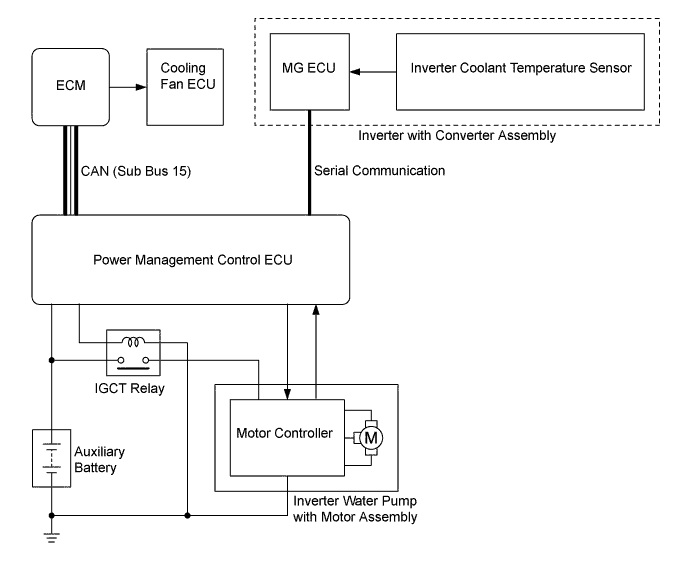
-
-
HV Battery Cooling Control
-
The power management control ECU detects increases in battery temperature via the 4 temperature sensors in the HV battery. Then, the power management control ECU steplessly actuates the battery cooling blower assembly using duty cycle control, in order to maintain the temperature of the HV battery within the specified range.
-
If there is any leeway in the HV battery temperature while the air conditioning system is operating and cooling down the cabin, the power management control ECU turns the battery cooling blower assembly off or sets the assembly to a low speed. The purpose of this control is to give priority to cooling down the cabin. If this control was not performed, air taken from the cabin for battery cooling would slow the cooling of the cabin by the air conditioning system.
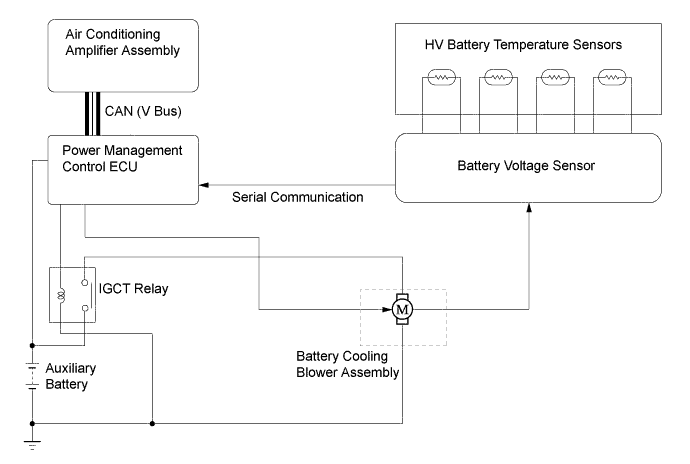
-
-
Auxiliary Battery Charging Control
-
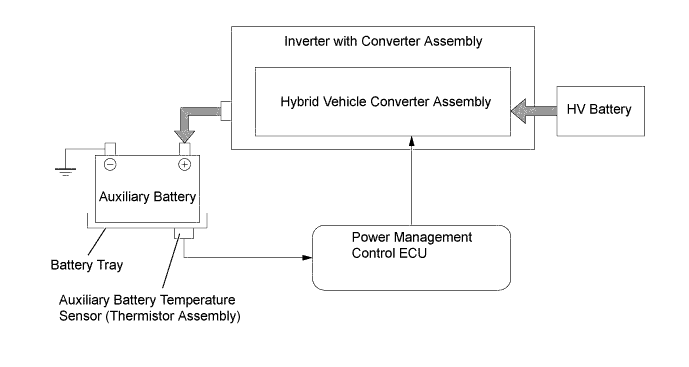
The power management control ECU controls the hybrid vehicle converter assembly in accordance with the signals from the auxiliary battery temperature sensor (thermistor assembly), in order to control the charging voltage to the auxiliary battery.
-
-
ECM Control
-
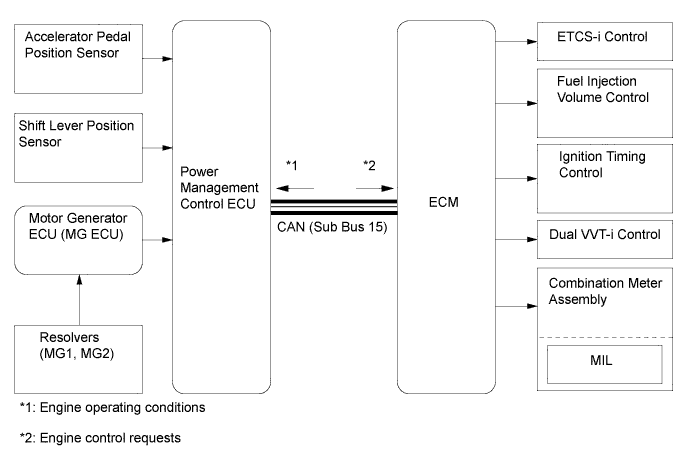
The ECM receives the target engine speed and required engine motive force which were sent from the power management control ECU, and controls the ETCS-i system, fuel injection volume, ignition timing and Dual VVT-i system.
-
The ECM transmits information about the engine operating conditions to the power management control ECU.
-
Upon receiving an engine stop signal from the power management control ECU in accordance with basic hybrid vehicle control, the ECM will stop the engine.
-
When a malfunction occurs in the system, the ECM activates the MIL in accordance with requests from the power management control ECU.
-
-
MG1 and MG2 Main Control
-
MG1, which is driven by the engine, generates high voltage electricity (alternating current) in order to power MG2 and charge the HV battery. Also, MG1 functions as a starter to start the engine.
-
MG2 is driven by electrical power from the HV battery and/or MG1, and it generates motive force for the rear wheels.
-
MG2 generates electricity to charge the HV battery during braking (regenerative braking control), or when the accelerator pedal is not being depressed.
-
MG1 and MG2 are shut down when the shift lever is in N. In order to stop providing motive force, it is necessary to stop driving MG1 and MG2, because MG1 and MG2 are mechanically joined to the drive wheels.
-
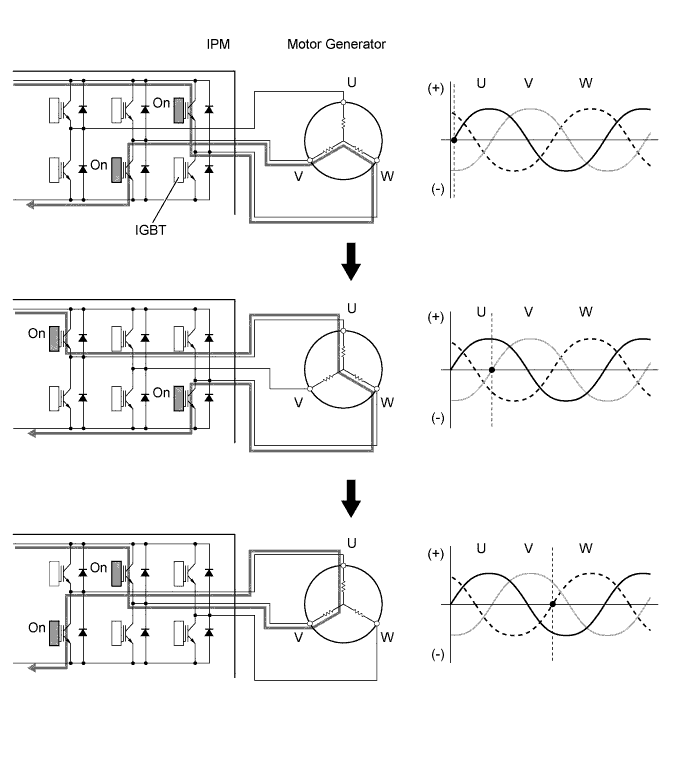
The Motor Generator ECU (MG ECU), which follows the commands from the power management control ECU, controls MG1 and MG2 via the Intelligent Power Modules (IPMs) for driving the vehicle. 6 Insulated Gate Bipolar Transistors (IGBTs) switch on and off to control each individual motor generator in accordance with operation as either a motor or a generator.
-
The illustration below describes the basic control when a motor generator functions as a motor:
-
The IGBTs switch on and off to supply 3-phase alternating current to the motor.
-
In order to create the motive force required by the motor generator as calculated by the power management control ECU, the MG ECU switches the IGBTs on and off and controls the speed of the motor generator.
-
-
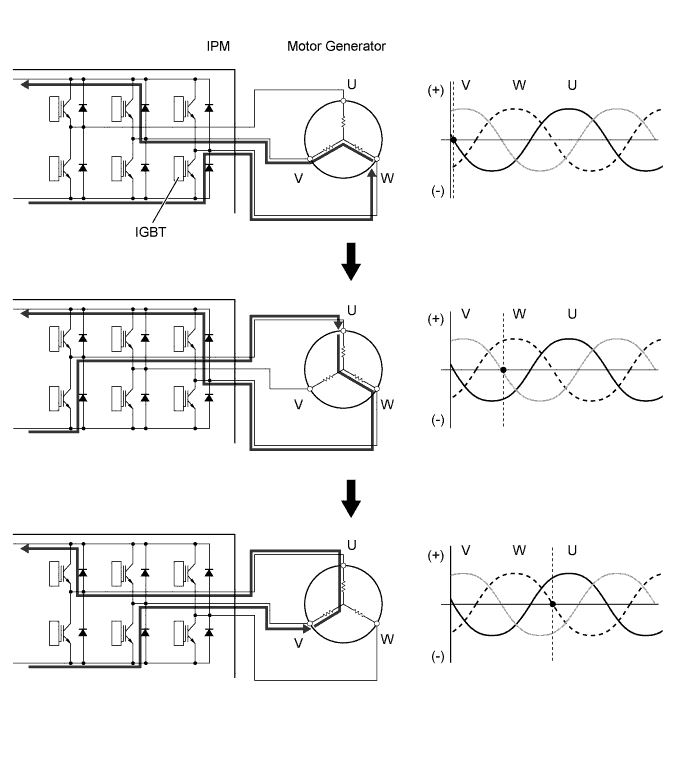
The illustration below describes the basic control used when a motor generator functions as a generator:
-
The current that is generated sequentially by the 3 phases of the motor, which is driven by the wheels, is utilized to charge the HV battery or drive another motor generator.
-
-
-
Inverter Control
-
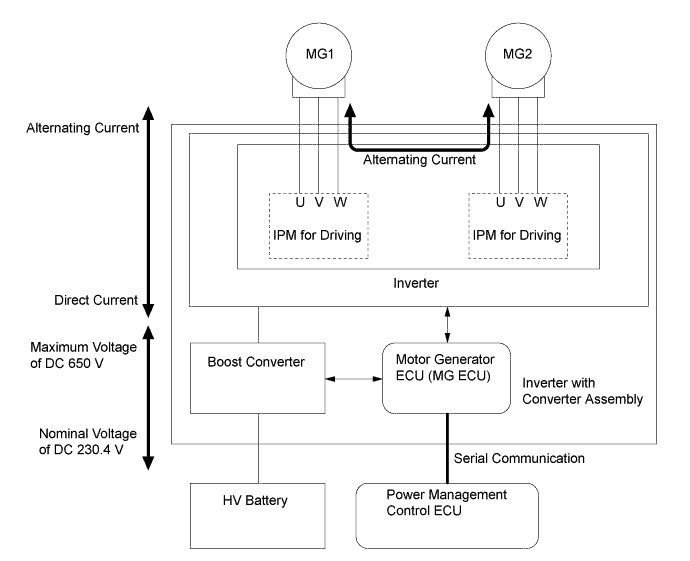
The inverter converts the direct current from the HV battery into alternating current for MG1 and MG2, or vice versa, in accordance with the signals provided by the power management control ECU via the Motor Generator ECU (MG ECU). In addition, the inverter takes power generated by MG1 and supplies it to MG2. However, the electricity generated by MG1 is converted into direct current inside the inverter before being converted back into alternating current by the inverter for use by MG2. This is necessary because the frequency of the alternating current output by MG1 is not appropriate for control of MG2.
-
The MG ECU transmits signals to the power transistors in the inverter for switching the U, V and W phases of the stator coils of MG1 and MG2 based on the rotor position information sent from the MG1 and MG2 resolvers.
-
When the shift lever is in N or when the power management control ECU has received an over-heating, over-current or fault voltage signal from the inverter, the power management control ECU transmits a shut down control signal to the inverter in order to turn off the power transistors to electrically disconnect MG1 and MG2.
-
-
Boost Converter Control
-
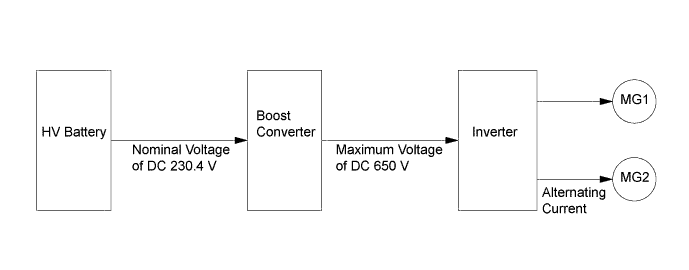
The boost converter boosts the HV battery voltage from a nominal voltage of DC 230.4 up to a maximum voltage of DC 650 V in accordance with the signals provided by the power management control ECU via the Motor Generator ECU (MG ECU).
-
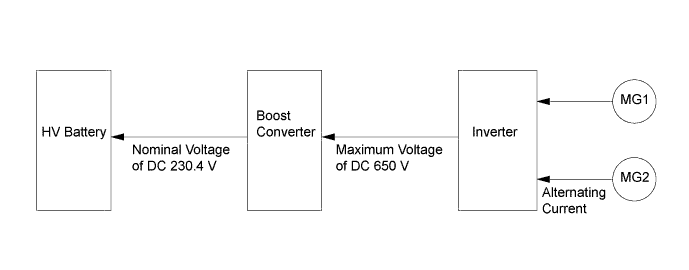
The inverter converts the alternating current generated by MG1 or MG2 into direct current. The boost converter reduces the voltage from DC 650 V (maximum) to DC 230.4 V (nominal) for the HV battery in accordance with the signals provided by the power management control ECU via the Motor Generator ECU (MG ECU).
-
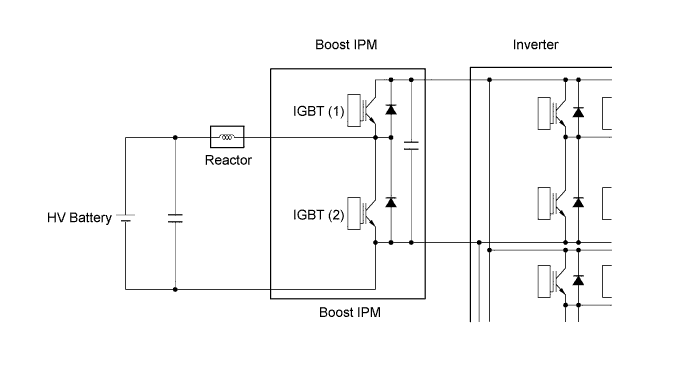
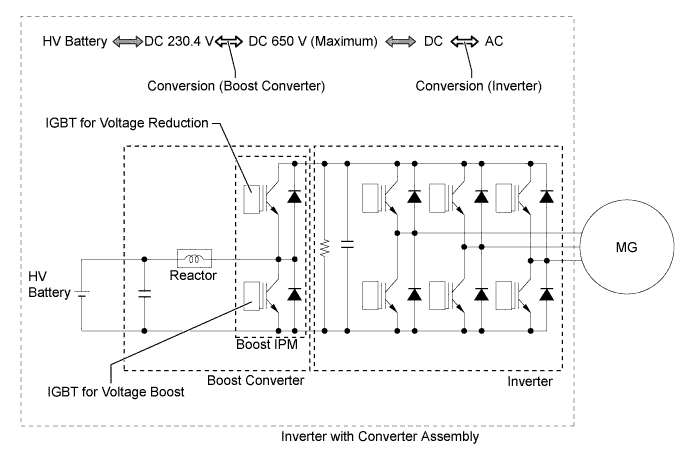
The boost converter consists of a reactor and a boost Intelligent Power Module (IPM) with built-in Insulated Gate Bipolar Transistors (IGBTs) that perform switching control.
-
The reactor is an electronic component that has characteristics that resist changes in current flow. If a circuit containing a reactor is switched on and then off, the reactor will attempt to maintain current flow after being switched off. At the time of voltage reduction, these characteristics also assist in smoothing the output from the voltage drop IGBT (1). The reactor can be charged quickly by turning on the boost IGBT (2).
-
The boost converter boosts the HV battery voltage from DC 230.4 V (nominal) to a maximum of DC 650 V as described in the following 2 steps:
-
The IGBT (2) turns on, causing the electrical power of the HV battery (nominal voltage of DC 230.4 V) to charge the reactor. As a result, the reactor stores power.
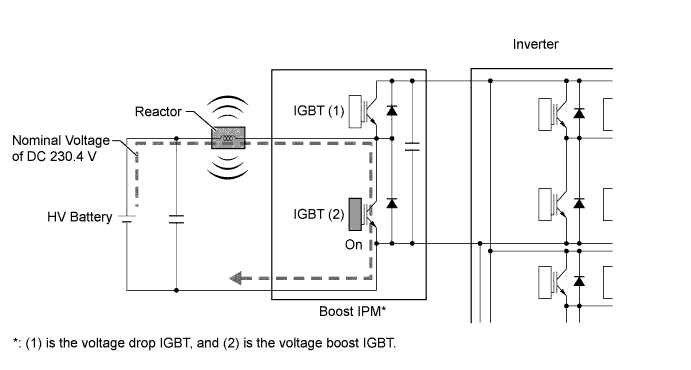
-
The IGBT (2) turns off, causing the reactor to produce an electromotive force (the current continues to flow from the reactor). This electromotive force causes the voltage to rise to a maximum of DC 650 V.
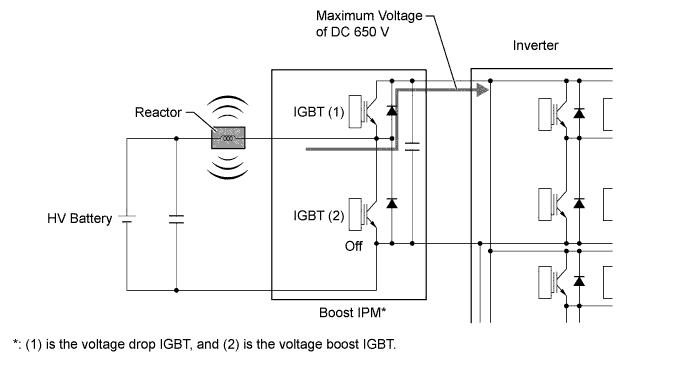
-
-
The alternating current which is generated by MG1 or MG2 for the purpose of charging the HV battery is converted into direct current (maximum voltage of approximately 650 V) by the inverter. Then, the boost converter is used to reduce the voltage to approximately DC 230.4 V. This is accomplished by IGBT (1) being switched on and off using duty cycle control, intermittently interrupting the electrical power provided to the reactor by the inverter.
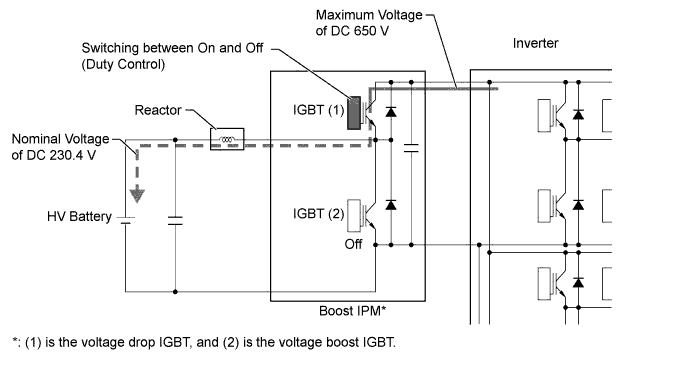
-
-
Hybrid Vehicle Converter Assembly Control
-
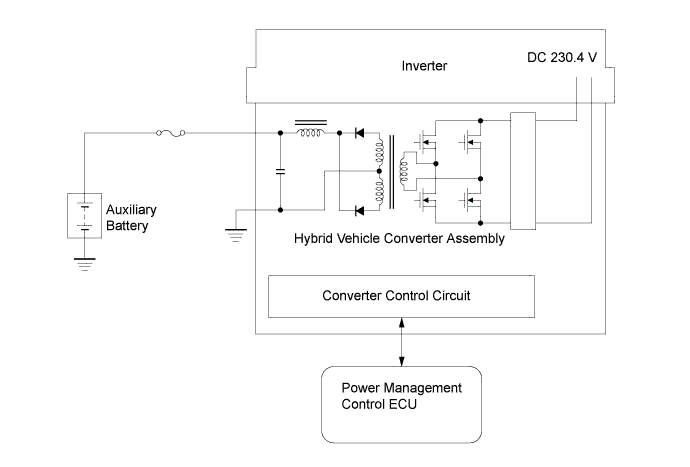
The hybrid vehicle converter assembly reduces the nominal voltage of the HV battery from DC 230.4 V to approximately DC 14 V in order to supply electricity to the electrical components, as well as to recharge the auxiliary battery.
-
In order to regulate the output voltage from the hybrid vehicle converter assembly, the power management control ECU transmits the output voltage request signal to the hybrid vehicle converter assembly in response to the auxiliary battery temperature sensor (thermistor sensor) signals.
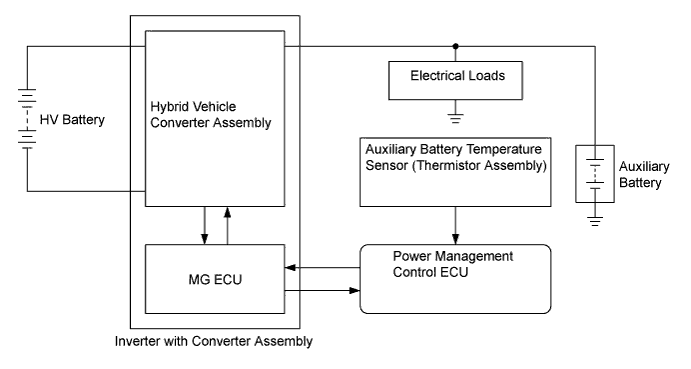
-
-
Battery Voltage Sensor Control
-
The battery voltage sensor converts the HV battery related signals (voltage, current and temperature) into digital signals, and transmits the signals to the power management control ECU via serial communication. These signals are needed to determine the charge or discharge values that are calculated by the power management control ECU.
-
A leakage detection circuit is provided in the battery voltage sensor in order to detect any electrical leakage from the HV battery or high voltage circuit. Also, the battery voltage sensor detects the feedback frequency from the battery cooling blower assembly, which is needed by the power management control ECU to perform HV battery cooling control. The battery voltage sensor converts the electrical leakage and feedback frequency information into digital signals and transmits them to the power management control ECU via serial communication.
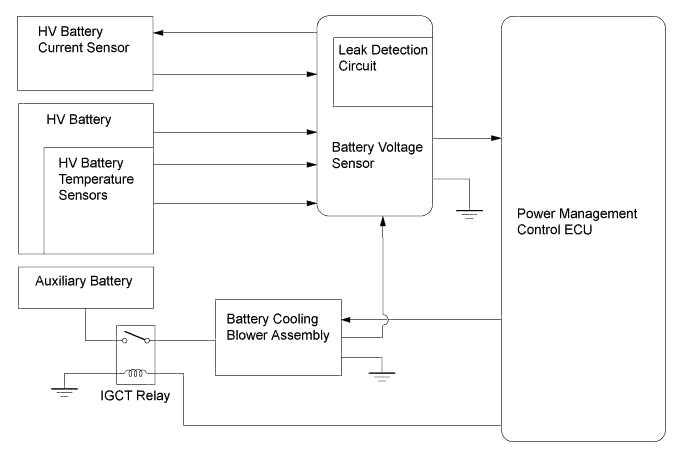
-
-
Skid Control ECU Assembly Control
-
The skid control ECU calculates the total brake force needed based on the master cylinder pressure in the brake actuator and the brake pedal stroke sensor signal generated when the driver depresses the brake pedal.
-
After calculating the total brake force required, the skid control ECU sends a regenerative braking force request to the power management control ECU. The power management control ECU replies with the amount of regenerative braking force that is possible.
-
The power management control ECU uses MG2 to create minus torque (deceleration force), carrying out the regenerative braking.
-
The skid control ECU controls the brake actuator and generates wheel cylinder pressure. The pressure that is generated is what remains after the actual regenerative braking control value has been subtracted from the total required brake force.
-
The skid control ECU outputs a request to the power management control ECU to limit the motive force while the TRC or VSC is operating to control wheel spin. The power management control ECU controls the engine, MG1 and MG2 in accordance with the present driving conditions in order to suppress the motive force.
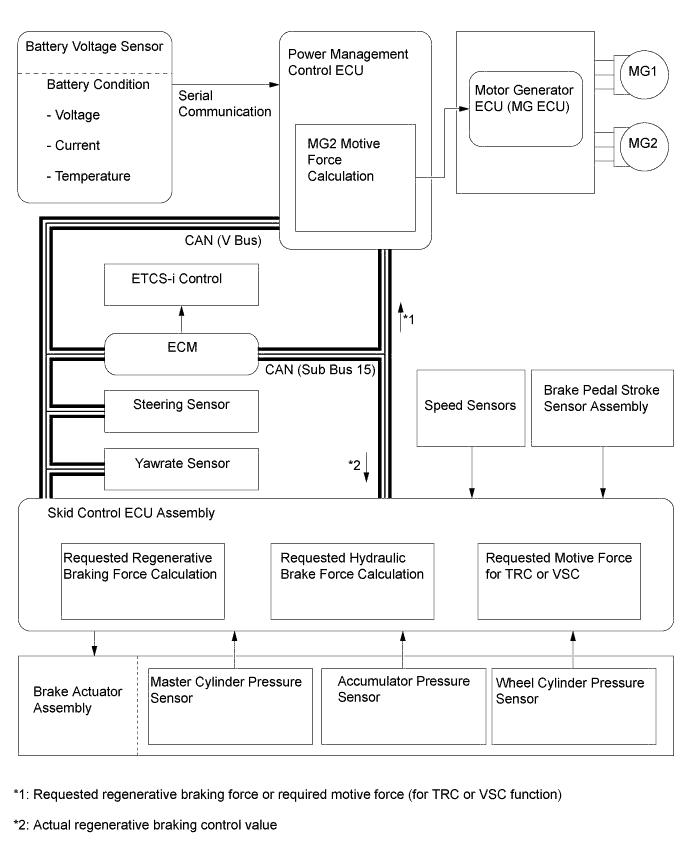
-
-
During Collision Control
-
If the vehicle encounters one of the situations described below, the power management control ECU will shut down the power supply by turning the System Main Relays (SMRs) off for safety.
-
The power management control ECU receives an airbag deployment signal from the center airbag sensor assembly during a frontal collision or side collision.
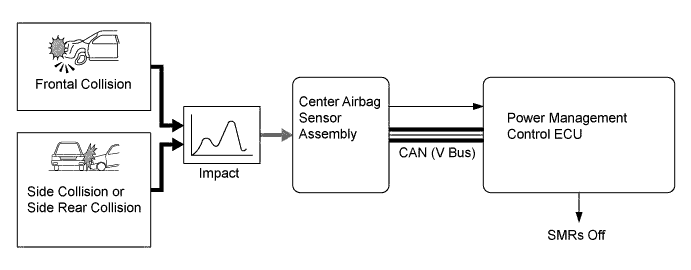
-
-
EV Drive Mode Control
-
EV drive mode is provided to reduce vehicle noise, such as when entering or leaving a garage, as well as reducing the production of exhaust gases in a garage. When the EV drive mode switch is operated by the driver, the power management control ECU uses only MG2 to drive the vehicle if the operating conditions are satisfied.
-
The available driving range during the EV drive mode varies in accordance with the driving conditions and the HV battery charge level. However, the range is usually between several hundred meters (several hundred yards) and approximately 1 km (0.6 miles).
-
When all operating conditions are satisfied, pressing the EV drive mode switch enters the EV drive mode, and the EV drive indicator light will be illuminated. If any operating condition is not satisfied and the EV drive mode switch is pressed, a message is displayed on the multi-information display to inform the driver that the EV drive mode switch operation is rejected, and the EV drive mode cannot be entered.
-
If any condition does not meet the operating conditions while the vehicle is traveling in EV drive mode, the EV drive indicator light flashes 3 times and a buzzer sounds. When the EV drive mode has been automatically canceled, another message is displayed to indicate that the EV drive mode has been canceled.
-
-
Drive Mode Select Control
-
The drive mode can be selected by operating the drive mode select.
-
The selected drive mode will be shown on the multi-information display in the combination meter assembly.
-
The characteristics of each drive mode are as follows:
Drive Mode Outline NORMAL Mode This drive mode provides optimum driveability. ECO Mode The power management control ECU optimizes fuel economy and driving performance by gradually generating the motive force in comparison to the accelerator pedal operation. At the same time, the ECU supports eco driving by optimizing air conditioning performance. SPORT Mode*1
SPORT S Mode*2
The power management control ECU controls motive force in the intermediate area of the accelerator pedal opening to a greater degree than that of NORMAL mode, improving acceleration performance. In addition, engine speed response performance has been improved in the high area of the accelerator pedal opening, thus producing a sporty drive. SPORT S+ Mode*2 In addition to the control when in SPORT S mode, the suspension control system and steering control system have been integrated to shift to SPORT S+ mode, in order to improve operability and stability without losing comfort. Also, a control which enables operation according to driver intent is performed.
-
*1: Models without AVS
-
*2: Models with AVS
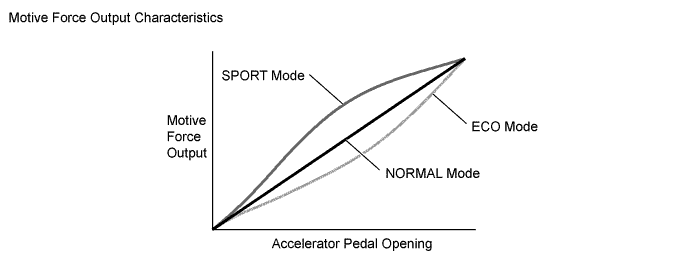
-
-
-
SNOW Mode Control
-
SNOW mode can be selected by operating the SNOW mode switch.
-
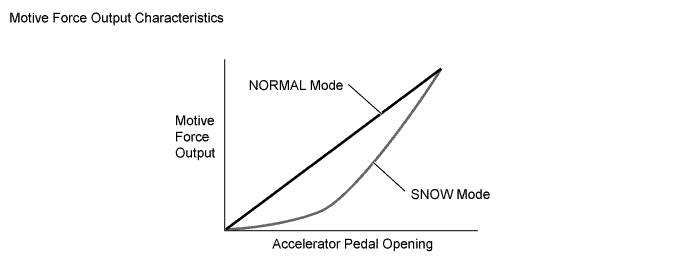
When SNOW mode is selected, the power management control ECU improves starting-off performance and acceleration performance on slippery road surfaces where the wheels may spin, such as snow, by restraining the motive force more than when in NORMAL mode.
-
When SNOW mode control is activated and the accelerator pedal angle is at an angle which causes the wheels to slip easily, the motive force that changes in accordance with the accelerator pedal operation is controlled to be smaller than the motive force used in NORMAL mode, achieving enhanced accelerator pedal controllability.
-
-
-
CONSTRUCTION
-
Motor Generator 1 (MG1) and Motor Generator 2 (MG2)
-
MG1 and MG2 each consist of a stator, stator coil, rotor, permanent magnets and resolver.
-
MG1 and MG2 are compact, lightweight and highly efficient alternating current permanent magnet motors.
-
MG1 charges the HV battery and supplies electrical power to drive MG2. In addition, by regulating the amount of electrical power generated (thus varying the generator's rpm), MG1 effectively controls the continuously variable transmission function of the transmission. MG1 also serves as the starter to start the engine.
-
MG2 drives the rear wheels using electric power from MG1 or the HV battery. In addition, MG2 acts as a generator when decelerating to charge the HV battery.
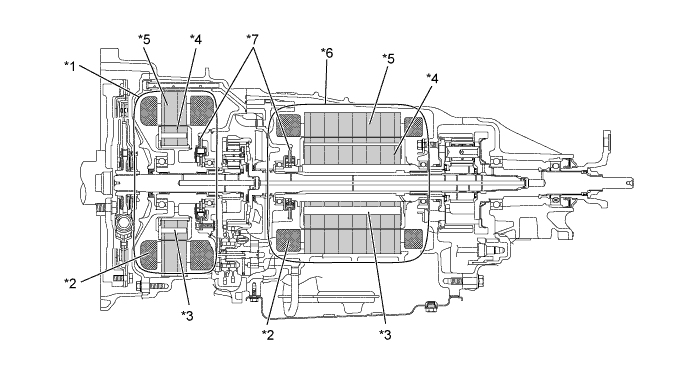
Text in Illustration *1 Motor Generator 1 (MG1) *2 Stator Coil *3 Permanent Magnet *4 Rotor *5 Stator *6 Motor Generator 2 (MG2) *7 Resolver - - -
When a 3-phase alternating current is passed through the 3-phase windings of the stator coil, a rotating magnetic field is created in the electric motor. By controlling this rotating magnetic field in accordance with the rotor's rotational position and speed, the permanent magnets that are provided in the rotor become attracted by the rotating magnetic field, generating torque.
-
The generated torque is for all practical purposes proportional to the amount of current, and the rotational speed is controlled by the frequency of the alternating current.
-
Furthermore, a high level of torque, up to high speeds, can be generated efficiently by properly controlling the relationship of the rotating magnetic field and the angle of the rotor magnets.
-
When the motor is used to generate electricity, the rotation of the rotor creates a rotating magnetic field, which creates current in the phases of the stator coils.
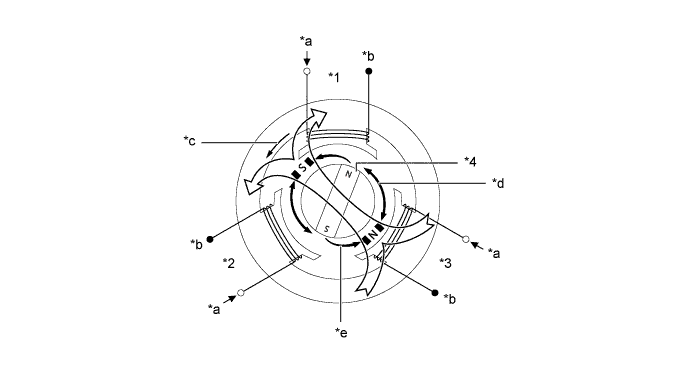
Text in Illustration *1 Stator Coil (U Phase) *2 Stator Coil (V Phase) *3 Stator Coil (W Phase) *4 Rotor (Permanent Magnet) *a From Inverter with Converter Assembly *b Connected Internally in Motor *c Rotating Magnetic Field *d Repulsion *e Attraction - - 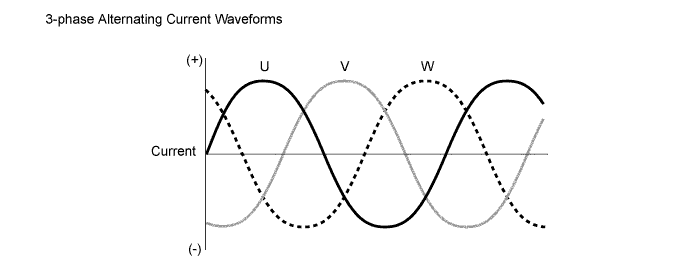
-
-
Resolver
-
A resolver is an extremely reliable and compact sensor that precisely detects the magnetic pole position. Determining the precise position of the magnetic poles of the motor rotor is necessary to ensure efficient control of MG1 and MG2. MG1 and MG2 both have their own resolver.
-
The stator of the resolver contains 3 types of coils: excitation coil A, detection coil S and detection coil C.
-
The rotor of the resolver is oval, so the gap between the stator and the rotor varies with the rotation of the rotor.
-
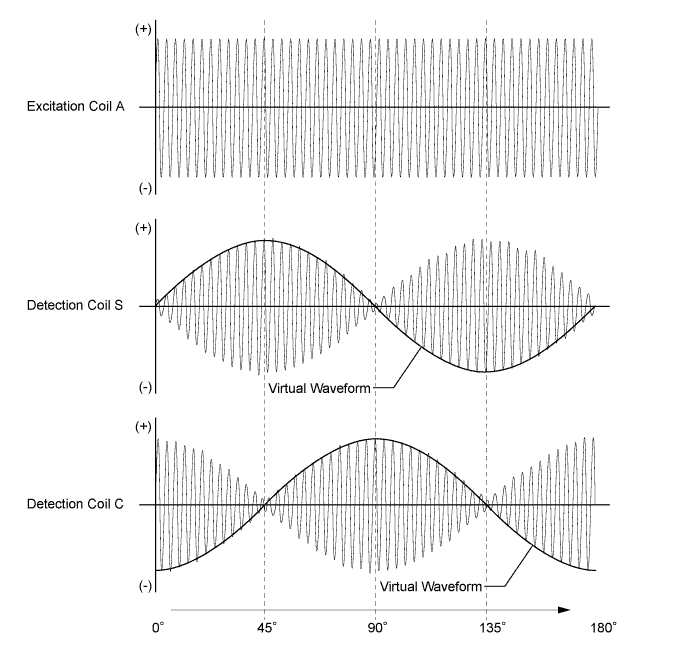
The flow of alternating current into excitation coil A results in the creation of a constant frequency magnetic field. Using this constant frequency magnetic field, coil S and C will output values that correspond to the position of the rotor. Therefore, the Motor Generator ECU (MG ECU) detects the absolute position based on the difference between the coil S and coil C output values. Furthermore, the MG ECU calculates the rotational speed based on the amount of change in the position within a given length of time.
-
The +S and -S pairs of the detection coil S are staggered by 90 degrees. The +C and -C pairs are staggered in the same way. The C and S pairs of coils are located 45 degrees from each other.
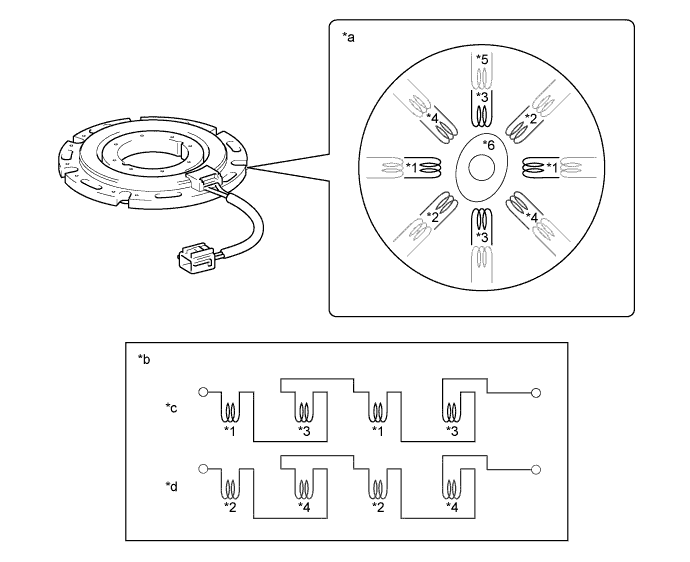
Text in Illustration *1 +S (Detection Coil S) *2 +C (Detection Coil C) *3 -S (Detection Coil S) *4 -C (Detection Coil C) *5 Excitation Coil A *6 Rotor *a Image of Resolver Internal Construction *b Electrical Orientation of Resolver Coils *c Circuit of Detection Coil S *d Circuit of Detection Coil C -
Because the excitation coil of the resolver is provided with alternating current at a constant frequency, a constant frequency magnetic field is output to coils S and C, regardless of rotor speed. The magnetic field of the excitation coil is carried to coils S and C by the rotor. The rotor is oval, so the gap between the stator of the resolver and the rotor varies with the rotation of the rotor. Due to the variation of the gap, the peak values of the waveforms output by coils S and C vary in accordance with the position of the rotor.
-
The MG ECU constantly monitors these peak values and connects them to form a virtual waveform. The MG ECU calculates the absolute position of the rotor from the difference between the values of coils S and C. The MG ECU determines the rotor direction based on the difference between the phases of the virtual waveform of coil S and the virtual waveform of coil C. Furthermore, the MG ECU calculates the rotational speed based on the amount of change in the rotor position within a given length of time.
-
The diagrams below illustrate the waveforms that are output at coils A, S and C when the rotor makes a rotation of 180°:
-
-
Temperature Sensor for Motor Generator
-
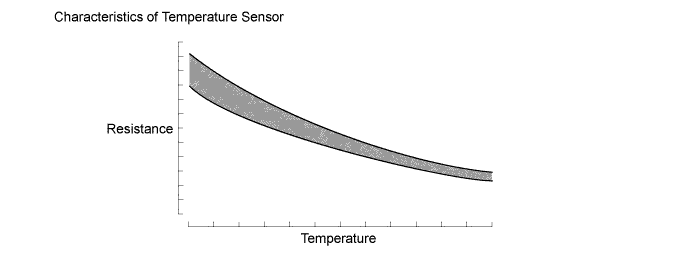
Temperature sensors are used to detect the temperature of the motor stators.
-
The temperature sensor thermistor resistance changes in accordance with changes in the motor temperature. The resistance of the thermistor is high when the temperature of the motor is low. Conversely, when the motor temperature is high, the thermistor resistance will be low.
-
When the temperature of a motor rises, motor output is limited.
-
-
Inverter with Converter Assembly
-
The inverter with converter assembly has a multi-layer structure which consists of a Motor Generator ECU (MG ECU), inverter, boost converter, condenser and hybrid vehicle converter assembly, achieving a lightweight and compact design.
-
The inverter with converter assembly is cooled by the dedicated radiator of the cooling system that is separate from that of the engine cooling system.
-
This inverter has a cooling system with a structure that makes it possible to cool the Insulated Gate Bipolar Transistors (IGBTs) of the boost converter and the inverter from both sides, contributing to a compact design.
-
In consideration of safety, interlock switches are provided for the inverter with converter assembly. The interlock switches turn off the System Main Relays (SMRs) when the inverter terminal cover or connector cover assembly is removed or the connector of the power cable is disconnected.
-
An atmospheric pressure sensor is provided on the MG ECU board. The sensor detects atmospheric pressure and transmits a signal to the MG ECU to allow corrections that correspond to the usage environment.
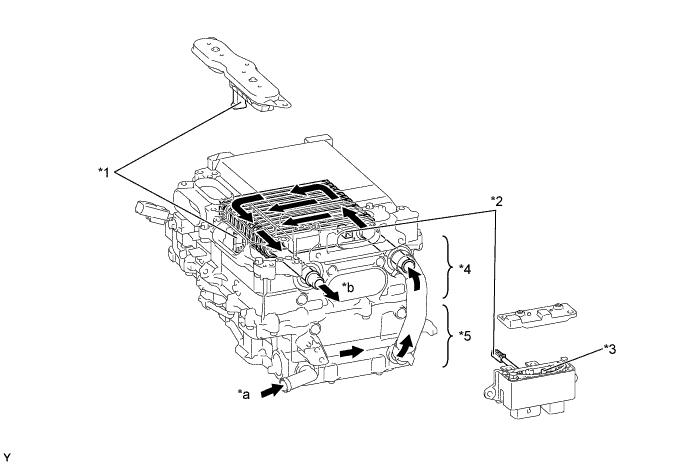
Text in Illustration *1 Interlock Switch (for Inverter Terminal Cover) *2 Interlock Switch (for Power Cable) *3 Interlock Switch (for Connector Cover Assembly) *4 Control Circuit Portion
-
Inverter
-
Boost Converter
-
Motor Generator ECU (MG ECU)
-
Atmospheric Pressure Sensor
*5 Condenser/Hybrid Vehicle Converter Assembly Portion - - *a Coolant Inlet *b Coolant Outlet 
Coolant Flow - - 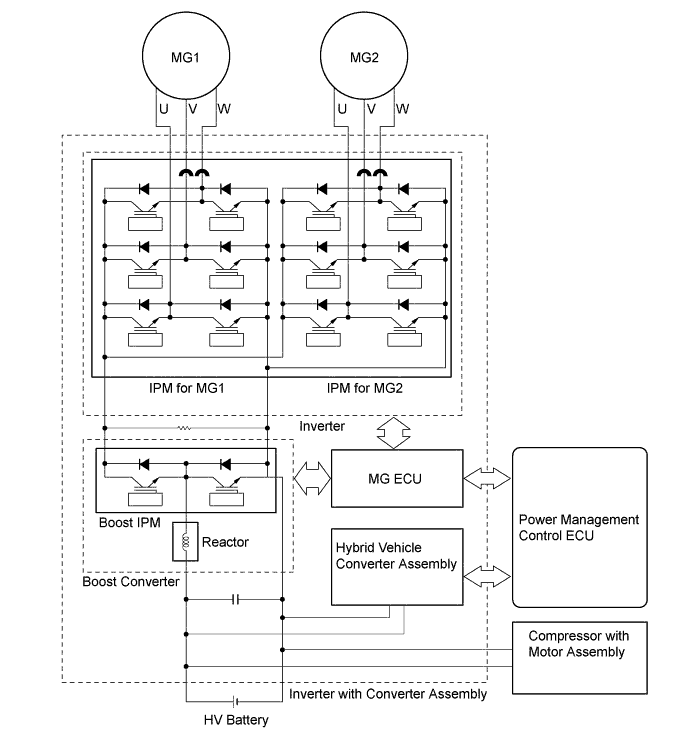
-
-
-
Inverter
-
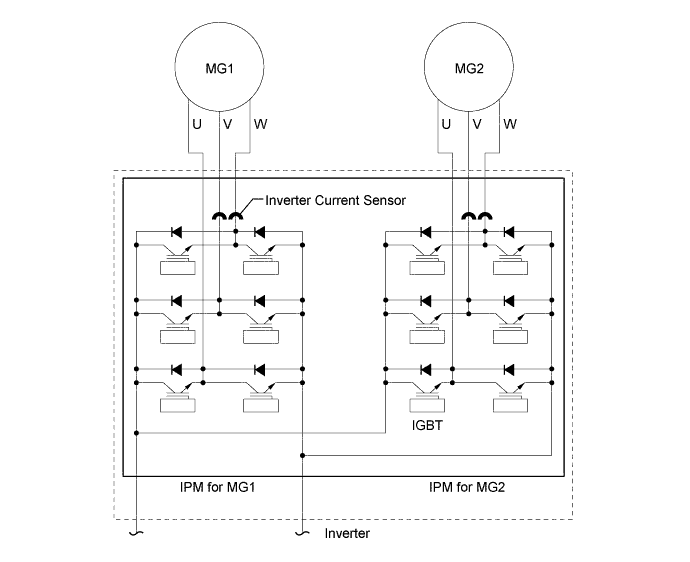
The inverter converts the boosted high-voltage direct current of the HV battery into 3-phase alternating current to drive MG1 and MG2.
-
The activation of the power transistors is controlled by the Motor Generator ECU (MG ECU). In addition, the inverter transmits information that is needed for current control, such as the output amperage or voltage, to the power management control ECU via the MG ECU.
-
The power transistors used in the inverter are Insulated Gate Bipolar Transistors (IGBTs).
-
Each of the bridge circuits for MG1 and MG2 contains 6 IGBTs, mounted on the high voltage and high current module portion of an Intelligent Power Module (IPM). In addition, a signal processor/protective function processor has been integrated into the control portion of the IPM. The IPM is used to operate the power transistors based on signals from the MG ECU.
-
-
Boost Converter
-
The boost converter boosts the nominal voltage output by the HV battery (DC 230.4 V) to a maximum voltage of DC 650 V. The boost converter consists of a boost Intelligent Power Module (IPM) with a pair of built-in Insulated Gate Bipolar Transistors (IGBTs) which perform switching control, and a reactor which acts as an inductor. By using these components, the converter boosts the voltage.
-
When MG1 or MG2 acts as a generator, the inverter converts the alternating current (maximum voltage of 650 V) into DC, and then the boost converter reduces the voltage to a nominal voltage of DC 230.4 V, charging the HV battery.
-
-
Hybrid Vehicle Converter Assembly
-
The power source for auxiliary equipment of the vehicle such as the lights, audio system and air conditioning system (except the compressor with motor assembly), as well as the ECUs, is based on a DC 14 V system. Because the hybrid system generates output with a nominal voltage of DC 230.4 V, the hybrid vehicle converter assembly is used to convert the voltage from DC 230.4 V to approximately DC 14 V in order to recharge the auxiliary battery.
-
-
Motor Generator ECU (MG ECU)
-
The Motor Generator ECU (MG ECU) is provided in the inverter with converter assembly. In accordance with signals received from the power management control ECU, the MG ECU controls the inverter and boost converter in order to drive MG1 or MG2 or to cause them to generate electricity.
-
The MG ECU transmits information that is required for vehicle control, such as the inverter output amperage, inverter temperature and failure information, to the power management control ECU. The MG ECU receives information that is required for controlling the motor generators, such as the required motive force or the motor temperature, from the power management control ECU.
-
-
Inverter Current Sensor
-
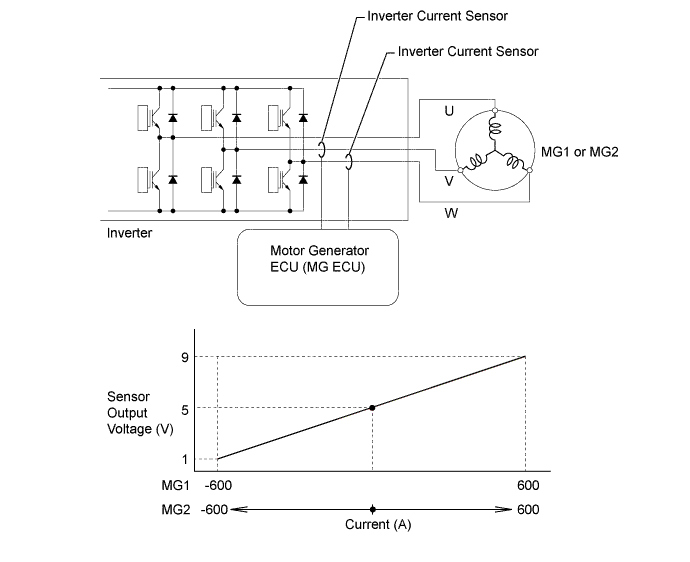
For the 3-phase AC used to drive MG1 and MG2, there are current sensors for the V and W phases. The actual current value is measured and used as feedback by the Motor Generator ECU (MG ECU).
-
If the current value of 2 phases (V and W phases) is measured, the current of the U phase can be determined, even though it is not equipped with a current sensor (U phase current + V phase current + W phase current = 0).
-
-
Inverter Temperature Sensor
-
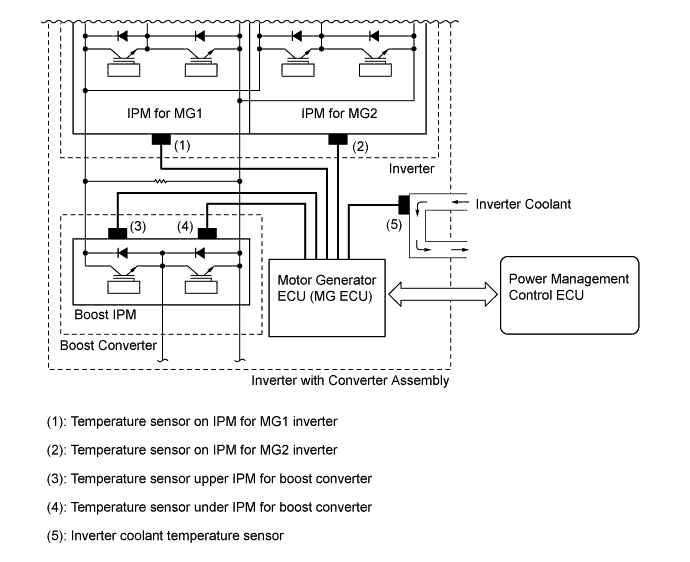
In the inverter with converter assembly, there are 5 different temperature sensors: 1 sensor for the coolant temperature, 2 for the boost converter and 1 each for the Intelligent Power Modules (IPMs) for MG1 and MG2. The Motor Generator ECU (MG ECU) confirms the effectiveness of the inverter cooling system based on the temperature information sent from these sensors. In addition, inverter output is limited when the temperature is high.
-
-
Atmospheric Pressure Sensor
-
The atmospheric pressure sensor is provided on the Motor Generator ECU (MG ECU) board.
-
This sensor detects the atmospheric pressure and transmits a signal to the MG ECU to allow corrections that correspond to the usage environment.
-
-
Inverter Radiator
-
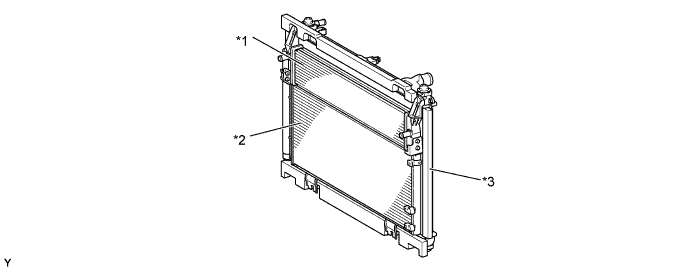
The inverter radiator and engine radiator are separate parts. The inverter radiator is mounted in front of the engine radiator.
-
The cooling fan is also shared by the engine radiator and A/C condenser.
Text in Illustration *1 Inverter Radiator *2 A/C Condenser *3 Engine Radiator - -
-
-
Inverter Water Pump with Motor Assembly
-
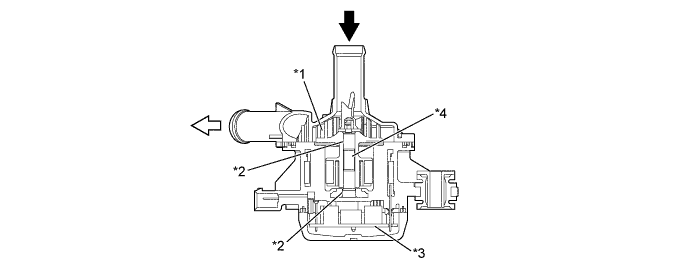
A compact and high-output type electric water pump is used.
-
A high-output DC motor (brushless type) is used for the pump motor. Furthermore, bearings that support the motor shaft at both ends are employed, suppressing noise and vibration.
-
The inverter water pump with motor assembly is controlled in 4 stages by the power management control ECU in accordance with the inverter coolant temperature in order to cool the inverter.
Text in Illustration *1 Impeller *2 Bearing *3 Motor Controller *4 Motor Shaft Coolant Inlet 
Coolant Outlet
-
-
Power Cable
-
The power cable is a set of high-voltage, high-amperage cables that connect the HV battery to the inverter with converter assembly, the inverter with converter assembly to the MG1 and MG2, and the inverter with converter assembly to the compressor with motor assembly.
-
The power cable is made of shielded cables in order to reduce electromagnetic interference.
-
For identification purposes, the high-voltage wiring harness and connectors are color-coded orange to distinguish them from ordinary low-voltage wiring.
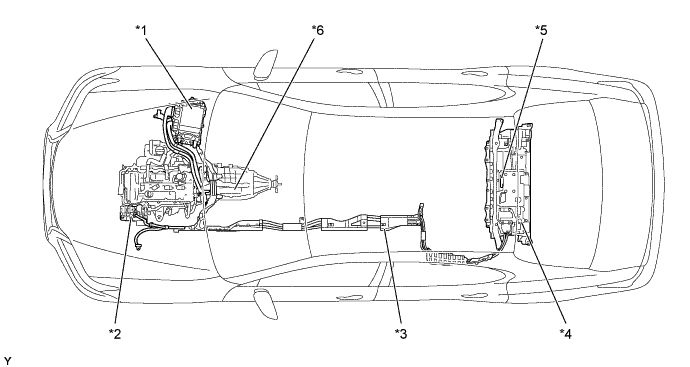
Text in Illustration *1 Inverter with Converter Assembly *2 Compressor with Motor Assembly *3 Power Cable *4 HV Battery Assembly *5 Service Plug Grip *6 L210 Hybrid Transmission (Hybrid Vehicle Transmission Assembly)
-
Motor Generator 1 (MG1)
-
Motor Generator 2 (MG2)
-
-
-
HV Battery Assembly
-
The HV battery assembly consists of an HV battery module group, battery voltage sensor, hybrid battery junction block assembly, battery cooling blower assembly and service plug grip.
-
The HV battery assembly is located in the luggage compartment behind the rear seat.
-
One battery cooling blower assembly is provided for the module group of the HV battery.
-
A service plug grip is provided to shut off the internal circuit of the battery.
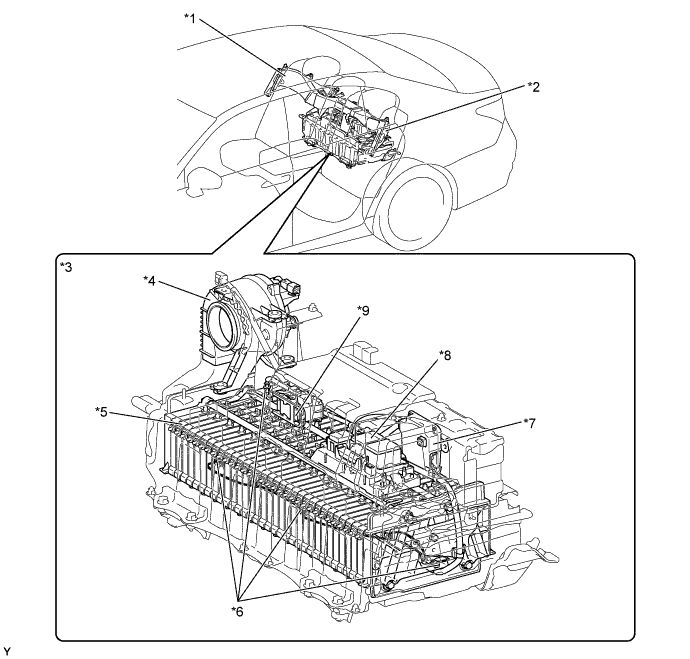
Text in Illustration *1 No. 1 Hybrid Battery Intake Air Duct RH *2 No. 6 Hybrid Battery Intake Air Duct LH *3 HV Battery Assembly *4 Battery Cooling Blower Assembly *5 HV Battery Module Group *6 HV Battery Temperature Sensor *7 Battery Voltage Sensor *8 Hybrid Battery Junction Block Assembly
-
System Main Relays (SMRs)
-
HV Battery Current Sensor
-
Precharge Resistor
*9 Service Plug Grip - - -
-
-
HV Battery Module Group
-
The HV battery module group consists of 32 modules that are connected in series by a bus bar module. Furthermore, the connection between cells is made at 2 locations in order to reduce internal resistance and improve efficiency.
-
The HV battery modules are each made up of 6 cells. Each cell is 1.2 V. The HV battery has a total of 192 cells (6 cells x 32 modules) and a nominal voltage of 230.4 V (1.2 V x 192 cells).
-
Metal is used for the material of the module cases to achieve enhanced cooling performance and compact construction.
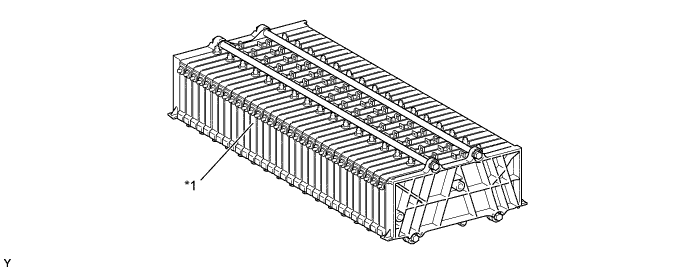
Text in Illustration *1 HV Battery Module Group (32 Modules) - -
-
-
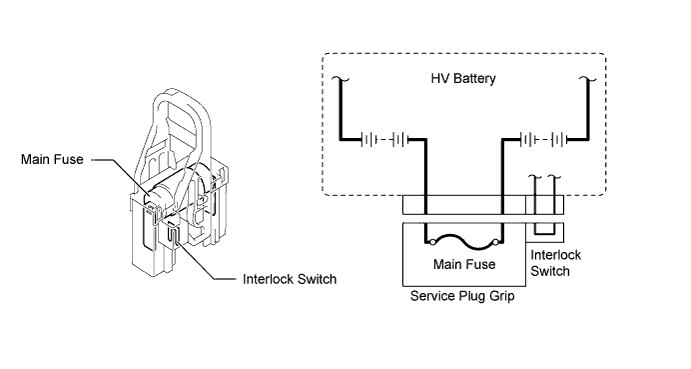
Service Plug Grip
-
The service plug grip is connected to the middle of the battery module circuit and is used to manually shut off the high-voltage circuit.
-
The main fuse for the high-voltage circuit is provided inside the service plug grip.
-
An interlock switch is provided on the service plug grip. When the grip section is unlocked, the interlock switch is turned off and the power management control ECU shuts off the system main relays. However, to ensure safety, make sure to turn the power switch off before removing the service plug grip.
Note
For further details on how to handle the service plug grip and for other safety cautions, refer to the Repair Manual.
-
-
Battery Voltage Sensor
-
The battery voltage sensor detects the HV battery condition signals (temperature, voltage and current value) and frequency from the HV battery cooling blower assembly, and sends the signals to the power management control ECU.
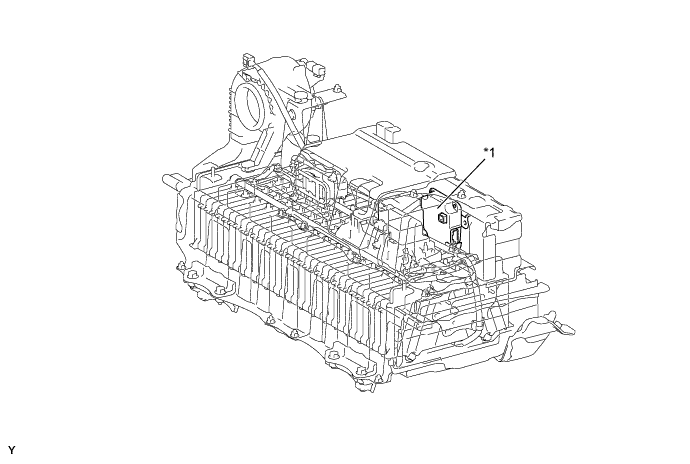
Text in Illustration *1 Battery Voltage Sensor - - 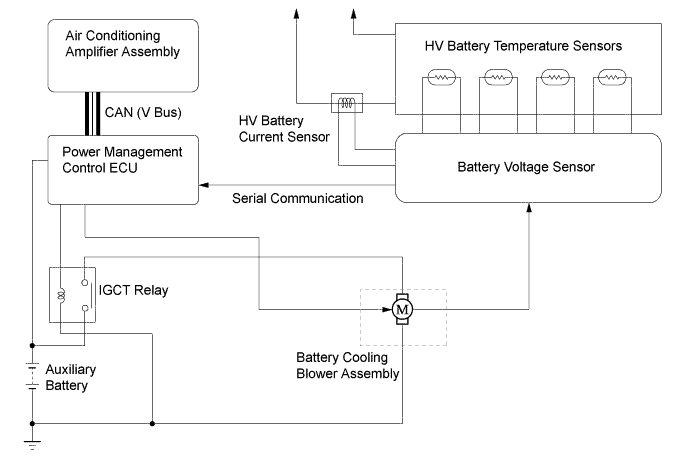
-
-
Hybrid Battery Junction Block Assembly
-
The hybrid battery junction block assembly consists of System Main Relays (SMRs), a precharge resistor and an HV battery current sensor.
-
The SMRs consist of the SMRB (+), SMRG (-) and SMRP (precharge).
-
A large amount of current is generated due to the connection of the power cables. As a result the SMRP and SMRB (+) are turned on first to allow the current to enter the circuit in a controlled manner through the precharge resistor to protect the circuit. Afterwards, the SMRG is turned on and the SMRP is turned off.
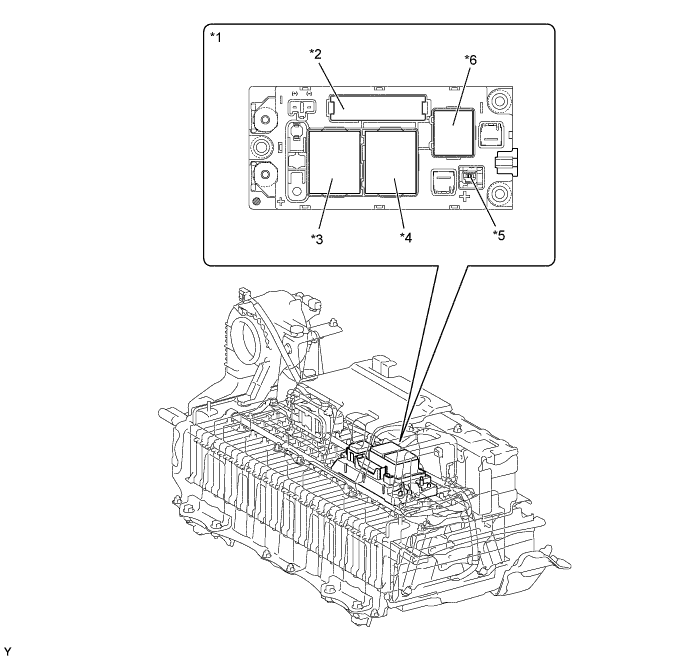
Text in Illustration *1 Hybrid Battery Junction Block Assembly *2 Precharge Resistor *3 SMRB (+) *4 SMRG (-) *5 HV Battery Current Sensor *6 SMRP (Precharge)
-
-
System Main Relays (SMRs)
-
The System Main Relays (SMRs) are the relays that connect or disconnect the high-voltage power system in accordance with commands from the power management control ECU.
-
-
HV Battery Current Sensor
-
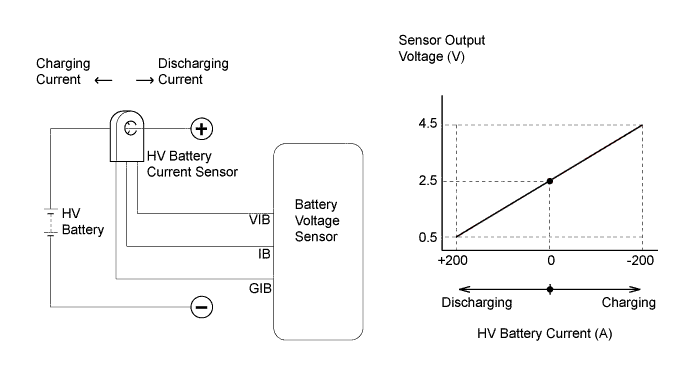
The HV battery current sensor is installed on the high-voltage cable inside the HV battery assembly, to detect current flow. The sensor sends a voltage signal to the battery voltage sensor. This signal changes between 0.5 V and 4.5 V in proportion to changes in the current flowing to or from the HV battery assembly. Less than 2.5 V means the HV battery assembly is being discharged, and more than 2.5 V means the HV battery assembly is being charged.
-
-
HV Battery Temperature Sensor
-
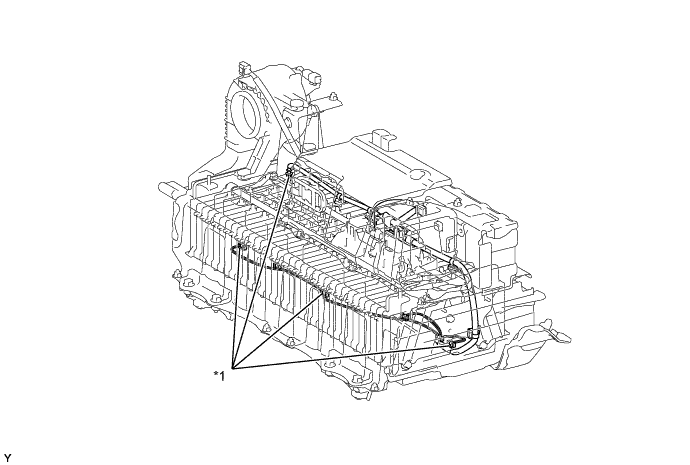
There are 4 HV battery temperature sensors; 3 are fitted on the battery module group and 1 is provided on the intake air duct.
-
The HV battery temperature sensor resistance changes along with the temperature of the HV battery assembly.
-
The battery voltage sensor transmits the detection results of the HV battery temperature sensors to the power management control ECU, which then controls the battery cooling blower assembly.
Text in Illustration *1 HV Battery Temperature Sensor - -
-
-
Battery Cooling Blower Assembly
-
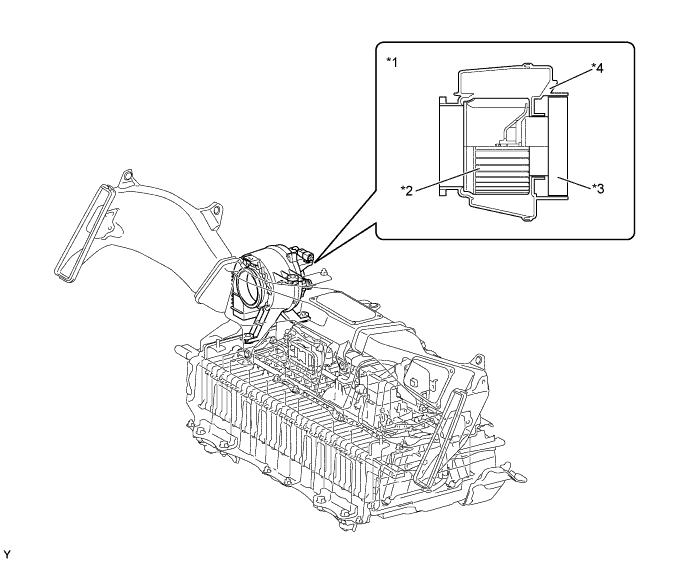
Because the battery cooling blower assembly has been made compact, the overall operating sound has been reduced. Furthermore, because the battery cooling blower assembly is mounted using rubber dampers, this construction also contributes to noise reduction.
-
A sirocco type fan, which is highly efficient and low-noise, is used.
-
A high-output brushless type motor is used for the blower motor, and the inner shape of the blower case has been optimized. As a result, blower noise is reduced.
-
The blower motor has a built-in motor controller, and is controlled in a variable manner by the duty cycle signal from the power management control ECU.
Text in Illustration *1 Battery Cooling Blower Assembly *2 Blower Fan *3 Blower Motor
-
Motor Controller
*4 Blower Case -
-
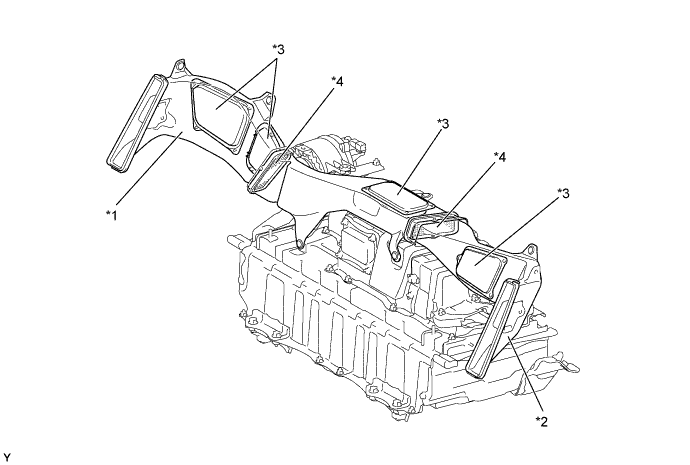
A dual-suction intake system is used to evenly draw air from the cabin from both sides of the rear seat to the battery modules. As a result, the amount of suction increases, achieving excellent cooling performance.
-
An HV battery intake filter is provided in the intake air ducts to prevent dust from entering.
-
Noise absorbing materials are optimally placed in the intake air ducts and the suction of outside air from the absorbing material sections is reduced, ensuring superior cooling performance without compromising quietness. Also, covers are added to the noise absorbing materials to achieve a structure that prevents heat from being transferred to the noise absorbing materials and prevents noise.
Text in Illustration *1 No. 1 Hybrid Battery Intake Air Duct RH *2 No. 6 Hybrid Battery Intake Air Duct LH *3 Noise Absorbing Material *4 HV Battery Intake Filter
-
-
Auxiliary Battery
-
A shielded, maintenance-free DC 12 V battery is used for the auxiliary battery.
-
A battery temperature sensor is mounted on the auxiliary battery.
-
The auxiliary battery is located at the LH side of the luggage compartment.
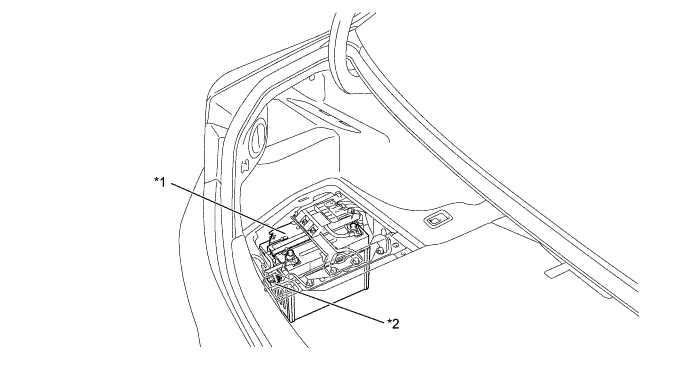
Text in Illustration *1 Auxiliary Battery *2 Auxiliary Battery Temperature Sensor (Thermistor Assembly)
-
-
Auxiliary Battery Temperature Sensor (Thermistor Assembly)
-
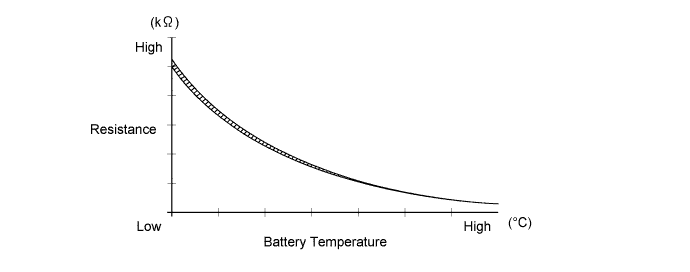
The battery characteristic (battery internal resistance) of taking in current for charging varies in accordance with battery electrolyte temperature. If the battery electrolyte temperature is too low or too high, the battery will degrade more quickly, resulting in premature failure.
-
To prevent this, the auxiliary battery temperature sensor (thermistor assembly) resistance changes as shown below to allow the power management control ECU to detect the auxiliary battery temperature.
-
-
Accelerator Pedal Position Sensor
-
The non-contact type accelerator pedal position sensor uses a Hall IC which is mounted on the accelerator pedal arm.
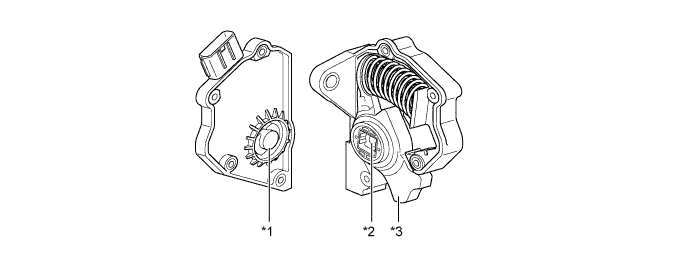
Text in Illustration *1 Hall IC *2 Magnetic Yoke *3 Accelerator Pedal Arm - - -
A magnetic yoke is mounted at the base of the accelerator pedal arm. This yoke rotates around the Hall IC in accordance with the amount of effort that is applied to the accelerator pedal. The Hall IC converts the changes in the magnetic flux that occur into electrical signals, and outputs accelerator pedal position signals to the power management control ECU.
-
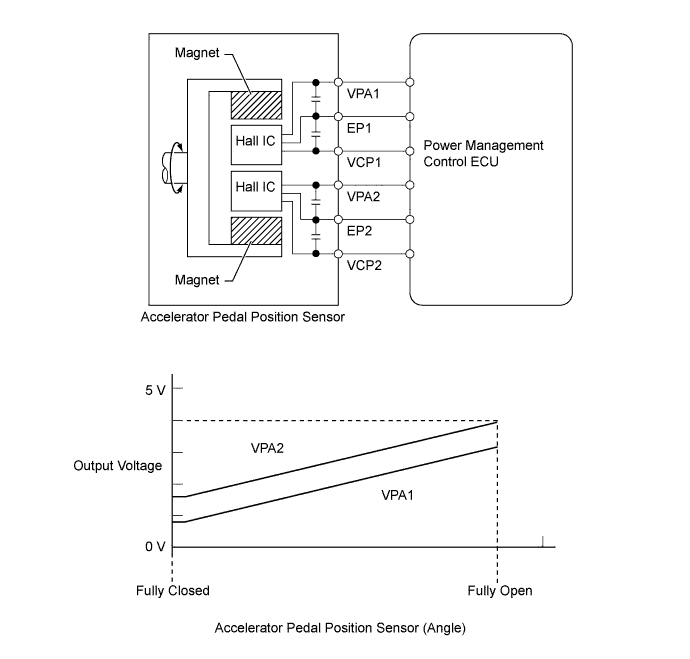
The Hall IC contains 2 circuits: one for the main signal, and one for the sub signal. The Hall IC converts the accelerator pedal position (angle) into electric signals that have differing characteristics and outputs them to the power management control ECU.
-
-
-
OPERATION
-
Operation of Hybrid Vehicle
-
The hybrid system uses motive force provided by the engine and MG2, and the system uses MG1 primarily as a generator. The system optimally combines these forces in accordance with various driving conditions.
-
The power management control ECU constantly monitors the State Of Charge (SOC) of the HV battery, the HV battery temperature, the engine coolant temperature and the electrical load condition. If any one of the monitoring items fails to satisfy the requirements when the READY indicator light is on and the shift lever is in P, R, D or S, or if the vehicle is being driven in reverse, the power management control ECU demands an engine start to drive MG1 in order to charge the HV battery.
-
The hybrid system drives the vehicle by optimally combining the operation of the engine, MG1 and MG2 in accordance with the driving conditions listed in the table below:
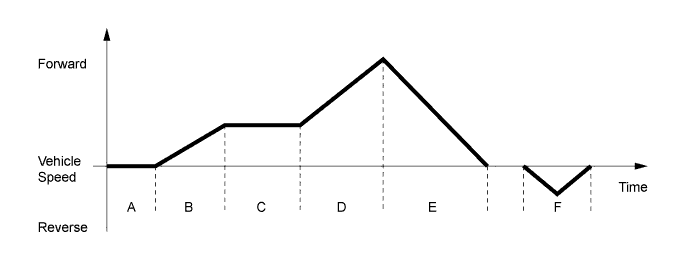
Driving Condition A READY-ON State B When Starting Off C During Constant-speed Cruising D During Full Throttle Acceleration E During Deceleration F During Reverse Driving
-
-
Driving Condition A: READY-ON State
-
Even if the driver turns the power switch on (READY), sometimes the engine will not start. If this happens, the engine, MG1 and MG2 remain stopped. The engine will only start if conditions such as engine coolant temperature, SOC of the HV battery, HV battery temperature and electrical load require an engine start.
-
After driving, if the driver stops the vehicle and moves the shift lever to P, the power management control ECU will continue to operate the engine. The engine will continue to operate until the SOC of the HV battery, engine coolant temperature, HV battery temperature and/or electrical load conditions reach a specified level.
-
If any of the items monitored by the power management control ECU indicates the need for an engine start when the READY indicator light is on and the shift lever is in P, the power management control ECU will activate MG1 to start the engine.
-
While the engine is cranking, to prevent the reactive force of the sun gear of MG1 from rotating the ring gear and driving the drive wheels, current is applied to MG2 in order to prevent MG2 from rotating. This function is called "reactive control".
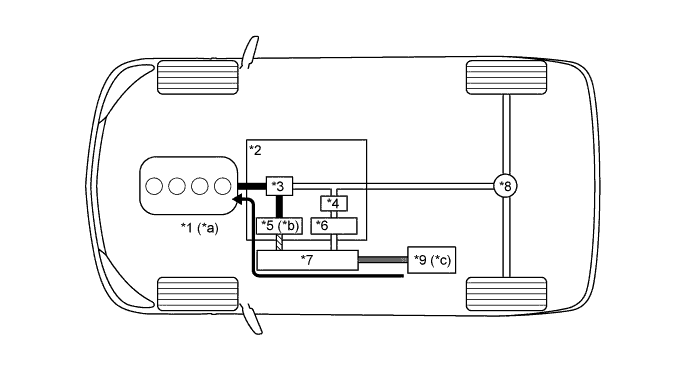
Text in Illustration *1 Engine *2 Hybrid Transmission (Hybrid Vehicle Transmission Assembly) *3 Power Split Planetary Gear *4 Motor Speed Reduction Planetary Gear *5 Motor Generator 1 (MG1) *6 Motor Generator 2 (MG2) *7 Inverter with Converter Assembly *8 Differential *9 HV Battery - - *a Driven *b Drives *c Discharge - - Power Transmission 
Mechanical Power Path 
Electrical Power Path (DC) 
Electrical Power Path (AC) -
If the SOC of the HV battery is low, the battery is charged by MG1 which is driven by the engine.
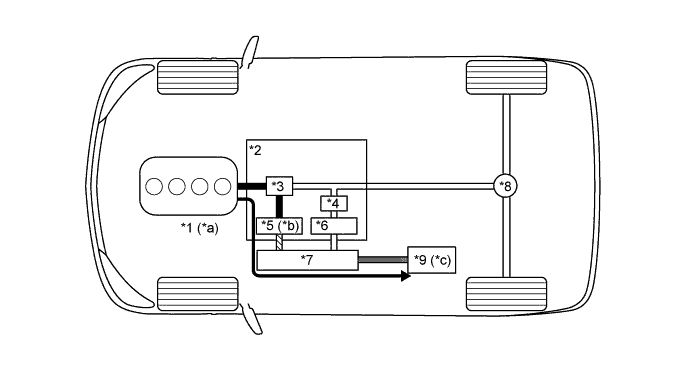
Text in Illustration *1 Engine *2 Hybrid Transmission (Hybrid Vehicle Transmission Assembly) *3 Power Split Planetary Gear *4 Motor Speed Reduction Planetary Gear *5 Motor Generator 1 (MG1) *6 Motor Generator 2 (MG2) *7 Inverter with Converter Assembly *8 Differential *9 HV Battery - - *a Drives *b Driven - Generates Electricity *c Charged by MG1 - - Power Transmission Mechanical Power Path Electrical Power Path (DC) Electrical Power Path (AC)
-
-
Driving Condition B: when Starting Off
-
When the vehicle is starting off, the vehicle operates while being powered by MG2.
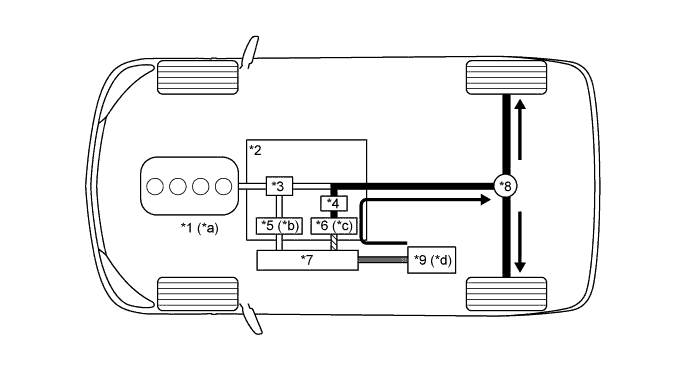
Text in Illustration *1 Engine *2 Hybrid Transmission (Hybrid Vehicle Transmission Assembly) *3 Power Split Planetary Gear *4 Motor Speed Reduction Planetary Gear *5 Motor Generator 1 (MG1) *6 Motor Generator 2 (MG2) *7 Inverter with Converter Assembly *8 Differential *9 HV Battery - - *a Stopped *b Rotates Freely *c Drives *d Discharges Power Transmission Mechanical Power Path Electrical Power Path (DC) Electrical Power Path (AC) -
If the SOC of the HV battery is low, the battery is charged by MG1 which is driven by the engine. The electricity from MG1 is also used to drive MG2.
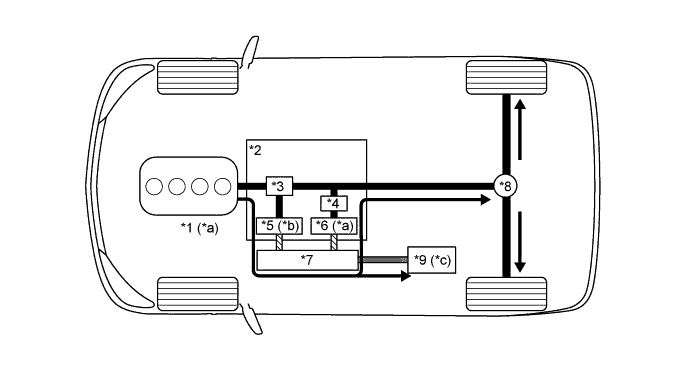
Text in Illustration *1 Engine *2 Hybrid Transmission (Hybrid Vehicle Transmission Assembly) *3 Power Split Planetary Gear *4 Motor Speed Reduction Planetary Gear *5 Motor Generator 1 (MG1) *6 Motor Generator 2 (MG2) *7 Inverter with Converter Assembly *8 Differential *9 HV Battery - - *a Drives *b Driven - Generates Electricity *c Charged by MG1 - - Power Transmission Mechanical Power Path Electrical Power Path (DC) Electrical Power Path (AC)
-
-
Driving Condition C: during Low Load and Constant-speed Cruising
-
When the vehicle is running under constant-speed cruising conditions, the engine will be operated in its most efficient range to power the vehicle.
-
The motive force from the engine is split into two in the power split planetary gear. One portion of the motive force is used to drive the wheels directly and the other is used to generate electricity using MG1.
-
The electricity from MG1 is used to drive MG2. This supports the directly transmitted engine motive force, contributing to fuel efficiency.
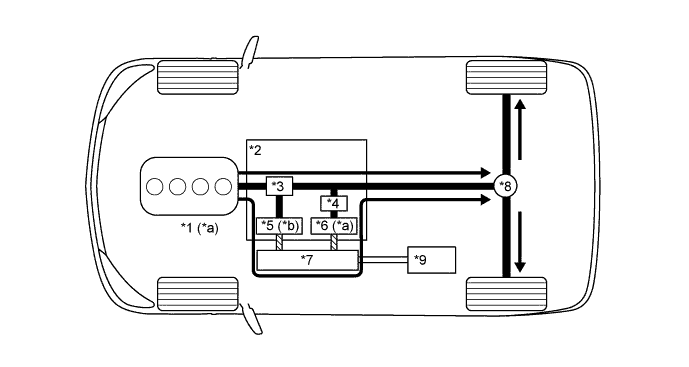
Text in Illustration *1 Engine *2 Hybrid Transmission (Hybrid Vehicle Transmission Assembly) *3 Power Split Planetary Gear *4 Motor Speed Reduction Planetary Gear *5 Motor Generator 1 (MG1) *6 Motor Generator 2 (MG2) *7 Inverter with Converter Assembly *8 Differential *9 HV Battery - - *a Drives *b Driven - Generates Electricity Power Transmission Mechanical Power Path Electrical Power Path (AC) - - -
If the SOC of the HV battery is low, more engine power is provided to increase the generation of electricity via MG1. This charges the HV battery.
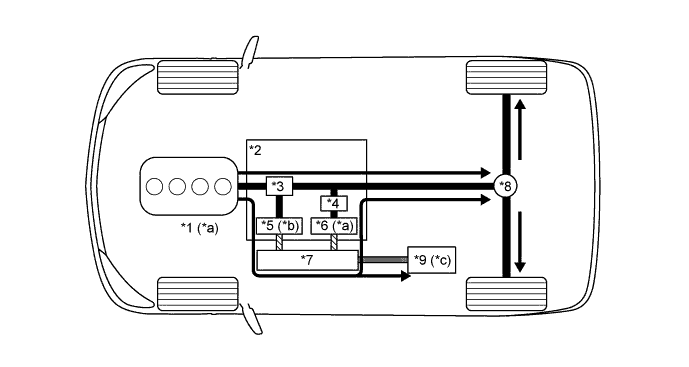
Text in Illustration *1 Engine *2 Hybrid Transmission (Hybrid Vehicle Transmission Assembly) *3 Power Split Planetary Gear *4 Motor Speed Reduction Planetary Gear *5 Motor Generator 1 (MG1) *6 Motor Generator 2 (MG2) *7 Inverter with Converter Assembly *8 Differential *9 HV Battery - - *a Drives *b Driven - Generates Electricity *c Charged by MG1 - - Power Transmission Mechanical Power Path Electrical Power Path (DC) Electrical Power Path (AC)
-
-
Driving Condition D: during Full Throttle Acceleration
-
When the vehicle driving condition changes from low load cruising to full throttle acceleration, the system supplements the motive force of MG2 with electrical power from the HV battery.
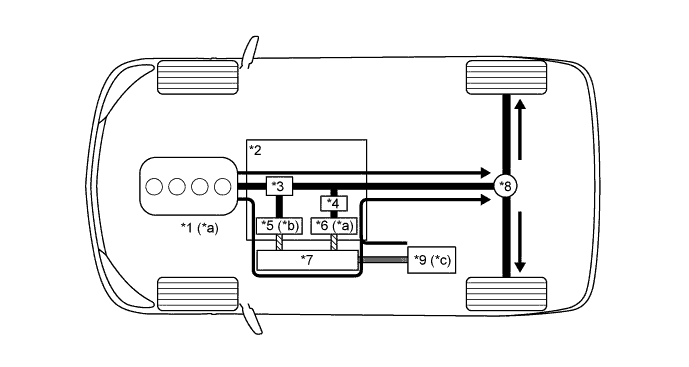
Text in Illustration *1 Engine *2 Hybrid Transmission (Hybrid Vehicle Transmission Assembly) *3 Power Split Planetary Gear *4 Motor Speed Reduction Planetary Gear *5 Motor Generator 1 (MG1) *6 Motor Generator 2 (MG2) *7 Inverter with Converter Assembly *8 Differential *9 HV Battery - - *a Drives *b Driven - Generates Electricity *c Discharges - - Power Transmission Mechanical Power Path Electrical Power Path (DC) Electrical Power Path (AC)
-
-
Driving Condition E: during Deceleration
-
While the vehicle is being driven with the shift lever in D and the vehicle decelerates, the engine turns off and the engine motive force output to the wheels will be zero. At this time, the wheels drive MG2, causing MG2 to operate as a generator and charge the HV battery. While MG2 is operating as a generator, it creates resistance against the rotation of the wheels, producing a braking effect.
-
If the vehicle decelerates at a higher speed, the engine (crankshaft) will not stop turning. The engine will maintain a predetermined speed in order to protect the planetary gear unit. This operation is not shown in the following diagrams:
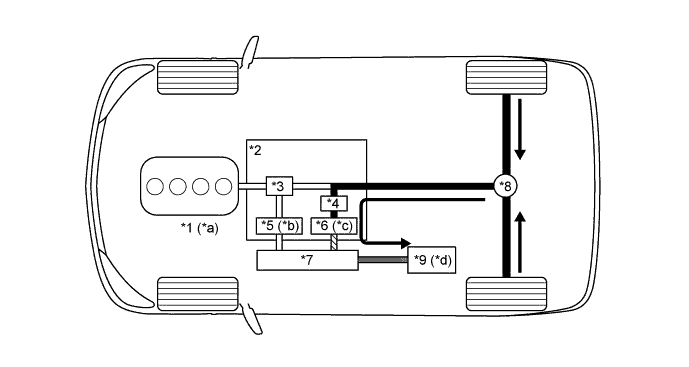
Text in Illustration *1 Engine *2 Hybrid Transmission (Hybrid Vehicle Transmission Assembly) *3 Power Split Planetary Gear *4 Motor Speed Reduction Planetary Gear *5 Motor Generator 1 (MG1) *6 Motor Generator 2 (MG2) *7 Inverter with Converter Assembly *8 Differential *9 HV Battery - - *a Stopped *b Rotates Freely *c Driven - Generates Electricity *d Charged by MG2 Power Transmission Mechanical Power Path Electrical Power Path (DC) Electrical Power Path (AC)
-
-
Driving Condition F: Driving in Reverse
-
While the vehicle is being driven in reverse, its power is delivered by MG2. At this time, MG2 is spinning in the opposite (-) direction of forward travel, the engine can remain stopped, and MG1 is spinning in the (+) direction without generating electricity.
-
While driving in reverse, when any of the conditions monitored by the power management control ECU, such as the SOC of the HV battery, HV battery temperature, engine coolant temperature and electrical load condition, reach a specified level, MG1 will be used to start the engine. The following illustration represents an example when the engine is not running:
Text in Illustration *1 Engine *2 Hybrid Transmission (Hybrid Vehicle Transmission Assembly) *3 Power Split Planetary Gear *4 Motor Speed Reduction Planetary Gear *5 Motor Generator 1 (MG1) *6 Motor Generator 2 (MG2) *7 Inverter with Converter Assembly *8 Differential *9 HV Battery - - *a Stopped *b Rotates Freely *c Drives *d Discharges Power Transmission Mechanical Power Path Electrical Power Path (DC) Electrical Power Path (AC)
-
-
-
DIAGNOSIS
-
In the LEXUS Hybrid Drive, if the power management control ECU or Motor Generator ECU (MG ECU) detects a malfunction, the power management control ECU records the fault and memorizes the information that relates to the fault. To inform the driver of the malfunction, the power management control ECU illuminates or blinks the MIL and master warning light, and displays a message on the multi-information display.
-
The power management control ECU will store the respective DTCs of the malfunctions.
-
3-digit information codes (INF codes) have been provided with the conventional DTCs as a subset of the primary 5-digit code. This enables the troubleshooting procedure to further narrow down a trouble area to identify a problem.
-
The INF codes can be accessed by viewing the freeze frame data associated with the hybrid system DTCs.
-
The DTCs can be accessed by using the Global TechStream (GTS).
-
A permanent DTC is used for the DTCs associated with the illumination of the MIL. The permanent DTCs cannot be cleared by using the Global TechStream (GTS), disconnecting the battery terminal or removing the AM2 fuse.
-
For details, refer to the Repair Manual.
-