ENGINE UNIT
-
OUTLINE
-
The 2AR-FSE engine is an in-line 4-cylinder, 2.5 liter, 16 valve DOHC engine.
-
This engine uses a high-expansion ratio Atkinson cycle, Dual Variable Valve Timing-intelligent (Dual VVT-i) system, Direct Ignition System (DIS), Electronic Throttle Control System-intelligent (ETCS-i) and Exhaust Gas Recirculation (EGR) system* employing a highly efficient EGR cooler. Thus, improved engine performance, quietness, fuel economy, and cleaner emissions have been achieved.
-
*: Models with EGR system
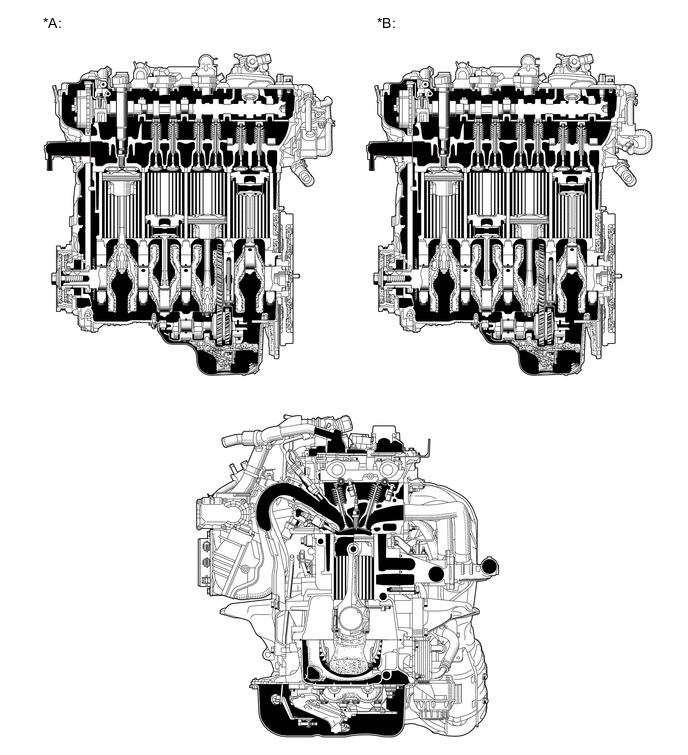
Text in Illustration *A Models with EGR System *B Models without EGR System -
-
-
SPECIFICATION
No. of Cyls. & Arrangement 4-cylinder, In-line Valve Mechanism 16-valve DOHC, Chain Drive (with Dual VVT-i) Combustion Chamber Pentroof Type Flow of Intake and Exhaust Gasses Cross-flow Fuel System Sequential Multiport Fuel Injection (SFI) D-4S Ignition System DIS Displacement 2494 cm3(152.2 cu. in.)
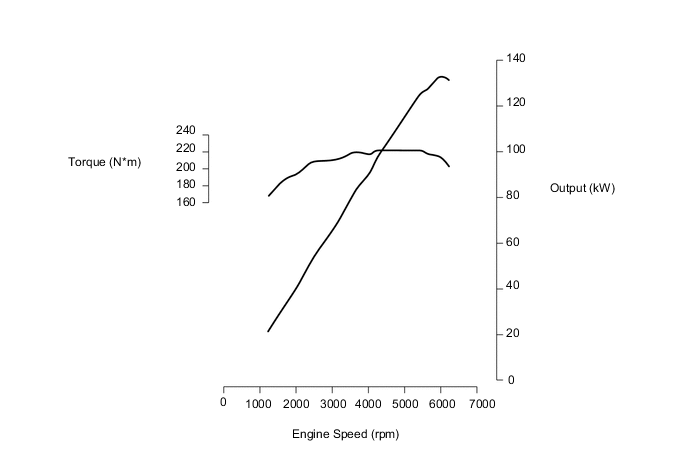
Bore x Stroke 90.0 mm x 98.0 mm (3.54 in. x 3.86 in.) Compression Ratio 13.0 : 1 Max. Output (EEC) 133 kW @ 6000 rpm Max. Torque (EEC) 221 N*m @ 4200 rpm to 5400 rpm Valve Timing Intake Open -15° to 35° BTDC Closed 105° to 55° ABDC Exhaust Open 54° to 14° BBDC Closed 0° to 40° ATDC Spark Plug Manufacturer DENSO Type FK20HBR8 Plug Gap 0.7 mm to 0.8 mm (0.0276 in. to 0.0315 in.) Firing Order 1 - 3 - 4 - 2 Research Octane Number Except China 95 or higher for China 92 or higher Emission Regulations* EURO 6 EURO 5 Engine Service Mass (Reference) 145 kg (320 lb) Tech Tips
*: Emission regulation differ by country and region
-
MAIN FEATURES
-
The 2AR-FSE engine has achieved the following through the use of the items listed in the table below:
-
High performance and reliability
-
Low noise and vibration
-
Lightweight and compact design
-
Good serviceability
-
Clean emissions and fuel economy
Item (1) (2) (3) (4) (5) The high-expansion ratio Atkinson cycle is used. - - - - ○ Engine Proper A cylinder head cover sub-assembly made of aluminum alloy is used. - - ○ - - A taper squish shape is used for the combustion chambers. ○ - - - ○ Spiny-type liners are used in the cylinder bores. ○ - ○ - ○ A cylinder block water jacket spacer is used. ○ - - - ○ The piston skirt is coated with resin. ○ ○ - - ○ Low-tension piston rings are used. ○ - - - ○ An offset crankshaft is used. ○ ○ - - ○ A resin gear engine balancer assembly is used. - ○ ○ - - Valve Mechanism The Dual Variable Valve Timing-intelligent (Dual VVT-i) system is used. ○ - - - ○ A chain sub-assembly and No. 1 chain tensioner assembly are used. - ○ - ○ - Valve lash adjuster assemblies are used. ○ ○ - ○ - No. 1 valve rocker arm sub-assemblies are used. ○ - - - ○ Lubrication System An oil filter with a replaceable element is used. - - - ○ - Cooling System TOYOTA Genuine Super Long Life Coolant (SLLC) is used. - - - ○ - A high elasticity belt is used. - - - ○ - Intake and Exhaust Systems
Emission Control System
An intake manifold made of plastic is used. - ○ ○ - - A linkless-type throttle body with motor assembly is used. - - ○ ○ - A stainless steel exhaust manifold sub-assembly is used. - - ○ - - A DC motor type Exhaust Gas Recirculation (EGR) valve is used.* ○ - - - ○ A water-cooled type Exhaust Gas Recirculation (EGR) cooler is used.* ○ - - - ○ An ultra thin-wall, high-cell density ceramic type Three-Way Catalyst (TWC) is used. - - - - ○ Fuel System A Direct injection 4-stroke gasoline engine Superior version (D-4S) system is used. ○ - - - ○ A fuel returnless system is used. - - ○ ○ ○ Quick connectors are used to connect the fuel hose with the fuel pipe. - - - ○ - Compact 12-hole type fuel injector assemblies are used. ○ - - - ○ Ignition System The Direct Ignition System (DIS) is used. ○ - - ○ ○ Long-reach type iridium-tipped spark plugs are used. ○ - - ○ ○ Engine Control System Magnetic Resistance Element (MRE) type camshaft position sensors are used. ○ - - - ○ The Electronic Throttle Control System-intelligent (ETCS-i) is used. ○ - - - ○ An evaporative emission control system is used. - - - - ○
-
○: Applicable
-
-: Not applicable
-
*: Models with EGR system
-
-
-
The 2AR-FSE engine uses the Direct injection 4-stroke gasoline engine Superior version (D-4S) system to achieve high performance while also achieving fuel economy and clean emissions. The features of the D-4S system are listed below:
-
The Direct injection 4-stroke gasoline engine Superior version (D-4S) system has both direct type fuel injection, which directly injects high-pressure fuel into the combustion chamber, and port type fuel injection, which injects fuel into the intake port. The system optimally controls the fuel injectors for direct injection and port injection according to engine load.
-
In low to medium engine load ranges, both direct type and port type fuel injections are used together or one of them is used to create homogeneous mixed air, thus contributing to stable combustions. With this, the system achieves low fuel consumption and low emissions. In addition, in high engine load ranges, only the direct type fuel injection is used to cool down the intake air with the chilling effect of vapors in the fuel which is injected into the cylinder, improving charging efficiency and anti-knock properties.
-
Immediately after the engine is started in a cold state, the fuel injector assembly on the port side is selected for the injection, in an effort to homogenize the mixture in the combustion chamber. Next, the fuel injector assembly on the cylinder injection side performs fuel injection during the compression process in order to stratify the mixture layers around the spark plug. This formation not only enables a substantial retardation of ignition timing but also raises the exhaust gas temperature, which facilitates the warm-up of the catalyst following a cold start.
-
A high-pressure single slit-nozzle injector is used as the fuel injector assembly (for direct injection). The fuel atomized by this injector is injected into the combustion chamber via the slit, spreading in a fan shaped pattern and combines with a large volume of intake air. The intake air will swirl in a vertical direction and promote mixture with the fuel, contributing to higher performance and higher output.
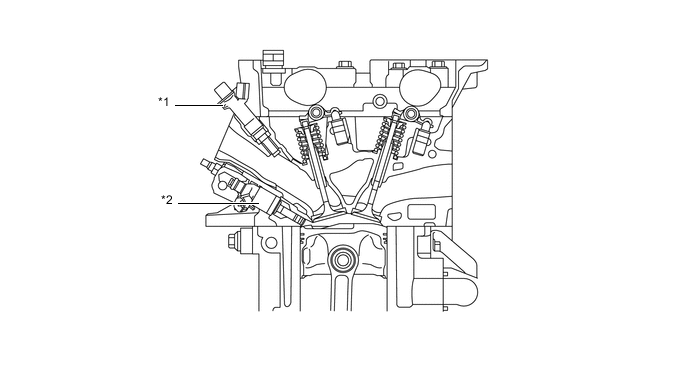
Text in Illustration *1 Fuel Injector Assembly (for Port Injection) *2 Fuel Injector Assembly (for Direct Injection)
-
-