POWER WINDOW CONTROL SYSTEM
-
SYSTEM CONTROL
-
The power window control system has the following functions:
Function Outline Power Up-and-down (All Doors) This function causes the window to open or close while the multiplex network master switch assembly or power window regulator switch assembly is being pulled halfway up or pushed halfway down. The window stops as soon as the switch is released. One-touch Auto Up-and-down (All Doors) The one-touch auto up-and-down function enables the window to be fully opened or closed by firmly operating the multiplex network master switch assembly or power window regulator switch assembly. Variable Speed Control (All Doors) This control minimizes the occurrence of noise during the power window open/close operation by changing the operating speed of the power window motor. Jam Protection (All Doors) The jam protection function automatically stops the power window and moves it downward if a foreign object gets jammed in the window during one-touch auto-up operation or power up operation. Catch Protection (All Doors) The catch protection function automatically stops the power window if a foreign object gets caught in the window during a down operation. Remote Control (All Doors) The multiplex network master switch assembly can control the up-and-down operation of the windows. Window Lock Operation of the 3 passenger windows is disabled when the window lock switch is pressed. Key Off Operation This function makes it possible to operate the power windows for approx. 43 seconds after the power switch is turned off, when the driver door is not opened. Mechanical key-linked Up-and-down* When the electrical key transmitter sub-assembly is not in the interior detection area, the driver's door is locked, and the mechanical key in the driver's door is turned and maintained in the lock direction for 1.5 seconds or more, the main body ECU activates the power window motor to close all the door windows while the mechanical key is turned. Similarly, when the driver's door is unlocked, turning and maintaining the driver's door key in the unlock direction for 1.5 seconds or more will cause all the door windows to be opened. Transmitter-linked Up-and-down* When a lock/unlock signal is transmitted by the electrical key transmitter sub-assembly for longer than 2.5 seconds to the certification ECU, the certification ECU transmits the window close/open signal to the main body ECU. Power window ECUs activate all the power window motors in accordance with the signals from the main body ECU to open or close all the windows. Lock Switch-linked Up Function All the windows are closed when the lock switch on the outside door handle is pressed for 3 seconds or more with the key in the detection area and all the doors locked. This function can be performed using the door lock switch of any door. Tech Tips
*: The setting function can be changed using the customized body electronics system.
The power window ECU stores the initial position. The memory is not cleared even if auxiliary battery terminals, fuses or power window ECU connectors are disconnected. However, the power window regulator motor assembly needs to be initialized if it is replaced with a new one or it is reinstalled with the power window regulator sub-assembly. For details, refer to the Repair Manual.
-
Variable Speed Control
-
Opening Power Window
-
In order to minimize the noise when the power window open function starts operating, the power window ECU accelerates the window opening speed within approximately 80 mm (3.2 in.) of the window fully closed position.
-
In order to minimize the noise when the power window is opened fully, the power window ECU decelerates the window opening speed within approximately 100 mm (4.0 in.) of the window fully open position.
-
The power window ECU stops the power window just before it reaches fully open position of the power window regulator assembly to minimize the noise when the window is opened fully.
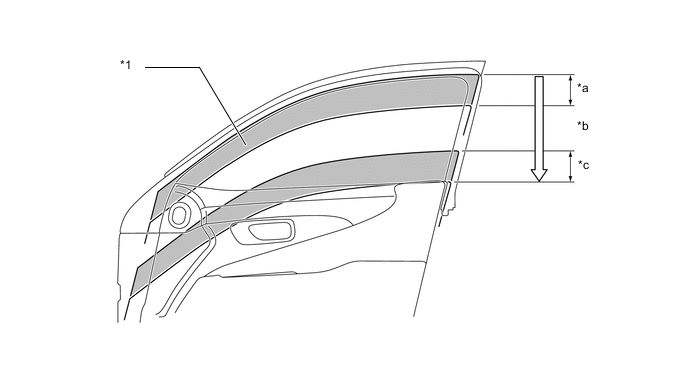
Text in Illustration *1 Door Window Glass - - *a Acceleration *b Normal Speed *c Deceleration - -
-
-
Closing Power Window
-
In order to minimize the noise when the power window close function starts operating, the power window ECU accelerates the window closing speed within approximately 25 mm (1.0 in.) of the window fully open position.
-
In order to minimize the noise when the power window is closed fully, the power window ECU decelerates the window closing speed within approximately 30 mm (1.2 in.) of the window fully closed position.
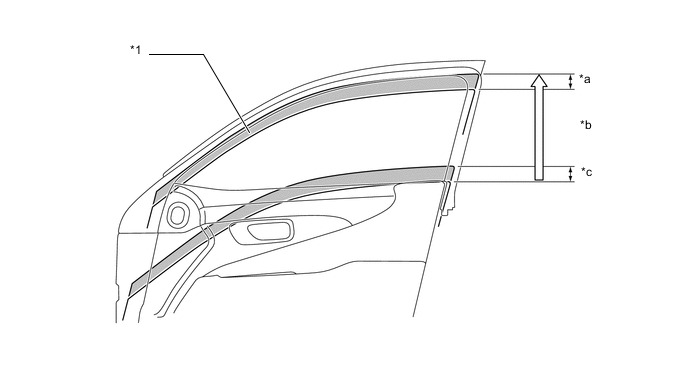
Text in Illustration *1 Door Window Glass - - *a Deceleration *b Normal Speed *c Acceleration - -
-
-
-
Jam Protection Function
-
The jam protection function automatically stops the power window and moves it downward if a foreign object gets jammed in the door window during one-touch auto up operation or manual up operation.
-
Even when the power window regulator switch assembly is maintained in the auto up position, the power window operates in reverse if a jam is detected.
-
In the case of manual up operation using the power window regulator switch assembly, the power window is moved downward by approximately 30 mm (1.2 in.) or for approximately 5 seconds. In the case of up operation except for manual up operation using the power window regulator switch assembly, the power window is moved downward by approximately 125 mm (4.9 in.) or for approximately 5 seconds.
-
The power window ECU determines if a foreign object gets jammed according to changes in the output signal from the pulse sensor (Hall IC). Both of the following 2 judgment methods are used:
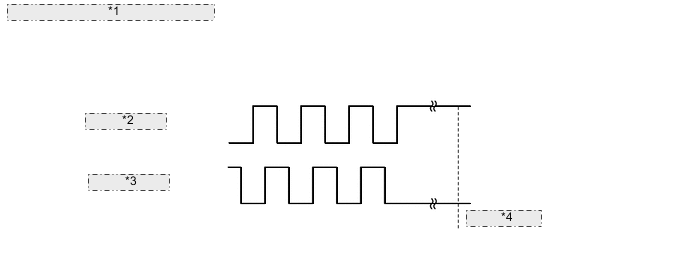
*1 Judgment Method (Overload Detection) *2 Pulse Signal 1 *3 Pulse Signal 2 *4 Judged Jammed 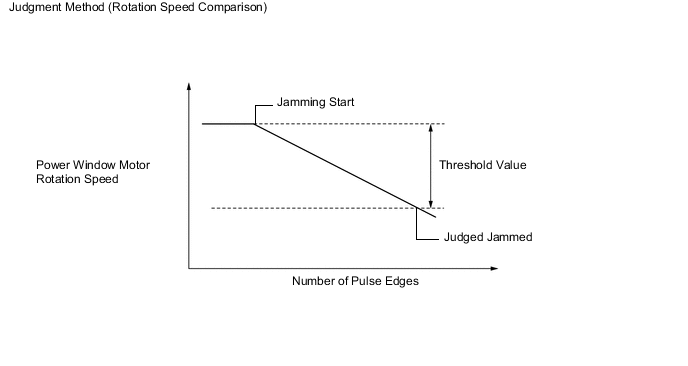
-
-
Catch Protection Function
-
The catch protection function automatically stops the power window if a foreign object gets caught in the window during a down operation.
-
The power window ECU determines if a foreign object gets caught according to changes in the output signal from the pulse sensor (Hall IC). The judgment method is as follows:
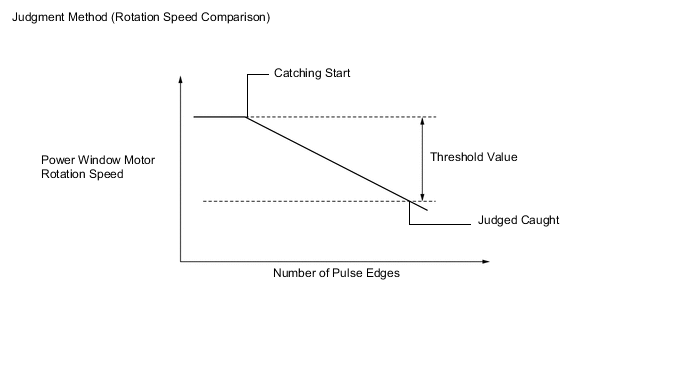
-
-
-
CONSTRUCTION
-
The power window regulator motor assembly consists of a power window motor and a power window ECU.
-
The power window ECU contains a built-in pulse sensor (Hall IC). The power window ECU detects the rotation of the power window motor according to output signals from the pulse sensor (Hall IC).
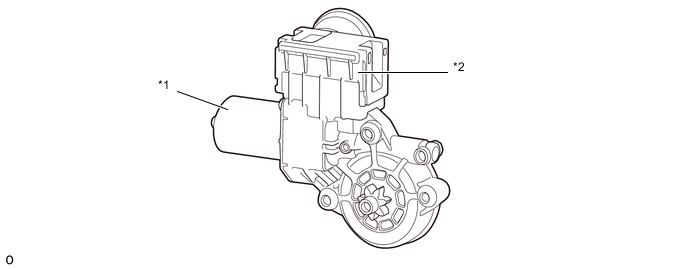
Text in Illustration *1 Power Window Motor *2 Power Window ECU -
Pulse Sensor (Hall IC)
-
The pulse sensor (Hall IC) sends pulse signals (2 pulse signals with different phases) in sync with the motor rotation to the power window ECU.
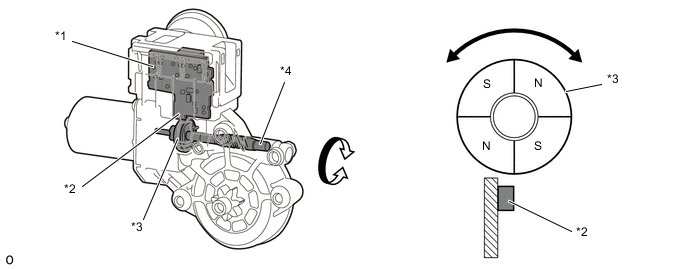
Text in Illustration *1 Power Window ECU *2 Pulse Sensor (Hall IC) *3 Magnet *4 Worm Shaft -
The power window ECU detects the amount of door glass movement by counting pulse signal 1 sent from the pulse sensor (Hall IC). The power window ECU also detects the direction of the door glass movement using 2 types of signals: pulse signal 1 and pulse signal 2 which have different phases. The power window ECU controls each function according to the data about the door glass position obtained from the 2 pulse signals.
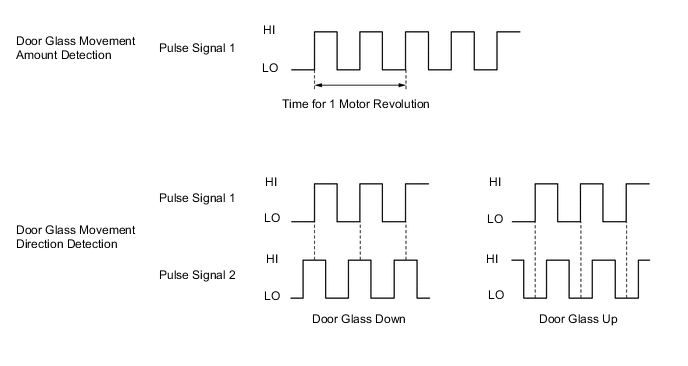
-
The power window ECU detects changes in the motor rotation speed using pulse signal 1. As a result, the power window ECU detects the load applied to the door glass and controls the jam protection and catch protection.
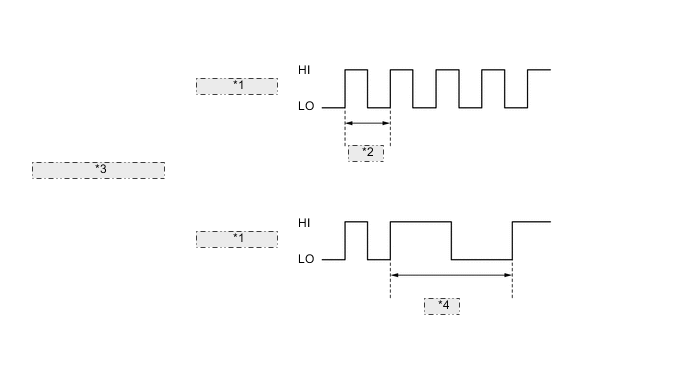
*1 Pulse Signal 1 *2 Normal *3 Door Glass Movement Speed Detection *4 Jammed
-
-
-
FAIL-SAFE
-
If a pulse sensor (Hall IC) in the power window regulator motor assembly malfunctions, the power window control system enters fail-safe mode. For details, refer to the Repair Manual.
-
-
DIAGNOSIS
-
When any power window ECU detects the following condition, it switches to fail-safe mode.
-
An abnormality in a Hall IC that detects the position, speed and direction of the window.
-
-