ENGINE UNIT
-
OUTLINE
-
The 2UR-FSE is a 5.0-liter, 32-valve DOHC V8 engine. The engine uses the Dual Variable Valve Timing-intelligent (Dual VVT-i) system which achieves optimal valve timing by using an electric motor to actuate the intake camshaft and the engine oil pressure to actuate the exhaust camshaft. In addition, this engine uses the Direct injection 4-stroke gasoline engine Superior version (D-4S) which uses both the direct injection and port injection systems, Direct Ignition System (DIS), Acoustic Control Induction System (ACIS) and Electronic Throttle Control System-intelligent (ETCS-i). These control functions achieve improved engine performance, quietness, fuel economy, and clean emissions.
-
-
SPECIFICATION
No. of Cyls. and Arrangement 8-cylinder, V-type Valve Mechanism 32-valve DOHC, Chain Drive (with Dual VVT-i) Combustion Chamber Pentroof Type Manifolds Cross-flow Fuel System Sequential Multiport Fuel Injection (SFI) D-4S Ignition System Direct Ignition System (DIS) Displacement 4969 cm3(303.2 cu. in.)
Bore x Stroke 94.0 mm x 89.5 mm (3.70 in. x 3.52 in.) Compression Ratio 11.8 : 1 Max. Output [ECE] 290 kW @ 6400 rpm Max. Torque [ECE] 520 N*m @ 4000 rpm Valve Timing Cylinder No. #4, #5, #7, #8 #1, #2, #3, #6 Intake Open (BTDC) -33° to 22° -29° to 26° Closed (ABDC) 101° to 46° 97° to 42° Exhaust Open (BBDC) 25° to 60° 29° to 64° Closed (ATDC) 39° to 4° 35° to 0° Spark Plug Manufacturer DENSO Type FK20HBR11 (Iridium) Plug Gap 1.0 mm to 1.1 mm (0.0394 in. to 0.0433 in.) Firing Order 1 - 8 - 7 - 3 - 6 - 5 - 4 - 2 Research Octane Number (RON) 95 or higher*3 Emission Regulations*1 EURO 6 Chinese EURO 5 EURO 5 EURO 4 Engine Service Mass (Reference)*2 236 kg (520 lb) Tech Tips
*1: Emission regulation differ by country and region
*2: Weight shows the figure with the oil and engine coolant fully filled.
*3: Premium unleaded gasoline with a Research Octane Number 95 or higher required for optimum engine performance. If 95 octane cannot be obtained, you may use unleaded gasoline with a Research Octane Number as low as 91. Use of unleaded fuel with a Research Octane Number lower than 95 may result in engine knocking and significantly reduced performance. Persistent knocking can lead to engine damage and should be corrected by refueling with higher octane unleaded gasoline.
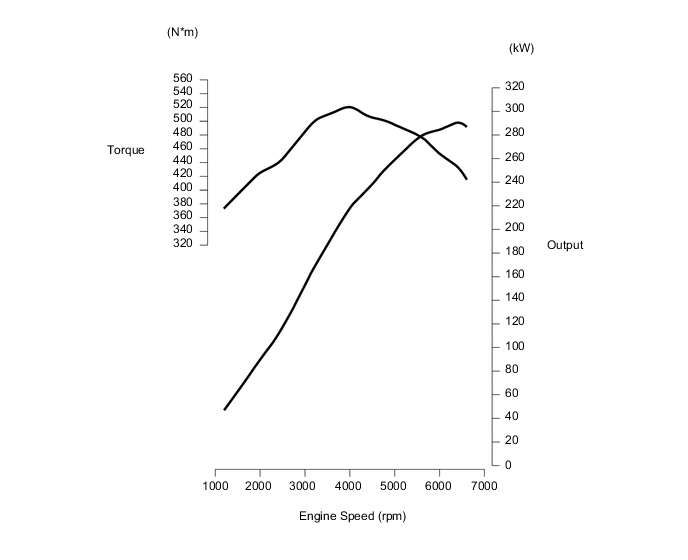
-
MAIN FEATURES
-
The 2UR-FSE engine has achieved the following performance features through the use of the items listed in the table below:
-
High performance and reliability
-
Low noise and vibration
-
Lightweight and compact design
-
Good serviceability
-
Clean emissions and fuel economy
Item (1) (2) (3) (4) (5) Engine Proper Magnesium alloy cylinder head covers are used. - - ○ - - Steel laminate type cylinder head gaskets are used. ○ - - - - A taper squish shape is used for the combustion chamber. ○ - - - ○ An aluminum alloy cylinder block containing an engine coolant distribution pathway is used. - - ○ - - Spiny-type liners are used in the cylinder bores. ○ - - - - Cylinder block water jacket spacers are used. ○ - - - - The skirt portion of the piston has a resin coating applied to reduce friction. ○ ○ - - ○ A No. 1 oil pan made of aluminum alloy is used. - ○ ○ - - No. 2 Oil pan made of vibration damping steel sheet is used. - ○ - - - Valve Mechanism Composite camshafts are used. ○ - ○ - ○ Timing chains and chain tensioners are used. ○ ○ ○ - - Valve lash adjuster assemblies are used. ○ ○ - ○ - Valve rocker arm sub-assemblies are used. ○ - - - ○ Lubrication System An oil filter with a replaceable element is used. - - - ○ - Cooling System Toyota Genuine Super Long Life Coolant (SLLC) is used. - - - ○ - Intake and Exhaust Systems A two-way split type air cleaner is used. ○ ○ - - - A linkless-type throttle body is used. - - ○ ○ - An intake manifold made of plastic is used. ○ - ○ - ○ Stainless steel exhaust manifolds are used. - - ○ - ○ Ceramic type TWCs (Three-Way Catalytic Converter) are used. - - - - ○ Fuel System The Direct injection 4-stroke gasoline engine Superior version (D-4S) is used. ○ - - - ○ Double slit nozzle type high pressure injectors are used. ○ - - - ○ A fuel vapor-containment system is used. - - - - ○ A fuel tank made of steel sheet, which is pressure resistant, is used. - - - - ○ Quick connectors are used to connect the fuel hose with the fuel pipe. - - - ○ - Ignition System The Direct Ignition System (DIS) makes ignition timing adjustment unnecessary. ○ - - ○ ○ Long-reach type iridium-tipped spark plugs are used. ○ - - ○ ○ Serpentine Belt Drive System A serpentine belt drive system is used. - - ○ ○ - Blowby Gas Ventilation System A separator case is used. - - ○ ○ - Engine Control System Magnetic Resistance Element (MRE) type crankshaft position, camshaft position and VVT sensors are used. ○ - - - - The Electronic Throttle Control System-intelligent (ETCS-i) system is used. ○ - - - ○ The Dual Variable Valve Timing-intelligent (Dual VVT-i) system is used. It consists of VVT-iE for the intake and VVT-i for the exhaust. ○ - - - ○ The Acoustic Control Induction System (ACIS) is used. ○ - - - ○ An evaporative emission control system is used. - - - - ○ Tech Tips
○: Applicable
-: Not applicable
-
-
The 2UR-FSE engine uses the Direct injection 4-stroke gasoline engine Superior version (D-4S) system to achieve high performance while also achieving fuel economy and clean emissions. The features of the D-4S system are as listed below:
-
The D-4S system is a system which combines a direct injection system and a port injection system which injects fuel to the intake ports. This system optimally controls the two types of fuel injectors according to the driving conditions.
-
When the engine is running under a medium or high load at lower speeds, both the direct and port injection systems are used. This control creates a homogeneous air-fuel mixture to stabilize combustion, improve fuel efficiency, and reduce emissions.
-
When the engine is running under heavy load, direct injection system is used. This control achieves an intake cooling effect by injecting fuel directly to the combustion chamber. This control also allows the compression ratio of the engine to be higher by reducing the tendency of the compressed mixture to preignite or detonate. The increased compression ratio improves engine output and performance.
-
The double slit nozzle type injectors for direct injection atomize fuel so that the fuel spreads out widely and finely in a fan shape. Fuel is mixed with intake air efficiently and homogeneously, aiming at ideal combustion under any driving conditions.
-
When the engine is cold, fuel is injected from the injectors (for port injection) to create a homogenous lean air-fuel mixture in the combustion chamber. Fuel is also injected from the injectors (for direct injection) during the latter half of the compression stroke to adjust the air-fuel mixture around the spark plug to allow stable combustion of under retarded ignition timing, thus increasing exhaust gas temperature. This promotes rapid warming of the catalysts and achieves cleaner emissions.
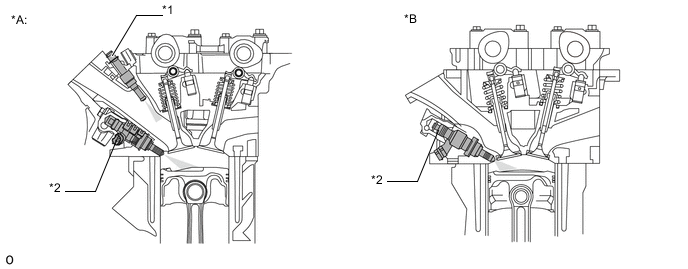
Text in Illustration *A Direct Injection 4-stroke Gasoline Engine Superior Version (D-4S) *B Direct Injection 4-stroke Gasoline Engine (D-4) *1 Fuel Injector Assembly (for Port Injection) *2 Fuel Injector Assembly (for Direct Injection)
-
-