FEATURES
-
OUTLINE
-
LEXUS Hybrid Drive
-
LEXUS Hybrid Drive optimally performs cooperative control of the 2UR-FSE engine, and Motor Generator 1 (MG1) and Motor Generator 2 (MG2) in the L110F hybrid vehicle transmission assembly that provides excellent transmission performance. Furthermore, this system uses a high-output HV battery with a nominal voltage of DC 288 V, and a variable voltage system in which a boost converter boosts the operating voltage of the system to a maximum voltage of DC 650 V.
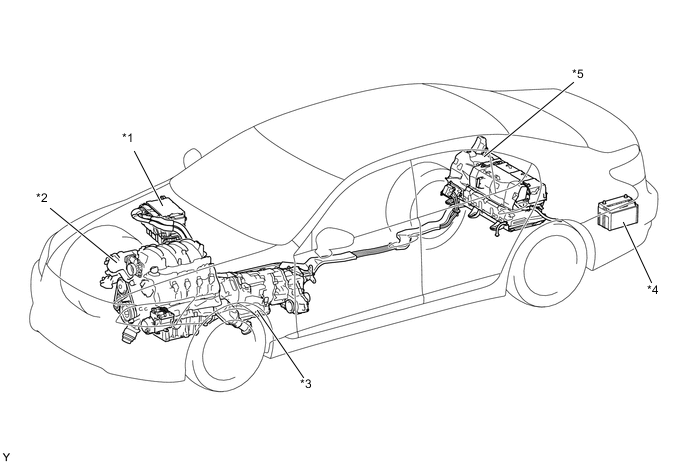
Text in Illustration *1 Inverter with Converter Assembly *2 2UR-FSE Engine *3 L110F Hybrid Vehicle Transmission Assembly *4 Auxiliary Battery *5 HV Battery Assembly - - System Performance Maximum System Output* 327 kW (439 HP) Tech Tips
*: Maximum system output is engine output and MG2 output controlled by LEXUS Hybrid Drive. MG2 output depends on power supplied by the HV battery.
-
-
2UR-FSE Engine
-
The 2UR-FSE is a 5.0-liter, 32-valve DOHC V8 engine. The engine uses the Dual Variable Valve Timing-intelligent (Dual VVT-i) system which achieves optimal valve timing by using an electric motor to actuate the intake camshaft and the engine oil pressure to actuate the exhaust camshaft. In addition, this engine uses the Direct injection 4-stroke gasoline engine Superior version (D-4S) which uses both the direct injection and port injection systems, Direct Ignition System (DIS), Acoustic Control Induction System (ACIS), Electronic Throttle Control System intelligent (ETCS-i) and Hydro-Carbon Adsorber and Catalyst (HCAC) system. These control functions achieve improved engine performance, quietness, fuel economy, and clean emissions.
Engine Type 2UR-FSE Item No. of Cyls. and Arrangement 8-cylinder, V-type Valve Mechanism 32-valve DOHC, Chain Drive (with Dual VVT-i) Displacement 4969 cm3(303.2 cu. in.)
Max. Output [ECE] 290 kW @ 6400 rpm Max. Torque [ECE] 520N*m @ 4000 rpm
-
-
Hybrid Vehicle Transmission Assembly
-
The L110F hybrid vehicle transmission assembly contains Motor Generator 1 (MG1) and Motor Generator 2 (MG2).
-
-
Suspension
-
An air suspension system is used.
-
A multi-link with upper and lower double ball joint type independent suspension is used on the front suspension.
-
A multi-link type independent suspension is used on the rear suspension.
-
-
Brake Control System
-
Vehicle Dynamic Integrated Management (VDIM) is used.
-
An electronically controlled brake system is used.
-
-
Front Brake
-
A ventilated disc brake is used.
-
-
Rear Brake
-
A ventilated disc brake is used.
-
-
Parking Brake
-
An Electric Parking Brake (EPB) is used.
-
-
Steering
-
Power tilt, power telescopic and Electric Power Steering (EPS) systems are used.
-
Variable Gear Ratio Steering (VGRS) is used.
-
-
Drive Mode Select
-
The conventional pattern select switch (PWR switch), ECO switch and damping mode select switch have been combined and the drive mode select which regulates various systems in a unified manner has been provided in the combination switch assembly.
-
Various modes are provided by anticipating various driving situations to meet the diversified needs of drivers.
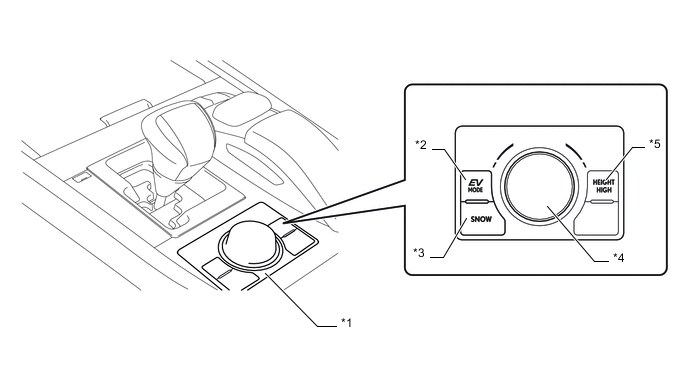
Text in Illustration *1 Combination Switch Assembly *2 EV Mode Switch *3 SNOW Mode Switch *4 Drive Mode Select *5 Height Control Switch - - Control Characteristics Drive Mode Select Position System ECT Air Conditioning AVS EPS VGRS SPORT S+ Mode POWER NORMAL SPORT*1 SPORT*2 SPORT SPORT S Mode POWER NORMAL NORMAL NORMAL NORMAL NORMAL Mode NORMAL NORMAL NORMAL NORMAL NORMAL COMFORT Mode NORMAL NORMAL COMFORT*3 NORMAL NORMAL ECO Mode ECO ECO NORMAL NORMAL NORMAL Tech Tips
*1: The damping force is higher than when in NORMAL mode.
*2: The steering assist volume is less than when in NORMAL mode.
*3: The damping force is set at a level lower than when in NORMAL mode, thus achieving a smooth and comfortable ride.
-
-