FRONT SUSPENSION SYSTEM
-
CONSTRUCTION
-
Front Suspension Support and Coil Spring (Models without Air Suspension System)
-
The front suspension support transmits the load that is applied via the spring through its metal structure, while the rubber portion receives only the load that is applied through the shock absorber.
-
The shape of upper and lower ends of the coil spring is optimized for lateral load applied to the shock absorber, thus achieving driving stability and riding comfort.
-
The dust cover is designed to completely cover the piston rod to reduce the intrusion of dust and improves the durability of the shock absorber.
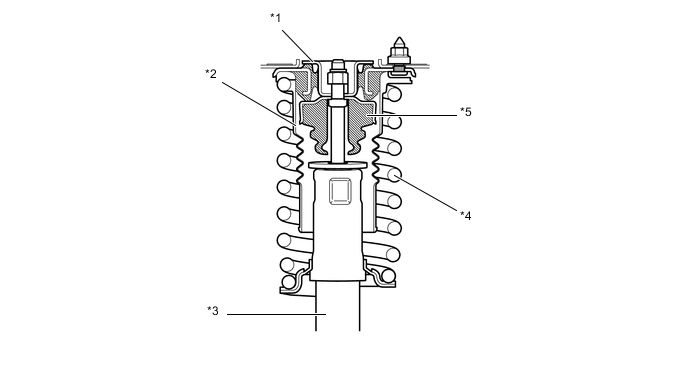
Text in Illustration *1 Front Suspension Support Sub-assembly *2 Dust Cover *3 Front Shock Absorber Assembly *4 Front Coil Spring *5 Bound Stopper - -
-
-
Shock Absorber
-
A mono-tube type shock absorber with a rebound spring is used.
-
A multi-leaf type linear control valve is used to attain linear damping force characteristics.
-
A high-pressure (N2) gas sealed type construction is used to suppress cavitation.
-
A frequency adaptive damping mechanism is used.
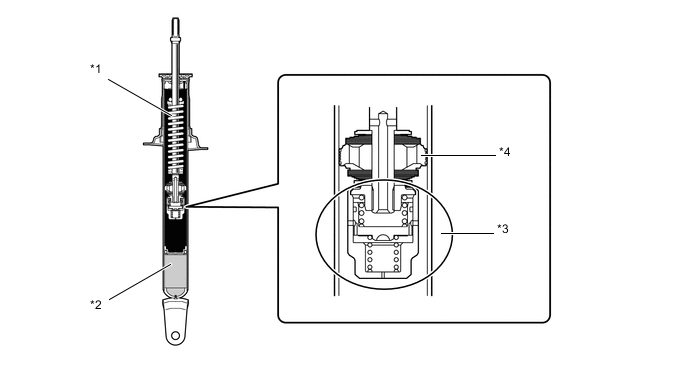
Text in Illustration *1 Rebound Spring *2 High-pressure (N2) Gas
*3 Frequency Adaptive Damping Mechanism *4 Multi-leaf Type Linear Control Valve -
Generally, the damping force of the shock absorber without an electronic control mechanism has constant characteristics (a repelling force generated in accordance with piston speed).
-
The frequency adaptive damping mechanism changes damping force characteristics in accordance with the motion of the piston, thus achieving improved ride comfort.
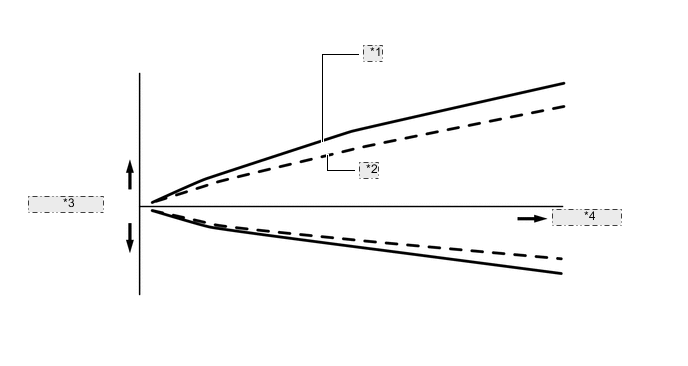
*1 Damping Force Characteristics (Low-frequency) *2 Damping Force Characteristics (High-frequency) *3 Damping Force *4 Piston Speed -
When the motion of the piston is large (low-frequency wave), a damping force is created due to the resistance generated when fluid passes through the control valve.
-
When the motion of the piston is small (high-frequency wave), the damping force is lowered by bypassing some of the fluid.
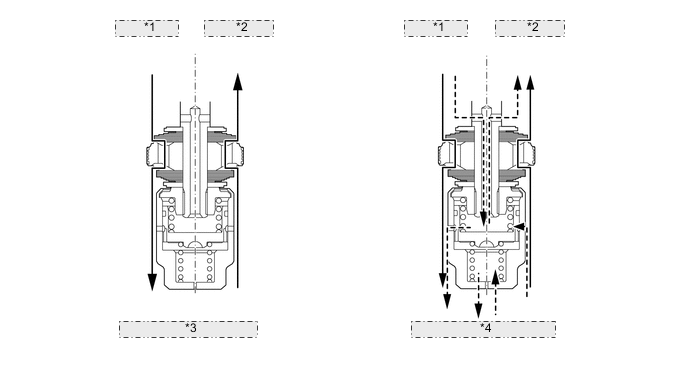
*1 Extend Side *2 Shorten Side *3 Oil Flow (Low-frequency) *4 Oil Flow (High-frequency)
-
-