BRAKE CONTROL SYSTEM
-
OUTLINE
-
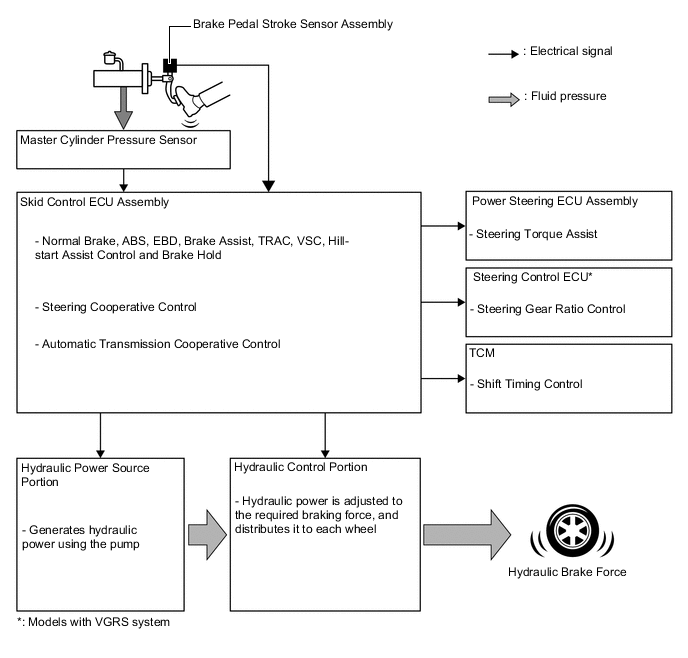
The following brake control functions are provided: Anti-lock Brake System (ABS), Electronic Brake force Distribution (EBD), brake assist, Traction Control (TRC), Vehicle Stability Control (VSC), hill-start assist control, brake hold, steering cooperative control and automatic transmission cooperative control.
-
Vehicle Dynamics Integrated Management (VDIM) is used.
-
An electronically controlled brake system is used to control the hydraulic pressure at the 4 wheels.
-
-
MAIN FEATURES
-
Vehicle Dynamics Integrated Management (VDIM)
-
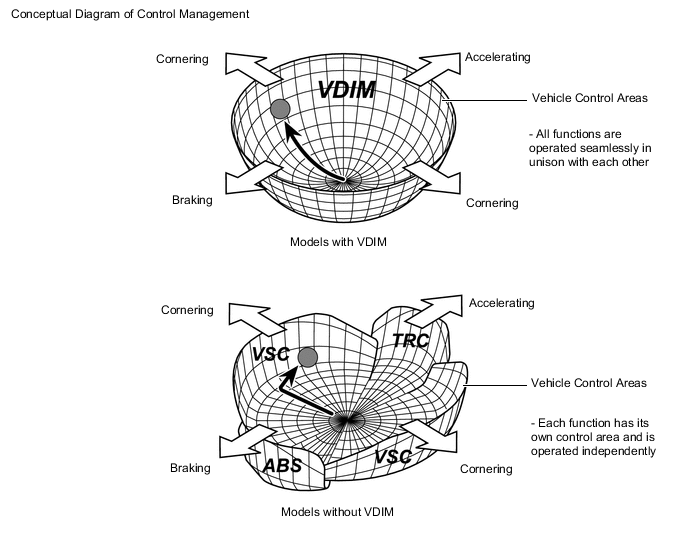
In contrast to the ABS, TRC and VSC functions that were controlled individually in the conventional brake control system, the VDIM manages these functions in the form of an integrated system.
-
Furthermore, the VDIM effects cooperative control together with the Electric Power Steering (EPS) system and Variable Gear Ratio Steering (VGRS)* in order to improve the dynamic performance of the vehicle to "run, turn, and stop".
-
*: Models with VGRS system
-
-
-
Electronically Controlled Brake System
-
In this system, the conventional brake booster portion has been discontinued. Instead, it consists of a power source and hydraulic control portions.
-
During normal braking, the fluid pressure generated by the master cylinder does not directly actuate the wheel cylinders, but serves as a hydraulic pressure signal. Instead, the actual control pressure is obtained by regulating the fluid pressure of the hydraulic power source in the brake actuator assembly, which actuates the wheel cylinders.
-
The brake control power supply assembly is used as an auxiliary power source, to supply power to the brake system in a stable manner.
-
-