PRE-COLLISION SYSTEM DETAILS
-
FUNCTION OF MAIN COMPONENTS
Item Function Combination Meter Assembly PCS Warning Light
-
Illuminates to warn the driver in accordance with signals from the driving support ECU assembly.
-
Flashes when the system is malfunctioning or temporarily disabled.
-
Illuminates when the pre-collision system is disabled using the pre-collision system switch assembly (Pre-collision system cancel switch assembly) or when pre-collision brake and pre-collision brake assist operation are disabled using the VSC OFF switch.
Multi-information Display Displays a warning message to inform or warn the driver of the system condition in accordance with signals from the driving support ECU assembly. Master Warning Light Illuminates to warn the driver in accordance with signals from the driving support ECU assembly. Buzzer Sounds to warn the driver in accordance with signals from the driving support ECU assembly when the system is malfunctioning. Millimeter Wave Radar Sensor Assembly Radiates millimeter wave radar forward, uses the reflected millimeter waves for detecting the presence of a vehicle ahead, the vehicle-to-vehicle distance, and the relative speed, and then transmits this information to the driving support ECU assembly. Driving Support ECU Assembly Determines whether the possibility of a collision is high or a collision is unavoidable based on the information received from the millimeter wave radar sensor assembly. It then outputs a brake assist standby request signal and pre-collision brake request signal if required. Brake Booster Pump Assembly Receives an operation signal from the skid control ECU and generates hydraulic pressure for brake control. Brake Booster with Master Cylinder Assembly Master Cylinder Pressure Sensor Detects the master cylinder pressure and transmits a signal to the skid control ECU. Skid Control ECU
-
Receives a brake assist standby request signal from the driving support ECU assembly and switches the brake assist to standby mode. When a stop light switch signal is input, it activates the brake assist.
-
Receives a pre-collision brake request signal from the driving support ECU assembly, and then applies the brakes.
-
Transmits vehicle speed signals to the driving support ECU assembly.
Speed Sensors Detect the wheel speed of each of the 4 wheels and transmits the signals to the skid control ECU. Airbag Sensor Assembly Yawrate Sensor Detects the yaw rate and lateral/longitudinal deceleration of the vehicle and transmits the signal to the driving support ECU assembly. Steering Sensor Detects the angle and direction of steering and transmits a signal to the driving support ECU assembly. Pre-collision System Switch Assembly (Pre-collision System Cancel Switch Assembly)
-
Switches between the 3 warning timings (Far, Middle and Near) when pressed.
-
Disables the pre-collision system when pressed and held.
Skid Control Buzzer Assembly Sounds to warn the driver in accordance with signals from the millimeter wave radar sensor assembly. Stop Light Switch Assembly Detects if the brake pedal is depressed and transmits a signal to the driving support ECU assembly. No. 1 Engine Room Relay Block and Junction Block Assembly Stop Light Control Relay Receives a stop light turn on request signal from the skid control ECU and turns on the stop lights. VSC OFF Switch Disables the pre-collision brake and pre-collision brake assist operation when the switch is turned on. -
-
OPERATING CONDITION
-
The pre-collision system operates when the driving support ECU assembly determines there is a high possibility of a collision, or an unavoidable collision with an obstacle in front of the vehicle.
Operating Conditions Pre-collision system operation has not been disabled using pre-collision system switch assembly (pre-collision system cancel switch assembly). -
The following pre-collision system controls are performed under the following conditions.
Control Condition Pre-collision Warning
-
Vehicle speed is approximately 15 km/h (10 mph) or higher.
-
The relative speed of obstacle or vehicle ahead of is approximately 10 km/h (7 mph) or higher.
-
Pre-collision system operation has not been disabled using pre-collision system switch assembly (pre-collision system cancel switch assembly).
Pre-collision Brake
-
Vehicle speed is approximately 15 km/h (10 mph) or higher.
-
The relative speed of obstacle or vehicle ahead is approximately 10 km/h (7 mph) or higher.
-
Pre-collision system operation has not been disabled using pre-collision system switch assembly (pre-collision system cancel switch assembly).
-
VSC system has not been disabled.
Pre-collision Brake Assist
-
Vehicle speed is approximately 30 km/h (19 mph) or higher.
-
The relative speed of obstacle or vehicle ahead is approximately 30 km/h (19 mph) or higher..
-
Brake pedal is depressed.
-
Pre-collision system operation has not been disabled using pre-collision system switch assembly (pre-collision system cancel switch assembly).
-
VSC system has not been disabled.
-
-
-
SYSTEM CONTROL
-
High Possibility of Collision or Unavoidable Collision
(1) The driving support ECU assembly determines that the possibility of a collision is high based on the signals received from the millimeter wave radar sensor assembly, steering sensor, speed sensor and yawrate sensor. (2) The driving support ECU assembly transmits a PCS warning display request signal to the combination meter assembly and a skid control buzzer assembly request signal to the millimeter wave radar sensor assembly. (3) The driving support ECU assembly outputs a pre-collision brake assist request signal to the skid control ECU. Upon receiving this signal, the skid control ECU switches the brake assist to the standby condition. At this time, the skid control ECU activates pre-collision brake assist when the brake pedal is depressed by the driver. (4) The driving support ECU assembly determines that an unavoidable collision condition exists based on the signals received from the millimeter wave radar sensor assembly, speed sensor, steering sensor and yawrate sensor. (5) The driving support ECU assembly outputs a pre-collision brake request signal to the skid control ECU. (6) The skid control ECU decreases the vehicle speed by activating the brake booster pump assembly to perform a pre-collision brake operation and activates the stop light control relay to turn on the stop lights. (7) If no collision occurs, the brake assist will return to its normal state. 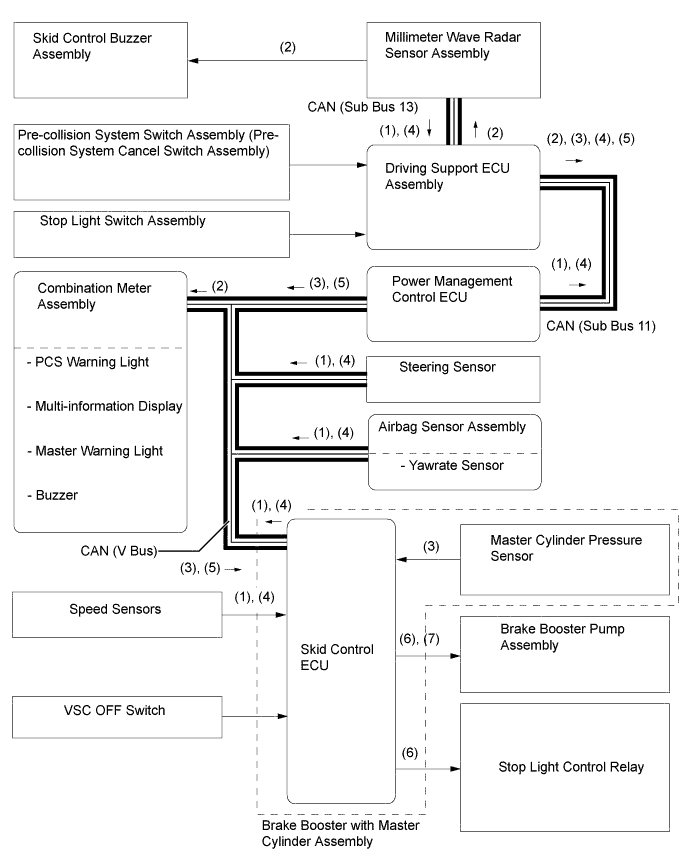
-
-
FUNCTION
-
Warning Indication
-
The combination meter assembly uses the multi-information display, master warning light, PCS warning light and multi buzzer to provide the driver with pre-collision system warnings and indications.
-
If the driving support ECU assembly determines that the possibility of a collision is high, it sends a signal to the combination meter assembly. Upon receiving this signal, the combination meter assembly indicates a warning using the multi-information display, PCS warning light and skid control buzzer assembly. Details are indicated below.
When there is a high possibility of a collision Multi-information Display PCS Warning Light Skid Control Buzzer Assembly BRAKE ! - Sounds Continuously -
When the system is not available, the following warning occurs to warn the driver.
When a system malfunction is detected Multi-information Display Detail Master Warning Light PCS Warning Light Buzzer DTC Check
Pre-Collision System
This message appears when the driving support ECU assembly detects a system malfunction. Illuminates Flashes Sounds once Repair is required
Corresponding DTCs are stored
Pre-Collision System Temporarily
not available
-
This message appears when the driving support ECU assembly determines either of the following conditions is present:
-
Dirty millimeter wave radar sensor assembly
-
Poor weather conditions
After these conditions have been resolved, the system will operate normally.
- Flashes - - When the pre-collision system has been disabled using the pre-collision system switch assembly (Pre-collision system cancel switch assembly) Multi-information Display Detail Master Warning Light PCS Warning Light Buzzer Pre-Collision System Turned Off
-
This message appears for 6 seconds on the multi-information display.
-
The pre-collision system has been disabled. If the switch is pressed again, the system will resume.
- Illuminates - When the VSC OFF switch is pressed Multi-information Display Detail Master Warning Light PCS Warning Light Buzzer Pre-Collision Brake is Disabled Due to VSC Off
-
This message appears for 6 seconds on the multi-information display.
-
Pre-collision brake and pre-collision brake assist operation is disabled (the warning for when there is a high possibility of a collision is still enabled).
- Illuminates - -
-
-
-
CONSTRUCTION
-
Millimeter Wave Radar Sensor Assembly
-
The millimeter wave radar sensor assembly consists of a millimeter wave radar circuit, signal processing circuit and CPU.
-
The millimeter wave radar outputs waves when the vehicle speed is 2 km/h (1.2 mph) or more, and not when the vehicle speed is lower than 2 km/h (1.2 mph). The millimeter wave radar uses frequencies in the 76.5 GHz band.
-
The reception antennas receive the millimeter wave radar waves that have been reflected.
-
The signal processing circuit detects the distance, relative speed, and the direction of the object by generating millimeter wave radar waves and calculating the signals received by the reception antennas. Then, it transmits this information to the driving support ECU assembly.
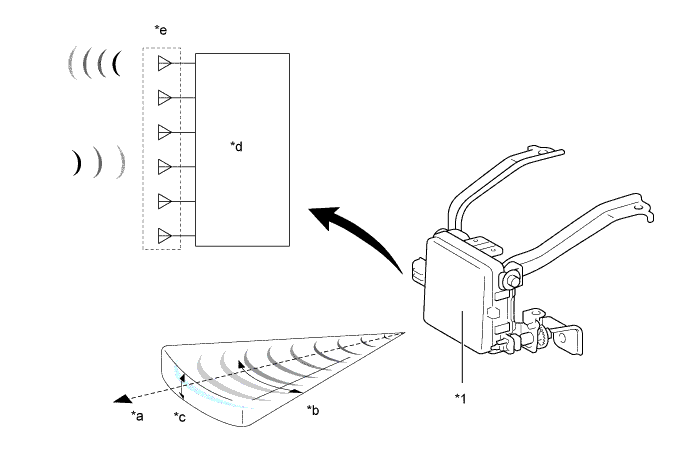
Text in Illustration *1 Millimeter Wave Radar Sensor Assembly - - *a Detection Distance: Approximately 150 m (490 ft.) *b Horizontal Angle: Approximately 20° *c Vertical Angle: Approximately 4° *d Signal Processing Circuit *e Millimeter Wave Radar Circuit - - -
The distance to the object, azimuth and relative speed are calculated from the information that is provided by the reflected millimeter wave radar as described below.
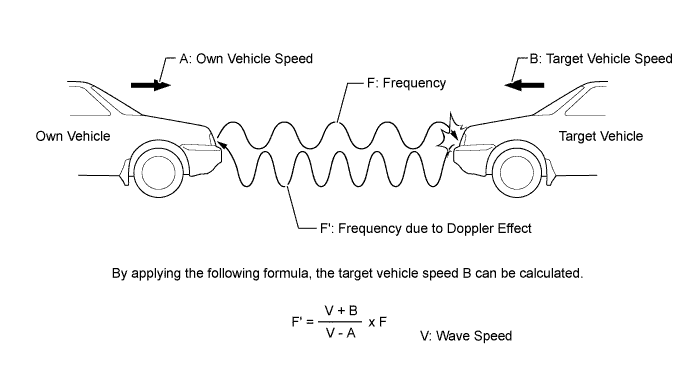
Item Calculation Method Distance Calculated from the length of time that has elapsed from the time the waves of the millimeter wave radar have been emitted, until the waves reflected by the millimeter wave radar are received. The detection distance is approximately 150 m (490 ft.). Azimuth Calculated from the angle of the waves reflected by the millimeter wave radar that have been received. The detection angle has a horizontal angle of approximately 20° and a vertical angle of approximately 4°. Relative Speed Calculated by utilizing the changes (Doppler effect*) that occur in the frequencies of the reflected millimeter wave radar waves. Tech Tips
*: The Doppler effect causes the observer to perceive the radio waves emitted by a moving object to be a higher frequency as it approaches, and to be a lower frequency as it recedes. This phenomenon is created because when an object is located far away, the radio waves are perceived at higher frequency than those of the radio source.
Tech Tips
-
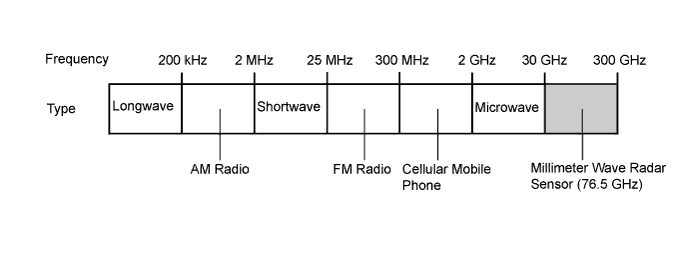
Millimeter wave radar uses an extremely high frequency band between 30 GHz and 300 GHz, with an extremely short wavelength between 1 and 10 mm (0.04 to 0.40 in.) in a vacuum. The millimeter wave radar sensor of the pre-collision system uses frequencies in the 76.5 GHz band.
-
Millimeter wave radar is less affected by weather conditions such as rain, fog, or snow, and provides excellent characteristics for recognizing objects. Therefore, it is well suited to the pre-collision system and the dynamic radar cruise control system.
-
An SST is used if radar axis adjustment is needed. For details, refer to the Repair Manual.
-
-
-
-
OPERATION
-
Pre-collision System Switch Assembly (Pre-collision system cancel switch assembly)
-
A pre-collision system cancel switch (pre-collision system cancel switch assembly) is provided to disable the system. When pressed and held for approximately 3 seconds, the pre-collision system will be disabled. A message will be displayed for 6 seconds and the pre-collision warning light will be illuminated. When the switch is pressed again while the system is disabled, the system will be reenabled.
-
The switch is also used to change the warning timing in 3 levels: far, mid, near. The warning timing changes in the order below each time the switch is pressed.
-
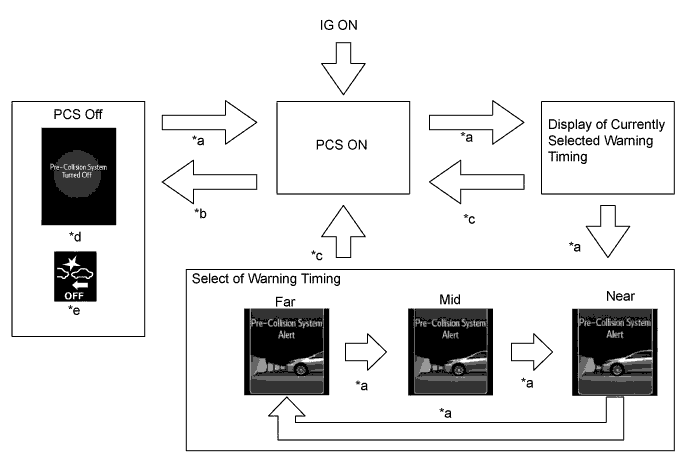
Text in Illustration *a Pre-collision system switch is pressed briefly *b Pre-collision system switch is pressed and held for 3 seconds *c Returns to previous screen when the switch is not operated for 6 seconds *d Displayed for 6 seconds *e Illuminated - - -
-
DIAGNOSIS
-
Initial Check
-
The driving support ECU assembly performs an initial check on the system for approximately 3 seconds after the power switch has been turned on (IG).
-
-
Monitor Function
-
After completing the initial check, the pre-collision system becomes ready to operate. During this time, the driving support ECU assembly periodically monitors the system for any malfunctions.
-
-
Diagnostic Trouble Code (DTC)
-
If the driving support ECU assembly detects a malfunction in the pre-collision system, it stores a 5 digit Diagnostic Trouble Code (DTC) in memory.
-
-