PRE-CRASH SAFETY SYSTEM (RADAR TYPE)
-
General
-
The pre-crash safety system (radar type) retracts the slack in the front seat belts. Then, the system sets the brake control system in the brake assist standby mode below are present before a collision. This dampen the impact of a collision.
System Operation Operating Condition Pre-crash Safety Operation A collision with an obstacle in front of the vehicle or a collision with the vehicle ahead is determined to be unavoidable. Sudden Braking Operation The sudden braking operation and serious vehicle skid operation are the same as in the pre-crash safety system. Serious Vehicle Skid Operation -
The millimeter wave radar sensor and distance control ECU determine whether a collision with an obstacle in front of the vehicle or a collision with the vehicle ahead is unavoidable.
-
The millimeter wave radar sensor and distance control ECU make this determination based on the vehicle speed relative to the speed of an oncoming vehicle or based on the speed with which an object is being approached.
-
The skid control ECU determines emergency braking, front wheel skid tendency and rear wheel skid tendency.
Figure 1. Unavoidable Collision Judgment
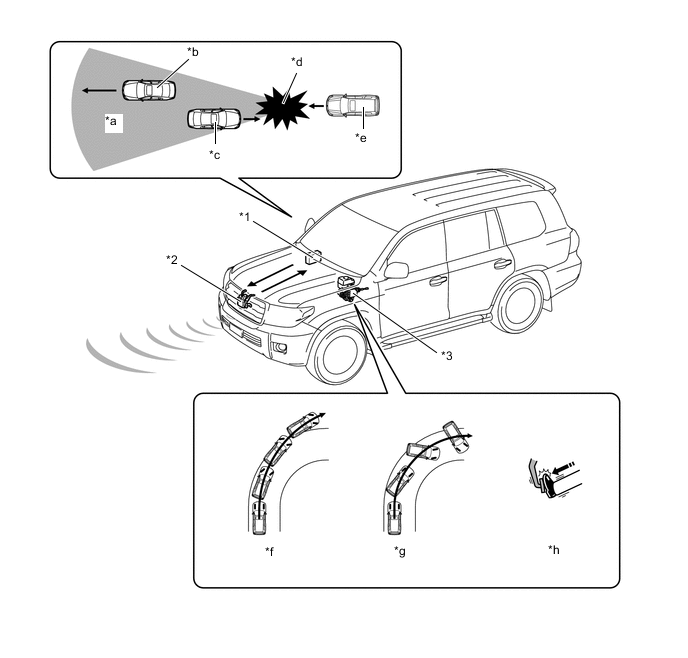
*a Radar Detection Area *b Vehicle Ahead *c Oncoming Vehicle *d Collision Unavoidable *e Own Vehicle *f Front Wheel Skid Tendency *g Rear Wheel Skid Tendency *h Brakes Suddenly Applied *1 Distance Control ECU *2 Front Millimeter Wave Radar Sensor *3 Skid Control ECU - - -
The pre-crash safety system will not operate under the following conditions:
Non-operating Condition
-
Oncoming vehicle relative speed is approx. 30 km/h (20 mph) or less.
-
The vehicle speed is approx. 30 km/h (20 mph) or less (for a sudden braking operation and a front or rear wheel skid tendency operation).
-
The vehicle speed is approx. 30 km/h (20 mph) or less (for a sudden braking operation and a front or rear wheel skid tendency operation).
-
The seat belt is not buckled.
-
Collision objects cannot be detected by the millimeter wave radar sensor:
-
Objects that cannot be detected: plastic items (safety cones, etc.), etc.
-
Objects that cannot be detected in a stable manner: people, bicycles, motorcycles, trees, animals, snow fence, etc.
-
The engine switch is off or on (ACC).
-
The multi-information display in the combination meter displays "CHECK PCS SYSTEM" and "PCS TEMPORARILY NOT AVAILABLE" warning messages.
-
The vehicle collides with an object located outside the detection area of the millimeter wave radar sensor.
-
-
-
REFERENCE
-
Millimeter Wave Radar
-
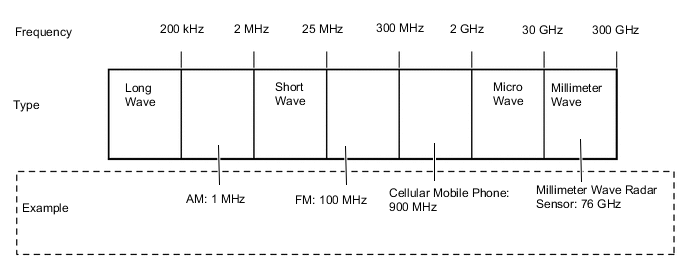
The millimeter wave radar uses an extremely high frequency band between 30 GHz and 300 GHz, with an extremely short wavelength between 1 and 10 mm (0.04 and 0.40 in.) in a vacuum. The millimeter wave radar sensor of the pre-crash safety system uses frequencies in the 76 GHz band.
-
The millimeter wave radar is less affected by weather conditions such as rain, fog or snow, and provides excellent characteristics for recognizing objects. Therefore, the millimeter wave radar is well suited to the pre-crash safety system and the dynamic radar cruise control system.
Figure 2. Main Wave Types and Frequencies
-
-