1UR-FE ENGINE
-
General
-
A linkless-type throttle body is used to achieve excellent throttle control.
-
The Electronic Throttle Control System-intelligent (ETCS-i) is used to ensure excellent throttle control in all operating ranges.
-
The Acoustic Control Induction System (ACIS) is used to improve the engine performance in all speed ranges.
-
A plastic intake manifold is used.
-
A cyclone pre-cleaner is used.:*
-
*: Models with pre-cleaner
-
-
Stainless steel exhaust manifolds and exhaust pipes are used.
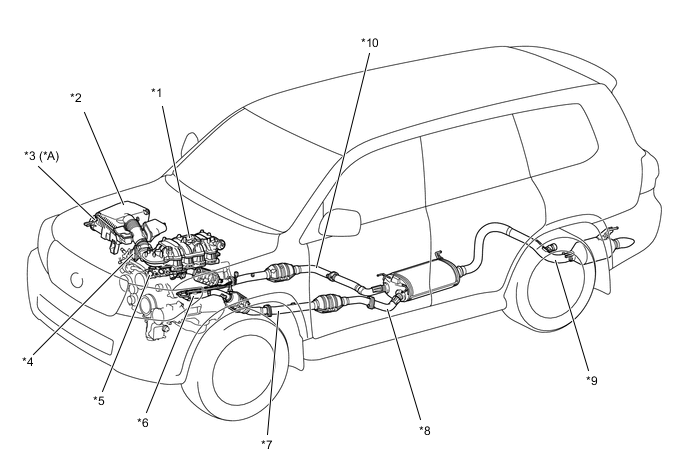
*A Models with Pre-cleaner - - *1 Intake Manifold *2 Air Cleaner Assembly *3 Pre-cleaner *4 Throttle Body *5 Exhaust Manifold Sub-assembly RH *6 Exhaust Manifold Sub-assembly LH *7 Front Exhaust Pipe Assembly LH *8 Center Exhaust Pipe Assembly *9 Tail Exhaust Pipe Assembly *10 Front Exhaust Pipe Assembly RH
-
-
Air Cleaner
-
A nonwoven, full-fabric type air cleaner element is used.
-
A cyclone pre-cleaner has been provided in the air cleaner case.* This cyclone pre-cleaner has a screw shape (turbinated blade) and gathers large dust particles in a dust cup by swirling the inlet air. The dust cup is removable from the inside of the air cleaner case, so the dust gathered can be disposed.
-
*: Models with pre-cleaner
-
-
A rear duct is provided for the air cleaner inlet, thus enhancing anti-dust performance while keeping engine performance.
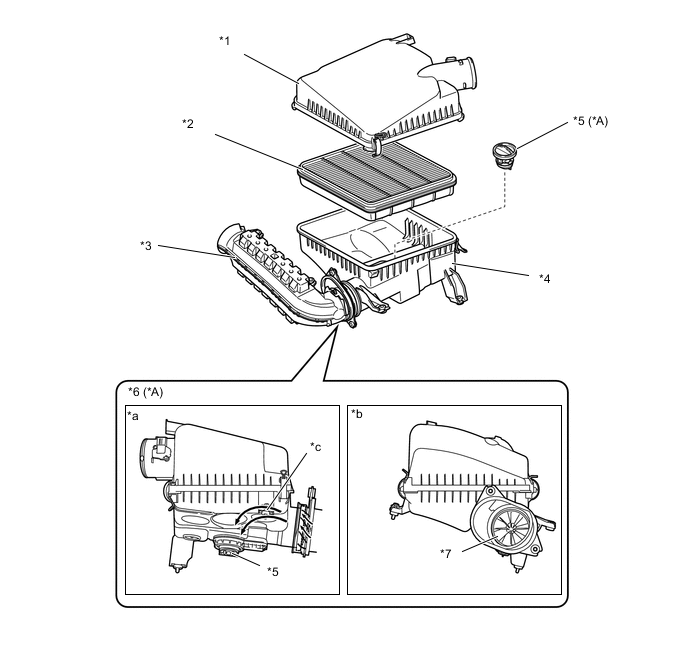
*A Models with Pre-cleaner - - *1 Air Cleaner Cap *2 Air Cleaner Filter Element *3 Air Cleaner Inlet *4 Air Cleaner Case *5 Dust Cup *6 Cyclone Pre-cleaner *7 Turbinated Blade - - *a Rear View *b Side View *c Swirl Air Flow - -
-
-
Throttle Body
-
A linkless-type throttle body in which the throttle position sensor and the throttle control motor are integrated is used to achieve excellent throttle valve control.
-
For a throttle control motor, a DC motor with excellent response and minimal power consumption is used. The ECM performs duty cycle control of the direction and the amperage of the current that is supplied to the throttle control motor in order to regulate the throttle valve angle.
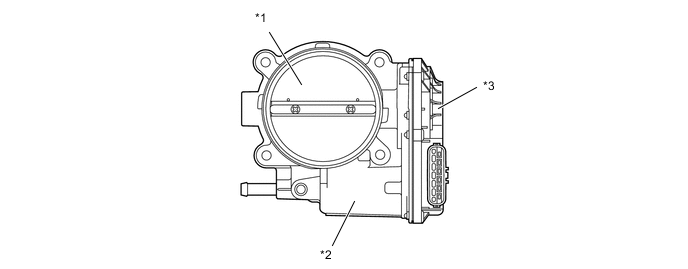
*1 Throttle Valve *2 Throttle Control Motor *3 Throttle Position Sensor Portion - -
-
-
Intake Manifold
-
An intake manifold with a built-in plastic intake air surge tank is used for weight reduction.
-
The port diameter and length have been optimized to achieve high torque in all driving ranges.
-
The intake manifold contains valves for the Acoustic Control Induction System (ACIS), and the actuator is laser-welded to the intake manifold.
-
The intake air control valve and ACIS actuator are integrated with the intake manifold. This valve opens and closes to change the effective length of the intake manifold in 2 stages.
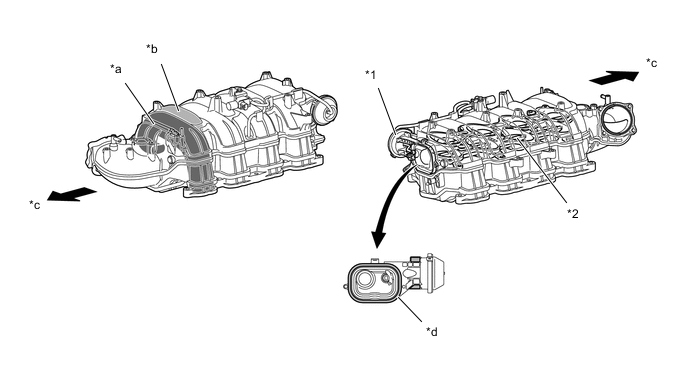
*1 ACIS Actuator *2 Intake Air Control Valve *a Left Bank Passage *b Right Bank Passage *c Front *d Laser-welding Tech Tips
Laser-welding:In laser-welding, a laser-absorbing material (for the intake manifold) is joined to a laser-transmitting material (for the ACIS actuator). Laser beams are then irradiated from the laser-transmitting side. The beams penetrate the laser-transmitting material to heat and melt the surface of the laser-absorbing material. Then, the heat of the laser-absorbing material melts the laser-transmitting material and causes both materials to become welded.
-
-
Exhaust Manifold
-
A stainless steel exhaust manifold is used for weight reduction and rust resistance.
-
A ceramic type Three-Way Catalytic converter (TWC) is provided in each exhaust manifold for the right bank and the left bank. The exhaust emission performance of the engine is improved as a result of these TWCs.
-
The exhaust manifold heat insulator is made of corrugated aluminum. This ensures rigidity, and at the same time, increases the surface area to improve heat dissipation. Furthermore, a floating construction is used at the tightened area to reduce the transfer of heat and vibration to the heat insulator and to improve reliability.
-
Along with the use of the air injection control, air injection pipes are provided for the right and left bank exhaust manifolds.
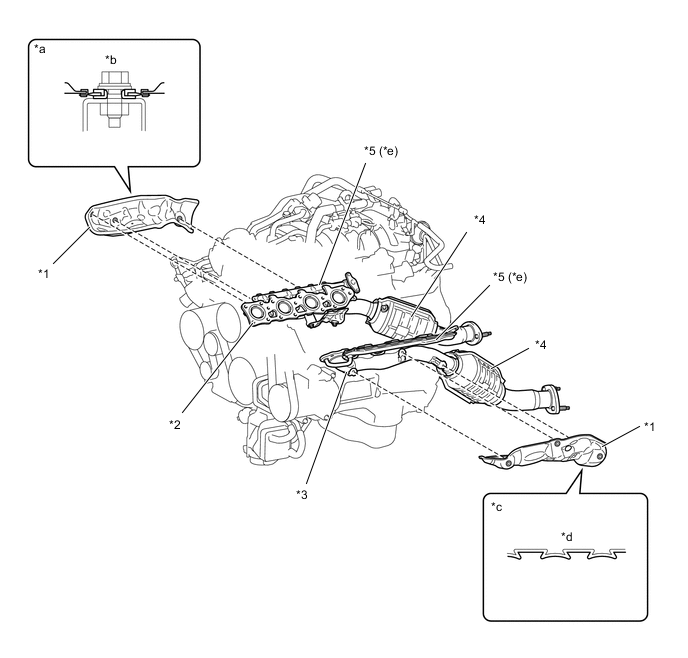
*1 Heat Insulator *2 Exhaust Manifold Sub-assembly RH *3 Exhaust Manifold Sub-assembly LH *4 TWC *5 Air Injection Pipe - - *a Heat Insulator Tightened Area Cross Section *b Floating Construction *c Heat Insulator Cross Section *d Corrugated *e Models with Air Injection Control - -
-
-
Exhaust Pipe
-
General
-
The exhaust pipes are made of stainless steel to reduce their weight and improve rust resistance.
-
A 2-way exhaust control system is provided in the main muffler.
-
A ceramic type TWC is provided in each front exhaust pipe for the right bank and the left bank.* As a result, exhaust emission performance of the engine is improved.
-
*: Models with TWC in the front exhaust pipe
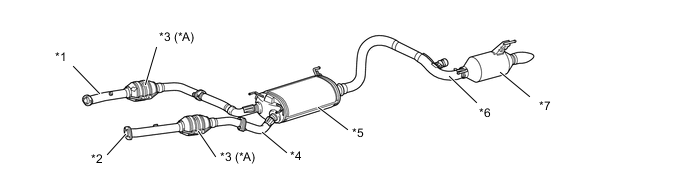
*A Models with TWC in the Front Exhaust Pipe - - *1 Front Exhaust Pipe Assembly RH *2 Front Exhaust Pipe Assembly LH *3 TWC *4 Center Exhaust Pipe Assembly *5 Main Muffler *6 Tail Exhaust Pipe Assembly *7 Sub Muffler - - -
-
-
2-way Exhaust Control System
-
General
-
The 2-way exhaust control system reduces the back pressure by opening and closing a control valve that is enclosed in the main muffler, thus varying the exhaust gas pressure.
-
The control valve opens steplessly in accordance with the operating condition of the engine, thus enabling a quieter operation at lower engine speeds and reducing back pressure at higher engine speeds.
-
When the exhaust gas pressure overcomes the spring force of the control valve, the control valve opens steplessly in accordance with the exhaust gas pressure.
-
-
Operation
-
When Control Valves are Closed (Low Engine Speed)
-
Since the pressure in the muffler is low, the control valves are closed. Hence exhaust gas does not pass the bypass passage, and exhaust noise is decreased in the muffler.
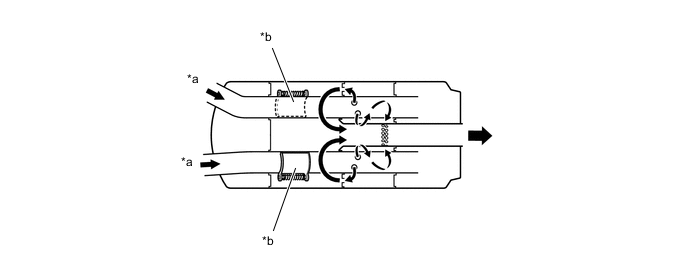
*a Exhaust Gas *b Control Valve Closed -
When Control Valves are Open (Middle to High Engine Speed)
-
The valves open as the engine speed and the back pressure in the muffler increase. This allows a large volume of exhaust gas to pass through the bypass passage, thereby substantially decreasing the back pressure.
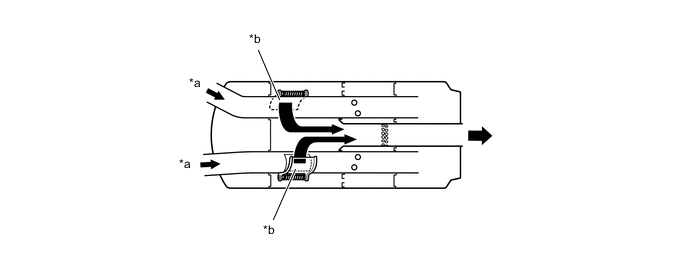
*a Exhaust Gas *b Control Valve Open
-
-
-