1UR-FE ENGINE
-
General
-
Each cylinder of this engine has 2 intake valves and 2 exhaust valves. Intake and exhaust efficiency is increased due to the larger total port areas.
-
This engine uses valve rocker arm sub-assemblies with the built-in needle bearings. This reduces the friction that occurs between the cams and the valve rocker arm sub-assemblies that push the valves down, thus improving fuel economy.
-
Valve lash adjuster assemblies, which maintain a constant zero valve clearance through the use of oil pressure and spring force, are used.
-
To ensure highly accurate valve timing, separate primary timing chains are driven by the crankshaft in order to rotate the intake camshafts of the left and right banks. The exhaust camshafts are driven by the intake camshaft of the respective bank via the secondary timing chains.
-
This engine has a Dual Variable Valve Timing-intelligent (VVT-i) system which controls the intake and exhaust camshafts to provide optimal valve timing in accordance with driving conditions. By using this system, lower fuel consumption, higher engine performance, and reduced exhaust emissions have been achieved.

*1 Secondary Timing Chain *2 Primary Timing Chain *3 Exhaust Camshaft *4 Intake Camshaft *5 Valve Rocker Arm Sub-assembly *6 Valve Spring Retainer *7 Valve *8 Valve Spring Seat *9 Valve Guide Bush *10 Compression Spring *11 Valve Lash Adjuster Assembly - -
-
-
Camshaft
-
The camshafts are made of cast iron alloy.
-
Oil passages are provided in the intake and exhaust camshafts in order to supply engine oil to the VVT-i system.
-
Camshaft timing gear assemblies are installed on the front of the intake and exhaust camshafts to vary the timing of the intake and exhaust valves.
-
Together with the use of the valve rocker arm sub-assemblies, the cam profile has been optimized. This results in increased valve lift when the valve begins to open and as it finishes closing, helping to achieve enhanced output performance.
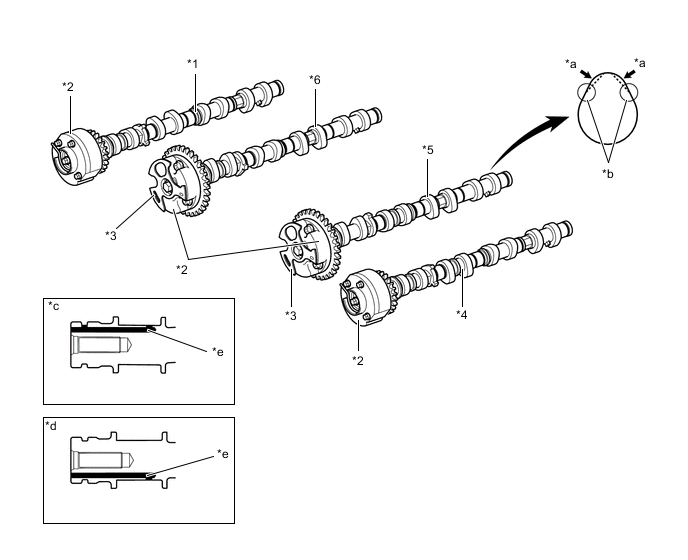
*1 No. 2 Camshaft (Exhaust) *2 Camshaft Timing Gear Assembly *3 Timing Rotor *4 No. 4 Camshaft (Exhaust) *5 No. 3 Camshaft (Intake) *6 No. 1 Camshaft (Intake) *a Increased Valve Lift *b Optimized Profile of Camshaft Lobe *c Cross Section of End of Intake Camshaft *d Cross Section of End of Exhaust Camshaft *e Oil Passage - -
-
-
Timing Chain and Chain Tensioner
-
Both the primary and secondary timing chains use roller chains with a pitch of 9.525 mm (0.375 in.).
-
A timing chain tensioner is provided for each primary timing chain and secondary timing chain on each bank.
-
Both the primary and secondary chain tensioners use a spring and oil pressure to maintain proper chain tension at all times. The tensioners suppress noise generated by the timing chains.
-
The chain tensioner for the primary timing chain is a ratchet type with a non-return mechanism. Furthermore, an oil pocket creates oil pressure when the engine is started, and simultaneously applies oil pressure to the chain tensioner. This prevents the timing chain from flapping and reduces noise.
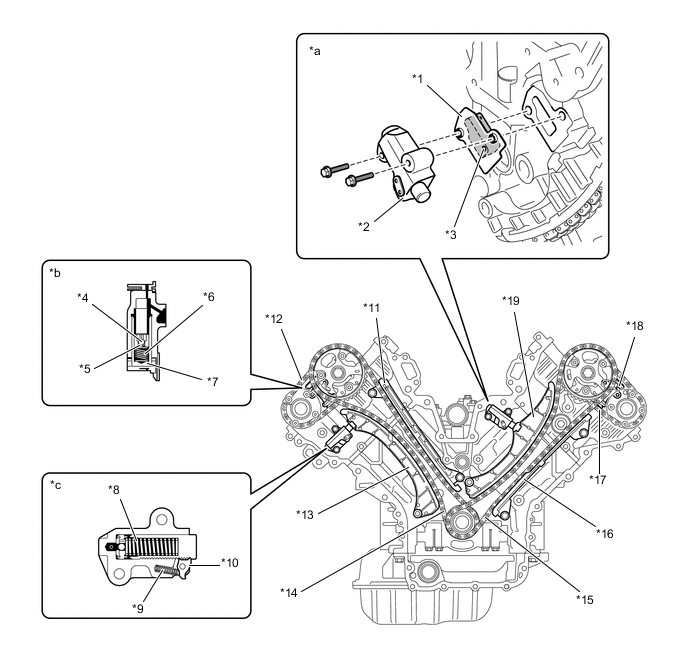
*1 Gasket *2 Chain Tensioner (Primary) *3 Oil Pocket *4 Ball *5 Ball Spring *6 Main Spring *7 Plunger *8 Spring *9 Cam Spring *10 Cam *11 Chain Damper *12 Secondary Timing Chain RH *13 Chain Slipper *14 Primary Timing Chain RH *15 Primary Timing Chain LH *16 Chain Damper *17 Secondary Chain LH *18 Secondary Chain Tensioner *19 Chain Slipper - - *a Chain Tensioner (Primary) LH Side *b Chain Tensioner (Secondary) RH Side *c Chain Tensioner (Primary) RH Side - -
-
-
Timing Chain Cover
-
The timing chain cover has an integrated construction consisting of a cooling system (water pump and water passage) and a lubrication system (oil pump and oil passage). Thus, the number of parts has been reduced to reduce weight.
-
A chain oil jet is provided in the oil pump cover to lubricate the timing chains.

*1 Water Pump *2 Water Pump Gasket *3 Timing Chain Cover *4 Oil Pump Cover *5 Oil Jet *6 Oil Pump Rotor *a Front Side View *b Back Side View *c Water Pump Swirl Chamber *d Oil Pump Chamber
-
-
Hydraulic Lash Adjuster
-
The valve lash adjuster assemblies, which are located at the fulcrum (pivot point) of the valve rocker arm sub-assemblies, each consist primarily of a plunger, plunger spring, check ball, and check ball spring.
-
The engine oil that is supplied from the cylinder head and the built-in spring actuate the valve lash adjuster assembly. The oil pressure and the spring force that act on the plunger push the valve rocker arm sub-assembly against the cam, in order to adjust the clearance between the valve stem and rocker arm. This prevents the generation of noise during the opening and closing of the valves. As a result, engine noise is reduced.
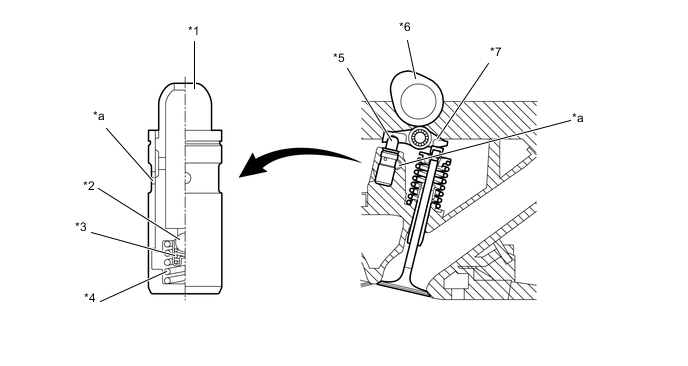
*1 Plunger *2 Check Ball *3 Check Ball Spring *4 Plunger Spring *5 Valve Lash Adjuster Assembly *6 Cam *7 Valve Rocker Arm Sub-assembly - - *a Oil Passage - - Tech Tips
Valve clearance adjustment is not necessary because hydraulic lash adjusters are used on this model.
-