EMISSION CONTROL SYSTEM
-
FUNCTION OF MAIN COMPONENTS
-
The main components of the emission control system are as follows:
Component Function Exhaust Emission Control System ECM Determines an optimal fuel injection volume based on the signals from various sensors. TWC Reduces CO, HC and NOx in the exhaust gas. Heated Oxygen Sensor Detects the oxygen concentration in the exhaust emissions by measuring the electromotive force generated in the sensor itself. For details, see the 2ZR-FAE Engine Control. Air Fuel Ratio Sensor Evaporative Emission Control System ECM Sends signals to the No. 1 vacuum switching valve assembly (VSV for EVAP) to control the purge flow. E.F.I. Vacuum Sensor Assembly Detects the intake manifold pressure. For details, see the 2ZR-FAE Engine Control. Charcoal Canister Contains activated charcoal to absorb the fuel vapor created in the fuel tank assembly. No. 1 Vacuum Switching Valve Assembly (VSV for EVAP) Opens in accordance with the signals from the ECM when the system is purging, in order to send the fuel vapor that was absorbed by the charcoal canister assembly into the intake manifold.
-
-
CONSTRUCTION
-
Three-Way Catalytic converter (TWC)
-
2 TWCs have been provided for the front exhaust pipe assembly.
-
Ultra thin-wall, high-cell density ceramic type TWCs are used.
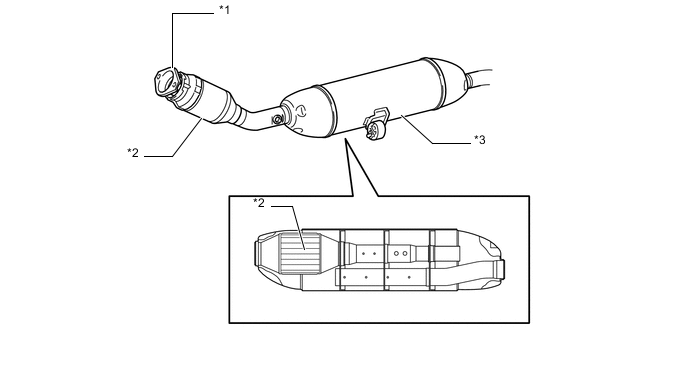
Text in Illustration *1 Front Exhaust Pipe Assembly *2 TWC *3 Main Muffler with TWC - -
-
-
Charcoal Canister
-
The charcoal canister is integrated into the fuel suction with pump and gauge tube assembly.
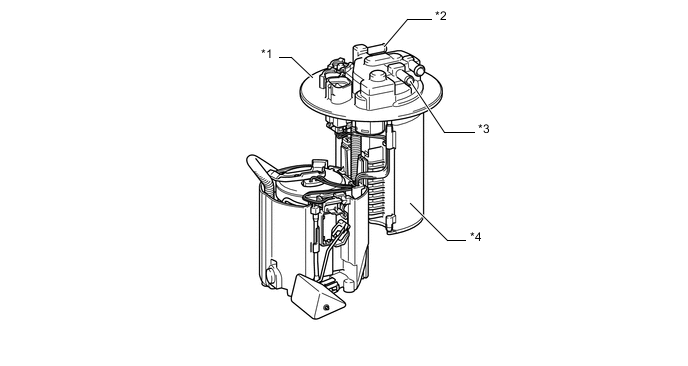
Text in Illustration *1 Suction with Pump and Gauge Tube Assembly *2 Purge Port (to Intake Manifold) *3 Fresh Air Port *4 Charcoal Canister
-
-
-
OPERATION
-
Evaporative Emission Control System
-
Based on the signals from various sensors, the ECM opens and closes the No. 1 vacuum switching valve assembly (VSV for EVAP). Thus, it controls the purge flow of evaporative emissions (HC) in the charcoal canister in accordance with the engine conditions.
-
-