REAR BRAKE
-
CONSTRUCTION
-
Built-in Type Disc Brake
-
The rear disk brake caliper assembly is comprised of a cylinder, piston assembly and actuator assembly, and has a built-in parking mechanism.
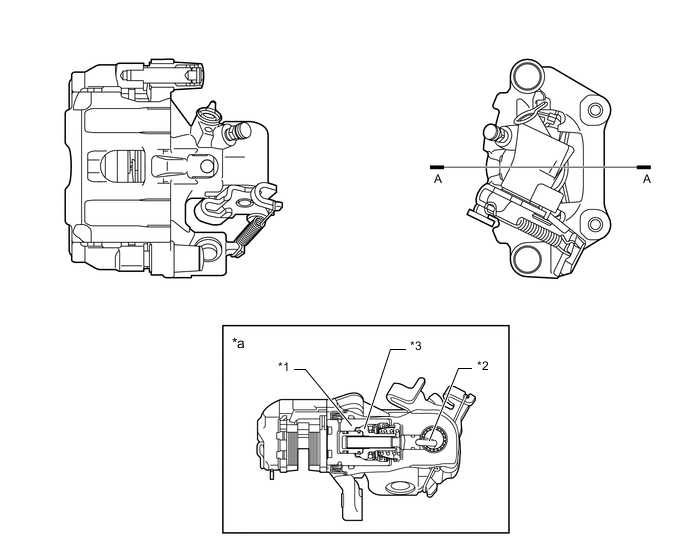
Text in Illustration *1 Piston Assembly *2 Actuator Assembly *3 Cylinder - - *a A-A Cross Section - -
-
-
-
OPERATION
-
Built-in Type Disc Brake
-
Operating the parking brake lever causes the actuating shaft to rotate. The push rod coupled with the actuating shaft will convert the actuating shaft motion into axial sliding movement. The converted sliding movement will be transmitted to the piston via the spindle, and the adjusting nut will push out the brake pad to generate the braking force. When the parking brake is released, the return spring will move back to the original position, and the sealing ring will return the piston to the original state.
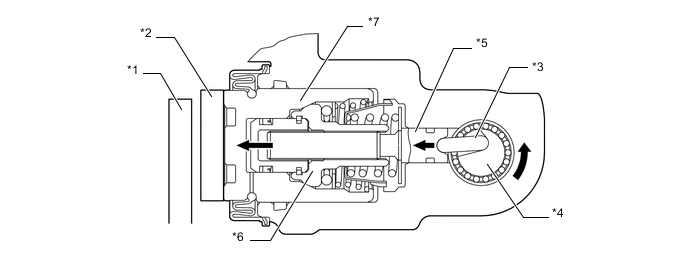
Text in Illustration *1 Disc Rotor *2 Disc Pad *3 Push Rod *4 Actuating Shaft *5 Spindle *6 Adjusting Nut *7 Piston - - -
When the brake pad has worn and the clearance between the disc pad and disc rotor has reached a predetermined level, depressing the brake pedal will activate the automatic adjustment that harnesses the hydraulic pressure.
-
The piston continues sliding until the disc pad comes into contact with the disc rotor, providing the clearance between the piston and adjusting nut. At this time, the adjusting nut starts revolving and moves itself axially until it comes into contact with the piston, adjusting the clearance between the pad and rotor.
-
However, when the hydraulic pressure rises further, the adjusting nut will stop revolving and the push rod will push the spring down. As a result, over adjustment is precluded by the push rod that slides together with the piston, and the correct clearance will be maintained between the disc pad and disc rotor.
-
-