STOP AND START
-
OUTLINE
-
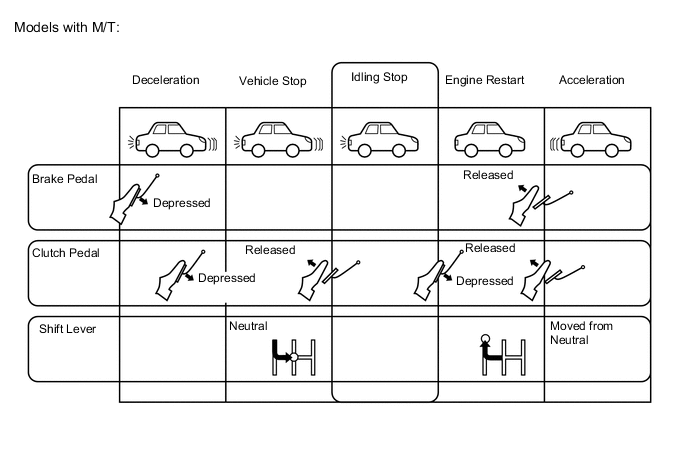
To achieve low emissions and enhanced fuel economy, stop and start system has been developed.
-
The stop and start system automatically stops the engine when the vehicle comes to a stop, such as when the vehicle stops at a red traffic light. When starting off, the engine is automatically restarted without requiring extra activity from the driver.
-
Models with CVT
-
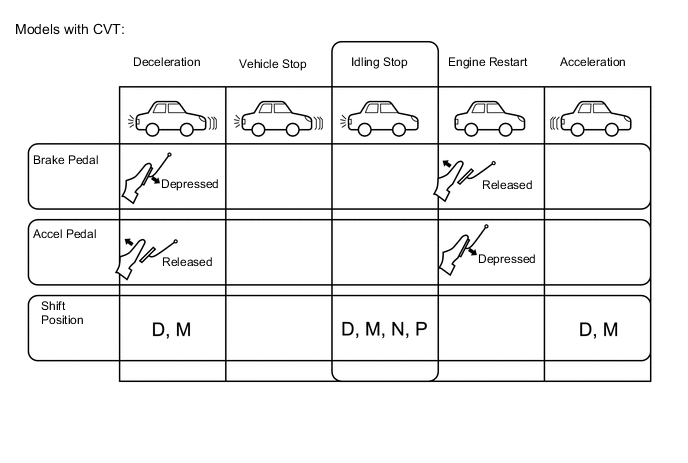
When the shift position is in the D or M positions and the driver moves their foot off of the brake pedal, electricity is supplied from the battery to the starter assembly and the engine starts.
-
When the shift position in P or N and the brake pedal remains depressed, if the shift position is shifted to a position other than P or N, the engine starts.
-
While the engine is stopped, depressing the accelerator pedal will start the engine.
-
-
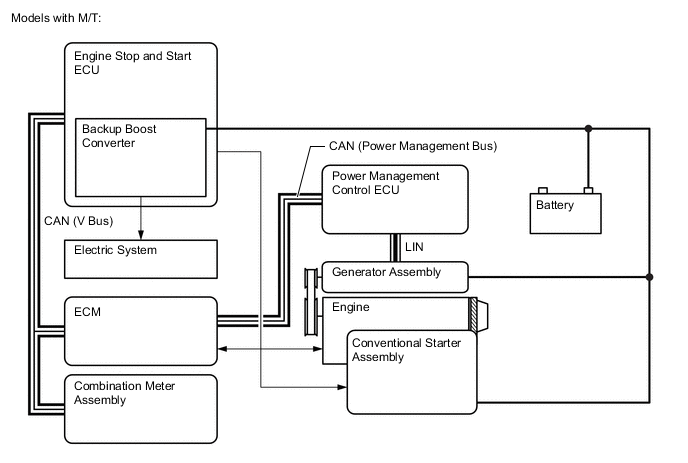
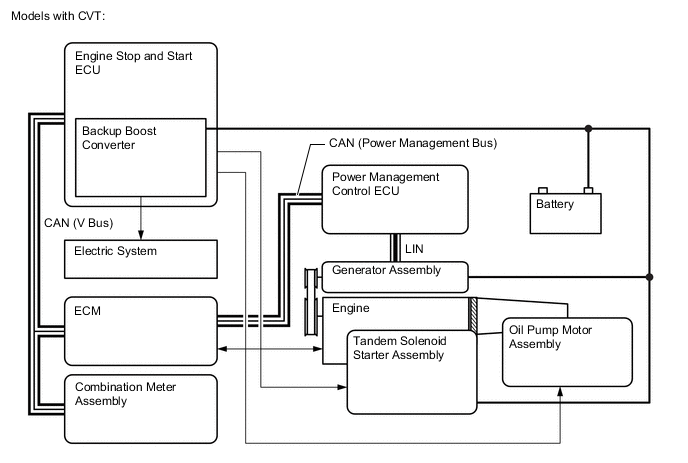
The stop and start system consists of an engine stop and start ECU with a built-in backup boost converter and a conventional starter assembly*1 or tandem solenoid starter assembly*2.
-
*1: Models with M/T
-
*2: Models with CVT
-
-
Tandem solenoid starter assembly equips with a pinion push out solenoid (SL1) and a motor drive solenoid (SL2) separately so that the pinion can engage with the ring gear even if the engine is rotating by its inertia before fully stopping.
-
Electric oil pump motor assembly is used for models with CVT. Therefore, the vehicle can hold CVT oil pressure while idle stop.
-
Based on signals from various sensors, switches, and the ECM, the engine stop and start ECU controls the stopping and starting of the engine.
-
When the engine is stopped, the ECM stores the crankshaft angle. This is used to determine which cylinder to inject fuel into and ignite the next time the engine is restarted. This shortens amount of the time necessary to restart the engine. (Models with 1KR-FE and 1NR-FE Engine)
-
The stopping position control have been provided for the models with 1NR-FE engines. While the engine stopping operation is performed, the ECM uses ignition timing and generator assembly load torque to control the crankshaft position at the time when the engine is stopped. The ECM always positions the crankshaft at the optimal position. This shortens the time necessary to start the engine. (Models with 1KR-FE and 1NR-FE Engine)
-
The hill-start assist function have been provided for the models with CVT. The skid control ECU controls the hill-start assist function according to the signals from the engine stop and start ECU.
-
The oil pump motor assembly control have been provided for the models with CVT. Because the engine stop and start ECU operates the oil pump motor assembly at the time of idle stop, the CVT oil pressure is secured, enabling smooth vehicle start. For details, see the CVT System in the K411 Multidrive / CVT section.
-
To allow management of the lifespan of the starter, the engine stop and start ECU counts the number of times the starter operates. If the number exceeds a threshold, the ECU blinks the stop and start cancel indicator light to inform the driver of recommended replacement timing.
Tech Tips
After the starter has been replaced, it is necessary to clear the record of the number of times that the starter has been operated. For details, refer to the Repair Manual.
-
-
PRECAUTION
-
Ignition Switch Expressions
-
The type of ignition switch used on this model differs depending on the specifications of the vehicle. The expressions listed in the table below are used in this section.
Expression Ignition Switch (Position) Engine Switch (Condition) Ignition Switch off LOCK Off (Lock) Ignition Switch ACC ACC On (ACC) Ignition Switch ON ON On (IG) Engine Start START On (Start)
-
-