STARTING SYSTEM
-
OUTLINE
-
4 different types of starters are used, which are the PA1.0 starter; PS1.3 starter; PA70LLMG starter; and PA70LLMG tandem solenoid starter.
-
The PA1.0 starter is a conventional planetary reduction type starter.
-
The PS1.3 starter is for the cold area specification models.
-
The PA70LLMG starter and PA70LLMG tandem solenoid starter are used on models with the stop and start system.
-
The tandem solenoid starter has a mechanism to separately control the forward slide of the pinion gear and the energization of the motor. Thus, the tandem solenoid starter can restart the engine even while it is coasting when the vehicle is stopped.
-
A cranking hold function is used on models with the entry and start system. Once the engine switch (push start switch) is pushed, this function operates the starter until the engine starts.
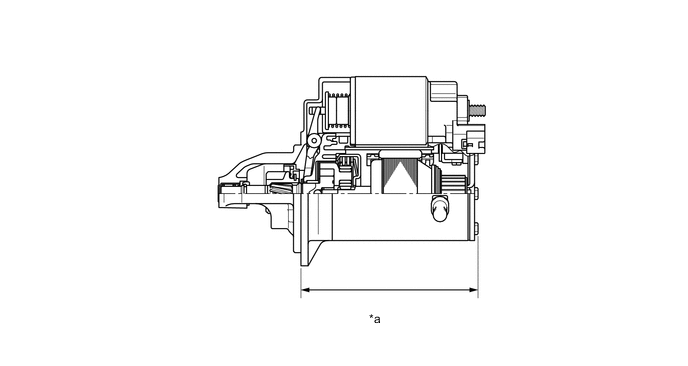
Text in Illustration (PA1.0 Type:) *a Length - - 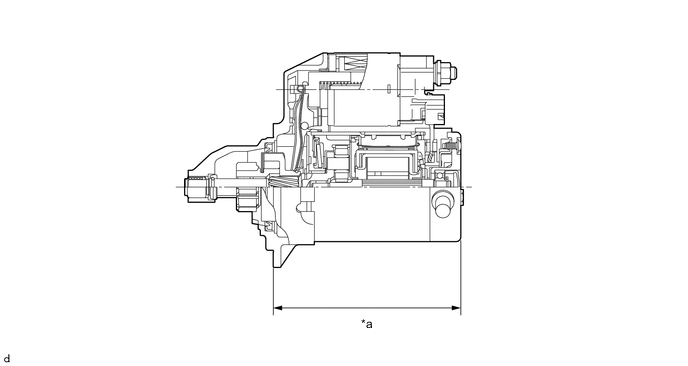
Text in Illustration (PS1.3 Type:) *a Length - - 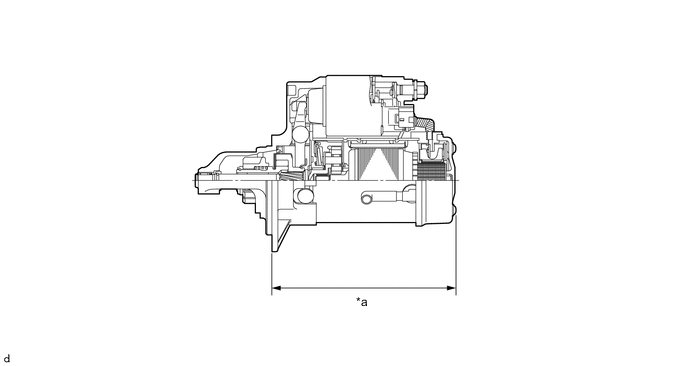
Text in Illustration (PA70LLMG Type:) *a Length - - 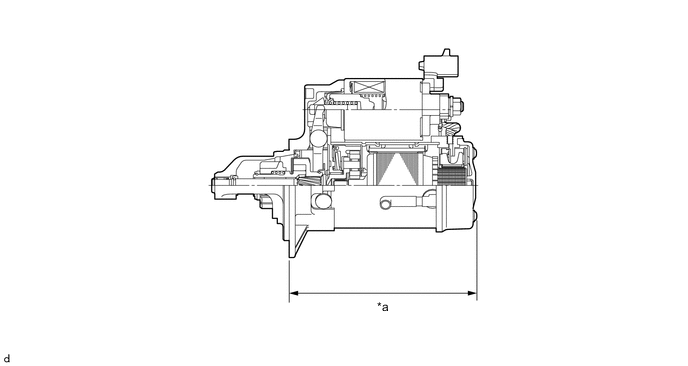
Text in Illustration (PA70LLMG Tandem Solenoid Starter Type:) *a Length - -
-
-
SPECIFICATION
Starter Type PA1.0 (Planetary Reduction Type) PS1.3*1 (Planetary Reduction Type) PA70LLMG*2 (Planetary Reduction Type) PA70LLMG for Tandem Solenoid *3 (Planetary Reduction Type) Length mm (in.) 121.2 (4.77) 123.3 (4.85) 152.8 (6.01) ← Weight g (lb) 2200 (4.85) 2750 (6.06) 3250 (7.16) 3450 (7.61) Rating Voltage V 12 ← ← ← Rating Output kW 1.0 1.3 1.6 ← Rotating Direction (Viewed from pinion side) Clockwise ← ← ←
-
*1: Cold area specification models
-
*2: Models with M/T with stop and start system
-
*3: Models with tandem solenoid starter assembly
-
-
PRECAUTION
-
Cranking hold function has following safety features.
-
While the engine is running normally, the starter does not operate.
-
Even if the driver keeps pressing the engine switch (push start switch), the certification ECU (smart key ECU assembly) stops the output of the STAR and ACCD signals when the engine speed becomes higher than 1200 rpm. Thus, the starter operation stops and the certification ECU (smart key ECU assembly) energizes the ACC relay.
-
In case the driver keeps pressing the engine switch (push start switch) and the engine does not start, the certification ECU (smart key ECU assembly) stops the output of the STAR and ACCD signals after 30 seconds have elapsed. Thus, the starter operation stops and the certification ECU (smart key ECU assembly) energizes the ACC relay.
-
Also, if the certification ECU (smart key ECU assembly) can not detect a continuous engine speed signal although the starter is operating and this continues for 6 seconds, the certification ECU (smart key ECU assembly) will stop sending out STAR and ACCD signals. As a result, the starter will stop operating and then the certification ECU (smart key ECU assembly) will energize the ACC relay.
-
-