STARTING SYSTEM
-
SYSTEM CONTROL
-
Cranking Hold Function (Models with Entry and Start System)
-
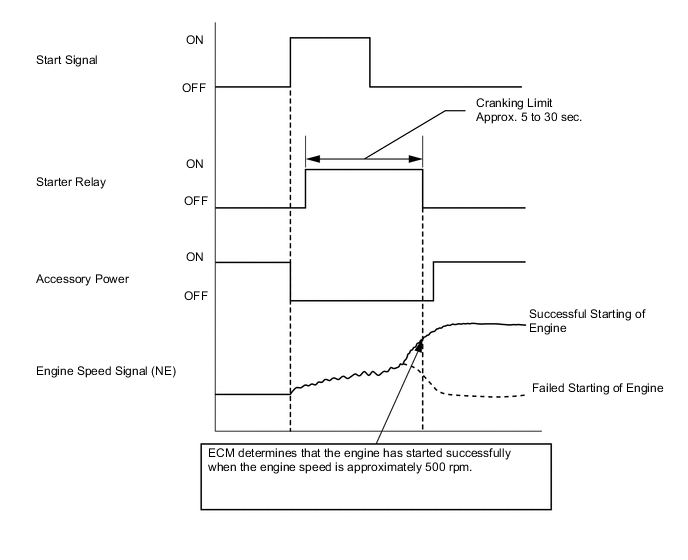
Once the engine switch (push start switch) is pushed, this function continues to operate the starter until the engine starts, provided that the clutch pedal is pressed. This prevents starting failures and the engine from being cranked after the engine has started.
-
This system cuts off the current that powers the accessories while the engine is cranking to prevent the accessory illumination from operating intermittently due to the unstable voltage that is associated with the cranking of the engine.
-
When the certification ECU (smart key ECU assembly) detects a start signal from the engine switch (push start switch), this system monitors the engine speed (NE) signal and continues to operate the starter until it determines that the engine has started. Furthermore, even if the certification ECU (smart key ECU assembly) detects a start signal from the ECM, this system will not operate the starter if the certification ECU (smart key ECU assembly) has determined that the engine has already started.
-
After the starter operates and the engine speed becomes higher than approximately 500rpm, the certification ECU (smart key ECU assembly) determines that the engine has started and stops the output of the STAR signal to the starter relay. Thus, the starter operation stops and the certification ECU (smart key ECU assembly) energizes the ACC relay.
-
If the engine has any failure and does not start, the starter operates as long as its maximum continuous operation time and stops automatically. The maximum continuous operation time is approximately 5 seconds through 30 seconds depending on the water temperature condition. When the engine water temperature is extremely low, it is approximately 30 seconds and when the engine is warmed up sufficiently, it is approximately 5 seconds.
-
-
Timing Chart
-