BODY STRUCTURE
-
CONSTRUCTION
-
Impact Absorbing Structure for Frontal Collision
-
A structure that ensures collision energy absorption efficiency, dissipates impact, and minimizes cabin deformation during a frontal collision has been achieved.
-
The front body pillar inner and the roof side rail reinforcement inner are overlapped. The buckling force and the duration of buckling during a frontal collision have both been increased, thus suppressing the body deformation of the front door periphery.
-
The front body pillar reinforce lower is divided into two, and is structurally overlapped to suppress the deformation of the front door periphery by the load input from the tires during a frontal collision.
-
Rocker panel outer reinforcement made from ultra high-tensile strength steel has been added to suppress the deformation of the front door periphery by the load input from the tires during a frontal collision.
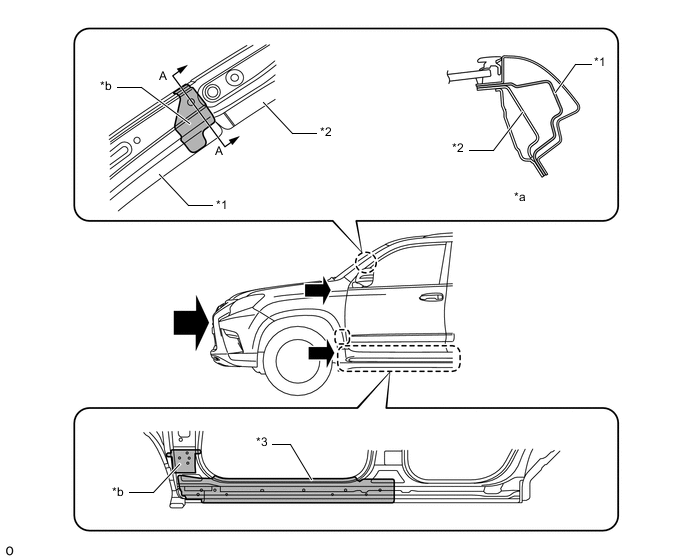
*1 Front Body Pillar Inner *2 Roof Side Rail Reinforcement Inner *3 Rocker Panel Outer Reinforcement - - *a A - A Cross Section *b Overlap Area 
Impact Energy - -
-
-
-
Impact Absorbing Structure for Side Collision
-
A structure that ensures collision energy absorption efficiency, dissipates impact, and minimizes cabin deformation during a side collision has been achieved.
-
High-tensile strength steel is used for the front body pillar, center body pillar, and roof side rail. In addition, ultra high-tensile strength steel is used for the center body pillar and rocker, thus ensuring high strength in a side collision.
-
Crossmembers are optimally positioned in the floor. They efficiently deform to suppress the level of body intrusion during a side collision.
-
Closed cross section roof headlining reinforcement is provided to support the front body pillar, center body pillar, and roof side rail.
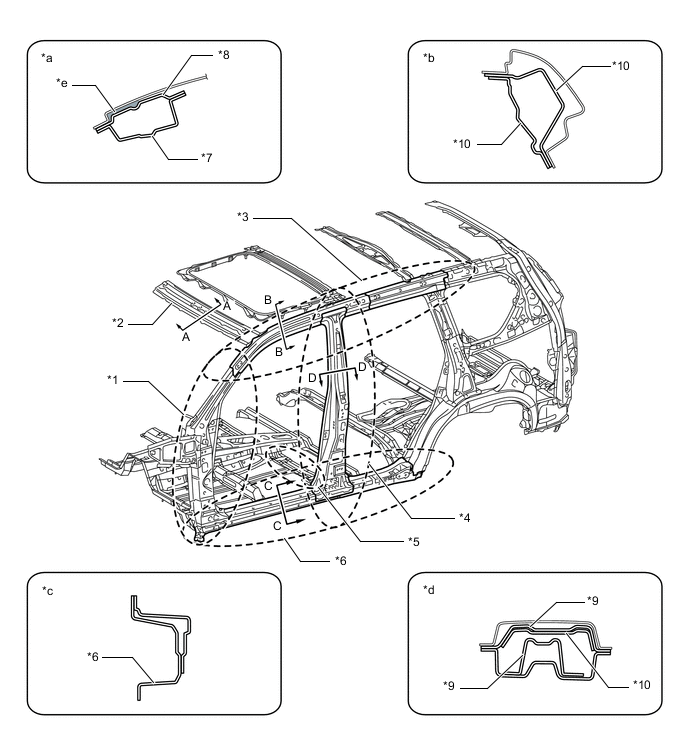
*1 Front Body Pillar *2 Windshield Header Panel Sub-assembly *3 Roof Side Rail Reinforcement *4 Center Body Pillar Reinforcement *5 Crossmember *6 Rocker Panel Reinforcement *7 Windshield Header Panel Inner *8 Windshield Header Panel Outer *9 Ultra High-tensile Strength Steel *10 High-tensile Strength Steel *a A - A Cross Section *b B - B Cross Section *c C - C Cross Section *d D - D Cross Section *e Closed Section - - -
Front floor to brace reinforcement is provided as a load transmission material, in order to efficiently transmit load input from the center pillar to the front floor cross member No.1 and floor crossmember. In addition, a load transmission bracket is provided between the rocker inner reinforcement and chassis frame and input load from the rocker panel outer is transmitted to the frame, thus reducing the level of the body deformation.
-
An energy absorbing pad is provided inside the door panel and door trim to enhance the transmission efficiency of collision load and the reduction of the injury criterion on the passenger's lumbar.
-
A crushable structure is provided for the armrest, thus enhancing the reduction of the injury criterion on the passenger's lumbar.
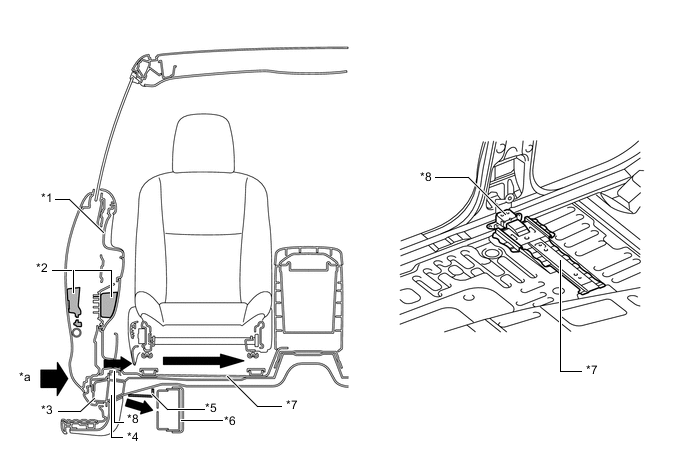
*1 Door Trim *2 Energy Absorbing Pad *3 Rocker Panel Outer *4 Rocker Panel Inner *5 Load Transmission Bracket *6 Frame *7 Front Floor Cross Member No. 1 *8 Front Floor to Brace Reinforcement *a Impact Energy - -
-
-
A head impact protection structure is used. With this type of construction, if the occupant's head hits against the roof side rail and pillar in reaction to a collision, the inner panel of the roof side rail and pillar collapses to help reduce the impact.
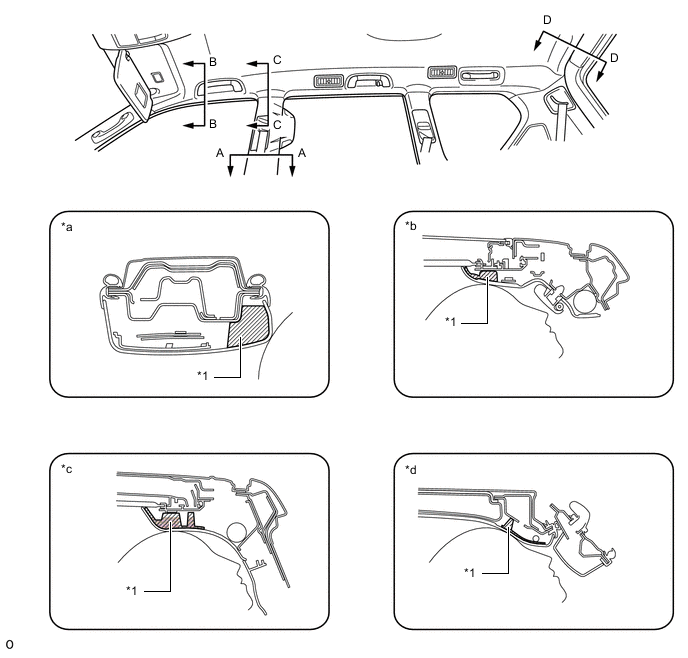
*1 Energy Absorber - - *a A - A Cross Section *b B - B Cross Section *c C - C Cross Section *d D - D Cross Section
-
-
Lessening Pedestrian Head Injury
-
A vertical frame structure is provided in the hood to enable the hood as a whole to dampen the impact.
-
An impact absorption shape is used for the front section of the hood. In addition, the intersection between the hood outer panel and hood inner panel is positioned further rearward to lower the reaction force from the hood panel. This achieves a reduction of the injury criterion on the pedestrian's head in a collision with a pedestrian.
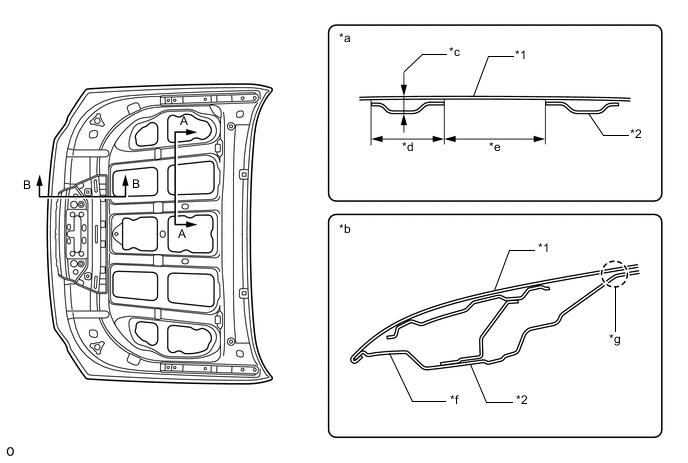
*1 Hood Panel *2 Hood Inner Panel *a A - A Cross Section *b B - B Cross Section *c Optimized Bead Height *d Optimized Frame Width *e Optimized Frame Pitch *f Impact Absorption Shape *g Intersection between Hood Outer Panel and Hood Inner Panel - - -
An auxiliary catch integrated with a hood lock is used. The auxiliary catch is shaped to enable impact absorption. During a collision with a pedestrian, the auxiliary catch efficiently deforms to absorb the impact, with the aim of reducing the predicted impact to the pedestrian's head.
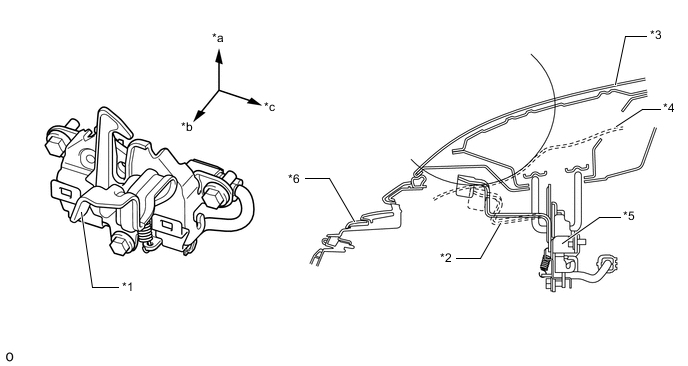
*1 Auxiliary Catch *2 Auxiliary Catch (after Impact Absorption) *3 Hood Panel *4 Hood Panel (after Impact Absorption) *5 Hood Lock *6 Radiator Grille *a Upside *b Front Side *c Left Side - - -
A collision stopper has been located to allow the hood hinge arm to rotate further downwards than the fully closed position without any interference. This enables the hood hinge arm to rotate downwards when a pedestrian collides with the hood panel, thus reducing collision energy and ensuring pedestrian protection performance.
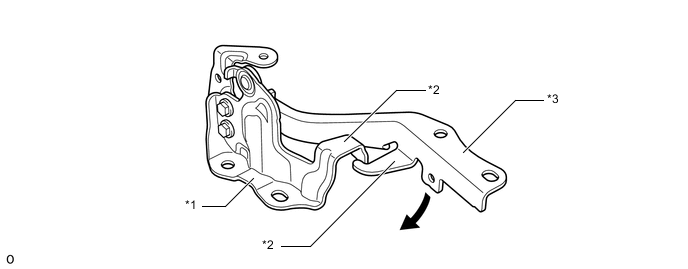
*1 Hood Hinge Bracket *2 Collision Stopper *3 Hood Hinge Arm - - -
Load reduction holes and fold lines are provided on the front and rear walls of the hood lock hook reinforcement to optimize strength. During a collision with a pedestrian, a space for the pedestrian's head to stroke is ensured, with the aim of reducing the predicted impact to the pedestrian's head.
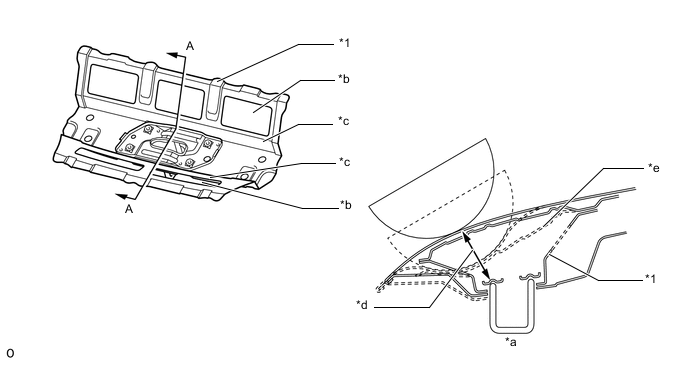
*1 Hood Lock Hook Reinforcement - - *a A - A Cross Section *b Load Reduction Hole *c Fold Line *d Ensured Stroke *e After Impact Absorption - - -
The cowl panel has an open structure. In the event of a collision with a pedestrian, this structure helps lessen the impact inflicted by the cowl to the head of the pedestrian.
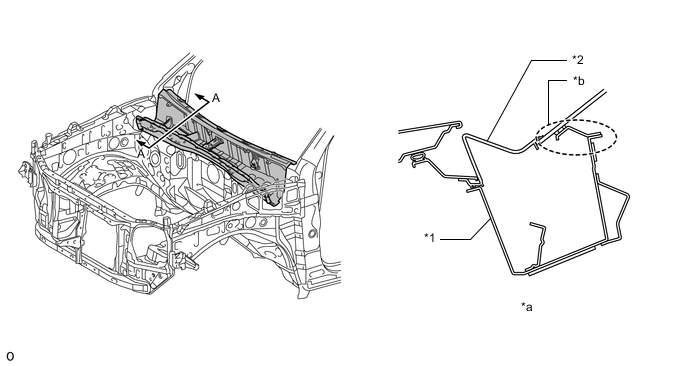
*1 Cowl Panel *2 Cowl Top Ventilator Louver *a A - A Cross Section *b Open Structure -
Fender brackets (fender apron reinforcement plate, front fender apron reinforcement rear and front fender apron reinforcement) are used in the joint portion of the front fender. The height of the fender bracket and the gap between the fender bracket and the fender have been optimized. Also, fold points are provided on the fender brackets. Therefore, during a collision with a pedestrian, the fender brackets absorb impact energy, with the aim of reducing the predicted impact to the pedestrian's head.
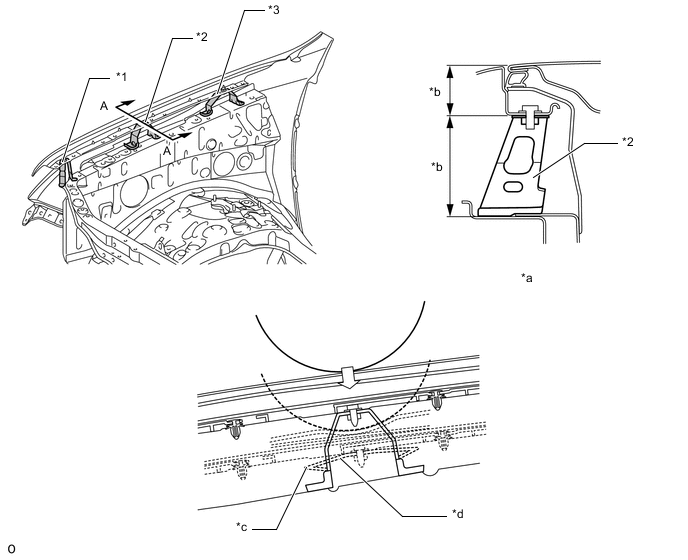
*1 Fender Apron Reinforcement Plate *2 Front Fender Apron Reinforcement Rear *3 Front Fender Apron Reinforcement - - *a A - A Cross Section *b Optimized Height *c Fold Point *d After Impact Absorption -
A flexible material is used for the front fender main seal. Also, the front fender main seal is structured to slide itself between other components as an impact load is applied to it. Therefore, the reaction force applied by the front fender main seal during a collision with a pedestrian is reduced, with the aim of reducing the predicted impact to the pedestrian's head.
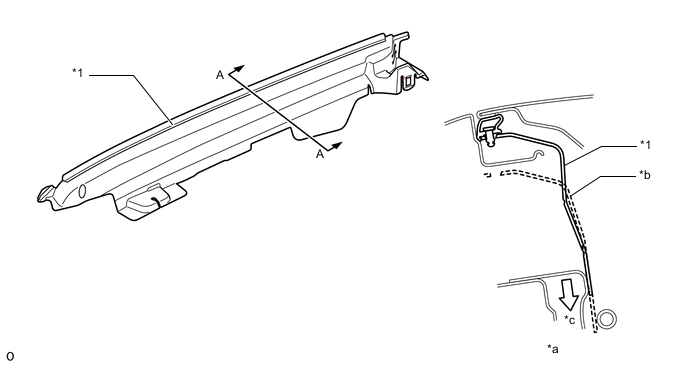
*1 Front Fender Main Seal - - *a A - A Cross Section *b After Collision *c Slide between Components - - -
The cowl top ventilator louver is structured to be easily broken during a collision with a pedestrian's head. Also, the thickness of the sheets differs to control deformation during a collision. Therefore, the cowl louver maintains the necessary rigidity, with the aim of reducing the predicted impact to the pedestrian's head.
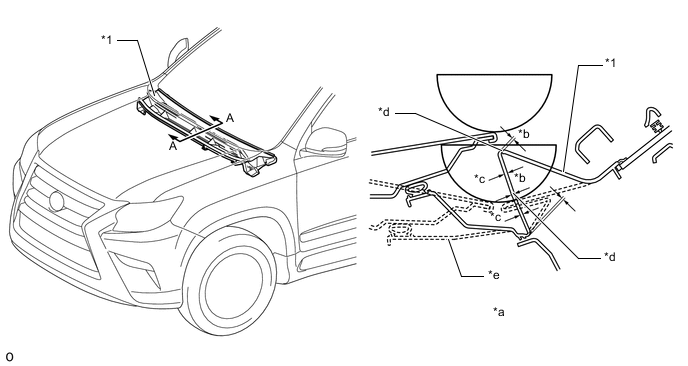
*1 Cowl Top Ventilator Louver - - *a A - A Cross Section *b Low Thickness *c High Thickness *d Fold Point *e After Impact Absorption - - -
By locating the windshield wiper motor on the lower part of the wiper link, the stroke to reduce impact energy from the top of the hood is ensured.
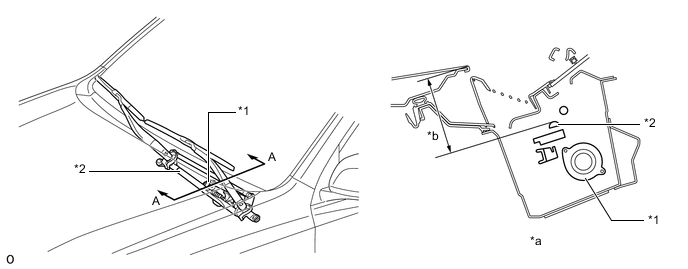
*1 Windshield Wiper Motor *2 Windshield Wiper Link *a A - A Cross Section *b Stroke Space
-
-