WIDE VIEW FRONT AND SIDE MONITOR SYSTEM
-
OUTLINE
-
The wide view front and side monitor system uses television camera assemblies located on the front grille and passenger-side outer rear view mirror to display images on the multi-display in order to allow the driver to see blind spots in the front and passenger side areas, thus assisting the driver's vision.
-
The screen display mode can be switched between manual display mode and automatic display mode to enhace usability.
-
A wide view front and side monitor switch has been placed on the steering wheel for switching the screen display and switching the wide view front and side monitor system on and off.
-
The system consists of the front television camera assembly, side television camera assembly, multi-display assembly, multi-media module receiver assembly and parking assist ECU.
-
-
PRECAUTION
-
Do not rely entirely on the wide view front and side monitor system. Use caution, just as when driving any vehicle.
-
Never drive while looking only at the screen. The image on the screen may differ from actual conditions. If the vehicle is driven while looking only at the screen, the vehicle may hit an object or have an accident. Be sure to confirm the safety around the vehicle when driving the vehicle.
-
The camera uses a wide-angle lens. The perceived distance from images that appear on the screen differs from the actual distance.
-
In the following cases, it may become difficult to see items in the image on the screen, but this does not indicate a malfunction:
-
In the dark (for example, at night)
-
When the temperature near the lens is very high or low
-
When water droplets are present on the television camera, or when humidity is high (for example, when it rains)
-
When a foreign matter (for example, mud or salt) is present on the television camera lens
-
When sunlight or headlights are shining directly into the television camera lens
-
The camera lens is damaged by flying stones
-
-
Flicker effect: when the camera is used under fluorescent lights, sodium lights, mercury light, etc., the lights and their illuminated areas may appear to flicker.
-
When washing the vehicle with a high-pressure washer, do not spray water on the television camera assembly or the surrounding area. High-pressure water can damage the camera.
-
If a bright light (for example, sunlight reflected off the vehicle body, sunlight and headlight directly reflected off the camera lens) is picked up by the television camera, the smear effect*, a phenomenon experienced by a CCD camera, may occur.
Tech Tips
*: A phenomenon that occurs when a bright light is received by the television camera and transmitted to the screen. The light source will appear to have a vertical streak above and below it.
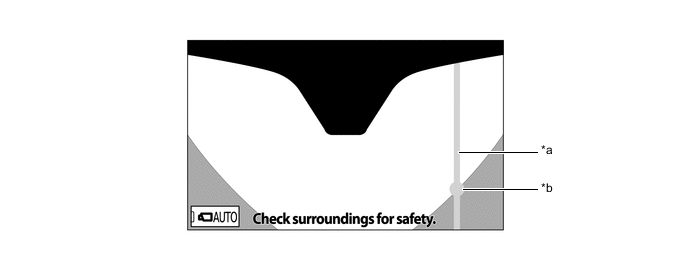
*a Vertical Streak *b Bright Light
-