AIR SUSPENSION SYSTEM
-
FUNCTION OF MAIN COMPONENTS
Component Function Height ControlCompressor Assembly Height Control Compressor with Motor Creates compressed air that is required for raising the vehicle height and supplies it to the rear pneumatic cylinder assembly. Height Control Dryer Assembly Removes moisture in the compressed air. Exhaust Solenoid Valve Discharges compressed air into the atmosphere from the rear pneumatic cylinder assembly to lower the vehicle height. Height Control Filter Removes dust and sand from the internal air. Rear Pneumatic Cylinder Assembly Supports the vehicle body and adjusts the vehicle height. No. 2 Height Control Valve Assembly Leveling Solenoid Valve Opens and closes the compressed air path between the height control dryer assembly and the rear pneumatic cylinder assembly. Gate Solenoid Valve Opens and closes the compressed air path between the right and left rear pneumaticcylinder assemblies. Rear Height Control Sensor Sub-assembly Detects the vehicle height. Height Control Switch Selects vehicle height (HI, Normal, or LO). Height Control OFF Switch Prohibits vehicle height control. Suspension Control Relay Supplies electricity to the height control compressor with motor. Combination Meter Assembly Height Control Indicator Indicates the selected condition of the height control switch. Height Control Off Indicator Indicates the selected condition of the height control OFF switch. Multi-information Display Displays to inform the driver when the suspension control ECU has detected a malfunction in the rear air suspension system. Master Warning Light Illuminates when the warning message is displayed in the multi-information display. Multi Buzzer Sounds when the warning message is displayed in the multi-information display. Suspension Control ECU Estimates the condition of the vehicle in accordance with the signals provided by the sensors and switches, and outputs control signals to the height control compressor assembly and No. 2 height control valve assembly. Skid Control ECU
-
Sends the vehicle speed signal to the suspension control ECU.
-
Sends the brake pedal depressing signal to the suspension control ECU.
Main Body ECU (Driver Side Junction Block Assembly)
-
Sends the open or closed status of the doors.
-
Sends the open or closed status of the back door.
Headlight Swivel ECU Assembly Calculates changes in the vehicle posture based on the signal from the suspension control ECU. ECM Sends the engine speed signal to the suspension control ECU. -
-
SYSTEM CONTROL
-
The rear air suspension system effects the following controls:
Control Outline Vehicle Height Control Vehicle Height Switching Control The driver can operate the height control switch to change the normal vehicle height position to the HI or LO vehicle height position as needed. Automatic Vehicle Height Control Provides a function to keep a constant rear vehicle height regardless of the number of occupants or cargo. Vehicle Speed Sensing Control When a vehicle height position other than Normal is selected and certain conditions have been met, the system automatically adjusts the position to the normal vehicle height in order to attain optimal levels of driving stability and ride comfort. Key Off Operation Control For the purpose of making corrections such as when the rear vehicle height rises as a result of an occupant exiting the vehicle after the engine switch has been turned off, this function effects control to lower the vehicle even after the engine switch has been turned off. Vehicle Height Control Off Vehicle height control can be halted by operating the height control OFF switch. Suspension Control Normal Control Shuts off the right and left rear pneumatic cylinder assemblies by closing the gate solenoid valve in order to ensure the proper rolling rigidity and stable driving. Off-road Control Connects the right and left rear pneumatic cylinder assemblies by opening the gate solenoid valve in order to ensure the proper driving performance on very bumpy roads. 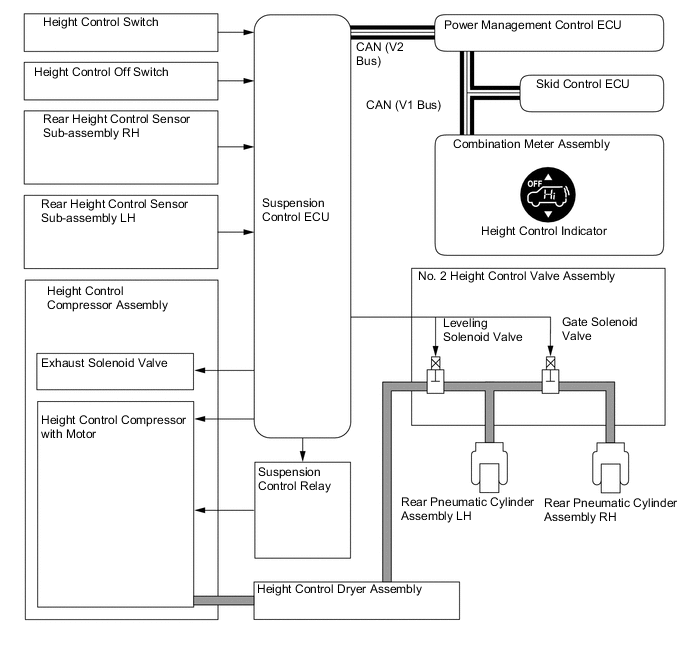
-
Vehicle Height Operation
-
The suspension control ECU calculates the vehicle condition based on signals from each sensor and switch, and sets the appropriate vehicle height by controlling the height control compressor with motor and each solenoid valve.
Figure 1. Raising Vehicle Height
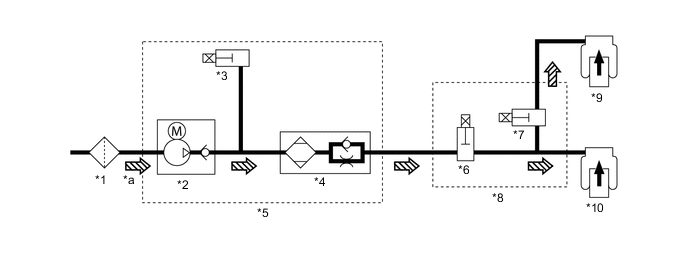
*1 Height Control Cleaner *2 Compressor and Motor *3 Exhaust Solenoid Valve (Open and Closed) *4 Dryer *5 Compressor and Motor with Dryer *6 Leveling Solenoid Valve (Open) *7 Gate Solenoid Valve (Open) *8 No. 2 Height Control Valve Assembly *9 Pneumatic Cylinder RH *10 Pneumatic Cylinder LH *a Air Flow - - Figure 2. Lowering Vehicle Height
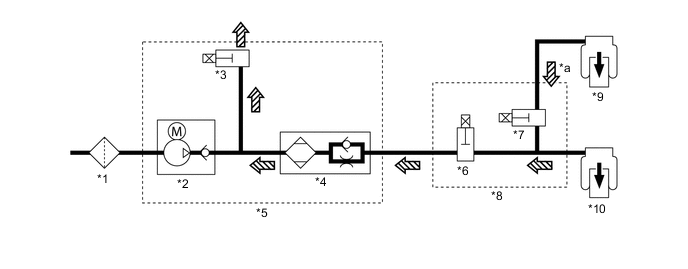
*1 Height Control Cleaner *2 Compressor and Motor *3 Exhaust Solenoid Valve (Open and Closed) *4 Dryer *5 Compressor and Motor with Dryer *6 Leveling Solenoid Valve (Open) *7 Gate Solenoid Valve (Open) *8 No. 2 Height Control Valve Assembly *9 Pneumatic Cylinder RH *10 Pneumatic Cylinder LH *a Air Flow - -
-
-
Vehicle Height Switching Control
-
The driver can operate the height control switch to change the normal vehicle height to the HI or LO vehicle height as needed.
-
Upon detecting the changes in the vehicle height through the signals from the 2 rear height control sensor sub-assemblies, the suspension control ECU blinks the height control indicator in the combination meter assembly while the vehicle height is being adjusted, and illuminates it after the operation has been completed.
Vehicle Height Range Vehicle Height Position Difference in Height Models for Europe Except Models for Europe HI + 30.0 mm (+ 1.2 in.) + 40.0 mm (+ 1.6 in.) Normal 0 ← LO - 20.0 mm (- 0.8 in.) ←
-
-
Automatic Vehicle Height Control
-
The suspension control ECU detects the changes in the rear vehicle height that result from changes in the number of occupants or the amount of load via the 2 rear height control sensor sub-assemblies. Then, the suspension control ECU controls the No. 2 height control valve assembly and the height control compressor assembly in order to automatically adjust the rear vehicle height to a constant (Normal) vehicle height.
-
If the vehicle height is lower than Normal, the suspension control ECU raises the vehicle height by turning on (open) the exhaust solenoid valve, leveling solenoid valve, gate solenoid valve, and actuating the height control compressor with motor. The exhaust solenoid valve remains on (open) for a prescribed length of time (between 0 and 1 seconds) in order to ensure the initial operation of the height control compressor with motor and then turns off (closed). This length of the time is changed by power supply (+B) voltage.
-
If the vehicle height is higher than Normal, the suspension control ECU lowers the vehicle height by turning on (open) the exhaust solenoid valve, leveling solenoid valve, and gate solenoid valve, and by stopping the height control compressor with motor.
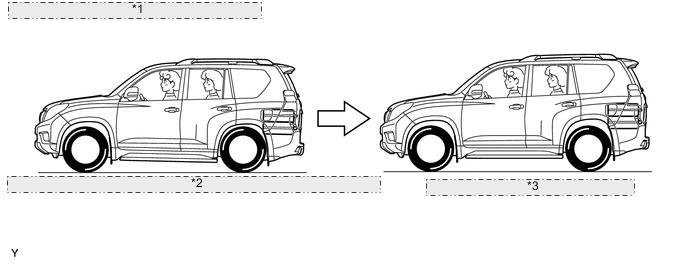
*1 The illustration provides a conceptual image *2 Vehicle height lowers in accordance with increases in the number of occupants and the amount of cargo loaded *3 Vehicle height is raised to the normal position automatically
-
-
Vehicle Speed Sensing Control
-
The suspension control ECU detects the vehicle speed through the signals from the skid control ECU. When a vehicle height position other than Normal is selected and the conditions indicated in the table below have been met, the system automatically adjusts the position to the Normal vehicle height in order to attain optimal levels of driving stability and ride comfort. At this time, the suspension control ECU blinks the height control indicator and illuminates it after height control has been completed.
-
Once the vehicle has been adjusted to the normal vehicle height through this control, it is not possible to select a vehicle height by operating the height control switch at a prescribed vehicle speed or below, unless the initial control is effected again.
Vehicle Speed Sensing Control Vehicle Speed Vehicle Height Position More than 50 km/h (31 mph) HI → Normal More than 12 km/h (7 mph) LO → Normal
-
-
Key Off Operation Control
-
If the vehicle height increases after an occupant exits the vehicle or cargo is unloaded when the engine switch is off, this control causes the vehicle to resume the target vehicle height only for a prescribed length of time.
-
The suspension control ECU detects the off signal of the engine switch from the power management control ECU, the door open and closed signal from the main body ECU, and the vehicle height condition from the 2 rear height control sensor sub-assemblies, in order to effect the key off operation control as shown in the timing chart below.
-
There are 2 types of key off operation time depending on the vehicle height condition.
Key Off Operation Time Vehicle Height Condition Key Off Operation Time No Change Approx. 15 sec. Change Approx. 35 sec. 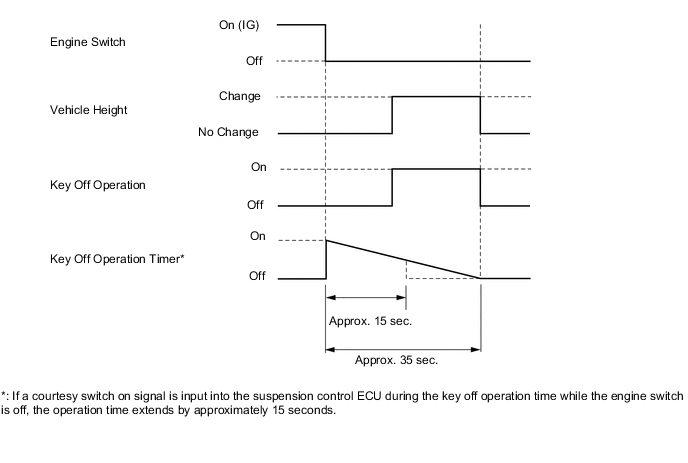
-
-
Vehicle Height Control Off
-
When the height control OFF switch is pressed, this control prohibits vehicle height control. This prevents unexpected changes in vehicle height or the inability of effecting normal control caused by raising the vehicle on a jack or hitching a trailer.
-
The suspension control ECU illuminates the height control OFF indicator.
-
When the vehicle is stopped, the vehicle height at the time the height control OFF switch was last pressed is preserved. However, vehicle speed sensing control is also implemented in order to maintain driving stability and ride comfort.
-
-
Suspension Control (Normal Control and Off-road Control)
-
The normal control turns off (closed) the gate solenoid valve during normal driving in order toincrease the vehicle's rolling rigidity and ensure stability.
-
Upon detecting the vehicle speed through the signals from the skid control ECU, and thevehicle height through the signals from the rear height control sensor sub-assemblies, thesuspension control ECU turns off (closed) the gate solenoid valve in order to shut off the airpath between the right and left rear pneumatic cylinder assemblies.
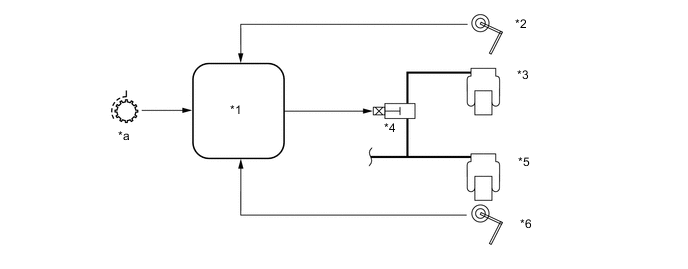
*1 Suspension Control ECU *2 Rear Height Control Sensor Sub-assembly RH *3 Rear Pneumatic Cylinder Assembly RH *4 Gate Solenoid Valve (Closed) *5 Rear Pneumatic Cylinder Assembly LH *6 Rear Height Control Sensor Sub-assembly LH *a Vehicle Speed Signal - - -
The off-road control turns on (opens) the gate solenoid valve while the vehicle is being drivenon bumpy roads at low speeds in order to ensure the proper driving performance.
-
The suspension control ECU determines when to start off-road control based on the heightposition signal and vehicle speed signal.
-
The suspension control ECU starts off-road control when the vehicle speed is below 20 km/h (12 mph) and the vehicle height difference between the right and left sides is 100.0 mm (3.9in.) or more.
-
When the off-road control starts, the gate solenoid valve opens, causing the rear roll rigidityto decrease. When the negative phase is input, the suspension stroke increases in order toenhance the grip of the tires, thus improving driving performance.
-
When the suspension control ECU detects a vehicle speed of 20 km/h (12 mph) or more, itcloses the gate solenoid valve and cancels the off-road control.
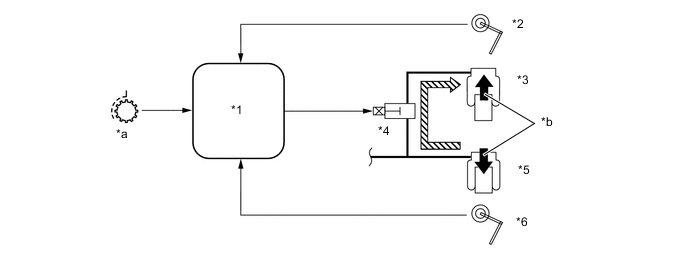
*1 Suspension Control ECU *2 Rear Height Control Sensor Sub-assembly RH *3 Rear Pneumatic Cylinder Assembly RH (Raise) *4 Gate Solenoid Valve (Open) *5 Rear Pneumatic Cylinder Assembly LH (Down) *6 Rear Height Control Sensor Sub-assembly LH *a Vehicle Speed Signal *b Air Flow
-
-
-
FAIL-SAFE
-
If a malfunction occurs in the rear air suspension system, the suspension control ECU prohibits the vehicle height control.
-
-
DIAGNOSIS
-
If the suspension control ECU detects a malfunction in the rear air suspension system, it displays a warning message on the multi-information display to alert the driver of the malfunction.
-
The suspension control ECU will also store a Diagnostic Trouble Code (DTC). The DTC can be accessed through the use of a Global TechStream (GTS). For details, refer to the Repair Manual.
-