CHARGING SYSTEM DETAILS
-
SYSTEM CONTROL
-
This system lowers the generated voltage when the vehicle is accelerating, and raises the generated voltage when the vehicle is decelerating. This reduces the load on the engine as a result of the electric generation of the generator, thus contributing to the fuel economy of the engine. When idling or driving at a constant speed, this system regulates the generated voltage in order to place the amperage estimation value close to the target value.
-
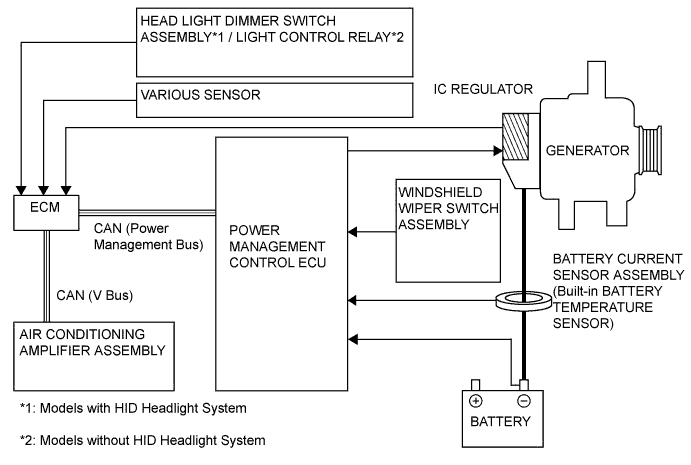
This control consists of the power management control ECU, battery current sensor assembly with a built-in battery temperature sensor, generator, various sensors, switches and ECM.
-
The ECM detects driving condition based on signals from various sensors and switches, and detects charging condition based on signals from the generator, battery current sensor assembly and battery temperature sensor. Then the power management control ECU outputs signals to the IC regulator to control the generated voltage of the generator.
-
The power management control ECU stops the charging control and the generator switches to normal power generation mode under the following conditions:
-
Low battery capacity
-
Low or high battery temperature
-
Wipers operating or blower motor operating with tail lamp relay ON
-
Battery current sensor assembly or battery temperature sensormalfunctions
-
Engine started
-
Battery charged for approximately 2 hours
-
Accumulated driving time becomes approximately 20 hours
-
CAN communication error
-
-
-
CONSTRUCTION
-
Generator
-
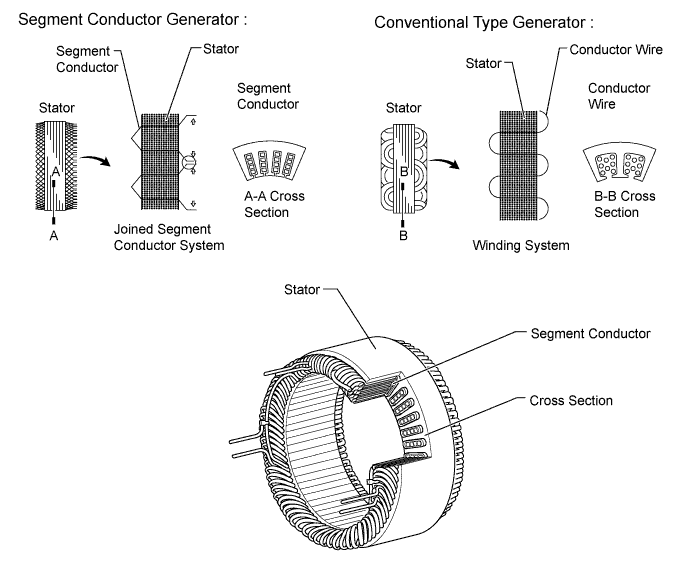
This generator has a joined segment conductor system in which multiple segment conductors are welded together to form the stator. Compared to the conventional winding system, the electrical resistance is reduced due to the shape of the segment conductors, and their arrangement helps to make the generator compact.
-
-
Battery Current Sensor Assembly
-
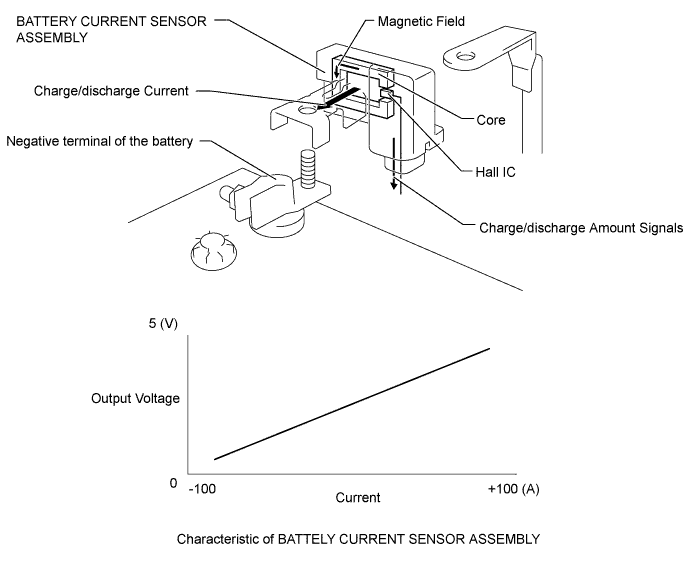
Installed on the negative terminal of the battery, this sensor detects the amount of charging and discharging amperage of the battery and sends signal to the power management control ECU. Based on this signal, the power management control ECU calculates the battery capacity.
-
A Hall IC is used for detecting the amount of charging and discharging amperage. The changes that occur in the magnetic flux density in the core as a result of the charging and amperage of the battery are converted and output as voltage.
-
-
Battery Temperature Sensor
-
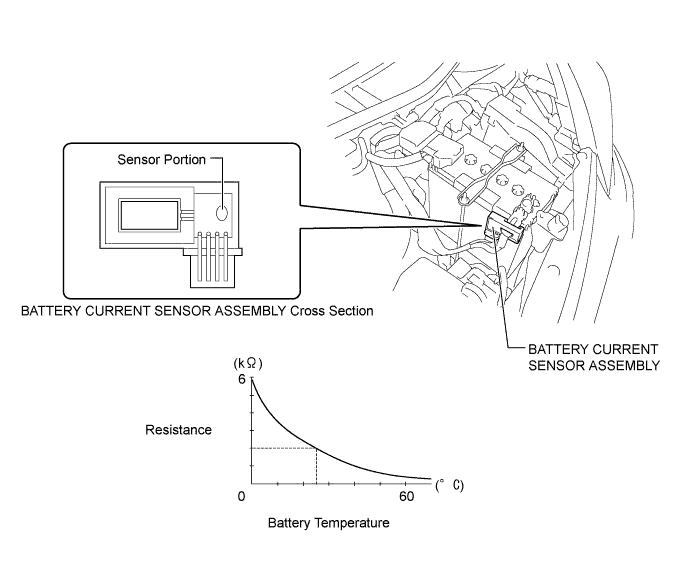
The battery temperature sensor is built into the battery current sensor assembly.
-
The battery characteristic (battery internal resistance) of taking in current for charging varies according to battery electrolyte temperature. If the electrolyte temperature is too low or too high, the battery internal resistance will increase, resulting in early deterioration. To prevent this, the battery temperature sensor changes its resistance as shown below to detect the temperature.
-
-