CLUTCH SYSTEM GENERAL
-
OUTLINE
-
A dry type single plate clutch system which is operated by hydraulic pressure is used.
-
The clutch system for the EE53 and EE63 M/T models uses the Concentric Slave Cylinder (CSC) in place of the clutch release cylinder.
-
The clutch start system is used to help ensure safety.
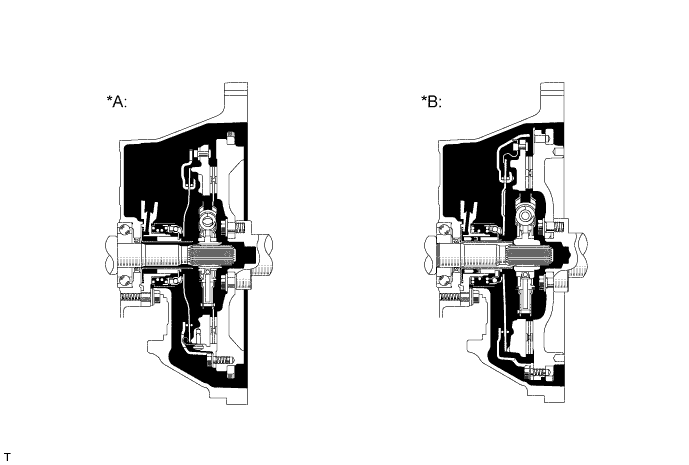
Text in Illustration *A for 1KR-FE Engine with EE53 M/T Models *B for 1NR-FE Engine with EE63 M/T Models
-
-
SPECIFICATION
for 1KR-FE Engine with EE53 M/T Models Item Specification Clutch Type Dry Type Single Plate Clutch Operation Hydraulic Clutch Cover Type Diaphragm Spring Turnover Size 190 mm (7.48 in.) Installed Load 3400 N Clutch Disc Facing Size
(Outer Diameter x Inner Diameter)
190 mm x 132 mm (7.48 in. x 5.20 in.) Clutch Master Cylinder Type for LHD: Plunger / for RHD: Conventional Cylinder Diameter 15.87 mm (0.62 in.) Clutch Slave Cylinder Type Concentric Slave Cylinder (CSC) Cylinder Area 524 mm2(0.81 in.2)
Clutch Pedal Conventional for 1NR-FE Engine with EE63 M/T Models Item Specification Clutch Type Dry Type Single Plate Clutch Operation Hydraulic Clutch Cover Type Diaphragm Spring Turnover Size 212 mm (8.35 in.) Installed Load 4900 N Clutch Disc Facing Size
(Outer Diameter x Inner Diameter)
212 mm x 140 mm (8.35 in. x 5.51 in.) Clutch Master Cylinder Type for LHD: Plunger / for RHD: Conventional Cylinder Diameter 15.87 mm (0.62 in.) Clutch Slave Cylinder Type Concentric Slave Cylinder (CSC) Cylinder Area 524 mm2(0.81 in.2)
Clutch Pedal Turnover -
MAIN FEATURES
-
CSC Type Clutch System
-
Unlike the conventional clutch system, this system uses the CSC, in which the release cylinder and the release bearing are integrated, creating a structure where the diaphragm spring of the clutch cover is directly pressed, thereby discontinuing the release fork and the fork support, and this offers an excellent clutch operation feeling and weight reduction.
-
The clutch release bleeder has been separated from the CSC in the front transaxle case and mounted on the transaxle. As a result, serviceability has been ensured.
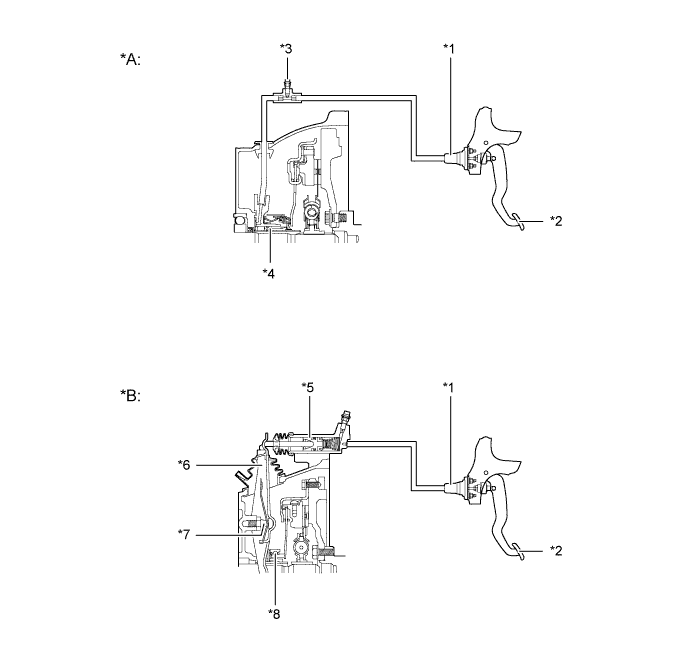
Text in Illustration *A CSC Type Clutch System *B Conventional Clutch System *1 Clutch Master Cylinder *2 Clutch Pedal *3 Clutch Release Bleeder *4 CSC (Clutch Release with Bearing Cylinder Assembly) *5 Clutch Release Cylinder *6 Release Fork *7 Fork Support *8 Release Bearing Note
-
The CSC cannot be disassembled.
-
When the transaxle is removed from the engine, the piston and piston seal will move to the engine side and the piston seal may be damaged by foreign matter on the sliding surface. When the transaxle is removed from the engine, replace the CSC with a new one.
-
The bolts that fasten the CSC to the transaxle are seal bolts. When the bolts are removed, replace them with new ones.
-
The clutch fluid should be replaced or inspected according to the Maintenance Schedule and Owner's Manual.
-
-
-