BODY STRUCTURE DETAILS
-
FUNCTION
-
Front Frame (Independent Type Front Suspension Models)
-
The front frame side rail and the center frame rail sub-assembly have been welded together. This weld ensures a high level of rigidity because the welded area consists of a necked section that extends to the area immediately preceding the No. 3 frame crossmember sub-assembly.
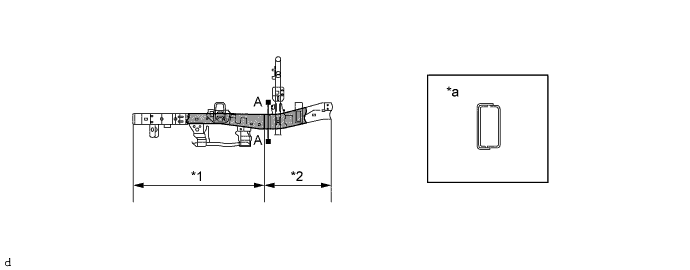
Text in Illustration *1 Front Frame Side Rail *2 Center Frame Rail Sub-assembly *a A-A Cross Section - - 
Necked Section - - -
The front suspension member assemblies consist of 2 members that have been joined with pipes in order to realize a lightweight and highly rigid construction.
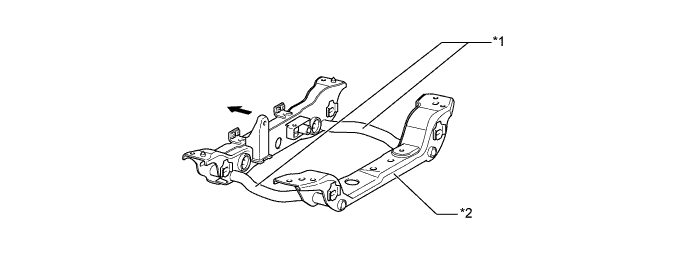
Text in Illustration *1 Pipe *2 Front Suspension Member Assembly 
Front - - -
A No. 3 frame crossmember sub-assembly to which both the torsion bar anchor arms and the rear engine mounts can be mounted, has been adopted.

Text in Illustration *1 No. 3 Frame Crossmember Sub-assembly - - Front - -
-
-
Front Frame (Rigid Type Front Suspension Models)
-
To ensure rigidity, reinforcements have been riveted to the areas to which the upper front shock absorber brackets are to be mounted.
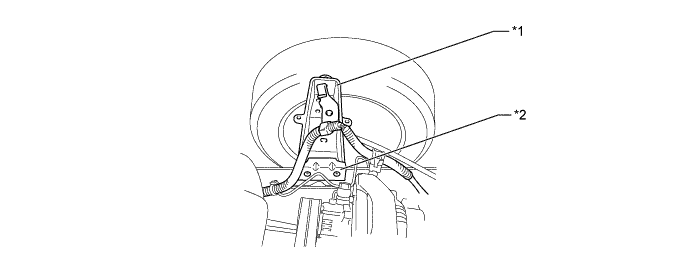
Text in Illustration *1 Upper Front Shock Absorber Bracket *2 Reinforcement -
The No. 2 frame crossmember sub-assembly has been riveted to the frame near the No. 1 spring bracket in order to ensure the rigidity of the area to which the suspension is to be mounted.
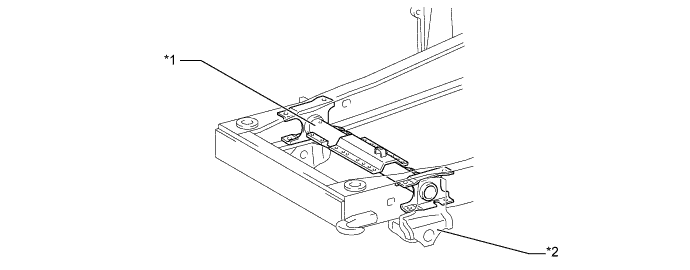
Text in Illustration *1 No. 2 Frame Crossmember Sub-assembly *2 No. 1 Spring Bracket
-
-
Rear Frame (Rear Frame Side Rail)
-
The center frame rail sub-assembly and the rear frame side rail have been riveted together.
-
The top of the rear frame side rail has been flattened in consideration of vehicle conversion applications.
-
The vertical face of the rear frame side rail has been lengthened at the center to realize enhanced rigidity.
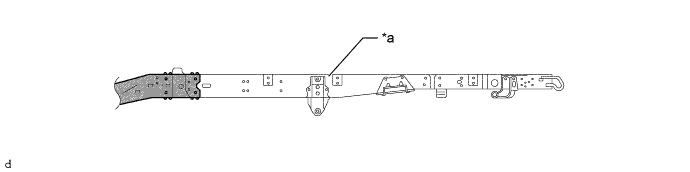
Text in Illustration *a Flattened - - Riveted - - -
The new Dyna 100/150 comes with wheelbases in 2 length. The long wheelbase models forms the standard, and the front ends of the rear frame side rails have been shortened to create the short wheelbase models. The rear frame configurations are indicated in the table and the illustration below.
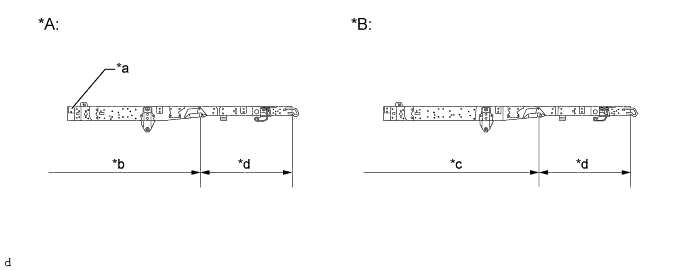
Text in Illustration *A Short Wheel Base *B Long Wheel Base *a Shortened at Front End *b Wheel Base 2300 mm (90.6 in.) *c Wheel Base 2542 mm (100.2 in.) *d 1020 mm (40.2 in.)
-
-
Rear Frame (Cross Member)
-
On the independent type front suspension models, the center frame rail sub-assembly and the rear frame side rail have been riveted together.
-
On the rigid type front suspension models, the front frame side rail and the rear frame side rail have been riveted together.
-
A No. 4 frame crossmember sub-assembly has been allocated to the position of the No. 3 spring brackets to ensure the rigidity of the area to which the suspension is to be mounted.
-
To provide clearance to the rear axle, a No. 5 frame crossmember sub-assembly made of a pipe that is bent upward has been adopted. To contribute to weight reduction, the pipe has a wall that is thinner at its middle than at its ends.
-
A No. 6 frame crossmember sub-assembly has been allocated to the position of the No. 4 spring brackets.
-
The spring brackets are riveted to the rear frame side rails.
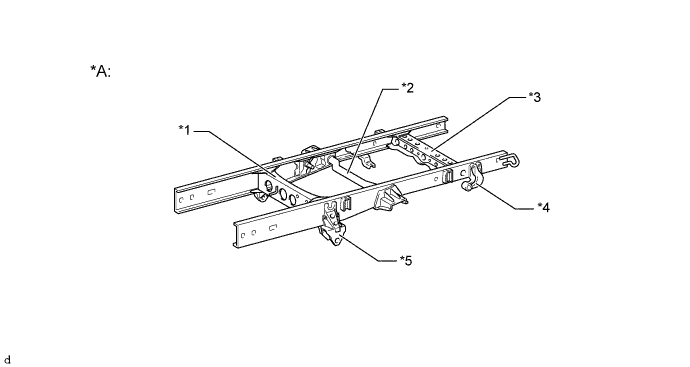
Text in Illustration *A Long Wheel Base - - *1 No. 4 Frame Crossmember Sub-assembly *2 No. 5 Frame Crossmember Sub-assembly *3 No. 6 Frame Crossmember Sub-assembly *4 No. 4 Spring Bracket *5 No. 3 Spring Bracket - -
-
-
Rear Frame (Upper Rear Shock Absorber Bracket Sub-assembly)
-
The upper rear shock absorber bracket sub-assembly RH has been positioned in front of the rear axle, and the upper rear shock absorber bracket sub-assembly LH has been positioned in the back of the rear axle. The upper rear shock absorber bracket sub-assembly RH is riveted to the rear frame side rail and the upper rear shock absorber bracket sub-assembly LH is welded to the No. 3 side rail reinforcement.
-
The No. 3 side rail reinforcement, to which the upper rear shock absorber bracket sub-assembly LH is mounted, is riveted to the inside of the rear frame side rail located between the No. 5 frame crossmember sub-assembly and No. 6 frame crossmember sub-assembly.
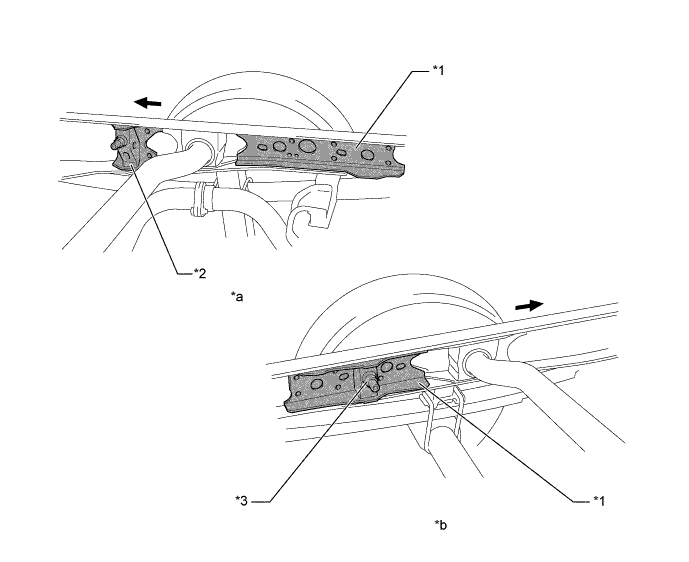
Text in Illustration *1 No. 3 Side Rail Reinforcement *2 Upper Rear Shock Absorber Bracket Sub-assembly RH *3 Upper Rear Shock Absorber Bracket Sub-assembly LH - - *a Rear Frame Side Rail RH *b Rear Frame Side Rail LH Front - -
-
-
Auxiliary Cross Member (No. 3 Cab Mounting Bracket Sub-assembly)
-
An auxiliary cross member (No. 3 cab mounting bracket sub-assembly), which consists of a pipe that joins the rear cab mounts has been adopted in order to disperse the force that is applied to the mounts. Furthermore, this cross member contributes to improving the torsional rigidity of the frame.
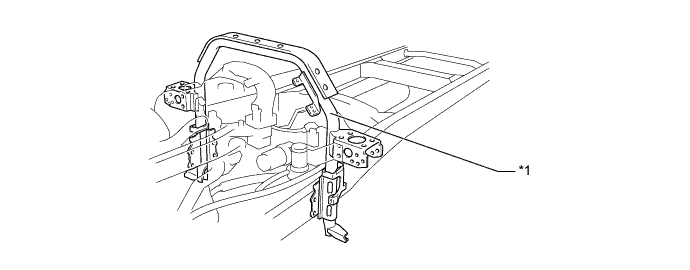
Text in Illustration *1 Auxiliary Cross Member (No. 3 Cab Mounting Bracket Sub-assembly) - -
-
-
-
CONSTRUCTION
-
Anti-Corrosion Sheet Steel
-
Anti-corrosion sheet steel is used for many inner and outer panels of the body shell such as the front panel assembly, outer front side panels, inside front door panel and outer front door panel in order to further improve rust-resistant performance.
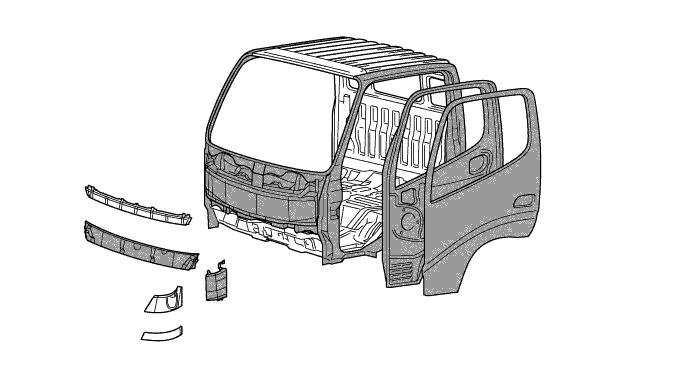
Text in Illustration Anti-Corrosion Sheet Steel - -
-
-
Wax and Sealer
-
Wax and sealer is applied to the hemmed portions of the doors, around hinges and at the joints between panels to improve rust-resistant performance.
-
-
Under Coat
-
To improve rust-resistant performance, PVC (Polyvinyl chloride) coating is applied to the under side of the cab which are subject to damage by stone chipping.
-
The inside of the rear fenders of the deck of the complete models has been coated with PVC (polyvinyl chloride).
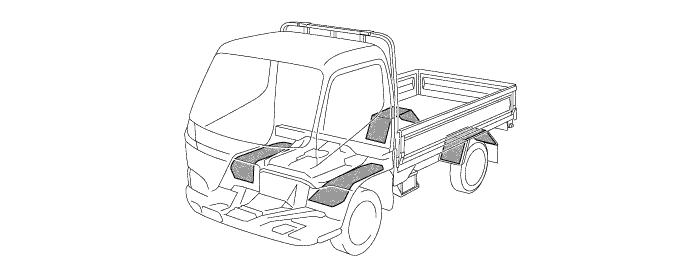
Text in Illustration PVC Coating Area - -
-
-
Sound Absorbing and Vibration Damping Materials
-
Asphalt sheet is applied to most of the floor area to reduce engine and road noise during vehicle operation.
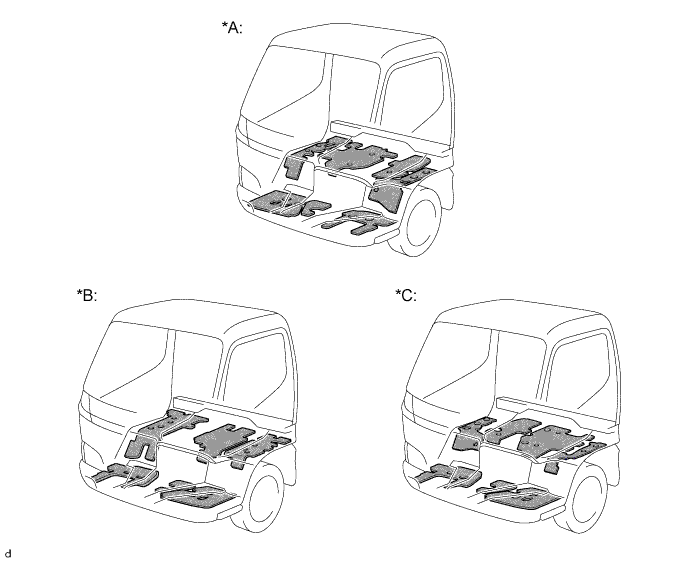
Text in Illustration *A LHD Models *B RHD Models (Singapore Package) *C RHD Models (Except Singapore Package) - - Asphalt Sheet - - -
Foamed seal materials are applied onto the front panel assembly and pillars to reduce wind and road noise.
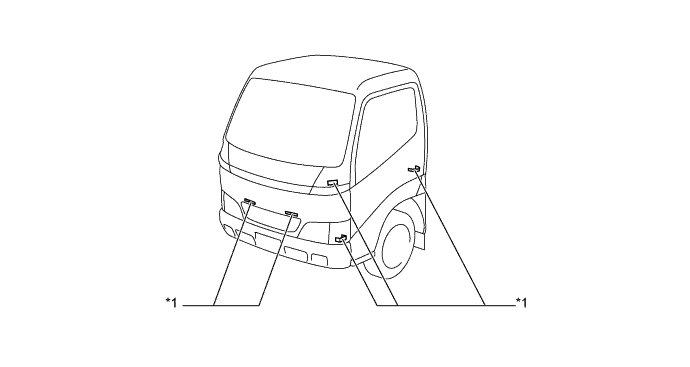
Text in Illustration *1 Foamed Seal Material - -
-
-
Cab
-
Reinforcements have been provided in the front floor cross member sub-assembly in order to improve the rigidity of the frame and thus reduce the generation of droning noise.
-
The back panel has been made not to resonate with the engine noise or the drive train vibration by effectively allocating its vertical beads and back panel reinforcements.
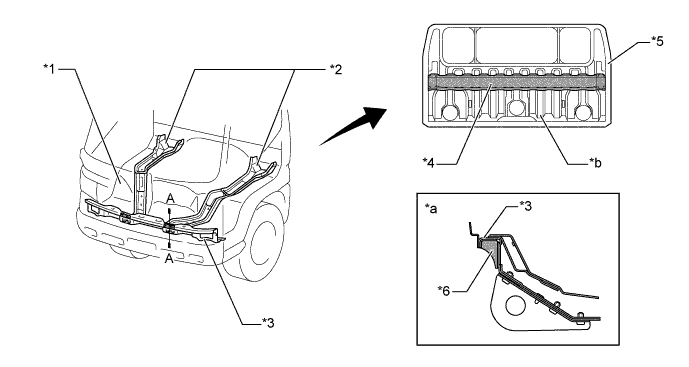
Text in Illustration *1 Front Floor Panel *2 Floor Side Member *3 Front Floor Cross Member Sub-assembly *4 Back Panel Reinforcement *5 Back Panel *6 Reinforcement *a A-A Cross Section *b Vertical Bead
-
-
Cab Mount
-
Compression type mounts have been adopted for the front and rear cab mounts of the rigid type front suspension models. These mounts provide revised spring characteristics that have been designed to reduce noise and vibration and to improve ride comfort.
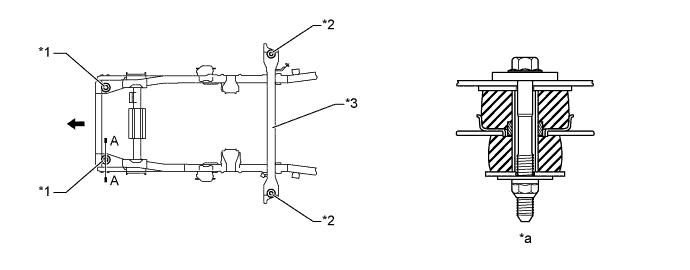
Text in Illustration (Rigid Type Front Suspension Models: ) *1 Front Cab Mount *2 Rear Cab Mount *3 Auxiliary Cross Member (No. 3 Cab Mounting Bracket Sub-assembly) - - *a A-A Cross Section - - Front - - -
A front cab mount in which a cab front mounting cushion sub-assembly and a cab front mounting bracket have been combined has been adopted on the independent type front suspension models. This resulted in reducing noise and vibration and improving ride comfort.
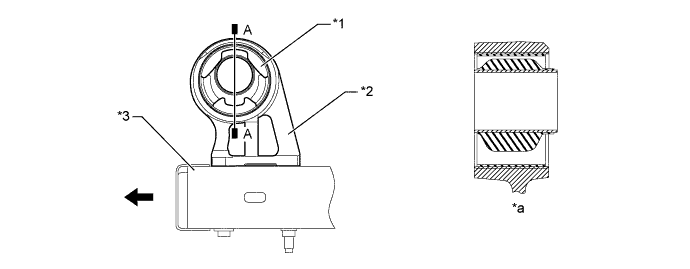
Text in Illustration (Independent Type Front Suspension Models: ) *1 Cab Front Mounting Cushion Sub-assembly *2 Cab Front Mounting Bracket *3 Frame - - *a A-A Cross Section - - Front - - -
A shear type rear cab mount has been adopted on the independent type front suspension models. This resulted in reducing noise and vibration and improving ride comfort.
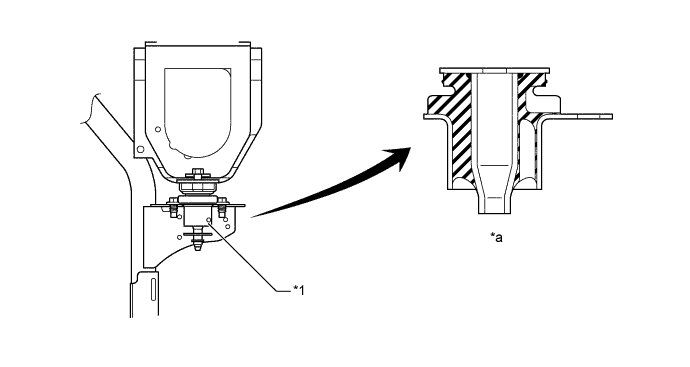
Text in Illustration (Independent Type Front Suspension Models: ) *1 Rear Cab Mount - - *a Rear Cab Mount Cross Section - -
-
-
Steel Deck (Only for Complete Models)
-
The protrusion on the inside at the front of the deck has been eliminated to improve the ease of use.
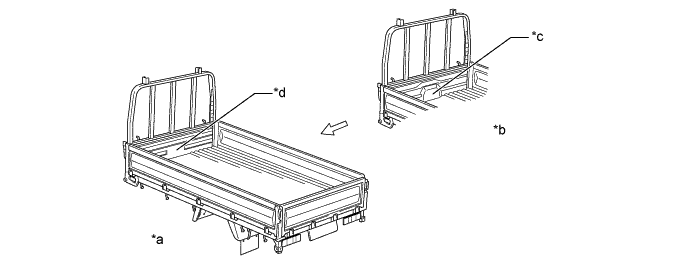
Text in Illustration *a New Models *b Previous Models *c Protrusion *d Flattened
-
-
Arch Cover (Engine Rear Cover Silencer)
-
To prevent debris from entering the vicinity of the engine compartment or the exhaust pipe from behind the cab, an arch cover (engine rear cover silencer) has been provided on the auxiliary cross member (No. 3 cab mounting bracket sub-assembly) of the independent type front suspension models.
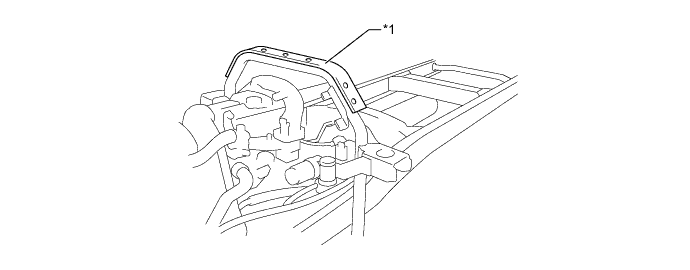
Text in Illustration *1 Arch Cover (Engine Rear Cover Silencer) - -
-
-
Tilt Cab Mechanism (Models with Tilt Cab Mechanism)
-
A tilt-cab mechanism has been adopted to improve serviceability.
-
For the tilt cab mechanism, a single torsion bar spring type has been adopted.
-
To ensure safety, a tilt stopper is used for the tilt cab stay assembly.
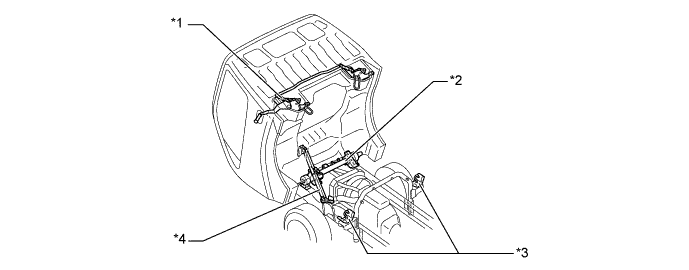
Text in Illustration *1 Cab Lock (Tilt Cab Mounting Lock Assembly) *2 Single Torsion Bar Spring (No. 1 Tilt Cab Spring) *3 Rear Cab Mount *4 Tilt Cab Stay Assembly -
To ensure safety, a tilt stopper is used for the tilt cab stay assembly. This stopper prevents the lock of the stay that engages when the cab is in the full-tilt state from becoming disengaged.
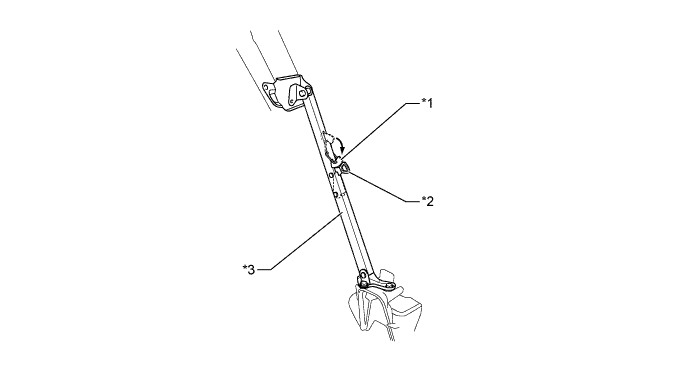
Text in Illustration *1 Tilt Stopper *2 Tilt Lock *3 Tilt Stay - -
-
-