FUEL SYSTEM DETAILS
-
FUNCTION OF MAIN COMPONENTS
-
The D-4 system has following components and functions:
Component Function Fuel Pump Assembly (for Low Pressure) Sends fuel (400 kPa) from the fuel tank assembly to the fuel pump assembly (for high pressure). Fuel Pump Assembly (for High Pressure) Increases the pressure of the fuel from the fuel pump assembly (for low pressure) to a pressure of 4 to 13 MPa and sends it to the fuel delivery pipe sub-assembly. Spill Control Valve Closes and opens the fuel flow path to the fuel delivery pipe sub-assembly in accordance with signals from the Electronic Driver Unit (EDU). Fuel Delivery Pipe Sub-assembly Delivers the high-pressure fuel to the fuel injector assembly. Fuel Pressure Pulsation Damper Assembly Reduces the fuel pressure fluctuation (pulsation) and noise. Fuel Pressure Sensor Senses the fuel pressure and outputs a signal to the ECM. Fuel Relief Valve Assembly If the fuel pressure in the delivery pipe is abnormally high, the fuel relief valve assembly discharges some of the fuel to the fuel tank assembly in order to limit the pressure. Fuel Injector Assembly Injects a calculated (by the ECM) quantity of 4 to 13 MPa (high pressure) fuel directly into the combustion chamber. Cold Start Fuel Injector Assembly* Injects fuel into the intake manifold when the engine is started at low engine coolant temperature to improve cold-starting performance. Electronic Driver Unit (EDU) Transforms signals sent from the ECM (fuel injection request and high-pressure fuel injection volume control) into high-pressure and high-voltage operation signals in order to operate the fuel injector assemblies and spill control valve at high-speed. ECM Depending on the vehicle condition, and based on signals from various sensors, the ECM calculates the optimal injection timing and volume, and controls the fuel injector assembly and fuel pump assembly (for high pressure).
-
*: Models with cold start fuel injector assembly
-
-
-
CONSTRUCTION
-
Fuel Pump Assembly (for Low Pressure)
-
A compact fuel pump assembly is used. Its basic components are a fuel pump, a fuel filter, a pressure regulator and a fuel sender gauge assembly.
-
The fuel pump assembly (for low pressure) is located in the fuel tank assembly. This fuel pump pressurizes the fuel from the fuel tank assembly and sends the fuel to the fuel pump assembly (for high pressure).
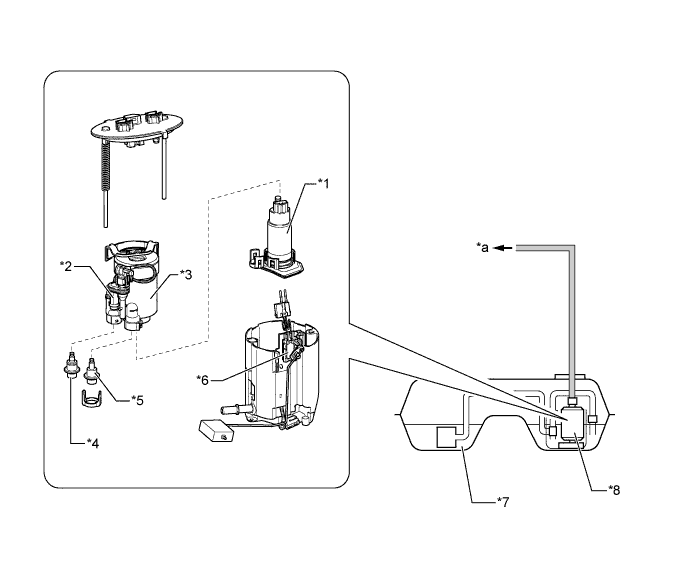
Text in Illustration *1 Fuel Pump *2 Jet Pump *3 Fuel Filter Assembly *4 Fuel Main Valve Assembly *5 Fuel Pressure Regulator Assembly *6 Fuel Sender Gauge Assembly *7 Fuel Tank Assembly *8 Fuel Pump Assembly (for Low Pressure) *a To Fuel Pump Assembly (for High Pressure) - -
-
-
Fuel Pump Assembly (for High Pressure)
-
The fuel pump assembly (for high pressure) consists of a plunger, spill control valve and check valve. A fuel pressure pulsation damper assembly is also installed at the fuel inlet.
-
The plunger is moved up and down by a lobe that is located at the rear end of the exhaust camshaft on the right bank of the engine. This lobe causes three strokes of the pump piston to occur for each camshaft revolution (3 protrusions exist 120 degrees from each other on the same camshaft "lobe").
-
A spill control valve is used to control the pump discharge pressure. The spill control valve is located in the inlet passage of the fuel pump assembly (for high pressure). It is electrically opened and closed by the EDU, based on instructions from the ECM.
-
A check valve is present in the outlet of the fuel pump assembly (for high pressure). As the pressure in the outlet of the pump rises, and becomes high enough to push the check valve off its seat, fuel will begin to flow to the fuel delivery pipe sub-assembly (for direct injection), (minimum pressure to open the check valve is 60 kPa).
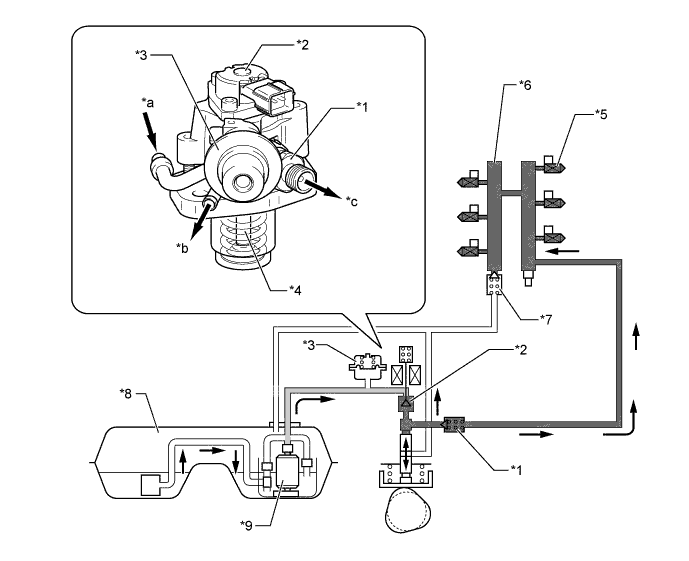
Text in Illustration *1 Check Valve *2 Spill Control Valve *3 Fuel Pressure Pulsation Damper Assembly *4 Plunger *5 Fuel Injector Assembly *6 Fuel Delivery Pipe Sub-assembly *7 Fuel Relief Valve Assembly *8 Fuel Tank Assembly *9 Fuel Pump Assembly (for Low Pressure) - - *a From Fuel Pump Assembly (for Low Pressure) *b To Fuel Tank Assembly *c To Fuel Delivery Pipe Sub-assembly - - 
Low-pressure Fuel 
High-pressure Fuel
-
-
Fuel Delivery Pipe Sub-assembly
-
Aluminum alloy fuel delivery pipes are used for the fuel delivery pipe sub-assembly.
-
A fuel pressure sensor and a fuel relief valve assembly are installed on the fuel delivery pipe.
-
An injector clamp is provided for each area of the fuel delivery pipe where a fuel injector assembly is installed. This clamp applies a constant spring force to the injector to prevent the injector from moving when the combustion pressure is applied to the injector while the engine is being started, during which the fuel pressure is low. As a result, the clamp increases the sealing performance of the injector, while reducing vibration and noise.
-
O-rings and backup rings are used in the areas in which the fuel injector assembly and fuel delivery pipe are joined. This reduces the transmission of the operating sounds of the fuel injector assembly, enhances quiet operation, and ensures the sealing performance of the joined areas.
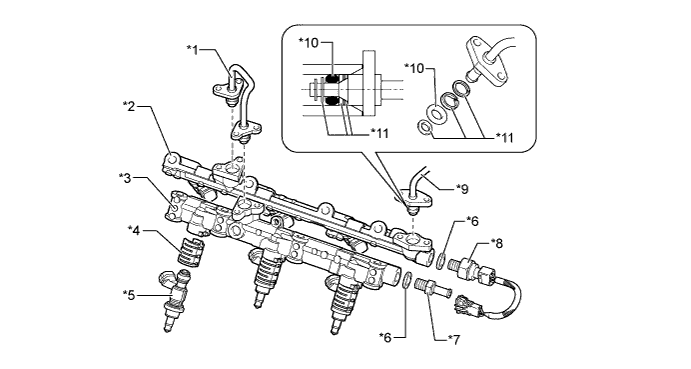
Text in Illustration *1 No. 3 Fuel Pipe *2 Fuel Delivery Pipe RH *3 Fuel Delivery Pipe LH *4 Injector Clamp *5 Fuel Injector Assembly *6 Gasket *7 Fuel Relief Valve Assembly *8 Fuel Pressure Sensor *9 No. 2 Fuel Pipe *10 O-ring *11 Backup Ring - -
-
-
Fuel Injector Assembly
-
High-pressure, slit-nozzle type fuel injector assemblies are used in conjunction with the adoption of the Direct injection 4-stroke gasoline engine (D-4) system.
-
Each injector, based on signals from the ECM, measures the flow of high-pressure fuel. The fuel is injected as a fine-grained mist in a fan shaped pattern, directly to the combustion chamber, via a slit type nozzle.
-
An insulator is used in the area in which the injector comes in contact with the cylinder head, and a Teflon shaft seal is used to seal the injector against the combustion pressure in the cylinders. This is conducted in order to reduce vibration and noise and to enhance sealing performance.
-
Each nozzle hole is coated to reduce the adhesion of deposits.
-
The injectors are actuated by the EDU using high-voltage and a constant-current control based on instructions from the ECM. This control allows the injectors to inject high-pressure fuel in a short amount of time.
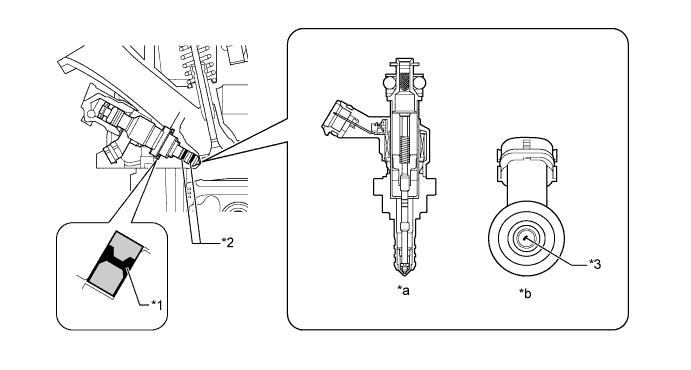
Text in Illustration *1 Insulator *2 Teflon Shaft Seal *3 Injection Nozzle - - *a Cross Section *b Bottom Side View
-
-
Cold Start Fuel Injector Assembly (Models with Cold Start Fuel Injector Assembly)
-
A cold start fuel injector assembly is used to improve cold-starting performance. It is provided in the surge tank of the intake manifold and injects fuel when the engine is started and the engine coolant temperature is low.
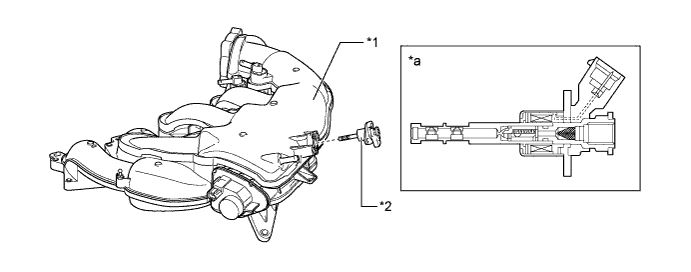
Text in Illustration *1 Intake Air Surge Tank *2 Cold Start Fuel Injector Assembly *a Cross Section - -
-
-
Fuel Tank Assembly
-
A multi-layer plastic fuel tank is used. The multiplex layered plastic fuel tank consists of six layers of four types of materials, and one of those is a recyclable material to address environmental concerns.
-
A fuel drain mark has been provided at the lowest position of the fuel tank assembly. When dismantling (scrapping) the vehicle, drain fuel by drilling a hole at the drain mark.
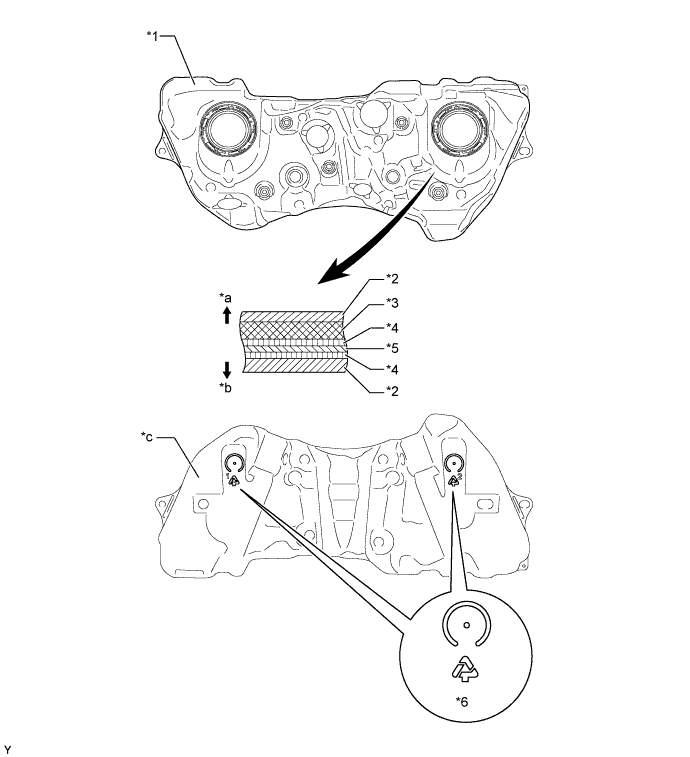
Text in Illustration *1 Fuel Tank Assembly *2 High Density Polyethylene (HDPE) *3 Regrind Material *4 Adhesive *5 Ethylene Vinyl Alcohol Copolymer (EVOH) *6 Fuel Drain Mark *a Fuel Tank Outside *b Fuel Tank Inside *c Bottom Side View - - -
The fuel tank uses a saddle shape to allow the propeller shaft to pass under the center portion of the tank. Also, a jet pump is used to transfer the fuel from the side of the tank without the fuel pump to the side with the fuel pump.
-
A fuel tank with such a shape tends to cause fuel to be present in both chamber A and chamber B when the fuel level is low. This stops the fuel in chamber B from being pumped out. To prevent this from occurring, a jet pump has been provided to transfer the fuel from chamber B to chamber A.
-
This is accomplished by utilizing the flow of the fuel through the jet pump, so that the pressure difference, which is created by the fuel as it passes through the venturi, is used to suck the fuel out of chamber B and send it to chamber A.
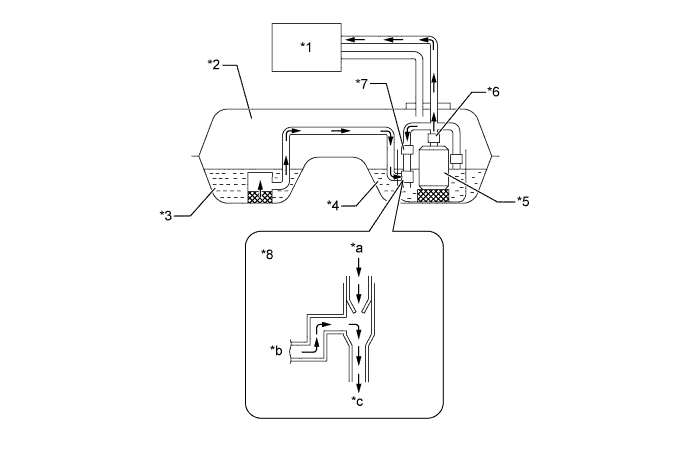
Text in Illustration *1 Engine *2 Fuel Tank Assembly *3 Chamber B *4 Chamber A *5 Fuel Pump *6 Fuel Filter Assembly *7 Fuel Main Valve *8 Jet Pump *a From Fuel Pump (Return) *b From Chamber B *c To Chamber A - -
-
-
-
OPERATION
-
Fuel Pump Assembly (for High Pressure)
-
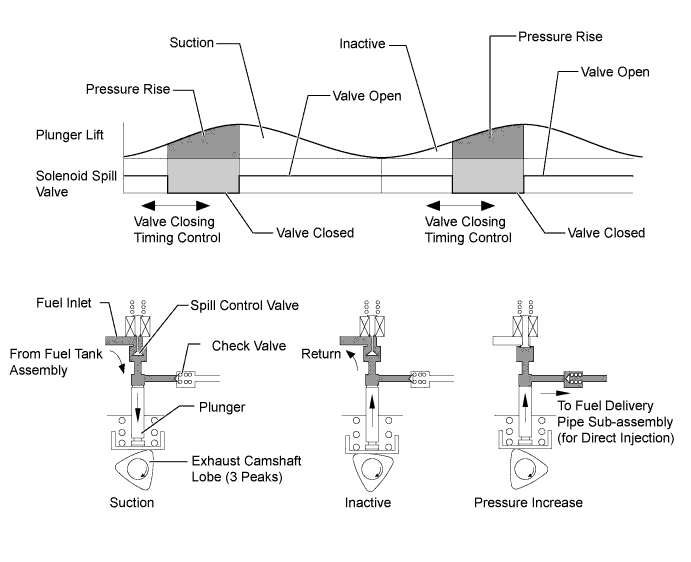
During the intake portion of the pump cycle, the spill control valve is opened, and the pump plunger (piston) is moved downward by spring force. This allows fuel to be drawn into the cylinder of the pump. If the spill control valve has not been closed yet, when the cam forces the plunger to move upward, the fuel in the pump cylinder (this fuel is not pressurized) will be pushed back to the pump inlet (fuel tank side).
-
In order to close the spill control valve as the piston is moving upward, the ECM sends a signal to the valve via the EDU. When the spill control valve is closed and the plunger is moving upward, the pressure in the pump cylinder will rise. As this pressure rises above 60 kPa (or the pressure of the delivery pipe, whichever is higher), the fuel will begin to flow to the fuel delivery pipe sub-assembly. The ECM calculates the target fuel pressure based on driving conditions. The ECM controls the pressure by operating the spill control valve via the EDU. The timing and duration of the spill control valve closing are varied to cause the pump pressure to meet the target pressure.
-
-