NAVIGATION SYSTEM / MULTI INFORMATION SYSTEM DETAILS
-
FUNCTION OF MAIN COMPONENTS
Component Function Radio and Display Receiver Assembly*1
-
Receives operation signals from the panel switches and touch-sensitive display panel, which allows flick or drag operation, and data from various components positioned in different parts of the vehicle and sends them to the navigation ECU.
-
Processes navigation information and the operation status from the navigation ECU and displays them on the multi-display.
-
Receives audio signals such as voice guidance from the navigation ECU and sends them to the stereo component amplifier assembly.
Major Components of Radio and Display Receiver Assembly*1 Multi-display Panel
-
Displays a map screen or an operation screen based on image signals from the navigation ECU.
-
Sends operation signals input via the touch-sensitive display panel to the navigation ECU.
Navigation ECU*1
-
Houses a navigation computer, gyro sensor and GPS receiver, and processes operation signals or vehicle status signals from the radio and display receiver assembly, controlling the navigation system.
-
Sends image and audio signals, such as navigation information, and the operation status to the radio and display receiver assembly.
Major Components of Navigation ECU*1 Navigation Computer
-
Corrects the vehicle position based on location information calculated from GPS information, vehicle speed signals, information from the built-in sensors and the shift status.
-
Applies the mark of the calculated vehicle position to the map data and sends the information and operation status to the radio and display receiver assembly.
-
Sends audio signals such as voice guidance provided in accordance with the vehicle position, to the radio and display receiver assembly.
Gyro Sensor Detects the vehicle's vertical axis rotation speed (yaw rate and rotation movement) and sends it to the navigation computer. GPS Receiver Demodulates GPS information received by the navigation antenna assembly, calculates the vehicle position and sends the position signal to the navigation computer. Navigation Receiver Assembly*2 Receives and processes data from the built-in components, such as the touch-sensitive display panel which allows flick or drag operation, navigation computer, gyro sensor or GPS receiver and various components positioned in different parts of the vehicle, controlling the navigation system and providing various information and the operation status via the multi-display using images, voice and sounds. Major Components of Navigation Receiver Assembly*2 Multi-display Panel
-
Displays a map screen or an operation screen based on image signals from the navigation computer.
-
Sends operation signals input via the touch-sensitive display panel to the navigation computer.
Navigation Computer
-
Updates the vehicle position based on location information calculated from GPS information, vehicle speed signals, information from the built-in sensors and the shift status.
-
Applies the mark of the calculated vehicle position to the map data in the microSD card (disc player disc) and sends the data to the multi-display.
-
Sends voice guidance audio signals to the speakers.
-
Sends navigation information, such as directions and route guidance, to the combination meter assembly.
Gyro Sensor Detects the vehicle's vertical axis rotation speed (yaw rate and rotation movement) and sends it to the navigation computer. GPS Receiver Demodulates GPS information received by the navigation antenna assembly, calculates the vehicle position and sends the position signal to the navigation computer. microSD Card Slot Interfaces with the microSD card (disc player disc), which contains map data, the navigation system control program, etc. microSD Card (Disc Player Disc)*2 Contains map data and the navigation system control program, etc. Navigation Antenna Assembly Receives GPS signals from satellites in orbit around the Earth, at an altitude of approximately 20200 km (12600 miles), and sends them to the navigation ECU*1 or navigation receiver assembly*2. Parking Brake Switch Assembly Sends the parking brake position signal to the radio and display receiver assembly*1 or navigation receiver assembly*2. Park/Neutral Position Switch Assembly Sends an R shift position signal to the radio and display receiver assembly*1 or navigation receiver assembly*2. Window Glass Antenna Wire
-
AM
-
FM
-
FM-sub
Receives radio broadcasting signals (AM/FM/FM-sub). No. 1 Amplifier Antenna Assembly Amplifies radio broadcasting signals from the radio antenna and sends them to the radio and display receiver assembly*1 or navigation receiver assembly*2. Steering Pad Switch Assembly Sends operation signals from switches such as the volume switch, mode switch and voice switch to the spiral cable with sensor sub-assembly. Spiral Cable with Sensor Sub-assembly Sends operation signals from the steering pad switch assembly to the radio and display receiver assembly*1 or navigation receiver assembly*2. Cooler Control Switch Assembly*3 Sends operation signals from switches such as the channel up/down switch, tune up/down switch, volume up/down switch, power switch and mode switch operation to the navigation receiver assembly. Roof Console Box Assembly Houses the telephone microphone. Telephone Microphone Recognizes speech during voice recognition system operation and sends the audio signal to the radio and display receiver assembly*1 or navigation receiver assembly*2. No. 1 Stereo Jack Adapter Assembly
-
Sends audio or image signals to the radio and display receiver assembly*1 or navigation receiver assembly*2 when an auxiliary device is connected.
-
Communicates with the navigation ECU*1 or navigation receiver assembly*2 via a USB communication line when a USB memory device, portable audio player (USB type) or Apple product is connected.
Combination Meter Assembly
-
Sends vehicle speed signals to the radio and display receiver assembly*1, stereo component amplifier*1 or navigation receiver assembly*2.
-
Displays navigation information, such as directions and route guidance, sent from the navigation receiver assembly on the multiinformation display.
Stereo Component Amplifier Assembly*1 Amplifies audio signals sent from the radio and display receiver assembly and sends them to the speakers.
-
*1: Models for Russia
-
*2: Destination packages for Brazil and Argentina
-
*3: Models with rear power seat system
-
-
FUNCTION
-
Navigation Screen
-
The navigation computer calculates the present position and direction of travel, then determines a route and calculates the driving distance based on the following information sources:
-
- Map data in the navigation ECU (Models for Russia)
-
- Map data in the microSD card (disc player disc) (Destination packages for Brazil and Argentina)
-
- Global Positioning System (GPS) satellites
-
- Built-in gyro sensor
-
- Vehicle speed signal
-
- Reverse signal
-
- Parking Brake signal
-
- Radio Data System Traffic Message Channel (RDS-TMC) signal (Models for Russia)
-
- Traffic information signal (Destination packages for Brazil and Argentina)
-
-
The functions of the navigation screen are listed below.
Item Function Map Display Map Scroll Scroll operation on the map screen can be selected in the following 2 ways:
-
Flick/drag scrolling: Flick or drag in the direction that brings your desired location closer to the center of the map screen.
-
Point scrolling: Enables scrolling by connecting the touch points on the map screen.
Taillight-interlocked Map Color Change Changes the color of the map screen that is displayed when the taillights are turned on. North Up/Heading Up
-
If North Up is selected, regardless of the direction of vehicle travel, north is always up.
-
If Heading Up is selected, the direction of vehicle travel is always up.
3D Display Displays a 3-dimensional (3D) view of the map. 3D Icon Display*1 In some areas during the 3D display, buildings and landmarks are displayed using real image icons. Multi-step Scale Display Changes the map scale in 14 steps.*1 Changes the map scale in 17 steps.*2 Street Name Indication on Scrolled Map*1 Displays the street name and city name even when the map screen is being scrolled. Road Number Sign Board Display*1 Displays the road number on the map. Point of Interest Display Displays selected types of points of interest as marks on the map. Split-view Display*2 Displays different modes on a screen that is split into 2 views. Text Zoom*2 Enlarges map text information displayed on the map screen, such as locations and POIs. Information Window*2 Displays current location, current street name, latitude and longitude or audio information in the window at the bottom of the map screen. Route Guidance Demonstration Demonstrates the route guidance to the destination. Speed Limit Display Displays the speed limit of the road currently being traveled on. Safety Camera Display*1 Displays safety camera icons on the map. Traffic Bar*1 A traffic message icon and traffic congestion information are displayed based on traffic information received via the internet. RDS-TMC Display*1 Displays RDS-TMC icons, arrows and indicators when RDS-TMC service is being received. Destination Search Preset Destination Memory Search Sets a pre-registered point as a destination point while driving. Name Search*2 The name of a destination can be entered with the screen keyboard and searched for. Then a destination is selected using the distance or POI name. Address Search A destination can be set by entering a country, and town name/code name, and street/intersection name.*1 A destination can be set in 2 ways:*2
-
Information can be entered in the order of: city name, road name, and house number.
-
Information can be entered in the order of: road name and city name.
Point of Interest Search*1 A destination can be set in 2 ways:
-
The name of a POI can be entered and then searched for after selecting a search area. Search areas include defined areas (such as a user selected country, state and city), near the current position, near the main destination, or along the current route).
-
A POI category can be selected and searched for near the current position, in a defined area (such as a user selected country, state and city), near the main destination, or along the current route.
Online Search*1 Allows use of an internet search engine to set a destination using the most up to date information. Google Sync Search*1 Sets a destination searched for using street view or panoramio. Postcode Search*2 The postcode of a destination can be entered and searched for with the screen keyboard. Then the destination can be selected using the city name, road name and house number. Telephone Number Search*2 The telephone number of a destination can be entered and searched for with the dial pad. Nearby Point of Interest Search*2 The destination can be selected using the following POIs:
-
POIs near the current position (Up to 50 POIs)
-
POIs near the destination
-
POIs in a vicinity of a certain city
Previous Destination Search A destination can be set using the destination list in which previously set destinations are stored. Map Search A destination can be set by using the cursor on the map screen. Coordinate Search A destination can be input by entering its coordinates. Route Search Multiple Destination Setting Sets multiple destinations. Can also rearrange sequence of the destinations. Multiple Route Search Searches for multiple routes. Search Condition Designation Searches for the fast, short, and ecological routes.*1 Sets whether the following routes should be avoided during route search:*2
-
Toll roads
-
Ferry
-
Motorways
Detour Search*1 Changes the route to detour around a section of the route. Adds Waypoints*2 Adds waypoints along with the set route to set the pass points. Regulated Road Consideration*1 Performs searches which consider regulated roads. Avoid Traffic Search*1 Manually changes to another route to avoid heavy congestion. Auto Re-route Search*2 Performs automatic re-route search if the vehicle deviates from the set route. Guidance Voice Guidance Provides voice guidance about the distance and the direction of travel to a destination point based on road conditions and vehicle speed. Next Turn Guidance Next Turn Guidance Provides guidance about the distance to the next turn and indicates the direction of the turn using an arrow. Motorway (Highway) Exit or Junction Display*1 When the vehicle approaches an exit or junction, the motorway guidance screen will be displayed. Motorway Junction Display*2 Displays the junction and route in 3D in the vicinity of a major junction while driving. Lane Recommendation Display*1 When the vehicle approaches a maneuver point, the lane recommendation will be displayed. Turn List Display*1 Displays a turn list on the right side of the 2-screen display. Street List Display*2 Distance-to-destination Display Displays the distance from the present location to the destination. Estimated Arrival Time Display Displays estimated arrival time. Others Voice Recognition*1 Recognizes pre-programmed system commands spoken to operate the navigation system.
-
*1: Models for Russia
-
*2: Destination packages for Brazil and Argentina
-
-
-
Setup Screen (Models for Russia)
-
The settings for the functions of the multi-display are available from the setup screen. The settings for the functions of the multi-display are available from the setup screen.
Item Function General Setting
-
The language can be selected.
-
The voice guidance volume, phone voice volume, ring volume and voice recognition dialog volume can be adjusted or switched off.
-
The unit of measurement for fuel consumption can be changed.
-
The beep sound can be turned off.
-
Automatic text scrolling can be turned off.
-
Data can be stored on a USB memory device.
-
Data can be copied from a USB memory device.
-
Registered information (personal data) can be cleared.
-
System information
-
Third party software information used in the multimedia system, such as notices, can be displayed.
Display Settings
-
Day mode can be set (the screen remains in day mode regardless of the position of the headlight switch).
-
The screen can be turned off.
-
The Map Menu, Camera and Video screen can be adjusted.
Audio Settings
-
Sound quality can be adjusted.
-
The level of the ASL (Automatic Sound Levelizer) can be adjusted.
-
The ASL (Automatic Sound Levelizer) can be turned on/off.
-
Surround sound can be turned on/off.
Connectivity Settings
-
Bluetooth system settings can be changed:
-
The Bluetooth function can be turned on/off
-
Connectable Bluetooth devices can be search
-
The names of the Bluetooth devices that are currently connected or that are in the connection history can be displayed in a list. Additionally, availability information for each Bluetooth device is displayed.
-
Cost warnings function and roaming warning function on/off setting
-
Change of the system name and PIN code used for certification while connecting via Bluetooth
-
Wi-Fi communication function settings can be displayed or changed:
-
The Wi-Fi communication function can be turned on/off
-
Display a list of available Wi-Fi networks and change the connection priority
-
Automatic connection to Wi-Fi networks on/off setting
-
Confirmation of connection to a Wi-Fi network message on/off setting
-
A profile for connecting to the internet can be set.
-
The following detailed Toyota web account settings can be displayed or changed:
-
Display of TOYOTA web account
-
Setting of new account or changing an existing account
-
Reception settings of remotely customized vehicle settings data from Toyota portal site
-
Upload settings of remotely customized vehicle settings data to TOYOTA portal site
Phone Settings
-
Message reception notification can be turned on or off.
-
E-mail reception notification can be turned on or off.
-
The ring tone can be changed or turned off.
-
Phone book data stored on a cellular phone can be transferred manually.
Vehicle Settings Customizable vehicle settings can be changed. -
-
-
Edit/settings Screen (Destination packages for Brazil and Argentina)
-
The settings for the functions of the multi-display are available from the edit/settings screen.
Item Function Quick Setup The following settings related to the navigation system can be set:
-
Volume settings
-
Home settings
-
Bluetooth settings
-
Phone connection help setting
-
Time settings
-
Custom settings
System System settings
-
Time zones and the on/off setting of daylight saving time can be changed.
-
The language can be selected.
-
The screen theme color can be changed.
-
The base values of fuel consumption for each following road, which are used in Eco route search, can be set:
-
Normal roads
-
Motorway
-
Animation effects, such as ones for list scrolling, can be turned on/off.
-
The map menu and camera screen can be adjusted.
-
Service information, such as software updates or the update history of the navigation system, can be displayed.
Volume settings
-
The voice guidance volume can be adjusted.
-
The beep sound can be turned off.
Bluetooth settings
-
Bluetooth device registration settings can be changed:
-
Register a Bluetooth device
-
Delete the Bluetooth device
-
Select the Bluetooth device
-
Edit the Bluetooth device
-
Bluetooth system settings can be changed:
-
Bluetooth device name
-
Bluetooth device PIN-code
-
Bluetooth connection on/off settings
-
Display of Bluetooth device connection help
Screen off The screen can be turned off. Vehicle settings Customizable vehicle settings can be changed. Navigation Edit navi data
-
Favorites information can be changed.
-
Information of locations registered in favorites can be edited:
-
Registration name
-
Telephone number
-
2D mark displayed in the map
-
Sound effect when the vehicle is approaching the registered location
-
Location correction of the registered location
-
A location registered in favorites can be deleted.
-
All the locations registered in favorites can be deleted.
-
The route search history can be deleted.
-
Special favorites information can be changed.
-
Information of locations registered in special favorites can be edited:
-
Registration name
-
Telephone number
-
2D mark displayed in the map
-
Sound effect when the vehicle is approaching the registered location
-
Location correction of the registered location
-
A location registered in special favorites can be deleted.
-
Learned route data can be deleted.
-
The track logs can be deleted.
Navi settings Map display
-
The map screen color settings can be selected between taillight-linked color change or fixed daytime screen color.
-
Road color settings can be changed.
-
The rodizio restriction area alert can be turned on/off.*
-
The rodizio restriction area display can be turned on/off.*
-
The track log display can be turned on/off.
-
Automatic deletion conditions of the track log can be changed.
-
2D view correction during screen scroll can be turned on/off.
-
Contents displayed for current position information can be changed.
-
The 3D landmarks display can be turned on/off.
-
Map scroll operation can be changed.
Navigation Navi settings Guide
-
Route search priority can be selected among recommended, short or main road.
-
Route search conditions can be changed to include/exclude the following routes:
-
Toll roads
-
Ferry
-
Motorway
-
Route search conditions can be changed to include/exclude the following:
-
Cities and bridges, which have road closure time for crossing.
-
Learned route data
-
The distance and estimated arrival time display can be selected between a destination or waypoint.
-
Cruising speeds on each following road, which is used for calculation of an estimated arrival time, can be set: minor/major ordinary road and motorway.
-
The unit of measurement for fuel consumption can be changed.
-
The enlarged intersection map function during route guidance can be set.
-
An audio screen interruption when the enlarged intersection map and other information is being displayed can be set.
-
The IPD road guidance can be turned on/off.
Position/Direction The position of the current vehicle position mark can be adjusted manually. Location fix When driving on a road where an ordinary road and toll road are parallel, if the current vehicle position mark is displayed on the incorrect road on the map screen, it is adjusted to the correct road. Audio Audio settings The following can be set:
-
Front/rear and side speaker's volume balance
-
Tone (Bass, Middle and Treble) for each audio source
-
ASL (Automatic Sound Levelizer) adjusting level
DVD settings The following can be set:
-
Top-priority subtitle language
-
Top-priority audio language
-
Top-priority menu language
-
Aspect ratio of DVD playback screen
-
Parental lock
-
Automatic DVD playback
USB video settings Aspect ratio of the display for image files stored in a USB memory device can be set. DTV settings* The following can be set:
-
Digital TV channel list deletion
-
Parental lock
Ext. video settings The video standard can be set when an external video player is connected.
-
*: Destination package for Brazil
-
-
-
Fuel Consumption Screen
-
The fuel consumption screen is displayed as illustrated below. This screen has the display functions listed below.
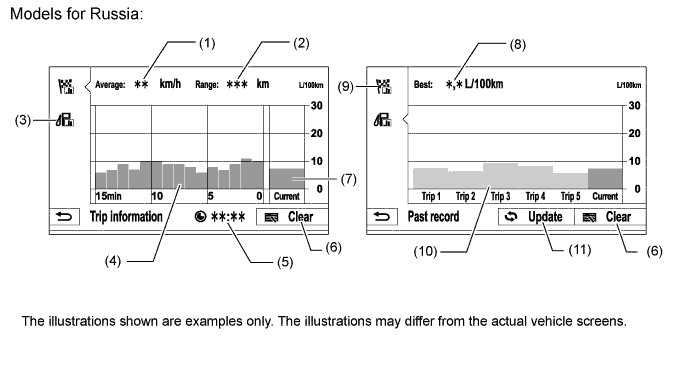
Item Outline (1) Average Speed Displays an average speed value that has been calculated by the combination meter assembly, which is based on the distance driven and time elapsed since the ignition switch was turned to ON. (2) Range Displays the approximate drivable distance. (3) Past Record Switch Changes the screen to the Past Record (per trip) fuel consumption screen. (4) Average Per Minute Fuel Consumption
-
Displays the value that has been calculated by the combination meter assembly, which is based on the driven distance and the volume of fuel consumed (fuel injection signal) since the ignition switch was turned to ON.
-
Displays the average fuel consumption for the last minute, or since clear was last selected.
(5) Elapsed Time Displays an elapsed time value that has been calculated by the combination meter assembly, which is based on the time elapsed since the ignition switch was turned to ON. (6) Clear Switch Clears all past information. (7) Current Per Minute Fuel Consumption Displays the instantaneous (current) fuel consumption value that has been calculated by the combination meter assembly, which is based on the driven distance and the volume of fuel consumed (fuel injection signal) since the ignition switch was turned to ON. (8) Best Fuel Consumption Displays the best (most economical) per trip fuel consumption. (9) Trip Information Switch Changes the screen to the average per minute fuel consumption screen. (10) Average Per Trip Fuel Consumption
-
Displays the current record and the last 5 average per trip fuel consumption records or the current record and those since clear was last selected.
-
Starts calculating the average fuel consumption when the average fuel consumption displayed on the combination meter assembly is reset.
(11) Update Switch
-
Restarts calculation of the average fuel consumption value.
-
Sends the average fuel consumption reset signal to the combination meter assembly to update the graph.
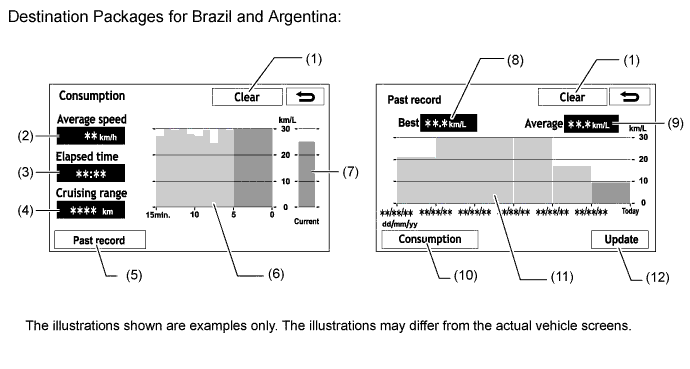
Item Outline (1) Clear Switch Clears all past information. (2) Average Speed Displays an average speed value that has been calculated by the combination meter assembly, which is based on the distance driven and time elapsed since the ignition switch was turned to ON. (3) Elapsed Time Displays an elapsed time value that has been calculated by the combination meter assembly, which is based on the time elapsed since the ignition switch was turned to ON. (4) Range Displays the approximate drivable distance. (5) Past Record Switch Changes the screen to the Past record (per trip) fuel consumption screen. (6) Average Per Minute Fuel Consumption Displays the value that has been calculated by the combination meter assembly, which is based on the driven distance and the volume of fuel consumed (fuel injection signal) since the ignition switch was turned to ON. (7) Current Per Minute Fuel Consumption Displays the instantaneous (current) fuel consumption value that has been calculated by the combination meter assembly, which is based on the driven distance and the volume of fuel consumed (fuel injection signal) since the ignition switch was turned to ON. (8) Best Fuel Consumption Displays the best (most economical) per trip fuel consumption. (9) Average Fuel Consumption Displays the average fuel consumption for this trip and the previous 5 trips. (10) Trip Information Switch Changes the screen to the average per minute fuel consumption screen. (11) Average Per Trip Fuel Consumption
-
Displays the current record and the last 5 average per trip fuel consumption records or the current record and those since clear was last selected.
-
Starts calculating the average fuel consumption when the average fuel consumption displayed on the combination meter assembly is reset.
(12) Update Switch
-
Restarts calculation of the average fuel consumption value.
-
Sends the average fuel consumption reset signal to the combination meter assembly to update the graph.
-
-
-
-
DIAGNOSIS
-
For details on the procedure required to enter the Service Menu screen, refer to the Repair Manual.
-