NIGHT VIEW SYSTEM GENERAL
-
OUTLINE
-
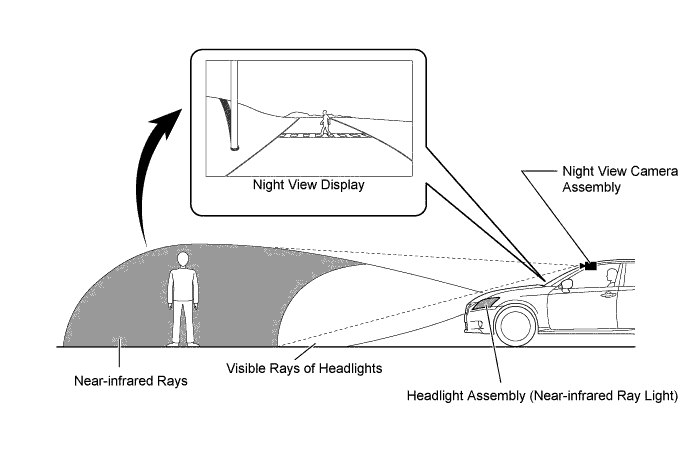
The Lexus night view is a system which uses near-infrared ray lights and the night view camera assembly to display an area which is further forward than the area the driver can typically see at night on the accessory meter assembly, thus assisting the driver's vision.
-
The Lexus night view uses near-infrared ray lights to radiate forward near-infrared rays, which are invisible to the naked eye. The night view camera assembly receives rays from the area to which near-infrared rays are radiated, allowing the situation ahead of the vehicle to be assessed.
-
The Lexus night view consists of near-infrared ray lights, a night view camera assembly and a No. 1 night view ECU. The near-infrared ray lights are built into the headlights, and the night view camera assembly is installed in the upper center of the windshield glass.
-
-
MAIN FEATURES
-
Features of Near-infrared Rays
-
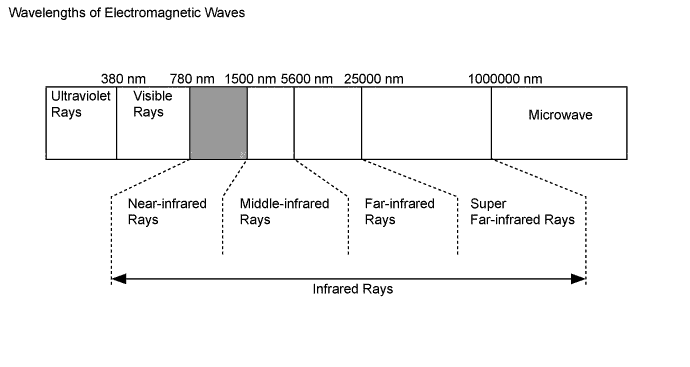
Near-infrared rays are light rays with a slightly longer wavelength than that of visible light rays. They are used not only for the night view system but also in optical communications, sensors and so on. The wavelength is 780 nm to 1500 nm.
-
-
Naked Eye Light Sensitivity and Camera Light Sensitivity
-
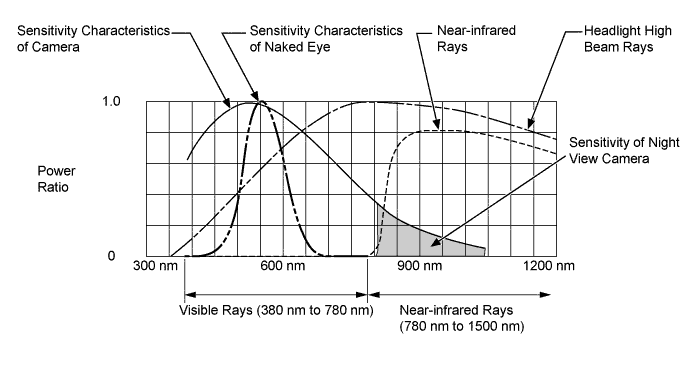
The near-infrared ray light and night view camera assembly use rays which are in an area slightly different to the area visible by the naked eye. The near-infrared rays prevent normally-visible color information from being seen, but allow black objects to be seen clearly.
-
-
-
PRECAUTION
-
When using the Lexus night view, pay attention to the following precautions:
-
Do not drive while continually watching the night view display instead of looking directly.
-
Do not stare at the night view display while driving.
-
Lexus night view is a system to support the driver's vision when driving on roads with few curves at night. Do not use it on hills or roads with many curves, or in downtown locations.
-
Lexus night view cannot always visualize everything clearly. In some cases, the whole screen may appear dark or some areas of the screen may be difficult to see.
-
-
In the following cases, screen images will become difficult to see:
-
During bad weather such as rain, fog, snow, snowstorms and so on.
-
When a large amount of light is being reflected from the road surface, for example by puddles.
-
When the windshield glass in front of the night view camera assembly is cloudy, dirty or frosted over.
-
When snow, ice, mud and so on is adhering to the front of the near-infrared ray light.
-
When the battery voltage is significantly low.
-
When there is a strong light source ahead of the vehicle, shining toward the vehicle.
-
-