BLIND SPOT MONITOR SYSTEM GENERAL
-
OUTLINE
-
The blind spot monitor system uses sensors to detect vehicles that are traveling in the vehicle's blind spot, helping the driver to confirm safety when changing lanes.
-
The blind spot monitor system consists of 2 blind spot monitor sensors, steering sensor, outer rear view mirror assemblies LH and RH, blind spot monitor main switch, combination meter assembly and speed sensors.
-
This system performs control using 2 blind spot monitor sensors.
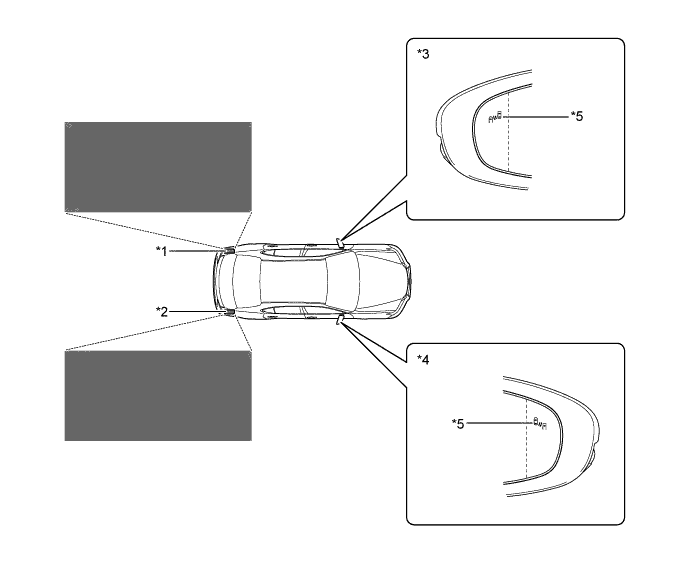
Text in Illustration *1 Blind Spot Monitor Sensor LH *2 Blind Spot Monitor Sensor RH *3 Outer Rear View Mirror Assembly LH *4 Outer Rear View Mirror Assembly RH *5 Outer Rear View Mirror Indicator Light - - 
Detection Area - -
-
-
PRECAUTION
-
The blind spot monitor may not detect vehicles correctly in the following conditions:
-
During bad weather such as heavy rain, fog, snow etc.
-
When there is a significant difference in speed between the driver's vehicle and the vehicle that enters the detection area.
-
When another vehicle which has been in the detection area while the driver's vehicle has been stopped remains in the detection area as the driver's vehicle accelerates.
-
When driving up or down steep inclines, such as hills, a dip in the road etc.
-
When multiple vehicles approach with only a small gap between each vehicle.
-
When vehicle lanes are wide, and the vehicle in the next lane is too far away from driver's vehicle.
-
When the vehicle that enters the detection area is traveling at about the same speed as driver's vehicle.
-
When there is a significant difference in height between driver's vehicle and the vehicle that enters the detection area.
-
When driving on a road surface that is wet due to rain, standing water etc.
-
When ice, mud etc. is attached to the rear bumper.
-
Directly after the blind spot monitor main switch assembly is turned on.
Tech Tips
In this section, the expression "driver's vehicle" is used to refer to the vehicle equipped with this blind spot monitor system.
-
-
The blind spot monitor is not designed to detect the following types of vehicles or objects:
-
Vehicles traveling from the opposite direction.
-
Small motorcycles, bicycles, pedestrians etc.*
-
Following vehicles that are in the same lane.*
-
Guardrails, walls, signs, parked vehicles and similar stationary objects.*
-
Vehicles driving 2 lanes across from driver's vehicle.
Tech Tips
*: Depending on conditions, detection of a vehicle and/or object may occur.
-
-
Instances of the blind spot monitor unnecessarily detecting a vehicle and/or object may increase under the following conditions:
-
When there is only a short distance between driver's vehicle and a guardrail, wall etc.
-
When vehicle lanes are narrow and a vehicle driving 2 lanes across from driver's vehicle enters the detection area.
-
When there is only a short distance between driver's vehicle and a following vehicle.
-
-
One blind spot monitor sensor is installed inside the left and right sides of the vehicle rear bumper respectively. Observe the following to ensure the blind spot monitor can function correctly.
-
Keep the sensor and its surrounding area on the bumper clean at all times.
-
Do not subject the sensor or surrounding area on the bumper to a strong impact. If the sensor moves even slightly off position, the system may malfunction and vehicles that enter the detection area may not be detected. If the sensor or surrounding area is subject to a strong impact, inspect the sensor and surrounding area.
-
Do not disassemble the sensor.
-
Do not attach accessories or stickers to the sensor or surrounding area on the bumper.
-
Do not modify the sensor or surrounding area on the bumper.
-
Do not paint the sensor or surrounding area.
-
Do not apply strong impacts to the sensor or drop it, as it is a high-precision device.
-
Do not reuse a sensor that has been dropped or subjected to a strong impact.
-
-