WHEN REMOVING,INSTALLING,REPAIRING OR REPLACING PARTS WHEEL ALIGNMENT STANDARD
Note
For vehicles equipped with VSC, if wheel alignment has been adjusted, and if suspension or underbody components have been removed/installed or replaced, be sure to perform the following initialization procedure in order for the system to function normally:
-
Check that the steering wheel is in the centered position.
-
Disconnect the negative battery terminal for more than 2 seconds.
-
Reconnect the negative battery terminal.
-
Perform zero point calibration of the yaw rate and deceleration sensor and test mode inspection.
-
MEASURE VEHICLE HEIGHT
Note
Before inspecting the wheel alignment, adjust the vehicle height to the specification.
-
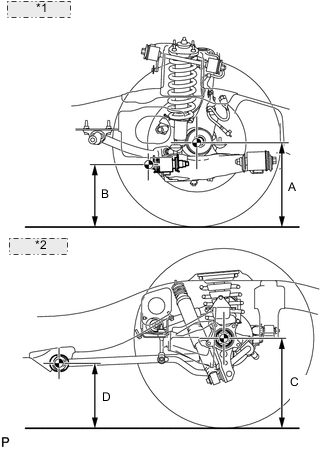
*1 Front Side: *2 Rear Side: Press down on the vehicle several times to stabilize the suspension, and then measure the vehicle height.
If the vehicle height is not as specified, adjust the height by pressing down on the vehicle several times to stabilize the suspension.
Note
The standard value shown here is a value that is used for adjusting the wheel alignment and does not indicate the height of an actual vehicle.
-
-
INSPECT CAMBER, CASTER AND STEERING AXIS INCLINATION
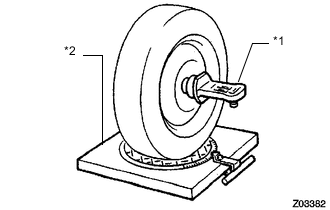
*1 Gauge *2 Alignment Tester
-
Install the camber-caster-kingpin gauge or place the front wheels on the center of the wheel alignment tester.
-
Inspect the camber, caster and steering axis inclination.
Tech Tips
The steering axis inclination is a reference value.
-
-
INSPECT TOE-IN
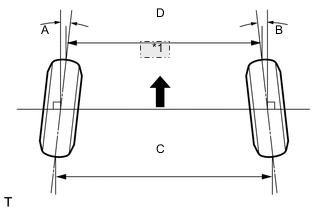
*1 Front
-
Bounce the vehicle up and down at the corners to stabilize the suspension and inspect the toe-in.
-
If the toe-in is not as specified, adjust it at the rack ends.
-
-
-
INSPECT WHEEL ANGLE
-
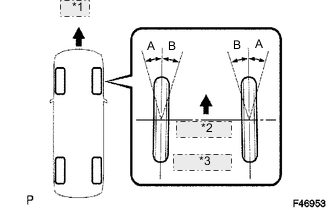
*1 Front *2 A: Inside *3 B: Outside Turn the steering wheel to the left and right full lock positions, and measure the turning angle.
If the right and left inside wheel angles differ from the specified range, check the right and left rack end lengths.
-