WORK NOTICES AND PRECAUTIONS PRECAUTIONS FOR FUEL CELL VEHICLE
Refer to the TOYOTA Repair Manual for each work procedure.
-
PRECAUTIONS FOR HIGH-VOLTAGE CIRCUIT INSPECTION AND SERVICE
CAUTION:
This vehicle has a hybrid system that operates at voltages up to 650 V. The hybrid system uses an EV battery that contains an electrolyte which is a strong alkali solution that includes potassium hydroxide. Be sure to follow the instructions in this manual to handle the system correctly. Failure to do so may result in serious injury or electrocution.
-
Technicians must undergo special training to be able to service and inspect the high-voltage system.
-
All high-voltage wire harnesses and connectors are colored orange. The EV battery and other high-voltage components have "High Voltage" caution labels. Do not carelessly touch these wires or components.
-
When there is a problem with the wire harness or connector of a high-voltage circuit, repairs to the harness or connector should not be attempted. Replace damaged or malfunctioning high voltage cables or connectors.
-
Before performing any of the following operations, be sure to follow all safety measures, such as turning the power switch off, wearing insulated gloves, and removing the service plug grips from both the FC stack and EV battery to prevent electrocution.
-
Working on the high-voltage system
-
Disconnecting the low voltage connector of the inverter with converter assembly
-
Disconnecting the low voltage connector of the EV battery
-
Disconnecting the low voltage connector of the FC stack assembly
-
Disconnecting the low voltage connector of the FC converter assembly
-
-
After removing the service plug grips from the FC stack and EV battery, store them according to the following guidelines to prevent other technicians from accidentally reconnecting them while you are working on the high-voltage systems.
-
Carry the service plug grip removed from the EV battery in your pocket to prevent other technicians from accidentally reconnecting it while you are servicing the vehicle.
-
Store the service plug grip removed from the FC stack in a safe location and use the "CATION: HIGH VOLTAGE DO NOT TOUCH" sign to notify other technicians that you are working on the high-voltage system.
Note
-
After turning the power switch off, waiting time may be required before disconnecting the cable from the negative (-) auxiliary battery terminal. Therefore, make sure to read the disconnecting the cable from the negative (-) auxiliary battery terminal notices before proceeding with work.
-
After removing the service plug grip, turning the power switch on (READY) may cause a malfunction. Do not turn the power switch on (READY) unless instructed by the repair manual.
Tech Tips
Remove the service plug grips from both the FC stack and EV battery, in no particular order.
-
-
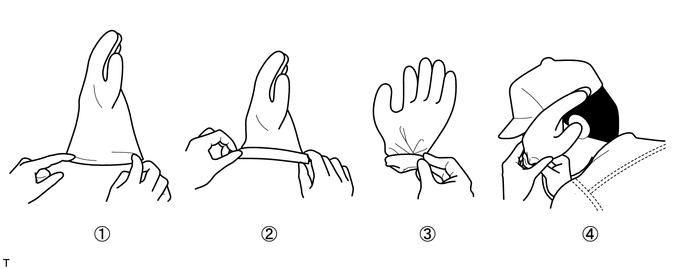
Before using insulated gloves, be sure to check them for cracks, tears and other types of damage by performing the following procedure.
-
Place the glove on its side.
-
Roll the opening up 2 or 3 times.
-
Fold the opening in half to close it.
-
Confirm that there are no air leaks.
-
-
When servicing the vehicle, do not carry metal objects like mechanical pencils or rulers that can be dropped accidentally and cause a short circuit.
-
Before touching a bare high-voltage terminal, wear insulated gloves and use a tester to make sure that the terminal voltage is 0 V.
-
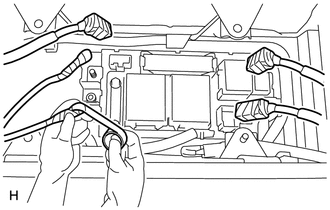
After disconnecting or exposing a high-voltage connector or terminal, insulate it immediately using insulating tape.
-
Bolts and nuts for high-voltage terminals should be tightened firmly to the specified torque. Both insufficient and excessive torque can cause failure.
-
Use the "CAUTION: HIGH VOLTAGE DO NOT TOUCH" sign to notify other technicians that the high-voltage system is being inspected and/or repaired.
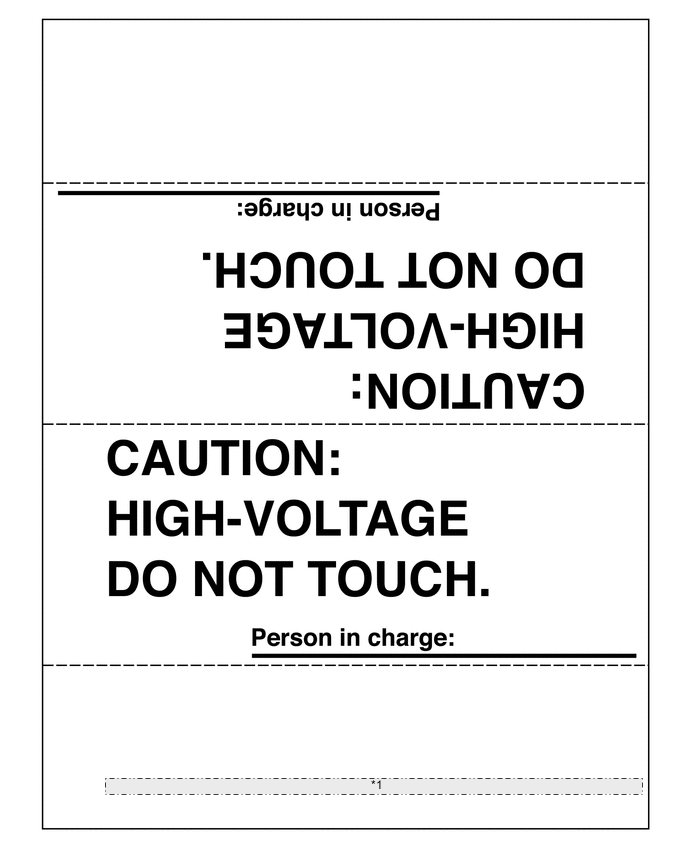
*1 When performing work on the EV system, fold this sign and put it on the roof of the vehicle. -
Use the "CAUTION: HIGH PRESSURE GAS DO NOT TOUCH" sign to notify other technicians that the high-pressure gas system is being inspected and/or repaired.
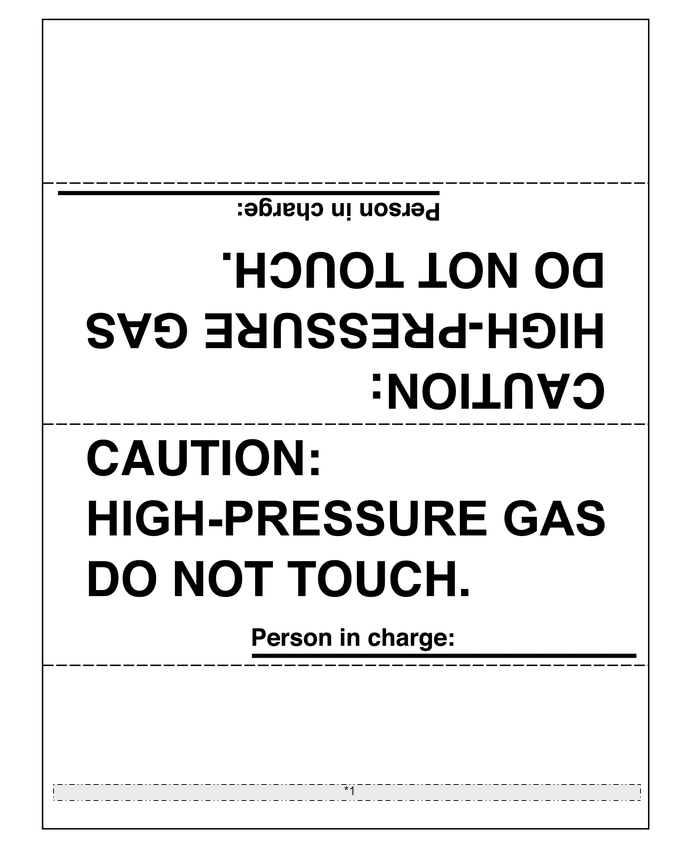
*1 Place signs [HIGH PRESSURE GAS WORK IN PROGRESS - DO NOT TOUCH!], etc. to warn other technicians to be cautious. (An example sign is included, so make a copy and use it.) -
After servicing the high-voltage system and before reinstalling the service plug grip, check again that you have not left a part or tool inside, that the high-voltage terminals are firmly tightened, and that the connectors are correctly connected.
-
When performing work involving high-voltage wires, use either a tool wrapped with vinyl insulation tape or an insulated tool.
-
When installing hybrid system components such as the EV battery, make sure that the polarity of all connections is correct.
-
-
ACTIONS TO BE TAKEN FOR VEHICLES DAMAGED BY IMPACT (Hydrogen System)
CAUTION:
-
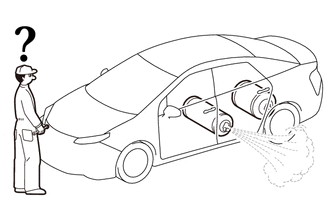
Hydrogen gas is a colorless, odorless and flammable gas.
-
Because the flammable concentration range is wide (4 - 74.5%) and the energy required for ignition is extremely low, even static electricity can easily cause hydrogen gas to ignite. While working on the vehicle, if the sound of hydrogen gas leaking (a loud hissing sound) can be heard, measure the hydrogen gas concentration with a hydrogen concentration detector. If the hydrogen gas concentration near the vehicle is more than 4%, there is a danger that the hydrogen could ignite, so move away from the vehicle immediately.
-
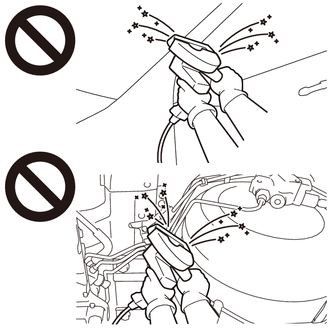
Even after the vehicle is stopped, there is still hydrogen gas remaining in hydrogen equipment such as the hydrogen tanks and in the hydrogen piping. To avoid fires or explosions, do not cut or destroy hydrogen equipment or hydrogen piping.
-
Because of the danger of hydrogen igniting, when a hydrogen leak is present, do not use electrical devices or rescue devices that could generate static electricity.
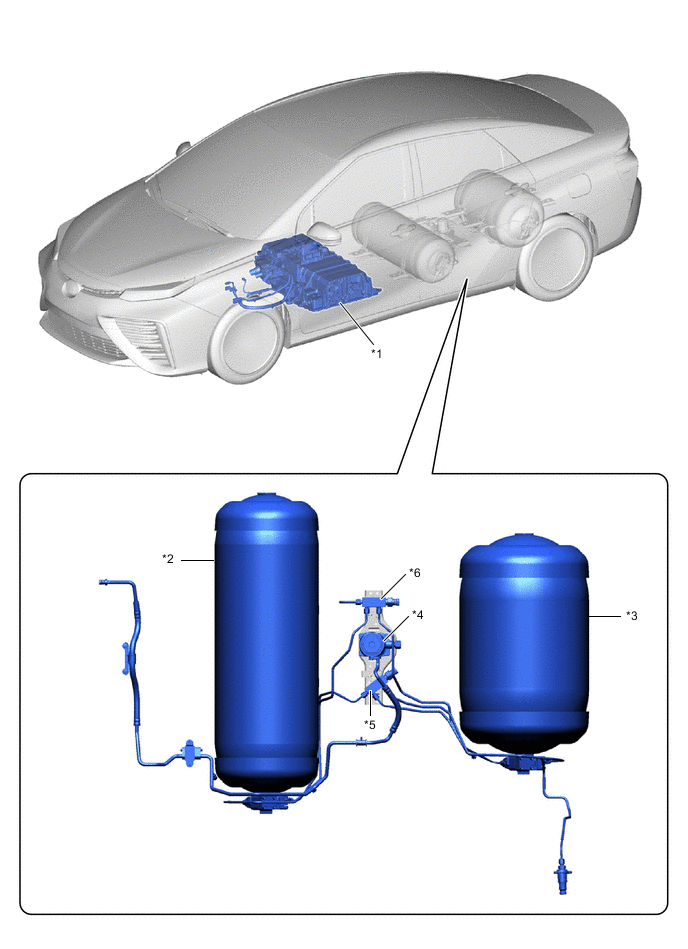
*1 FC Stack Assembly *2 No. 1 Hydrogen Tank Assembly *3 No. 2 Hydrogen Tank Assembly *4 Hydrogen Supply Regulator Assembly *5 Hydrogen Tube Joint (Inlet Side) *6 Hydrogen Tube Joint (Outlet Side)
-
In case of a vehicle fire
-
A fuel cell vehicle (FCV) contains compressed hydrogen gas.
-
When spraying water on the fire, prepare for the hydrogen to ignite, and keep your distance from the vehicle while spraying water.
-
In particular, spray a large amount of water on the hydrogen tanks under the floor at the rear of the vehicle to keep them cool.
-
If the hydrogen has ignited, completely extinguishing the fire could cause unburned hydrogen gas to collect, which could result in a secondary explosion. To prevent this, spray water to keep the fire from spreading to the surroundings, and wait for the fire to burn itself out (when all the fuel has been expended).
-
To prevent the hydrogen tanks from exploding due to abnormal temperature / pressure increase, fusible plug valves designed into the hydrogen tanks will open when the temperature exceeds 110°C, causing the hydrogen gas inside the tanks to be discharged toward the rear of the vehicle.
-
Although pure hydrogen gas burns with a nearly colorless flame that is very difficult to see, in the case of a vehicle fire, the flames will be mixed with other flames from nearby combustible materials, making them easier to see.
-
A peculiar characteristic of hydrogen flame is that while the temperature of the flame itself is extremely high, because the flame emits very little radiant heat, it is difficult to feel the heat of the fire when approaching it.
-
-
Make sure that the sound of hydrogen gas leaking (a loud hissing sound) cannot be heard.
-
When approaching the vehicle, approach from the front side of the vehicle.
-
When a leaking sound can be heard, there is a danger of igniting the hydrogen, so move away from the vehicle immediately.
-
Check that the leaking sound has stopped before moving on to the following procedure.
-
-
Using a hydrogen concentration detector, measure the hydrogen concentration around the vehicle to make sure that it does not exceed 4%.
-
If the concentration exceeds 4%, there is a danger of igniting the hydrogen, so move away from the vehicle immediately.
-
If a fan or blower is available, blow air to reduce the hydrogen concentration. When approaching the vehicle, approach from the upwind side.
-
Periodically measure the hydrogen concentration, and make sure that the hydrogen concentration does not exceed 4% before moving on to the following procedure.
-
-
-
ACTIONS TO BE TAKEN FOR VEHICLES DAMAGED BY IMPACT (High-voltage System)
CAUTION:
This vehicle has a hybrid system that operates at voltages up to 650 V. The hybrid system uses an EV battery that contains an electrolyte which is a strong alkali solution that includes potassium hydroxide. Be sure to follow the instructions in this manual to handle the system correctly. Failure to do so may result in serious injury or electrocution.
-
Items to be prepared for the accident site
-
Protective clothing (insulated gloves, rubber gloves, goggles and safety shoes)
-
20 liters (21.1 US qts, 17.6 Imp. qts) saturated boric acid solution (obtain 800 g (1.76 lb) of boric acid powder, put it into a container, and dissolve it in water)
-
Red litmus paper
-
ABC fire extinguisher (effective against both oil flames and electrical flames)
-
A shop rag or piece of cloth (for wiping up the neutralized electrolyte)
-
Insulating tape (for insulating cables)
-
Electrical tester
-
-
Actions to be taken at the accident site
CAUTION:
-
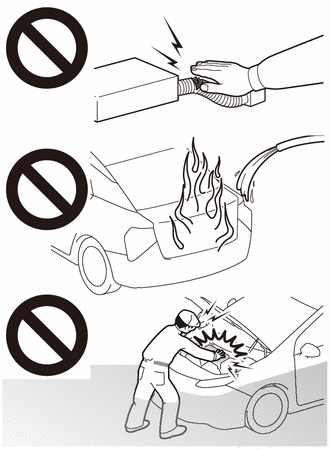
Do not touch any bare cables that may have high-voltage. If a cable must be touched or if accidental contact is possible, wear insulated gloves and insulate the cable using insulating tape.
-
If the vehicle catches on fire, use an ABC fire extinguisher to extinguish the fire. Trying to extinguish a fire using only a small amount of water can be more dangerous than effective. Use a substantial amount of water or wait for firefighters.
-
Visually check the EV battery and the immediate area for any electrolyte leakage. Do not touch any leaked liquid because it could be a highly alkaline electrolyte.
-
If the vehicle is submerged in water, work on the vehicle only after the vehicle has been pulled out of the water.
-
Check the vicinity of the EV battery for any leakage of the electrolyte.
CAUTION:
-
Do not touch any leaked liquid because it could be a highly alkaline electrolyte. Wear rubber gloves and goggles, neutralize the liquid with a saturated boric acid solution and then apply red litmus paper to the liquid. Check that the paper does not turn blue. Wipe up the neutralized liquid with a shop rag or piece of cloth.
-
If the electrolyte comes in contact with your skin, use a saturated boric acid solution or a large amount of water to wash it off. If the electrolyte comes in contact with an article of clothing, take it off immediately.
-
If the electrolyte comes in contact with your eyes, call out loudly for help. Do not rub your eyes. Wash them immediately with a large amount of water and seek medical care.
-
-
If damage to any of the high-voltage components and cables is suspected, cut the high-voltage circuit using the following procedure.
CAUTION:
Be sure to wear insulated gloves, goggles and safety shoes.
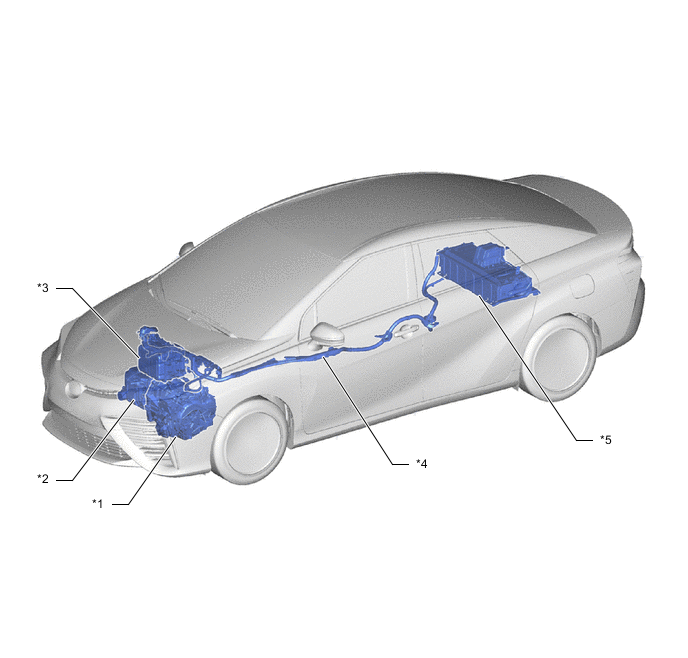
*1 FCV TRANSAXLE WITH MOTOR ASSEMBLY *2 FC AIR COMPRESSOR WITH MOTOR ASSEMBLY *3 INVERTER WITH CONVERTER ASSEMBLY *4 FRAME WIRE *5 EV BATTERY - - 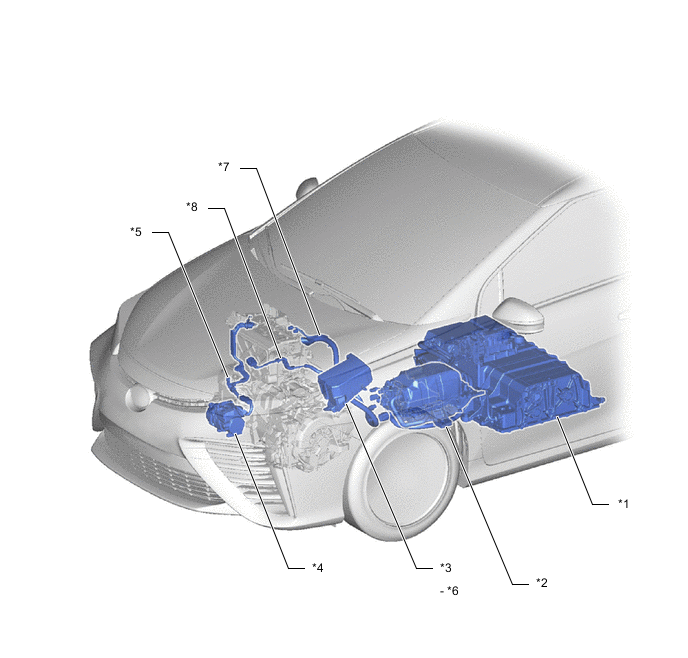
*1 FC STACK ASSEMBLY *2 FC CONVERTER ASSEMBLY *3 MOTOR COMPARTMENT RELAY BLOCK *4 COMPRESSOR WITH MOTOR ASSEMBLY *5 NO. 3 MOTOR WIRE *6 MG-IGCT FUSE *7 FC CONVERTER POWER OUTLET CABLE *8 HYDROGEN PUMP INVERTER CABLE -
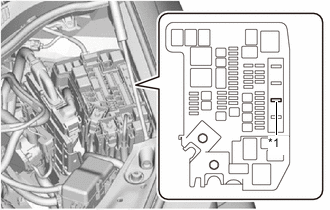
*1 IG2-MAIN Fuse Turn the power switch off.
Tech Tips
If the power switch cannot be turned off, remove the IG2-MAIN fuse from the motor compartment relay block. Confirm that the READY light is off.
-
Disconnect the cable from the negative (-) auxiliary battery terminal.
-
While wearing insulated gloves, remove the service plug grips.
Note
After removing the service plug grips, do not turn the power switch on (READY), unless instructed by the repair manual because this may cause a malfunction.
-
-
Moving the damaged vehicle
If any of the following conditions are met, tow the vehicle away using a tow truck.
-
One or more of the high-voltage components and cables are damaged.
-
One or more of the hydrogen system components and pipes are damaged.
-
Components related to driving, the transaxle, or the fuel system are damaged.
-
The master warning light is on.
-
The READY light does not come on when attempting to turn the power switch on (READY).
CAUTION:
Before towing the vehicle away using a tow truck, disconnect the cable from the negative (-) auxiliary battery terminal and remove the service plug grips.
Note
Perform the procedure below if the master warning light turns on, or there are abnormal noises, unusual smells, or strong vibrations while driving:
-
Park the vehicle in a safe place.
-
Apply the parking brake, and then push the P position switch.
-
Turn the power switch off, and disconnect the cable from the negative (-) auxiliary battery terminal.
-
Remove the service plug grips while wearing insulated gloves.
-
-
Actions required after moving the damaged vehicle
-
Procedure
If you see any liquid on the road surface, it could be highly alkaline electrolyte.
Wear rubber gloves and goggles, neutralize the liquid with a saturated boric acid solution, and then apply red litmus paper to the liquid. Check that the paper does not turn blue. Wipe up the neutralized liquid with a shop rag or piece of cloth.
-
-
Items to be prepared (when repairing a damaged vehicle)
-
Protective clothing (insulated gloves, rubber gloves, goggles and safety shoes)
-
20 liters (21.1 US qts, 17.6 Imp. qts) saturated boric acid solution (obtain 800 g (1.76 lb) of boric acid powder, put it into a container, and dissolve it in water)
-
Red litmus paper
-
A shop rag or piece of cloth (for wiping off the electrolyte)
-
Insulating tape (for insulating cables)
-
Electrical tester
-
-
Precautions to be observed when servicing a damaged vehicle
CAUTION:
Always follow instructions to ensure safety.
-
Wear insulated or rubber gloves, goggles, and safety shoes.
-
Check the EV battery and immediate area for any electrolyte leakage.
CAUTION:
-
Do not touch any leaked liquid because it could be a highly alkaline electrolyte. Wear rubber gloves and goggles, neutralize the liquid with saturated boric acid solution and then apply red litmus paper to the liquid. Check that the paper does not turn blue. Wipe up the neutralized liquid with a shop rag or piece of cloth.
-
If the electrolyte comes in contact with your skin, use a saturated boric acid solution or a large amount of water to wash it off. If the electrolyte comes in contact with an article of clothing, take it off immediately.
-
If the electrolyte comes in contact with your eyes, call out loudly for help. Do not rub your eyes. Wash them immediately with a large amount of water and seek medical care.
-
-
Do not touch any bare cables that could be high voltage cables. If a cable must be touched or if accidental contact is possible, follow the following instructions: 1) wear insulated gloves and goggles, 2) measure the voltage between the cable and body ground using an electrical tester, and 3) insulate the cable using insulating tape.
-
If damage to any of the high-voltage components and cables is suspected, cut the high-voltage circuit using the procedure below.
CAUTION:
Do not touch any bare cables that may have high-voltage. If a cable must be touched or if accidental contact is possible, wear insulated gloves and insulate the cable using insulating tape.
-
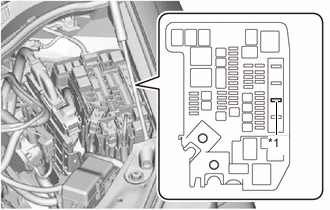
*1 IG2-MAIN Fuse Turn the power switch off.
Tech Tips
If the power switch cannot be turned off, remove the IG2-MAIN fuse from the motor compartment relay block. Confirm that the READY light is off.
-
Disconnect the cable from the negative (-) auxiliary battery terminal.
-
While wearing insulated gloves, remove the service plug grips.
Note
After removing the service plug grip, do not turn the power switch on (READY), unless instructed by the repair manual because this may cause a malfunction.
-
-
Precautions to be taken when disposing of an EV battery
-
When disposing of an EV battery, make sure to return it through an authorized collection agent who is capable of handling it safely. If the EV battery is returned via the manufacturer specified route, it will be returned properly and in a safe manner by an authorized collection agent.
CAUTION:
-
Accidents such as electric shock may result if the EV battery is disposed of improperly or abandoned. Therefore, make sure to return all EV batteries through an authorized collection agent.
-
After removing the EV battery, keep it away from water. Exposure to water may cause the EV battery to produce heat, resulting in a fire.
-
-
-
Precautions to be observed when towing
-
Tow the damaged vehicle with its front and rear wheels lifted off the ground.
CAUTION:
Towing the damaged vehicle with its wheels on the ground will cause the motor to generate electricity. This electricity could, depending on the nature of the damage, leak and cause a fire.
-
-
Towing with the 4 wheels on the ground
CAUTION:
-
If the vehicle needs to be towed using a cable or chain with all 4 wheels on the ground, do not exceed 5 km/h (3 mph) and tow only for a short distance and then have the vehicle towed by a truck.
-
Turn the power switch on (IG), move the shift lever to N and confirm that neutral (N) has been selected.
-
Make sure not to turn the power switch off while the vehicle is being towed. Park (P) may be selected, resulting in damage or an accident.
-
If any abnormality is present in the damaged vehicle during towing, stop towing immediately.
Tech Tips
-
Neutral (N) cannot be selected if the auxiliary battery is disconnected.
-
There is a possibility that neutral (N) cannot be selected when parts related to the transmission control ECU have a malfunction.
-
-
-
ELECTRONIC CONTROL
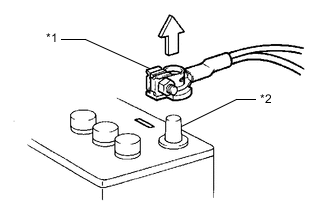
*1 Cable *2 Negative (-) Auxiliary Battery Terminal Note
-
Certain systems need to be initialized after disconnecting and reconnecting the cable to the negative (-) auxiliary battery terminal.
-
Before starting the hybrid system, make sure that the ground point is installed to the body with the bolts.
-
After the power switch is turned off, the navigation receiver assembly records various types of memory and settings. As a result, after turning the power switch off, make sure to wait at least 90 seconds before disconnecting the cable from the negative (-) auxiliary battery terminal.
-
DISCONNECTING AND RECONNECTING NEGATIVE AUXILIARY BATTERY CABLE
-
Before performing work on electronic components, disconnect the cable from the negative (-) auxiliary battery terminal to prevent damage to the electrical system or components.
-
When disconnecting the cable, turn the power switch and headlight switch off and loosen the cable nut completely. Perform these operations without twisting or prying the cable. Then disconnect the cable.
-
Clock settings, radio settings, audio system memory, DTCs and other data will be cleared when the cable is disconnected from the negative (-) auxiliary battery terminal. Write down any necessary data before disconnecting the cable.
-
-
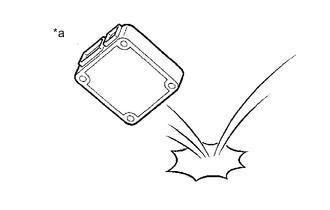
*a INCORRECT HANDLING OF ELECTRONIC PARTS
-
Do not open the cover or case of the ECU unless absolutely necessary. If the IC terminals are touched, the IC may be rendered inoperative by static electricity.
-
Do not pull on the wires when disconnecting electronic connectors. Pull on the connector itself.
-
Do not drop electronic components, such as sensors or relays. If they are dropped on a hard surface, they should be replaced.
-
When cleaning the motor room components with steam, protect the electronic components, air filter and emission-related components from water.
-
Never use an impact wrench to remove or install temperature switches or temperature sensors.
-
When measuring the resistance between terminals of a wire connector, insert the tester probe carefully to prevent the terminals from bending.
-
-
-
REMOVING/INSTALLING COMPRESSED HYDROGEN SYSTEM COMPONENTS
CAUTION:
-
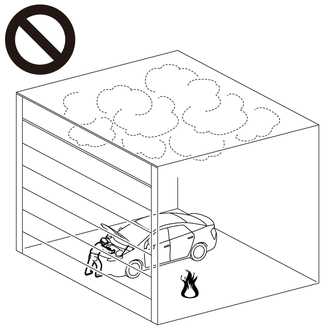
Work procedures must be performed in an area with good ventilation (airflow) where hydrogen gas will not accumulate, and flames or other things that could act as ignition sources must not be present.
-
Accumulated hydrogen gas could ignite, resulting in a serious accident.
-
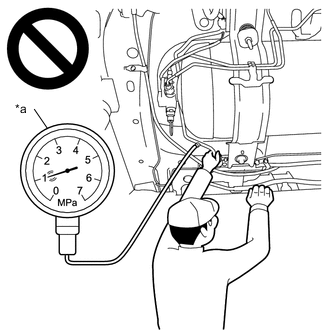
*a When inside of piping is pressurized Do not install or remove any hydrogen system components without first performing depressurization procedures.
-
The highly pressurized hydrogen gas inside the hydrogen tank assembly could blow out, resulting in a serious accident.
-
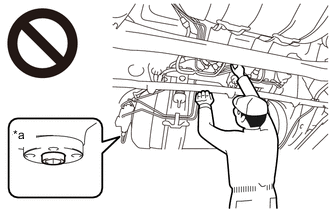
*a Manual Valve Open Do not perform depressurization procedures when the manual valve of the hydrogen tank assembly is open.
-
The highly pressurized hydrogen gas inside the hydrogen tank assembly could blow out, resulting in a serious accident.
-
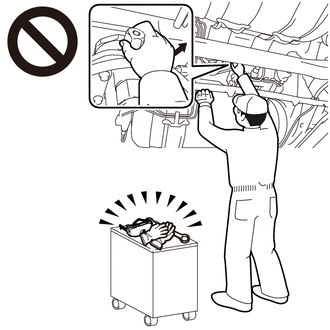
When performing depressurization, do not perform procedures by hand without wearing protective glasses and gloves.
-
The highly pressurized hydrogen gas inside the hydrogen tank assembly could blow out, resulting in a serious accident.
-
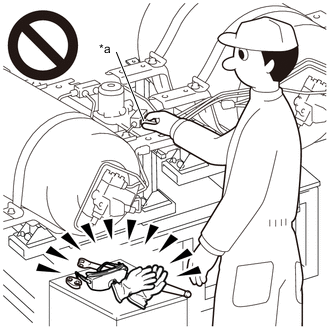
*a After depressurization procedures, the high pressure piping union nut that is loosened first. After performing depressurization procedures, when first loosening the union nut of the high pressure hydrogen piping, do not loosen the union nut by hand without wearing protective glasses and gloves.
-
Even when depressurization procedures are performed, the pressurized hydrogen gas inside the high pressure hydrogen piping cannot be completely depressurized, so the highly pressurized hydrogen gas remaining in the high pressure hydrogen piping could blow out, resulting in a serious accident.
-
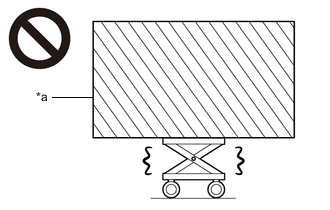
*a Heavy load exceeding the weight limits or size limits of the engine lifter Because the hydrogen tank unit is extremely heavy, make sure to follow the work procedures described in the repair manual.
-
If work is not performed according to the procedures described in the repair manual, there is a danger that the engine lifter could drop and components could fall down.
-
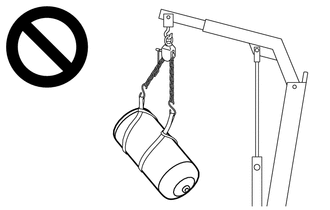
When hoisting up the hydrogen tank assembly, do not hoist it when not properly balanced.
-
The hydrogen tank assembly could fall, resulting in a serious accident.
-
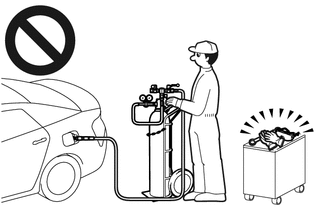
When performing the primary leak inspection, do not perform procedures without wearing protective glasses and gloves.
-
High pressure nitrogen gas could cause a serious accident.
-
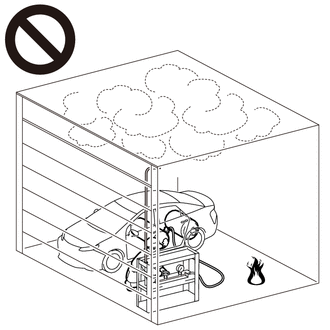
When venting pressurized hydrogen gas from the from the hydrogen tank assembly, do not perform the procedure in an indoor area with poor ventilation.
-
Accumulated hydrogen gas could ignite, resulting in a serious accident.
Note
-
After turning the power switch off, waiting time may be required before disconnecting the cable from the negative (-) auxiliary battery terminal. Therefore, make sure to read the disconnecting the cable from the negative (-) auxiliary battery terminal notices before proceeding with work.
-
Use the "CAUTION: HIGH PRESSURE GAS DO NOT TOUCH" sign to notify other technicians that the high-pressure gas system is being inspected and/or repaired.
*1 Place signs [HIGH PRESSURE GAS WORK IN PROGRESS - DO NOT TOUCH!], etc. to warn other technicians to be cautious. (An example sign is included, so make a copy and use it.) -
When performing depressurization, do not open or close any parts of the hydrogen gas piping except for the following:
- Adjustment bolt of the hydrogen tank assembly manual valve
- Tank shut valve of the hydrogen tank assembly
- Nut of the hydrogen supply regulator assembly medium pressure leak check port
-
When installing or removing hydrogen system components (the hydrogen tank assembly, high pressure hydrogen piping, hydrogen inlet receptacle, hydrogen tube joint, hydrogen tank pressure sensor, and hydrogen supply regulator assembly), to prevent strain such as twisting from being applied to the high pressure hydrogen piping, use the hydrogen tank installation and removal guide tool, and remove the hydrogen tank unit from the vehicle before performing procedures.
-
Even when replacing only the No. 1 hydrogen tank assembly, or only the No. 2 hydrogen tank assembly, to prevent strain from being applied to the high pressure hydrogen piping, use the tank positioning attachment of the hydrogen tank installation and removal tool, and perform positioning of the No. 1 hydrogen tank assembly and No. 2 hydrogen tank assembly.
-
Even when not removing or installing the high pressure hydrogen piping, be careful not to pull or otherwise apply strain to the high pressure hydrogen piping.
-
Do not reuse high pressure hydrogen piping after it has been removed, because the coupling portions will not maintain their airtightness.
-
When reusable parts such as the hydrogen tank assembly valve portion, hydrogen inlet receptacle, hydrogen tube joint and hydrogen supply regulator assembly have been removed, to protect the seal portions and threaded portions from damage as well as to prevent foreign matter such as dust and metal fragments from entering through openings, cover these areas with protective tape.
-
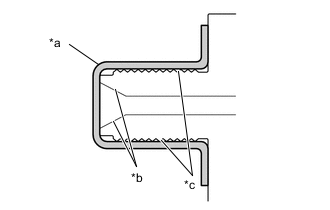
*a Protective Tape *b Seal Portion *c Threaded Portion Do not use use packing tape, or any other tape that will leave residue on parts, as protective tape.
-
Protect seal portions and threaded portions as shown in the illustration.
-
To protect the seal portions and threaded portions from damage or contamination by foreign matter, remove the protective tape immediately before installation.
-
When reassembling components that have been removed, make sure that there is no foreign matter adhering to the openings.
-
After installing hydrogen system components, first perform a primary leak inspection with low pressure nitrogen gas, and then fill pressurized hydrogen gas at a hydrogen station to perform a secondary leak inspection. When performing the secondary leak inspection, the vehicle cannot be driven to the hydrogen station under its own power, so transport it using a car carrier, etc.
-
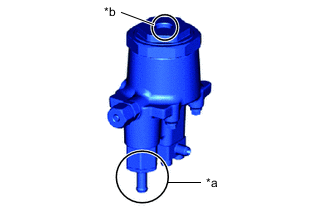
*a Exhaust Tube *b Atmosphere Ventilation Hole Cap Do not insert any sharp objects into the exhaust tube of the hydrogen supply regulator assembly release valve.
-
Do not remove the atmosphere ventilation hole cap of the hydrogen supply regulator assembly.
-
When the vehicle is parked with the power switch off, if the FC control ECU judges that the FC stack temperature will go below 0°C (32°F), it activates the FC air compressor, hydrogen pump and FC cooling water pump for a maximum of 180 seconds and drains water from the FC stack assembly. When performing inspection or repairs with the power switch off (not on (IG) or on (READY)), disconnect the cable from the negative (-) auxiliary battery terminal before performing work.
-
-
REMOVING/INSTALLING FC COOLING SYSTEM COMPONENTS
Note
-
The coolant (Toyota genuine FC stack coolant) is an exclusive coolant.
-
The coolant (Toyota genuine FC stack coolant) cannot be reused, so when filling, be sure to fill with new coolant (Toyota genuine FC stack coolant).
-
To prevent degradation of coolant (Toyota genuine FC stack coolant) performance, do not add or fill any other substances such as tap water or battery electrolyte refill liquid.
-
Do not use cotton work gloves or other gloves that could shed fibers.
-
DO NOT use any container that has previously been used to fill substances such as oil.
-
To prevent foreign matter from contaminating the coolant (Toyota genuine FC stack coolant) passages, wash out the prepared container with tap water, then wipe away any water remaining inside the container before using it.
-
If the coolant (Toyota genuine FC stack coolant) passages are filled incorrectly, follow the countermeasures according to "Countermeasures when coolant (Toyota genuine FC stack coolant) passages are filled incorrectly".
-
When the vehicle is parked with the power switch off, if the FC control ECU judges that the FC stack temperature will go below 0°C (32°F), it activates the FC air compressor, hydrogen pump and FC cooling water pump for a maximum of 180 seconds and drains water from the FC stack assembly. When performing inspection or repairs with the power switch off (not on (IG) or on (READY)), disconnect the cable from the negative (-) auxiliary battery terminal before performing work.
-
If foreign contaminants such as metal fragments enter the cooling system, they will adversely affect the FC stack and other components.
-
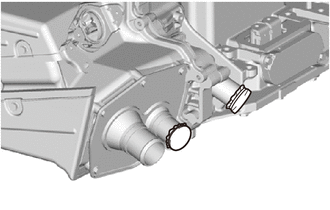
When installing or removing cooling system components, cover the openings of the removed cooling system components as well as the openings of the parts they connect to with protective tape to prevent entry of foreign matter.
-
When installing cooling system components, make sure there is no contamination by foreign matter.
-
-
INSTALLING/REMOVING EV COOLING SYSTEM COMPONENTS
-
If foreign contaminants such as metal fragments enter the cooling system, they will adversely affect the inverter and other components.
-
When installing or removing cooling system components, cover the openings of the removed cooling system components as well as the openings of the parts they connect to with protective tape to prevent entry of foreign matter.
-
When installing cooling system components, make sure there is no contamination by foreign matter.
-
-
PRECAUTIONS FOR TOWING FRONT WHEEL DRIVE VEHICLES
-
Use one of the following methods to tow the vehicle.
-
If the vehicle has trouble with the chassis or drivetrain, use method 1 (flatbed truck).
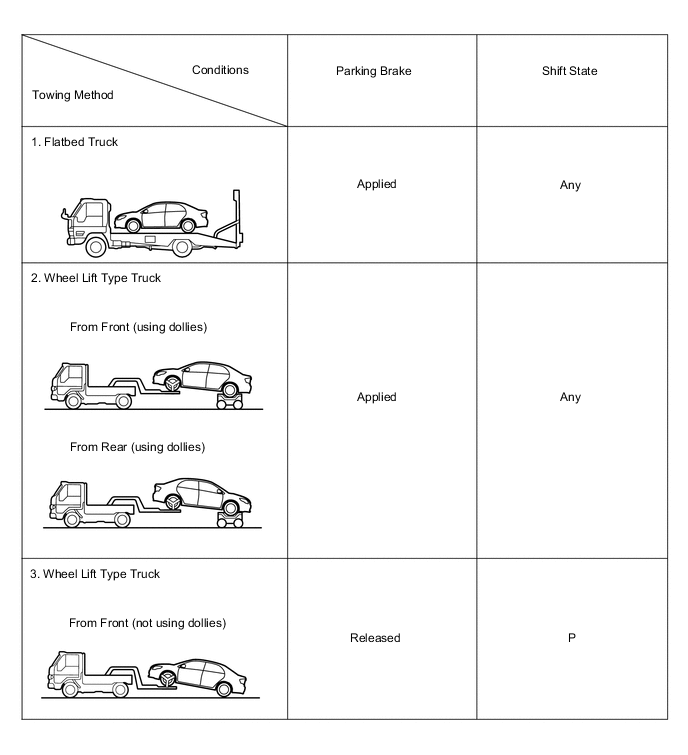
Note
Do not use any towing method other than those shown above.
-
If a tow truck is not available, in an emergency the vehicle may be temporarily towed using a cable or chain secured to the emergency towing eyelet(s). This should only be attempted on hard surfaced roads for as short of a distance as possible and at a vehicle speed of 5 km/h (3 mph) or less.
A driver must be in the vehicle to steer and operate the brakes. The vehicle's wheels, drivetrain, axles, steering and brakes must be in good condition.
Note
If the towing speed exceeds the above limits, or if the vehicle is towed for a long distance or in a backward direction with any of the wheels on the ground, the drivetrain may be damaged.
-
Emergency towing procedure
-
Turn the power switch on (IG).
-
Depress the brake pedal and move the shift lever to N.
-
Release the parking brake.
-
Release the brake pedal slowly.
Note
-
Use extreme caution when towing the vehicle. Avoid sudden starts or erratic driving maneuvers which place excessive stress on the emergency towing eyelet and the cables or chains.
Tech Tips
-
Neutral (N) cannot be selected if the auxiliary battery is discharged or if it has been disconnected.
-
There is a possibility that neutral (N) cannot be selected when parts related to the transmission control ECU have a malfunction.
-
-
-
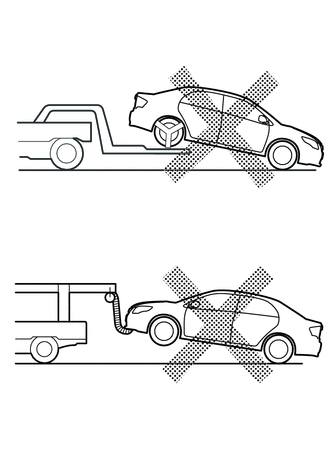
The towing methods shown below are dangerous and can damage the vehicle, so do not use them.
-
Do not tow the vehicle with only 2 wheels on the ground.
Note
If the vehicle is towed with only 2 wheels on the ground, the drivetrain may overheat and be damaged, or the wheels may come off the dollies.
-
Do not use a sling-type towing method either from the front or rear.
Note
If a sling-type tow truck is used, damage may occur to the vehicle body.
-
-