| DTC Code | DTC Name |
|---|---|
| B27A7 | Open in Inside Luggage Compartment Electrical Key Oscillator Circuit |
DESCRIPTION
The certification ECU generates a request signal and transmits the signal to the indoor electrical key oscillator (inside luggage). The indoor electrical key oscillator (inside luggage) detects that the electrical key is inside the vehicle and transmits the request signal received from the certification ECU. DTC B27A7 is stored by the certification ECU when an open circuit is detected in the circuit between the certification ECU and indoor electrical key oscillator (inside luggage) (CLG7 - CLG6, CG7B - CLGB).
| DTC Code | DTC Detection Condition | Trouble Area |
|---|---|---|
| B27A7 | An open circuit is detected in the circuit between the certification ECU and indoor electrical key oscillator (inside luggage) (CLG7 - CLG6, CG7B - CLGB). |
|
INSPECTION PROCEDURE
When using the intelligent tester with the engine switch off to troubleshoot: Connect the intelligent tester to the DLC3, and turn a courtesy light switch on and off at 1.5-second intervals until communication between the tester and vehicle begins.
PROCEDURE
- Click here
CHECK CONNECTOR CONNECTION CONDITION
-
Turn the engine switch off.
-
Check that the connectors are properly connected to the certification ECU and indoor electrical key oscillator (inside luggage).
OK Connectors are properly connected.
- OKClick here
- NGClick here
-
- Click here
CHECK HARNESS AND CONNECTOR (INDOOR ELECTRICAL KEY OSCILLATOR - CERTIFICATION ECU)
-
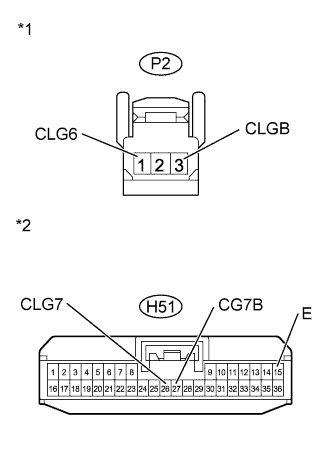
Disconnect the H51 ECU connector.
-
Disconnect the P2 oscillator connector.
-
Measure the resistance according to the value(s) in the table below.
Standard Resistance Tester Connection Condition Specified Condition P2-1 (CLG6) - H51-26 (CLG7) Always Below 1 Ω P2-3 (CLGB) - H51-27 (CG7B) Always Below 1 Ω H51-26 (CLG7) - Body ground Always 10 kΩ or higher H51-27 (CG7B) - Body ground Always 10 kΩ or higher H51-15 (E) - Body ground Always Below 1 Ω Table 1. Text in Illustration *1 Front view of wire harness connector
(to Indoor Electrical Key Oscillator [Inside Luggage])
*2 Front view of wire harness connector
(to Certification ECU)
- OKClick here
- NGClick here
-
- Click here
CHECK CERTIFICATION ECU
-
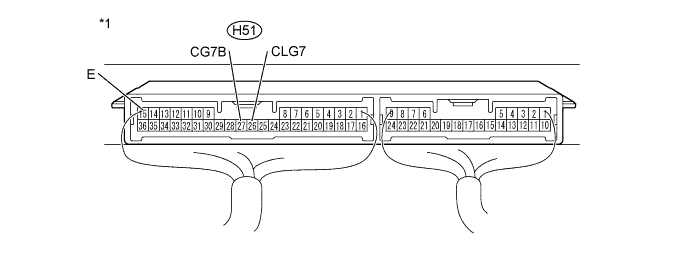
Measure the voltage according to the value(s) in the table below.
Standard Voltage Tester Connection Switch Condition Specified Condition H51-26 (CLG7) - H51-15 (E) Engine switch off, all doors closed, key not in cabin and lock sensor off No pulse generation H51-26 (CLG7) - H51-15 (E) Engine switch off, all doors closed, key not in cabin and lock sensor on Pulse generation H51-27 (CG7B) - H51-15 (E) Engine switch off, all doors closed, key not in cabin and lock sensor off No pulse generation H51-27 (CG7B) - H51-15 (E) Engine switch off, all doors closed, key not in cabin and lock sensor on Pulse generation Table 2. Text in Illustration *1 Component with harness connected
(Certification ECU)
- -
- OKClick here
- NGClick here
-
- Click here
REPLACE INDOOR ELECTRICAL KEY OSCILLATOR (INSIDE LUGGAGE)
-
Temporarily replace the indoor electrical key oscillator (inside luggage) with a new or normally functioning one (Click here).
- NEXTClick here
-
- Click here
CHECK FOR DTC
-
Clear the DTCs (Click here).
-
Check for DTCs (Click here).
OK DTC B27A7 is not output.
- OKClick here
- NGClick here
-
- Click here
CONNECT CONNECTORS PROPERLY
- Click here
REPAIR OR REPLACE HARNESS OR CONNECTOR
- Click here
REPLACE CERTIFICATION ECU
- Click here
END (INDOOR ELECTRICAL KEY OSCILLATOR IS DEFECTIVE)