ENTRY AND START SYSTEM (for Entry Function) SYSTEM DESCRIPTION

CAUTION:
If using a pacemaker, be sure to read the manual of the pacemaker before using the key, as the radio waves of the key may affect the pacemaker.
-
ENTRY AND START SYSTEM DESCRIPTION
-
In addition to conventional mechanical key and wireless door lock control functions, the entry and start system enables door locking/unlocking, steering lock releasing, engine control system starting and back door opening without operating the key. The only requirement is that the key is in the possession of the user.
-
This system is controlled by the certification ECU. When the certification ECU detects the presence of the key in one of the detection areas, it identifies and checks the ID code, and outputs operation signals to the related ECU in accordance with their functions.
-
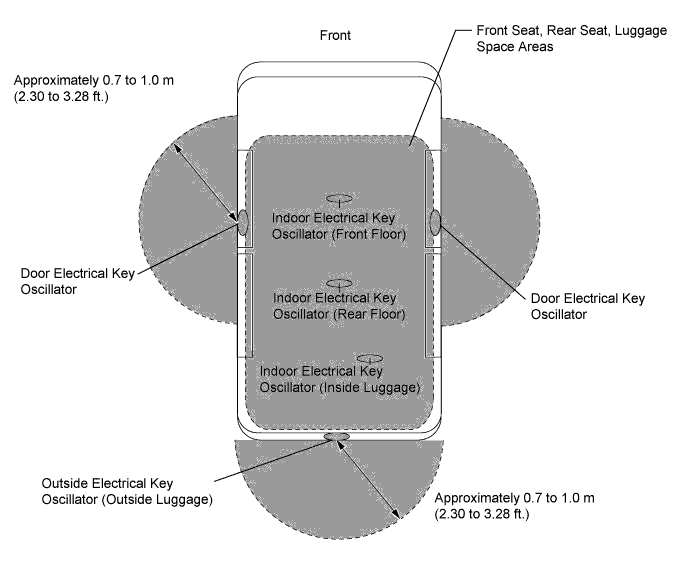
The detection areas are formed by 6 oscillators (2 door oscillators, an outside oscillator and 3 indoor oscillators).
-
-
-
DETECTION AREA
-
Precautions for the entire system:
-
Be sure to carry the key during inspection of the entry and start system.
-
As weak radio waves are used to detect the key, the key detection area may decrease, or the key may not be detected correctly in the following situations.
-
The key battery is depleted.
-
Any facilities that generate strong radio waves, such as a TV tower, power plant, broadcast station or gas station, are located near the inspection site.
-
A wireless device, such as a cell phone, is carried with the key.
-
The key is in contact with or covered with metal.
-
Electric wave type keyless entry systems are being operated nearby.
-
The key is located near a device that generates high voltage or noise.
-
Film with some metallic content is stuck to the back glass.
Tech Tips
In this case, remove the cause or unlock the door using the mechanical key.
-
Even if the key is in the vehicle exterior key detection area, the key may not operate properly due to the vehicle body design.
-
The key may not be detected correctly if it is around the vehicle windows, door handle or center of the bumper, even when it is in the detection area outside the vehicle.
-
The key may not be detected correctly if it is on the instrument panel or floor, or in the glove box, even when it is in the detection area inside the vehicle.
-
The key may not operate if the key is not held properly.
-
The entry and start system does not operate in the following conditions:
-
The entry and start system is canceled.
-
The key battery is completely depleted (the indicator does not blink when pushing any of the switches on the key).
-
-
-
FUNCTION OF MAIN COMPONENTS
Component Function Certification ECU Controls the entry and start system in accordance with signals from each oscillator, various switches, ECUs and the key.
-
Performs key verification.
-
Performs vehicle interior/exterior transmission.
-
Performs occupant sensor control.
-
Sends lock/unlock commands during entry function.
-
Sends steering lock/unlock commands.
-
Sends immobiliser set/unset commands.
-
Records verification codes.
Main body ECU
-
Receives request signals from the certification ECU and actuates each door lock motor to unlock or lock the doors.
-
Transmits each door condition to the certification ECU.
Power management control ECU Controls the push button start function in accordance with signals from various switches, ECUs and the combination meter.
-
Transmits the electrical key verification request signal to the certification ECU in accordance with the engine switch signal, and turns relays on and off.
ID code box
-
Receives a command from the certification ECU, and sends an immobiliser set/unset command to the ECM.
-
Records verification codes.
Indoor electrical key oscillator (front floor, rear floor and inside luggage) Receives a request signal from the certification ECU, and forms the detection area in the vehicle interior. Door control receiver Receives the ID code from the key in the detection area and transmits it to the certification ECU. Outside electrical key oscillator (outside luggage) Receives a request signal from the certification ECU, and forms the detection area around the back door. Back door opener switch Transmits a back door open request signal to the main body ECU. Back door lock switch Transmits a back door lock request signal to the certification ECU. Door electrical key oscillator (for driver, front passenger side doors) Receives a request signal from the certification ECU, and forms the detection area around each door. Front door outside handle (for driver, front passenger side doors) (oscillator) Transmits request signals. Front door outside handle (for driver, front passenger side doors) (unlock sensor) Detects when a person touches the inside of the outside handle. Front door outside handle (for driver, front passenger side doors) (lock sensor) Transmits door lock request signals to the certification ECU. Key Consists of a mechanical key, transmitter for wireless door lock control and transceiver for entry and start system. Wireless door lock buzzer
Combination meter
-
Multi-information display
-
Buzzer
When the certification ECU detects human errors such as those below, it warns the driver by sounding the wireless door lock buzzer, displays information and sounds the buzzer in accordance with the request signal from the ECU.
Example:
-
Key is brought out of the vehicle while the engine is still running.
-
Key is brought out of the vehicle while the shift lever is in a position other than P*.
-
*: except Manual Transaxle
-
-
CONSTRUCTION AND OPERATION
-
Key:
A total of 7 keys can be registered.
-
Electrical key transmitter:
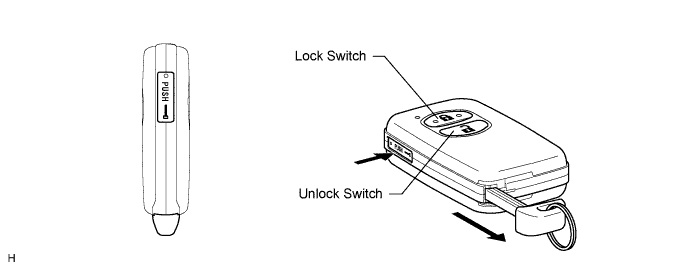
The electrical key transmitter consists of a mechanical key, a transmitter function for the wireless door lock control and a transceiver for the entry and start system.
-
The transceiver function for the entry and start system receives the signals from the oscillators and sends the ID code to the door control receiver.
-
The transmitter function for the wireless door lock control has a lock switch, unlock switch and luggage switch.
-
The mechanical key can lock/unlock all the doors. To lock or unlock the doors, remove the cap from the driver door outside handle, insert the key into the door key cylinder, and then turn it to the lock or unlock position.
-
-
-
Oscillator (each door oscillator, front floor, rear floor and inside luggage indoor oscillator, and outside oscillator):
Each oscillator transmits the request signal received from the certification ECU, and forms a key detection area to detect the presence of a key. The detection area formed by each door oscillator and the outside oscillator is approximately 0.7 to 1.0 m (2.30 to 3.28 ft.) from the outside handle of each door and the center of the rear bumper.
-
The detection area of each door oscillator is formed by transmitting a request signal every 0.25 seconds while the engine switch is off and each door is locked. In this way, it detects the proximity of a key. During entry lock, the detection area is formed with the lock switch on.
-
The detection area of the outside oscillator is formed when the back door opener switch is on.
-
The detection area of the indoor oscillators (front floor, rear floor and inside luggage) is formed when the driver door is opened or closed, during starting, when a warning is activated, or when the lock switch is on.
-
-
-
ENTRY FUNCTION OPERATION
-
The entry and start system has the following functions.
Function Outline Mechanical Key Operation is the same as a conventional mechanical key. Wireless Door Lock Control This function remotely locks and unlocks all doors and the back door. Operation is the same as the wireless door lock control system. However, the receiver in the certification ECU uses the door control receiver to control locking and unlocking. Entry Illumination When a person carrying the key enters the detection area, the door will enter unlock standby mode and the room light will illuminate. Entry Unlock When the key is located in the detection area of the door oscillator, the door will unlock by touching the inside of the outside door handle. Entry Unlock Mode Switching Click here
Changes the doors that can be unlocked with the entry unlock function between 2 modes.
-
Driver door unlock mode
-
All door unlock mode
Entry Lock
-
When the key is located in the detection area of a door electrical key oscillator and the engine switch is off, the door can be locked by touching the lock sensor on the door outside handle assembly.
-
When the key is located in the detection area of the outside electrical key oscillator and the engine switch is off, the back door can be locked by pressing the lock switch on the back boor outside handle.
Entry Back Door Open When the key is in the detection area of the outside electrical key oscillator (outside luggage), the back door opens by pressing the back door opener switch. Key Lock-in Prevention Prevents lock-in of the key if the door is locked using the outside door handle while the key is still inside the vehicle. Warning When any of the situations below occur, the entry and start system causes the certification ECU to sound the buzzer in the combination meter and the wireless door lock buzzer, and display information in order to alert the driver.
-
Shift lever not in P (power source cut reminder) vehicle exit warning*
-
Key reminder warning
-
Shift lever in P (power source cut reminder) vehicle exit warning*
-
Entry door ajar warning
-
Passenger has brought key out of vehicle warning
-
Key is not within detection area warning
-
Key lock-in prevention function buzzer
-
Key battery low warning
Battery Saving If the key is constantly located within the detection area of the door oscillator, the system maintains periodic communication with the key. Therefore, if the vehicle remains parked in that state for a long time, the key battery and vehicle battery could be drained. For this reason, the vehicle has controls for saving battery power. Key Cancel Click here
The following key functions can be canceled:
-
Entry Unlock/Lock
-
Entry Ignition
-
Entry Back Door Open
-
Key Lock-in Prevention
-
Warning
-
*: except Manual Transaxle
-
-
-
ENTRY UNLOCK FUNCTION
-
The detection area is formed by communication between a door oscillator and the certification ECU when the door is locked in order to detect the person carrying the key.
-
When the person carrying the key enters the detection area around the vehicle, the matching of the ID codes for a door oscillator and key will automatically be performed. After the matching is completed, the door will enter unlock standby mode.
-
In unlock standby mode, the oscillator built into the outside handle starts sensing. If the outside handle is held (the back side of the handle is touched), the door unlock operation will be performed. At this time, the hazard warning lights blink twice.
-
If any of the doors are not opened after a door unlock operation, all doors will automatically lock after 30 seconds.
-
-
ENTRY LOCK FUNCTION
-
After leaving the vehicle carrying the key, touch the lock sensor on the outside handle assembly or push the back door open switch on the back door outside handle when all doors are closed.
-
The certification ECU determines whether the key is located inside or outside of the cabin based on the information from a door oscillator and indoor oscillator. Then matching of the ID codes is performed.
-
When the matching result shows that the key is not detected inside the vehicle and the ID codes of the key and door oscillator match, the door lock function will operate. At this time, the hazard warning lights blink once.
-
If the key is located inside of the cabin, the door lock function will not operate and the alarm buzzer (beep sound) will sound for 2 seconds.
-
-
ENTRY BACK DOOR OPEN FUNCTION
Stand in front of the back door with the key and push the back door opener switch to start the matching of the ID codes for the outside oscillator. If the ID codes match, the back door open operation will be performed.
-
PREVENTION OF KEY LOCK-IN FUNCTION
-
If the key is in the cabin, the doors are closed and the entry lock operation is attempted (the lock sensor on the door outside handle is touched), the system determines that the key is located in the cabin and unlocks the doors.
-
If the back door is closed and the lock switch is pressed with the key in the vehicle and the other doors locked, the alarm will sound and the back door will not lock.
-
-
ENTRY ILLUMINATION FUNCTION
In order to improve ease of entering and exiting the vehicle at night, the vehicle lights illuminate when the key is brought near the vehicle.
-
WARNING FUNCTION
-
General:
When any of the situations below occur, the entry and start system responds to alert the driver.
Warning Function Operation Condition Situation Shift lever not in P (power source cut reminder) vehicle exit warning* A Key reminder warning B Shift lever in P (power source cut reminder) vehicle exit warning* C Entry door ajar warning D Passenger has brought key out of vehicle warning E Key is not within detection area warning F Key lock-in prevention function buzzer (for cabin) G Key battery low warning H
-
*: except Manual Transaxle
-
-
Situation A:
Shift lever not in P (power source cut reminder) vehicle exit warning
-
With the shift lever not in P, the driver door is opened and vehicle exit (while holding key) is attempted.
Reason for warning: Sudden vehicle start prevention, vehicle theft prevention, vehicle roll-away prevention Warning start condition: Shift lever is not in P, engine switch is on (ACC) or on (IG), driver side door is opened and vehicle speed is 0 km/h (0 mph) Warning stop condition: Engine switch is off, shift lever is in P, vehicle speed is above 0 km/h (0 mph), or driver side door is closed Warning description Combination meter buzzer Multi-buzzer Sounds continuously (beep) Combination meter display Combination meter information "Shift to P Range" Telltale None Wireless buzzer None Recommended user action Move shift lever to P -
With the shift lever not in P, the driver door is opened, the key is brought out of vehicle, the driver door is closed and movement away from the vehicle is attempted.
Reason for warning: Sudden vehicle start prevention, vehicle theft prevention, vehicle roll-away prevention Warning start condition: Shift lever is not in P, engine switch is on (ACC) or on (IG), opened driver side door is closed, vehicle speed is 0 km/h (0 mph) and key is not in detected in vehicle interior or luggage interior Warning stop condition:
-
Key is detected in vehicle interior or luggage interior:
-
Buzzer stops and "Shift to P Range" is displayed on combination meter
-
Vehicle speed is more than 0 km/h (0 mph):
-
Buzzer stops and "Key is not detected" - "Check key position" is displayed on combination meter
-
Engine switch off:
-
All warnings are turned off
Warning description Combination meter buzzer Multi-buzzer Sounds continuously (beep) Combination meter display Combination meter information Information below is displayed alternately on combination meter
"Shift to P Range"
"Key is not detected" - "Check key position"
Telltale None Wireless buzzer Sounds continuously (beep) Recommended user action Move shift lever to P -
-
-
Situation B:
Key reminder warning
-
The steering lock is unlocked, the driver door is opened and movement away from the vehicle is attempted.
Reason for warning: Vehicle theft prevention, required by law Precondition: Remote start is not operating Warning start condition: One of following conditions is met
-
Engine switch is off, steering lock is unlocked and driver door is opened
Warning stop condition: One of following conditions is met
-
Engine switch is on (IG) or driver door is closed
-
Engine switch is on (ACC) or off, and steering lock is locked
Warning description Combination meter buzzer Multi-buzzer Sounds intermittently (several "pon" sounds) Combination meter display Combination meter information None Telltale None Wireless buzzer None Recommended user action If engine switch is on (ACC) or on (IG), turn engine switch off and close driver door -
-
-
Situation C:
Shift lever in P (power source cut reminder) vehicle exit warning
-
With the shift lever in P, the driver door is opened, the key is brought out of the vehicle, the driver door is closed and movement away from the vehicle is attempted.
Reason for warning: Vehicle theft prevention, "Engine control system cannot be restarted" prevention, battery depletion prevention Warning start condition: Shift lever is in P, engine switch is on (ACC) or on (IG), opened driver side door is closed and key is not in detected in vehicle interior or luggage interior Warning stop condition: Engine switch is off, or key is detected in vehicle interior or luggage interior Warning description Combination meter buzzer Multi-buzzer Sounds once (1 "pon" sound) (when key is not detected continuously, sounds again when vehicle is first driven) Combination meter display Combination meter information "Key is not detected" - "Check key position" Telltale None Wireless buzzer Sounds 3 times (short beeps) Recommended user action Turn engine switch off and exit vehicle while holding key -
With the shift lever in P and the engine switch on (ACC) or on (IG), the driver door is opened, the user moves away from the vehicle, and the door handle lock sensor is touched in an attempt to perform the entry lock operation.
Reason for warning: Vehicle theft prevention, battery depletion prevention Precondition: Change door control lock switch from off to on Warning start condition: Shift lever is in P, engine switch is on (ACC) or on (IG), all doors are closed, driver side door is opened and closed, key is detected outside of vehicle, key is not detected in vehicle interior, and lock sensor is on Warning stop condition: One of following conditions is met
-
Engine switch is off
-
Key is detected in vehicle interior or luggage interior
-
Vehicle speed is more than 0 km/h (0 mph)
-
Shift lever is not in P
Warning description Combination meter buzzer Multi-buzzer Sounds once (1 "pon" sound) (when key is not detected continuously, sounds again when vehicle is first driven) Combination meter display Combination meter information None Telltale None Wireless buzzer Sounds continuously (beep) Recommended user action Turn engine switch off and perform entry lock operation -
-
-
Situation D:
Entry door ajar warning
-
With one vehicle door open, the entry lock operation is attempted.
Reason for warning: Vehicle theft prevention Precondition: Engine switch is on (ACC) or off, and one door is open Warning start condition: Preconditions are met and entry lock operation is performed Warning stop condition: Engine switch is on (ACC) or on (IG), all doors are closed, wireless unlock is performed, entry unlock operation is performed or 5 seconds have passed after warning start Warning description Combination meter buzzer Multi-buzzer None Combination meter display Combination meter information None Telltale None Wireless buzzer Sounds continuously (beep) Recommended user action Close all doors and perform entry lock operation
-
-
Situation E:
Passenger has brought key out of vehicle warning
-
With the engine switch in a condition other than off, the key is brought out of the vehicle by the passenger.
Reason for warning: "Engine control system cannot be started" prevention Warning start condition: Engine switch is on (ACC) or on (IG), opened door other than driver side door is closed, vehicle speed is 0 km/h (0 mph) and key is not in detected in vehicle interior or luggage interior Warning stop condition: Engine switch is off or key is detected in vehicle interior or luggage interior Warning description Combination meter buzzer Multi-buzzer Sounds once (1 "pon" sound) (when key is not detected continuously, sounds again when vehicle is first driven) Combination meter display Combination meter information "Key is not detected" - "Check key position" Telltale None Wireless buzzer Sounds 3 times (short beeps) Recommended user action Check if passenger who exited vehicle has key or not
-
-
Situation F:
Key is not within detection area warning
-
With the key not in the vehicle cabin or the key battery depleted, an engine switch on (ACC) or on (IG) operation is attempted.
Reason for warning: User confusion prevention Warning condition: Engine switch is not off and key is not detected in vehicle interior Warning description Combination meter buzzer Multi-buzzer Sounds once (1 "pon" sound) Combination meter display Combination meter information "Key is not detected" - "Check key position" is displayed for 10 seconds, then display ends Telltale None Wireless buzzer None Recommended user action Check if key is within detection area of vehicle cabin
If key is within the vehicle interior, built-in battery may be depleted
If wireless door lock switch on key is pressed, check if indicator on key illuminates
If indicator does not illuminate, replace built-in battery
It is recommended that battery be bought at dealer, but battery can be replaced according to user preference
-
-
Situation G:
Key lock-in prevention function buzzer (for cabin)
-
With the key in the vehicle cabin, the vehicle is exited and the door handle lock switch is touched in an attempt to perform the entry lock operation.
Reason for warning: Key reminder vehicle theft warning prevention Warning condition: Engine switch is off, all doors are closed, door handle lock sensor is on and key is detected in vehicle interior Warning description Combination meter buzzer Multi-buzzer None Combination meter display Combination meter information None Telltale None Wireless buzzer Sounds continuously (beep) Recommended user action Pick up key that is in vehicle interior and perform entry lock operation again
-
-
Situation H:
Key battery low warning
-
A key with an almost depleted battery is used to drive the vehicle.
Reason for warning: Helpful function Warning condition: After engine switch not off condition continues for 20 minutes or more, engine switch is turned off, key battery is low and key is detected in vehicle interior Warning description Combination meter buzzer Multi-buzzer Sound once (1 "pon" sound) Combination meter display Combination meter information "Low Key Battery" - "Have your vehicle checked by a dealer" Telltale None Wireless buzzer None Recommended user action Replace built-in key battery with new one
It is recommended that battery be bought at dealer, but battery can be replaced according to user preference
-
-
-
BATTERY SAVING
-
Vehicle battery saving function:
In the entry and start system, signals are emitted outside of the vehicle at a prescribed interval (0.25 seconds) when the doors are locked. Therefore, the vehicle battery could be drained if the vehicle remains parked for a long time. For this reason, the controls listed below exist.
Condition Control Both conditions below are met for 5 days:
-
Key is not in detection area
-
Touch sensor or lock sensor operation is not performed
Signal transmission interval is extended from 0.25 to 0.75 seconds Both conditions below are met for 14 days:
-
Key is not in detection area
-
Touch sensor or lock sensor operation is not performed
Automatically deactivates the entry and start system Reinstatement Conditions:
-
A wireless door lock control signal (lock, unlock) is input and the ID matches.
-
A user carries the key and touches the lock sensor on a door outside handle assembly.
-
The driver door is locked or unlocked by the mechanical key.
-
-
Key battery and vehicle battery saving function:
In the entry and start system, if the key is constantly located within the vehicle exterior detection area of the doors, the system maintains periodic communication with the key. Therefore, if the vehicle remains parked in that state for a long time, the key battery and the vehicle battery could be drained. For this reason, if this state continues for more than 10 minutes, the entry and start system automatically becomes deactivated.
Reinstatement Conditions:
-
A wireless door lock control signal (lock, unlock) is input and the ID code matches.
-
A user carries the key and touches the lock sensor on a door outside handle assembly.
-
The driver door is locked or unlocked by the mechanical key.
-
-
-
KEY DIAGNOSTIC MODE (Using the intelligent tester)
Tech Tips
Key diagnostic mode checks if the electrical key transmitter within a selected oscillator/antenna detection area is operating normally. The results are output through the wireless door lock buzzer (in the front fender).
-
Connect the intelligent tester to the DLC3.
-
Turn the engine switch on (IG).
-
Turn the intelligent tester on.
-
Enter the following menus: Body / Entry&Start / Key Communication Check.
-
Check the values by referring to the table below.
Entry & Start Tester Display Inspection Range Overhead + Driver Side*1 Door electrical key oscillator (for Driver Side) Overhead + Passenger Side*2 Door electrical key oscillator (for Front Passenger Side) Overhead + Front Room*3 Indoor electrical key oscillator (Front Floor) Overhead + Rear Room*4 Indoor electrical key oscillator (Rear Floor) Overhead + Back Door (inside)*5 Indoor electrical key oscillator (Inside Luggage) Overhead + Back Door*6 Outside electrical key oscillator (Outside Luggage) -
When the electrical key transmitter is brought near the selected oscillator/antenna, check that the wireless door lock buzzer sounds.
-

*1: Door electrical key oscillator (for Driver Side)
Tech Tips
-
Hold the key at the same height as the door outside handle (0.7 to 1.0 m (2.30 to 3.28 ft.)). Pay attention to the direction of the key in the illustration.
-
*2: Perform the same inspection above for the other door electrical key oscillator (for Front Passenger Side).
-
-
*3: Indoor electrical key oscillator (front floor)
Tech Tips
Place the electrical key transmitter on the driver or front passenger seat cushion.
-
*4: Indoor electrical key oscillator (rear floor)
Tech Tips
Place the electrical key transmitter on the rear seat cushion.
-
*5: Indoor electrical key oscillator (inside luggage)
Tech Tips
Place the electrical key transmitter in the luggage room.
-
*6: Outside electrical key oscillator (outside luggage)
Tech Tips
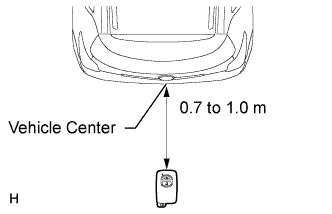
Hold the electrical key transmitter at the same height as the rear bumper upper surface and aligned with the center of the rear of the vehicle, as shown in the illustration.
-
-