Click here
-
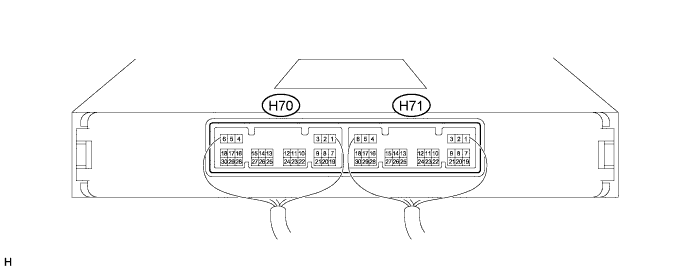
CHECK POWER MANAGEMENT CONTROL ECU (w/ Entry and Start System)
-
Measure the voltage and resistance according to the value(s) in the table below.
Tip:Perform the measurements with the connectors connected.
Terminal No. (Symbol) Wiring Color Terminal Description Condition Specified Condition H71-1 (AM22) - Body ground L - Body ground Battery Always 9.5 to 16 V H71-2 (AM21) - Body ground B - Body ground Battery Always 9.5 to 16 V H71-6 (GND) - Body ground W-B - Body ground Ground Always Below 1 Ω H70-10 (RLO) - H70-25 (E2) V - BR Generator signal Engine warmed up, charging control operating, vehicle driven at constant speed Pulse generation
(See waveform 1)
Engine warmed up, charging control operating, vehicle accelerating Pulse generation
(See waveform 2)
Engine warmed up, charging control operating, vehicle decelerating Pulse generation
(See waveform 3)
H70-23 (VC) - H70-25 (E2) W - BR Battery current sensor power supply Ignition switch ON 4.5 to 5.5 V H70-28 (THB) - H70-25 (E2) P - BR Battery current sensor thermistor signal Ignition switch ON
(Temperature of thermistor of battery current sensor: -30 to 90°C (-22 to 194°F))
0.5 to 4.5 V H70-30 (IB) - H70-25 (E2) B - BR Battery current sensor signal Ignition switch ON
(Temperature of thermistor of battery current sensor: -30 to 90°C (-22 to 194°F))
0.5 to 4.5 V H70-25 (E2) - Body ground BR - Body ground Battery current sensor ground Always Below 1 Ω If the result is not as specified, the ECU may have a malfunction.
-
Using an oscilloscope, check the signal waveform of the ECU.
Tip:The oscilloscope waveform shown in the illustration is an example for reference only. Waveforms with noise or chattering are not shown.
-
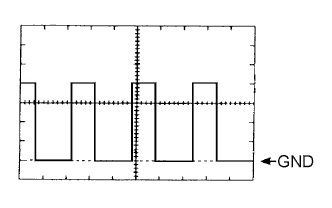
Waveform 1
Waveform 1 (Reference) Terminal No. (Symbol) Tool Setting Condition H70-10 (RLO) - H70-25 (E2) 2 V/DIV, 50 ms/DIV Engine warmed up, charging control operating, vehicle driven at constant speed Tip:As the duty cycle changes in accordance with the electrical load and battery condition, the output waveform also changes.
-
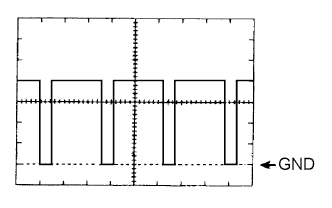
Waveform 2
Waveform 2 (Reference) Terminal No. (Symbol) Tool Setting Condition H70-10 (RLO) - H70-25 (E2) 2 V/DIV, 50 ms/DIV Engine warmed up, charging control operating, vehicle accelerating Tip:As the duty cycle changes in accordance with the electrical load and battery condition, the output waveform also changes.
-
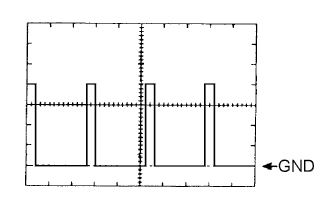
Waveform 3
Waveform 3 (Reference) Terminal No. (Symbol) Tool Setting Condition H70-10 (RLO) - H70-25 (E2) 2 V/DIV, 50 ms/DIV Engine warmed up, charging control operating, vehicle decelerating Tip:As the duty cycle changes in accordance with the electrical load and battery condition, the output waveform also changes.
-
-
-
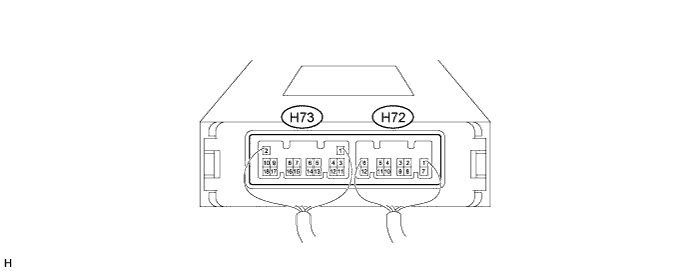
CHECK POWER MANAGEMENT CONTROL ECU (w/o Entry and Start System)
-
Measure the voltage and resistance according to the value(s) in the table below.
Tip:Perform the measurements with the connectors connected.
Terminal No. (Symbol) Wiring Color Terminal Description Condition Specified Condition H72-8 (AM21) - Body ground B - Body ground Battery Always 9.5 to 16 V H72-12 (GND) - Body ground W-B - Body ground Ground Always Below 1 Ω H73-14 (RLO) - H73-18 (E2) V - BR Generator signal Engine warmed up, charging control operating, vehicle driven at constant speed Pulse generation
(See waveform 1)
Engine warmed up, charging control operating, vehicle accelerating Pulse generation
(See waveform 2)
Engine warmed up, charging control operating, vehicle decelerating Pulse generation
(See waveform 3)
H73-12 (VC) - H73-18 (E2) W - BR Battery current sensor power supply Ignition switch ON 4.5 to 5.5 V H73-15 (THB) - H73-18 (E2) P - BR Battery current sensor thermistor signal Ignition switch ON
(Temperature of thermistor of battery current sensor: -30 to 90°C (-22 to 194°F))
0.5 to 4.5 V H73-13 (IB) - H73-18 (E2) B - BR Battery current sensor signal Ignition switch ON
(Temperature of thermistor of battery current sensor: -30 to 90°C (-22 to 194°F))
0.5 to 4.5 V H73-18 (E2) - Body ground BR - Body ground Battery current sensor ground Always Below 1 Ω If the result is not as specified, the ECU may have a malfunction.
-
Using an oscilloscope, check the signal waveform of the ECU.
Tip:The oscilloscope waveform shown in the illustration is an example for reference only. Waveforms with noise or chattering are not shown.
-
Waveform 1
Waveform 1 (Reference) Terminal No. (Symbol) Tool Setting Condition H73-14 (RLO) - H73-18 (E2) 2 V/DIV, 50 ms/DIV Engine warmed up, charging control operating, vehicle driven at constant speed Tip:As the duty cycle changes in accordance with the electrical load and battery condition, the output waveform also changes.
-
Waveform 2
Waveform 2 (Reference) Terminal No. (Symbol) Tool Setting Condition H73-14 (RLO) - H73-18 (E2) 2 V/DIV, 50 ms/DIV Engine warmed up, charging control operating, vehicle accelerating Tip:As the duty cycle changes in accordance with the electrical load and battery condition, the output waveform also changes.
-
Waveform 3
Waveform 3 (Reference) Terminal No. (Symbol) Tool Setting Condition H73-14 (RLO) - H73-18 (E2) 2 V/DIV, 50 ms/DIV Engine warmed up, charging control operating, vehicle decelerating Tip:As the duty cycle changes in accordance with the electrical load and battery condition, the output waveform also changes.
-
-