BLACK OUT TAPE (for Rear Door) INSTALLATION

Tech Tips
-
Use the same procedure for the RH side and LH side.
-
The procedure listed below is for the LH side.
-
A bolt without a torque specification is shown in the standard bolt chart Click here.
-
When installing the black out tape, heat the vehicle body surface and black out tape using a heat light
| Standard | ||||||
|---|---|---|---|---|---|---|
|
Note
Do not heat the vehicle body or black out tape excessively.
-
REPAIR INSTRUCTION
-
Clean the vehicle body surface.
-
Using a heat light, heat the vehicle body surface.
-
Wipe off any tape adhesive residue with cleaner.
-
-
Installation temperature.
-
When the ambient temperature is below 15°C (59°F), perform the installation procedure after warming the vehicle body surface (installation surface of the door frame) and tape to between 20 and 30°C (68 and 86°F) using a heat light. When the ambient temperature is above 35°C (95°F), cool the vehicle body surface (installation surface of the door frame) and tape to between 20 and 30°C (68 and 86°F) prior to installation.
Tech Tips
-
The most appropriate temperature for installing the tape is 25°C (77°F).
-
When the temperature is low, the tape turns stiff and falls off easily. When the temperature is high, the tape loses elasticity.
-
-
-
Before installation.
-
Make sure any dirt on and around the vehicle body surface where the tape will be installed (installation surface of the door frame) is removed, and that the surface is smooth. If the surface is rough or dirt remains when pressing the tape onto the surface, air will be trapped under the tape and result in a poor appearance.
Tech Tips
Spray water on the shop floor to settle any dust.
-
-
Key points for handling the tape.
-
The tape bends and rolls up easily. Store the tape between flat pieces of cardboard or other similar objects and keep it dry and level.
Note
Do not bend the tape or leave it in high temperature places.
-
-
Key points for the installation of the tape (how to use a squeegee and the installation procedure for flat surfaces).
Note
-
Position the tape with a high level of accuracy to achieve a neat finish and to avoid peeling.
-
The tape cannot be reused because it deforms and will not fit after removal.
-
To avoid air bubbles, slightly raise the part of the tape that is going to be applied so that its adhesive surface does not touch the vehicle body while applying the tape. Tilt the squeegee 40 to 50° (for pressing forward) or 30 to 45° (for pulling) from the vehicle body surface and press with a force of 20 to 30 N (2 to 3 kgf) while moving the squeegee at a constant slow speed of 3 to 7 cm (1.2 to 2.8 in.) per second.
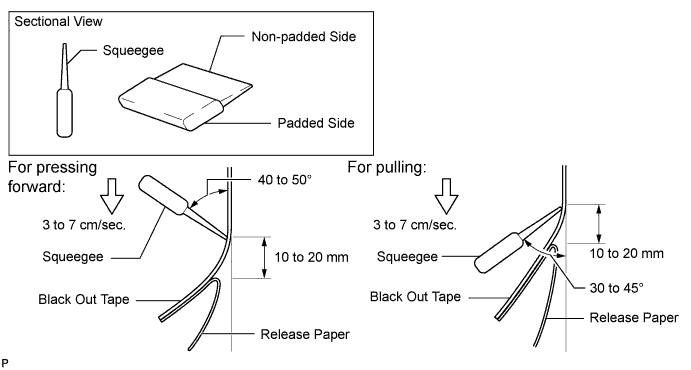
Note
Be sure to observe the specified pressing speed, force and angle of the squeegee to avoid wrinkles and air bubbles.
Tech Tips
-
Either angle of the squeegee (for pressing forward or for pulling) is acceptable.
-
Be sure to apply the tape while removing the release paper 10 to 20 mm (0.393 to 0.787 in.) from the edge of the squeegee.
-
-
-
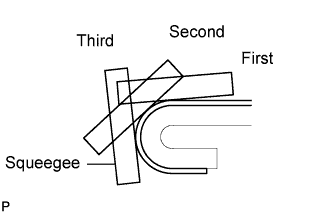
Key points for the installation of the tape (how to use a squeegee and the installation procedure for hemming surfaces).
-
If it is difficult to press the tape, press it in several steps as shown in the illustration. Use your fingers or the padded surface of a squeegee to slowly apply the tape to the hem of the vehicle, especially for a small hem.
Tech Tips
When applying tape to the backside of a hem, remove the release paper and use your fingers or the padded surface of a squeegee.
-
-
Key points for the installation of the tape (how to use a squeegee and the installation procedure for corners).
-
Remove the release paper and apply the tape carefully with your fingers.
-
Before applying the tape to each corner, heat the tape using a heat light and gradually apply it to avoid wrinkles on the tape and achieve a neat finish.
-
-
Check after installation.
-
After completing the application, check if the tape is applied neatly. If the tape is not applied neatly, apply new tape.
Note
Do not reuse the tape.
-
-
-
INSTALL NO. 4 BLACK OUT TAPE LH
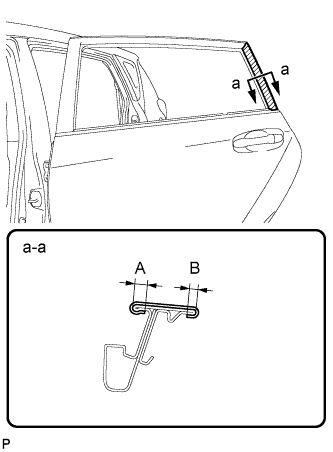
-
Refer to the illustration to position a new No. 4 black out tape.
Standard Area Dimension A 5 mm (0.197 in.) B 2 to 4 mm (0.078 to 0.158 in.) -
Remove the release paper and apply the tape.
-
-
INSTALL NO. 3 BLACK OUT TAPE LH
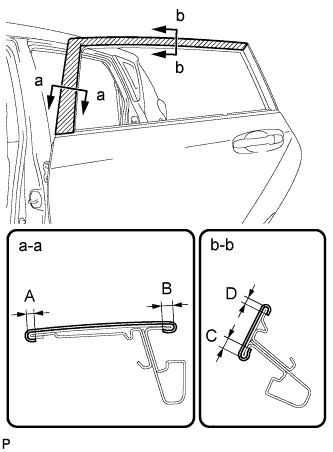
-
Refer to the illustration to position a new No. 3 black out tape.
Standard Area Dimension A 2 to 4 mm (0.078 to 0.158 in.) B 5 mm (0.197 in.) C 5 mm (0.197 in.) D 2 to 4 mm (0.078 to 0.158 in.) -
Remove the release paper and apply the tape.
-
-
INSTALL REAR DOOR WEATHERSTRIP LH
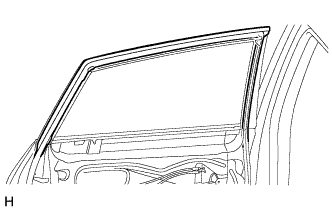
-
Install the upper part of the rear door weatherstrip.
-
-
INSTALL REAR DOOR BELT MOULDING ASSEMBLY LH
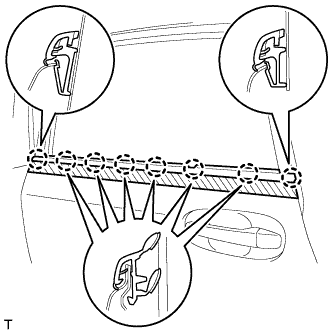
-
Attach the 8 claws to install the rear door belt moulding.
-
-
INSTALL REAR DOOR GLASS SUB-ASSEMBLY LH
-
w/ Power Window:
-
Temporarily install the regulator switch assembly.
-
Connect the cable to the negative (-) battery terminal.
-
Operate the regulator switch until the regulator reaches its bottom dead center.
-
Disconnect the cable from the negative (-) battery terminal.
Note
When disconnecting the cable, some systems need to be initialized after the cable is reconnected Click here.
-
Remove the regulator switch assembly.
-
-
w/o Power Window:
-
Temporarily install the rear door window regulator handle assembly.
-
Turn the handle until the regulator reaches its bottom dead center.
-
Remove the rear door window regulator handle assembly.
-
-
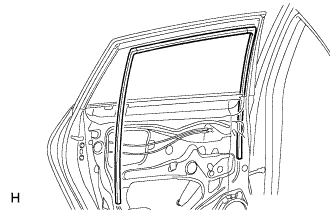
Install the front side of the glass run.
-
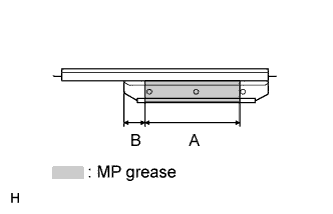
Apply MP grease to the sliding areas of the glass channel as shown in the illustration.
Standard Area Specified Condition A 130 mm (5.12 in.) B 29 mm (1.14 in.) -
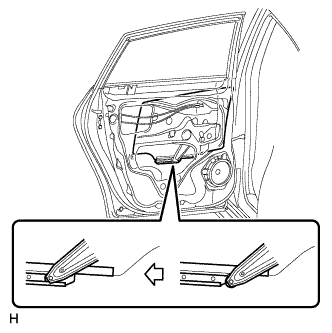
Slide the rear door glass sub-assembly as shown in the illustration to install it.
-
-
INSTALL REAR DOOR QUARTER WINDOW GLASS LH
-
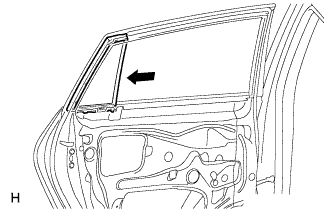
Install the rear door quarter window glass together with the rear door quarter window weatherstrip in the direction indicated by the arrow in the illustration.
-
-
INSTALL REAR DOOR WINDOW DIVISION BAR SUB-ASSEMBLY LH
-
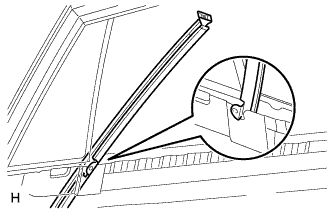
Insert the rear door window division bar sub-assembly from above.
-
Install the rear door window division bar sub-assembly to the glass run.
-
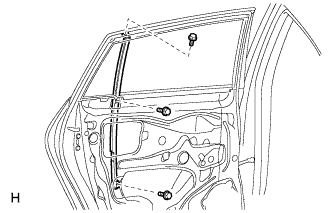
Install the rear door window division bar sub-assembly with the 2 bolts and screw.
- Torque:
- 6.2 N*m { 63 kgf*cm, 55 in.*lbf, for bolt and screw }
-
-
INSTALL REAR DOOR GLASS RUN LH
-
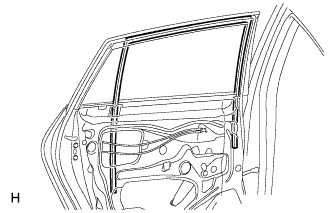
Completely install the glass run.
-
-
INSTALL REAR DOOR SERVICE HOLE COVER LH
-
Apply butyl tape to the door.
-
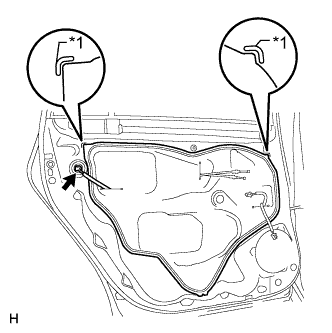
Text in Illustration *1 Reference Point Pass the rear door lock remote control cable and rear door inside locking cable through a new rear door service hole cover.
-
Install the rear door service hole cover by using the reference points on the rear door panel.
Note
-
There should be no wrinkles or folds after attaching the service hole cover.
-
After attaching the service hole cover, check the seal quality.
-
-
Connect the connector.
-
-
INSTALL REAR DOOR INNER GLASS WEATHERSTRIP LH
-
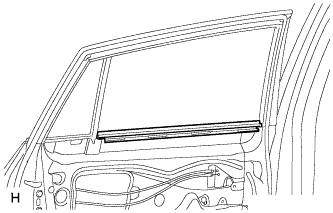
Install the rear door inner glass weatherstrip to the door panel.
-
-
INSTALL REAR DOOR INSIDE HANDLE SUB-ASSEMBLY LH
-
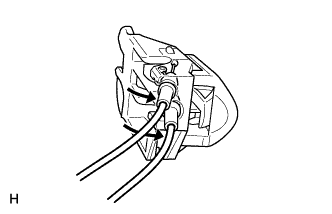
Connect the 2 cables to the inside handle to install the inside handle.
-
-
INSTALL REAR DOOR TRIM BOARD SUB-ASSEMBLY LH
-
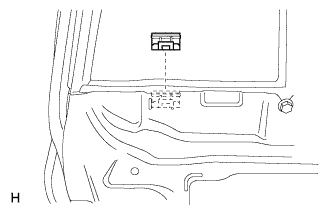
Install the clamp to the door panel.
-
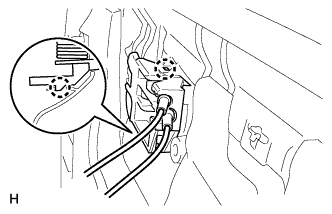
Attach the 2 claws to install the inside handle to the rear door trim board.
-
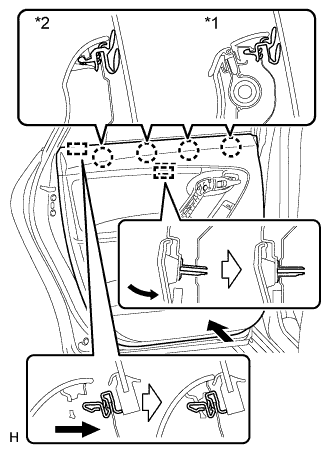
Text in Illustration *1 w/ Rear Door Sunshade *2 w/o Rear Door Sunshade Attach the rear door trim board with the 4 claws on the rear door inner glass weatherstrip.
-
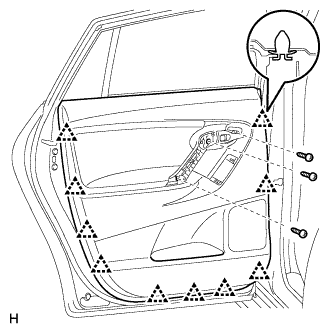
Install the rear door trim board with the 10 clips.
-
Install the 3 screws.
-
-
INSTALL REAR POWER WINDOW REGULATOR SWITCH ASSEMBLY WITH REAR DOOR ARMREST BASE PANEL (w/ Power Window)
-
Connect the connector.
-
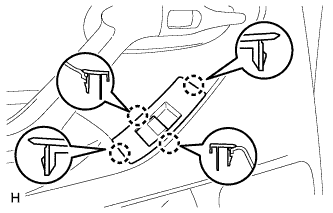
Attach the 4 claws to install the rear power window regulator switch assembly with rear door armrest base panel.
-
-
INSTALL REAR DOOR TRIM MOULDING LH
-
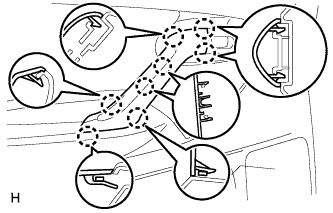
Attach the 8 claws to install the door trim moulding.
-
-
INSTALL REAR DOOR INSIDE HANDLE BEZEL LH
-
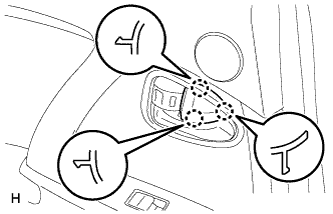
Attach the 3 claws to install the rear door inside handle bezel.
-
-
INSTALL REAR DOOR REGULATOR INSIDE HANDLE PLATE (w/o Power Window)
-
Install the rear door regulator inside handle plate.
-
-
INSTALL REAR DOOR WINDOW REGULATOR HANDLE ASSEMBLY (w/o Power Window)
-
Temporarily install the rear door window regulator handle assembly, fully close the window, and then remove the rear door window regulator handle assembly.
-
Install the snap ring to the rear door window regulator handle assembly.
-
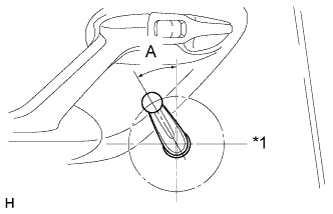
Text in Illustration *1 Front Side Install the rear door window regulator handle assembly as shown in the illustration.
Standard Area Specified Condition A 50° to 60°
-
-
CONNECT CABLE TO NEGATIVE BATTERY TERMINAL
Note
When disconnecting the cable, some systems need to be initialized after the cable is reconnected Click here.