CLUTCH RELEASE CYLINDER (for 1WW) INSTALLATION

-
INSTALL CLUTCH RELEASE CYLINDER KIT
-
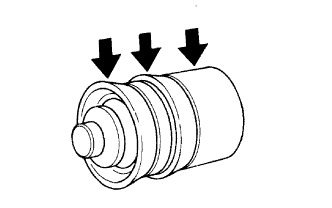
Coat a new piston with lithium soap base glycol grease as shown in the illustration.
-
Install the piston and a new spring to the release cylinder body.
Note
Do not damage the inside of the release cylinder body.
Tech Tips
Install the smaller end of the spring to the piston.
-
Install a new boot to the push rod.
-
Install the push rod together with the boot to the release cylinder body.
-
-
TEMPORARILY INSTALL RELEASE CYLINDER BLEEDER PLUG
-
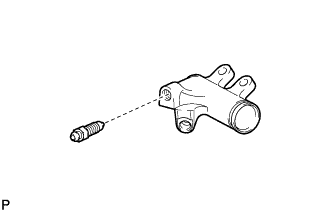
Install the release cylinder bleeder plug to the release cylinder body.
- Torque:
- 11 N*m { 112 kgf*cm, 8 ft.*lbf }
-
Install the bleeder plug cap to the bleeder plug.
-
-
INSTALL CLUTCH RELEASE CYLINDER ASSEMBLY
-
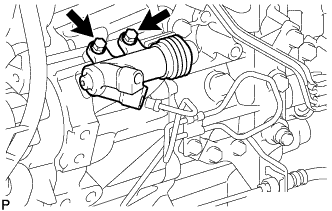
Install the clutch release cylinder assembly with the 2 bolts.
- Torque:
- 12 N*m { 122 kgf*cm, 9 ft.*lbf }
-
-
CONNECT CLUTCH RELEASE CYLINDER TO FLEXIBLE HOSE TUBE
-
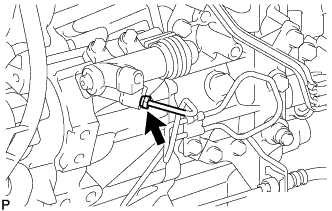
Using a union nut wrench, connect the clutch release cylinder to flexible hose tube.
- Torque:
- 15 N*m { 155 kgf*cm, 11 ft.*lbf }
Note
Use the formula to calculate special torque values for situations where a union nut wrench is combined with a torque wrench Click here.
-
-
BLEED CLUTCH LINE
-
Add brake fluid to keep the level between the MIN and MAX lines of the reservoir while bleeding the brakes.
Brake fluid SAE J1704 or FMVSS No, 116 DOT 4 -
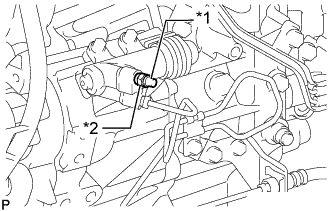
Text in Illustration *1 Bleeder Plug Cap *2 Bleeder Plug Remove the bleeder plug cap.
-
Connect a vinyl tube to the bleeder plug.
-
Depress the clutch pedal several times, and then loosen the bleeder plug while the pedal is depressed.
-
When fluid no longer comes out, tighten the bleeder plug, and then release the clutch pedal.
-
Repeat the previous 2 steps until all the air in the fluid is completely bled.
-
Tighten the bleeder plug.
- Torque:
- 11 N*m { 112 kgf*cm, 8 ft.*lbf }
-
Install the bleeder plug cap.
-
Check that all the air has been bled from the clutch line.
-
-
INSPECT FLUID LEVEL
-
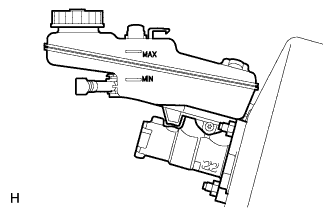
Check the fluid level.
If the brake fluid level is lower than the MIN line, check for leaks and inspect the disc brake pads. If necessary, refill the reservoir with brake fluid to the MAX line after repair or replacement.
Brake Fluid SAE J1704 or FMVSS No. 116 DOT 4
-
-
INSPECT FOR FLUID LEAK
Tech Tips
Check for leaks in the clutch system.
-
INSTALL NO.1 AIR TUBE ASSEMBLY
-
Connect the No. 1 air tube assembly to the manual transaxle assembly with the 2 bolts.
- Torque:
- 20 N*m { 204 kgf*cm, 15 ft.*lbf }
-
Connect the outlet heater water hose to the No. 2 radiator pipe, and slide the clamp to secure the hose.
-
Connect the water hose sub-assembly to the No. 1 radiator pipe, and slide the clamp to secure the hose.
-
Attach the clamp and connect the water hose sub-assembly to the compressor outlet elbow.
-
Connect the water by-pass hose assembly to the No. 2 radiator pipe, and slide the clamp to secure the hose.
-
Connect the radiator hose sub-assembly to the No. 1 radiator pipe, and slide the clamp to secure the hose.
-
-
INSTALL BATTERY CARRIER ASSEMBLY
-
Install the battery carrier with the 4 bolts.
- Torque:
- 19 N*m { 189 kgf*cm, 14 ft.*lbf }
-
Attach the 2 clamps to connect the engine wire.
-
-
INSTALL BATTERY TRAY
-
INSTALL BATTERY
-
INSTALL BATTERY INSULATOR
-
INSTALL BATTERY CLAMP SUB-ASSEMBLY
-
Attach the hook of the battery clamp sub-assembly to the battery carrier.
-
Partially tighten the nut and temporarily install the bolt.
-
Adjust the battery clamp sub-assembly position.
-
Tighten the nut and bolt.
- Torque:
- for bolt
- 17 N*m { 168 kgf*cm, 12 ft.*lbf }
- for nut
- 3.5 N*m { 36 kgf*cm, 31 in.*lbf }
-
-
CONNECT CABLE TO POSITIVE BATTERY TERMINAL
-
CONNECT CABLE TO NEGATIVE BATTERY TERMINAL
Note
When disconnecting the cable, some systems need to be initialized after the cable is reconnected Click here.
-
INSTALL AIR CLEANER CASE SUB-ASSEMBLY
-
Install the air cleaner case sub-assembly with the 3 bolts.
- Torque:
- 7.0 N*m { 71 kgf*cm, 62 in.*lbf }
-
-
INSTALL AIR CLEANER FILTER ELEMENT SUB-ASSEMBLY
-
INSTALL AIR CLEANER CAP SUB-ASSEMBLY WITH AIR CLEANER HOSE ASSEMBLY
-
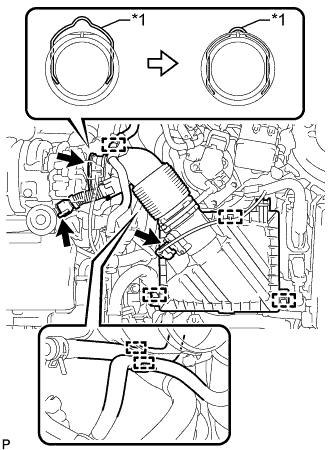
Text in Illustration *1 Retainer Connect the air cleaner hose assembly to the turbocharger sub-assembly and lock the retainer as shown in the illustration.
-
Attach the 2 clamps to install the air cleaner cap sub-assembly.
-
Connect the ventilation hose to the cylinder head cover sub-assembly.
-
Attach the clamp and connect the No. 2 fuel hose to the air cleaner hose assembly.
-
Attach the clamp and connect the No. 1 fuel hose to the air cleaner hose assembly.
-
Attach the clamp and connect the vacuum hose to the air cleaner hose assembly.
-
Attach the clamp and connect the mass air flow meter sub-assembly connector.
-
-
ADD ENGINE COOLANT
CAUTION:
Do not remove the reservoir cap and air release valve while the engine and radiator assembly are still hot. Pressurized, hot engine coolant and steam may be released and cause serious burns.
-
Tighten the radiator drain cock plug by hand.
-
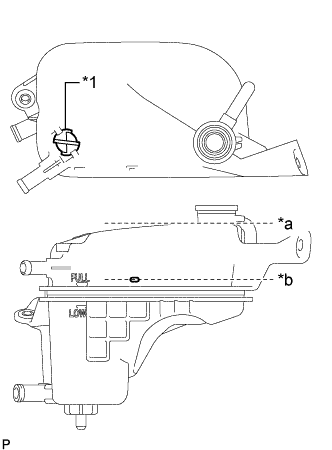
Text in Illustration *1 Air Release Valve *a Radiator Reservoir Assembly Filler Neck *b Pour Limit Line Remove the air release valve.
-
Add engine coolant to the pour limit line of the radiator reservoir assembly.
Standard Capacity Item Specified Condition w/o Combustion Type Power Heater 7.0 liters (7.4 US qts, 6.2 Imp. qts) w/ Combustion Type Power Heater 7.3 liters (7.7 US qts, 6.4 Imp. qts) Note
Never use water as a substitute for engine coolant.
Tech Tips
Toyota recommends the use of approved "Toyota Premium Long Life Coolant for 1WW/2WW engines" or equivalent.
-
Press the No. 2 radiator hose and radiator hose sub-assembly several times by hand, and then check the level of the engine coolant.
If the coolant level is low, add engine coolant.
-
Install the air release valve.
-
Add engine coolant to the filler neck of the radiator reservoir assembly.
-
Install the reservoir cap.
-
Start the engine, and warm it up until the cooling fan operates.
Note
-
Before starting the engine, turn the A/C switch off.
-
Adjust the air conditioning temperature setting to MAX (HOT).
-
Adjust the air conditioning blower setting to Lo.
-
-
Maintain the engine speed at 2000 to 2500 rpm and warm up the engine until the cooling fan operates.
Note
-
Make sure that the radiator reservoir assembly still has some engine coolant in it.
-
Pay attention to the needle of the water temperature meter. Make sure that the needle does not show an abnormally high temperature.
-
If there is not enough engine coolant, the engine may burn out or overheat.
-
Immediately after starting the engine, if the radiator reservoir assembly does not have any coolant, perform the following: 1) stop the engine, 2) wait until the engine coolant has cooled down, and 3) add engine coolant until the coolant is filled to the pour limit line.
-
Until the coolant level has stabilized, run the engine at 2000 rpm.
-
-
Press the No. 2 radiator hose and radiator hose sub-assembly several times by hand to bleed air.
CAUTION:
-
Wear protective gloves.
-
Be careful as the radiator hoses are hot.
-
Keep your hands away from the cooling fan.
-
-
Stop the engine and wait until the coolant cools down to ambient temperature.
-
Check that the coolant level is between the FULL and LOW line.
If the coolant level is below the LOW line, repeat all of the procedures above.
If the coolant level is above the FULL line, drain coolant so that the coolant level is between the FULL and LOW line.
-
-
INSPECT COOLANT LEAK
-
Remove the reservoir cap.
CAUTION:
To avoid the danger of being burned, do not remove the reservoir cap while the engine and radiator assembly are still hot. Thermal expansion will cause hot engine coolant and steam to blow out from the radiator assembly.
-
Fill the radiator assembly with coolant, and then attach a radiator cap tester.
-
Warm up the engine.
-
Pump the radiator cap tester to 143 kPa (1.5 kgf/cm2, 20.7 psi), and then check that the pressure does not drop.
If the pressure drops, check the hoses, radiator assembly and engine water pump assembly for leakage.
If there are no signs of external coolant leaks, check the heater core, cylinder block and head.
-
Reinstall the reservoir cap.
-
-
INSTALL NO.1 ENGINE UNDER COVER
-
Install the No. 1 engine under cover with the 11 clips and 6 bolts.
-