STOP AND START SYSTEM Engine Hood Courtesy Switch Circuit
DESCRIPTION
The engine stop and start ECU detects open/close of the engine hood based on a signal received from the engine hood courtesy switch that is built into the hood lock assembly.
-
The engine stop and start ECU prohibits starting of the engine by stop and start control and stalls the engine if the clutch pedal is depressed with the engine hood open while the engine is stopped by stop and start control.
-
The engine stop and start ECU permits starting of the engine by stop and start control if the engine hood is opened with the clutch pedal depressed while the engine is stopped by stop and start control.
WIRING DIAGRAM
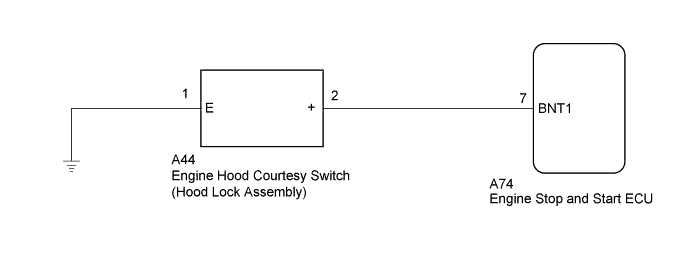
INSPECTION PROCEDURE
PROCEDURE
-
READ VALUE USING GTS (HOOD COURTESY SWITCH)
Note
Before performing this step, check that the engine hood can be opened by pulling the hood lock control cable.
-
Connect the GTS to the DLC3.
-
Turn the ignition switch to ON.
-
Turn the GTS on.
-
Enter the following menus: Powertrain / Stop and Start / Data List / Hood Courtesy Switch.
-
Read the value displayed on the GTS when the engine hood is opened and closed.
OK GTS Display Condition Normal Condition Hood Courtesy Switch Engine hood is closed ON Engine hood is open OFF
NG 
INSPECT ENGINE HOOD COURTESY SWITCH (HOOD LOCK ASSEMBLY) Click here
OK 
PROCEED TO NEXT SUSPECTED AREA SHOWN IN PROBLEM SYMPTOMS TABLE Click here
-
-
INSPECT ENGINE HOOD COURTESY SWITCH (HOOD LOCK ASSEMBLY)
-
Inspect the engine hood courtesy switch (hood lock assembly) Click here.
NG 
REPLACE HOOD LOCK ASSEMBLY Click here
OK 
-
-
CHECK HARNESS AND CONNECTOR (ENGINE HOOD COURTESY SWITCH (HOOD LOCK ASSEMBLY) - BODY GROUND)
-
Disconnect the A44 engine hood courtesy switch (hood lock assembly) connector.
-
Measure the resistance according to the value(s) in the table below.
Standard Resistance Tester Connection Condition Specified Condition A44-1 (E) - Body ground Always Below 1 Ω
NG
REPAIR OR REPLACE HARNESS OR CONNECTOR
OK
-
-
CHECK HARNESS AND CONNECTOR (ENGINE STOP AND START ECU - ENGINE HOOD COURTESY SWITCH (HOOD LOCK ASSEMBLY))
-
Disconnect the A74 engine stop and start ECU connector.
-
Disconnect the A44 engine hood courtesy switch (hood lock assembly) connector.
-
Measure the resistance according to the value(s) in the table below.
Standard Resistance Tester Connection Condition Specified Condition A74-7 (BNT1) - A44-2 (+) Always Below 1 Ω A74-7 (BNT1) - Body ground Always 10 kΩ or higher A44-2 (+) - Body ground Always 10 kΩ or higher
NG
REPAIR OR REPLACE HARNESS OR CONNECTOR
OK
PROCEED TO NEXT SUSPECTED AREA SHOWN IN PROBLEM SYMPTOMS TABLE Click here
-