HYBRID CONTROL SYSTEM PRECAUTION

-
PRECAUTIONS FOR INSPECTING HYBRID CONTROL SYSTEM
-
Before inspecting the high-voltage system or disconnecting the low voltage connector of the inverter with converter assembly, take safety precautions such as wearing insulated gloves and removing the service plug grip to prevent electrical shocks. After removing the service plug grip, put it in your pocket to prevent other technicians from accidentally reconnecting it while you are working on the high-voltage system.
Note
After removing the service plug grip, turning the power switch on (READY) may cause a malfunction. Do not turn the power switch on (READY) unless instructed by the repair manual.
-
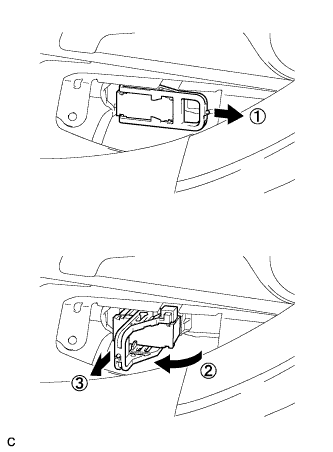
After disconnecting the service plug grip, wait for at least 10 minutes before touching any of the high-voltage connectors or terminals.
Tech Tips
Waiting for at least 10 minutes is required to discharge the high-voltage capacitor inside the inverter with converter assembly.
-
Check the voltage at the terminals in the inspection point in the inverter with converter assembly.
CAUTION:
Be sure to wear insulated gloves.
-
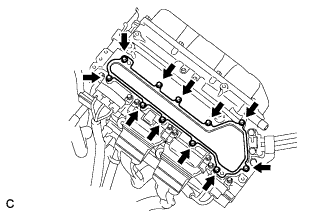
Remove the 11 bolts and inverter terminal cover. Click here
Note
Cover the opening with non-residue tape to prevent entry of foreign matter or liquid after removing the connector cover.
-
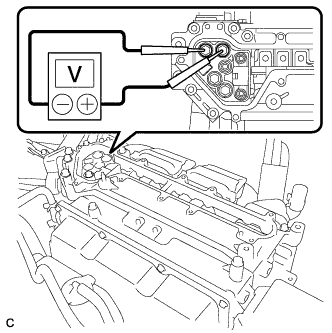
Measure the voltage according to the value(s) in the table below.
Tech Tips
Set the tester to DC750 V or more to measure the voltage.
-
-
When turning the power switch on (IG) during inspections, do not press the power switch with the brake pedal depressed.
CAUTION:
Pressing the power switch with the brake pedal depressed causes the system to enter the READY-on state. This is very dangerous because high voltage may be applied to the inspection area.
-
Turn the power switch off, wear insulated gloves, and disconnect the cable from the negative (-) terminal of the auxiliary battery before touching any of the orange-colored wires of the high-voltage system.
-
Turn the power switch off before performing any resistance checks.
-
Turn the power switch off before disconnecting or reconnecting any connectors.
-
When high-voltage connectors are removed, wrap the connectors with insulation tape to prevent them from contacting foreign objects.
-
-
NOTICE FOR HYBRID CONTROL SYSTEM ACTIVATION
-
When the warning light is illuminated, or the auxiliary battery has been disconnected and reconnected, attempting to turn the power switch on (READY) may not start the system (the system may not enter the READY-on state) on the first attempt. If so, turn the power switch off and reattempt to start the hybrid system.
-
-
PRECAUTIONS FOR DISCONNECTING AMD TERMINAL
Tech Tips
The AMD terminal is connected to the positive terminal of the auxiliary battery. To prevent damage when the AMD terminal is being disconnected, use the following procedure.
-
Be sure to disconnect the cable from the negative (-) terminal of the auxiliary battery before disconnecting the AMD terminal from the inverter with converter assembly or engine room junction block assembly.
-
After disconnecting the AMD terminal, wrap the terminal with insulation tape.
-
Be sure to reconnect the AMD terminal to the inverter with converter assembly or engine room junction block assembly before reconnecting the cable to the negative (-) terminal of the auxiliary battery.
Note
A short circuit to ground may occur if the AMD terminal is disconnected before the cable is disconnected from the negative (-) terminal of the auxiliary battery. If a short circuit to ground occurs, it can result in an open circuit in a fusible link or fuse.
-
-
DISPOSING OF AN HV BATTERY
-
When disposing of an HV battery, make sure to return it through an authorized collection agent who is capable of handling it safely. If the HV battery is returned via the manufacturer specified route, it will be returned properly and in a safe manner by an authorized collection agent.
CAUTION:
-
Accidents such as electric shock may result if the HV battery is disposed of improperly or abandoned. Therefore, make sure to return all HV batteries through an authorized collection agent.
-
After removing the HV battery, keep it away from water. Exposure to water may cause the HV battery to produce heat, resulting in a fire.
-
-
-
DISCONNECTING AND RECONNECTING NEGATIVE AUXILIARY BATTERY CABLE
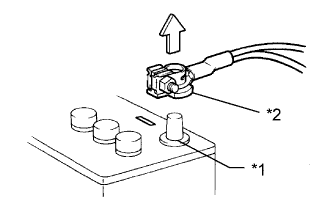
Text in Illustration *1 Negative (-) Auxiliary Battery Terminal *2 Cable
-
Before performing work on electronic components, disconnect the cable from the negative (-) auxiliary battery terminal to prevent damage to the electrical system or electrical components.
-
Before disconnecting and reconnecting the auxiliary battery cable, turn the power switch off and the headlight switch off. Then loosen the terminal nut completely. Do not damage the cable or terminal.
-
When the auxiliary battery cable is disconnected, the clock and radio settings and stored DTCs are cleared. Therefore, before disconnecting the auxiliary battery cable, make a note of them.
Note
-
When the cable is disconnected from the negative (-) auxiliary battery terminal, initialize the following system(s) after the cable is reconnected.
System Name See Procedure Parking Assist Monitor System (w/ Side Monitor System) Parking Assist Monitor System (w/o Side Monitor System) Side Monitor System Back Door Closer System Power Back Door System -
w/ HDD Navigation System
After the power switch is turned off, the display and navigation module display (HDD navigation system) records various types of memory and settings. As a result, after turning the power switch off, make sure to wait for the time specified in the following table before disconnecting the cable from the negative (-) auxiliary battery terminal.
Waiting Time before Disconnecting Cable from Negative (-) Auxiliary Battery Terminal Specification Waiting Time w/o Telematics transceiver 60 seconds w/ Telematics transceiver 120 seconds
-
-