PARKING ASSIST MONITOR SYSTEM (w/o Side Monitor System) Image from Camera for Parking Assist Monitor is Abnormal
DESCRIPTION
The video signal from the rear television camera assembly is transmitted to the multi-media module receiver assembly.
WIRING DIAGRAM
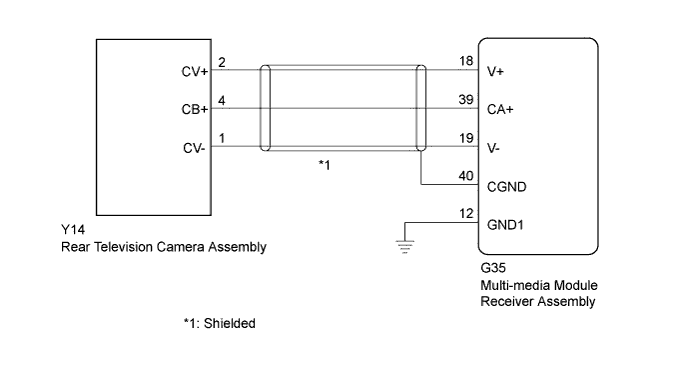
INSPECTION PROCEDURE
Note
-
When "System initializing" is displayed on the multi-display assembly after disconnecting the cable from the negative (-) auxiliary battery terminal, correct the steering angle neutral point Click here.
-
Depending on the parts that are replaced or operations that are performed during vehicle inspection or maintenance, calibration of other systems as well as the parking assist monitor system may be needed Click here.
Tech Tips
Images may be unclear even in normal conditions if:
-
Electrical devices are used in the cabin (noise may occur in the image).
-
Accessories that generate radio waves have been installed (noise may occur in the image).
-
The outer mirror switch assembly is operated (noise may occur in the image).
-
The camera lens is frosted over (the image immediately after turning the power switch on (IG) may be blurred or darker than normal).
-
The camera lens is dirty with snow, mud, etc.
-
A strong beam of light, such as a sunbeam or headlight, hits the camera.
-
It is too dark around the camera (at night etc.).
-
The ambient temperature around the camera is either too high or too low.
-
The vehicle is tilted at a steep angle.
-
The rear television camera assembly lens is scratched.
-
The rear television camera assembly lens has drops of water on it or the humidity is high.
-
When the camera is used under fluorescent lights, sodium lights, or mercury lights etc., the lights and the illuminated area may appear to flicker.
-
The ambience of the camera is too bright. (When a strong light, such as a sunbeam reflected off the vehicle body, hits the camera, the image may be blurred. This is called the "SMEAR" phenomenon, particular to the CCD camera.)
PROCEDURE
-
CHECK HARNESS AND CONNECTOR (MULTI-MEDIA MODULE RECEIVER ASSEMBLY - REAR TELEVISION CAMERA ASSEMBLY)
-
Disconnect the G35 multi-media module receiver assembly connector.
-
Disconnect the Y14 rear television camera assembly connector.
-
Measure the resistance according to the value(s) in the table below.
Standard Resistance Tester Connection Condition Specified Condition G35-39 (CA+) - Y14-4 (CB+) Always Below 1 Ω G35-18 (V+) - Y14-2 (CV+) Always Below 1 Ω G35-19 (V-) - Y14-1 (CV-) Always Below 1 Ω G35-39 (CA+) - Body ground Always 10 kΩ or higher G35-18 (V+) - Body ground Always 10 kΩ or higher G35-19 (V-) - Body ground Always 10 kΩ or higher G35-40 (CGND) - Body ground Always 10 kΩ or higher G35-18 (V+) - G35-39 (CA+) Always 10 kΩ or higher G35-18 (V+) - G35-19 (V-) Always 10 kΩ or higher G35-18 (V+) - G35-40 (CGND) Always 10 kΩ or higher
NG 
REPAIR OR REPLACE HARNESS OR CONNECTOR
OK 
-
-
CHECK MULTI-MEDIA MODULE RECEIVER ASSEMBLY (V-, CGND, CA+)
-
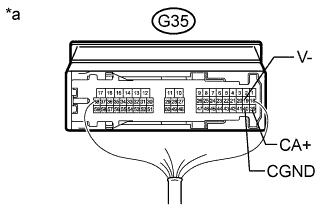
Text in Illustration *a Component with harness connected
(Multi-media Module Receiver Assembly)
Reconnect the G35 multi-media module receiver assembly connector.
-
Measure the resistance according to the value(s) in the table below.
Standard Resistance Tester Connection Condition Specified Condition G35-19 (V-) - Body ground Always Below 1 Ω -
Measure the voltage according to the value(s) in the table below.
Standard Voltage Tester Connection Condition Specified Condition G35-39 (CA+) - G35-40 (CGND) Power switch on (IG)
Shift lever in R
5.5 to 7.05 V
NG
REPLACE MULTI-MEDIA MODULE RECEIVER ASSEMBLY Click here
OK
-
-
CHECK MULTI-MEDIA MODULE RECEIVER ASSEMBLY (V+, GND1)
-
Reconnect the Y14 rear television camera assembly connector.
-
Reconnect the G35 multi-media module receiver assembly connector.
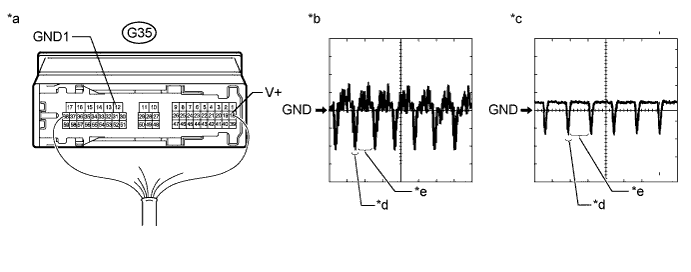
Text in Illustration *a Component with harness connected
(Multi-media Module Receiver Assembly)
*b Waveform 1 (camera lens is not covered, displaying an image) *c Waveform 2 (camera lens is covered, blacking out the screen) *d Synchronization Signal *e Video Waveform -
Check the waveform of the rear television camera assembly using an oscilloscope.
Tech Tips
A waterproof connector is used for the rear television camera assembly. Therefore, inspect the waveform at the multi-media module receiver assembly with the connector connected.
OK Waveform is as shown in the illustration. Item Content Terminal No. (Symbol) G35-18 (V+) - G35-12 (GND1) Tool Setting 200 mV/DIV., 50 μsec./DIV. Condition Power switch on (IG), shift lever in R Tech Tips
The video waveform changes according to the image sent by the rear television camera assembly.
NG
REPLACE REAR TELEVISION CAMERA ASSEMBLY Click here
OK 
PROCEED TO NEXT SUSPECTED AREA SHOWN IN PROBLEM SYMPTOMS TABLE Click here
-