BRAKE BOOSTER (for RHD) INSTALLATION

-
INSTALL BRAKE BOOSTER GASKET
-
Install a new brake booster gasket to the brake booster assembly.
-
-
TEMPORARILY TIGHTEN BRAKE BOOSTER ASSEMBLY
-
Temporarily install the brake booster assembly to the body.
Note
Do not kink or damage the brake lines.
-
-
TEMPORARILY TIGHTEN BRAKE MASTER CYLINDER PUSH ROD CLEVIS
-
Temporarily install the lock nut and brake master cylinder push rod clevis to the brake booster assembly.
-
-
INSTALL BRAKE BOOSTER ASSEMBLY
-

Install the brake booster assembly with the 4 nuts.
- Torque:
- 13 N*m { 130 kgf*cm, 9 ft.*lbf }
Note
Do not kink or damage the brake lines.
-
-
CONNECT BRAKE MASTER CYLINDER PUSH ROD CLEVIS
-
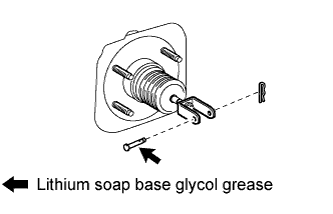
Apply lithium soap base glycol grease to the push rod pin.
-
Connect the brake master cylinder push rod clevis to the brake pedal with the push rod pin, and install a new clip as shown in the illustration.
-
-
INSTALL BRAKE PEDAL RETURN SPRING
-
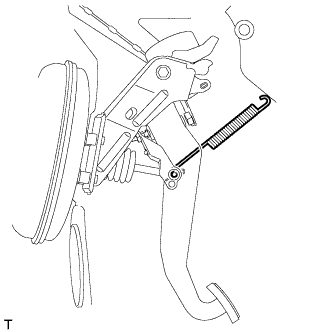
Install the brake pedal return spring between the instrument panel reinforcement and push rod pin.
-
-
INSTALL NO. 1 INSTRUMENT PANEL UNDER COVER SUB-ASSEMBLY
-
Engage each clamp.
-
Connect each connector.
-
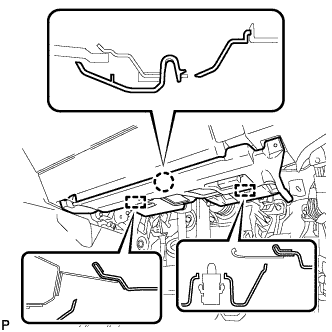
Engage the claw and 2 guides.
-
Install the No. 1 instrument panel under cover sub- assembly with the 2 screws <D>.
-
-
CONNECT BRAKE LINE
-
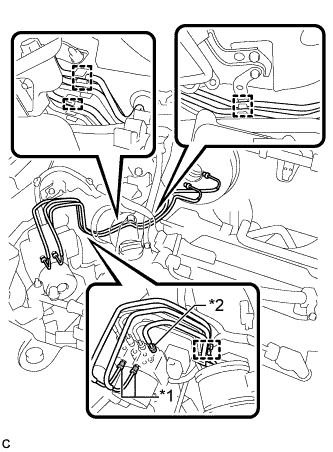
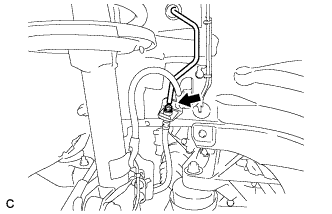
Text in Illustration *1 Front Brake Tube *2 No. 8 Front Brake Tube Engage the 5 clamps and install the brake lines.
-
Using a union nut wrench, connect the front brake tube*1 and No. 8 front brake tube*2 to the brake actuator assembly.
- Torque:
- *1
- 20 N*m { 199 kgf*cm, 14 ft.*lbf }
- *2
- 15 N*m { 155 kgf*cm, 11 ft.*lbf }
Note
-
Do not kink or damage the brake lines.
-
Do not allow any foreign matter such as dirt and dust to enter the brake lines.
-
Use the formula to calculate special torque values for situations where the union nut wrench is combined with a torque wrench Click here.
-
- Torque:
- *1
- 20 N*m { 199 kgf*cm, 14 ft.*lbf }
- *2
- 15 N*m { 155 kgf*cm, 11 ft.*lbf }
Using a union nut wrench, connect the No. 8 front brake tube to the front brake flexible hose RH.
- Torque:
- 15 N*m { 155 kgf*cm, 11 ft.*lbf }
Note
-
Do not kink or damage the brake line.
-
Do not allow any foreign matter such as dirt and dust to enter the brake line.
-
Use the formula to calculate special torque values for situations where the union nut wrench is combined with a torque wrench Click here.
-
-
INSTALL AIR CONDITIONING TUBE AND ACCESSORY ASSEMBLY
-
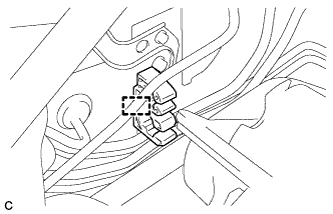
Install the tube clamp to the body.
Note
Do not damage the clamp.
-
Remove the attached vinyl tape from the pipe.
-
Sufficiently apply compressor oil to 2 new O-rings and the fitting surface of the air conditioning tube and accessory assembly and cooler condenser assembly.
Compressor oil ND-OIL 8 or equivalent -
Install the 2 O-rings on the air conditioning tube and accessory assembly.
Note
Keep the O-ring and O-ring fitting surfaces free from dirt or any foreign objects.
-
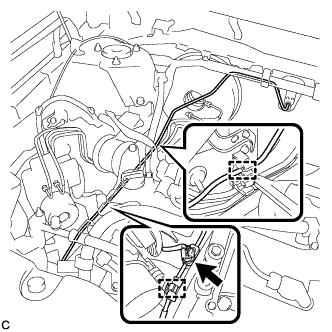
Engage the 2 clamps and connect the connector.
Note
-
Do not deform the piping.
-
Do not damage the plastic clamp.
-
-
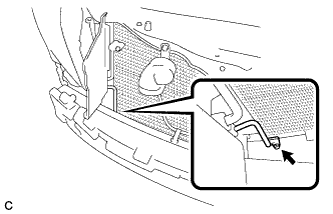
Connect the air conditioning tube and accessory assembly to the cooler condenser assembly with the bolt.
- Torque:
- 5.4 N*m { 55 kgf*cm, 48 in.*lbf }
-
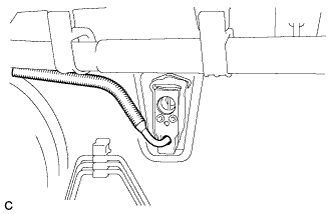
Install the air conditioning tube and accessory assembly to the air conditioning unit.
Note
Insert the pipe joint into the fitting hole securely.
-
-
INSTALL SUCTION PIPE SUB-ASSEMBLY
-
Remove the attached vinyl tape from the pipe.
-
Sufficiently apply compressor oil to a new O-ring and the fitting surface of the suction hose sub-assembly.
Compressor oil ND-OIL 8 or equivalent -
Install the O-ring on the suction hose sub-assembly.
Note
Keep the O-ring and O-ring fitting surfaces free from dirt or any foreign objects.
-
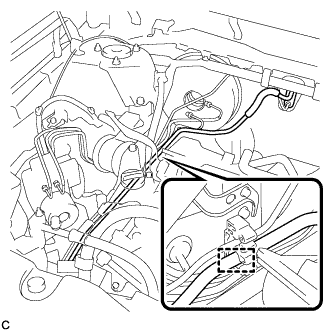
Connect the suction pipe sub-assembly to the air conditioning unit.
Note
-
Insert the pipe joint into the fitting hole securely.
-
Do not deform the piping.
-
Do not damage the plastic clamp.
-
-
Engage the clamp.
-
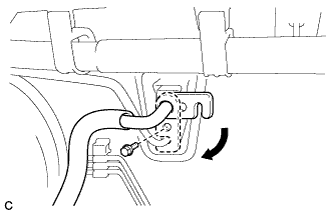
Move the hook connector in the direction indicated by the arrow in the illustration, and install the bolt.
- Torque:
- 9.8 N*m { 100 kgf*cm, 87 in.*lbf }
-
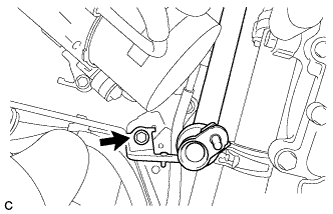
Install the suction pipe bracket to the brake actuator bracket with the bolt.
- Torque:
- 9.8 N*m { 100 kgf*cm, 87 in.*lbf }
-
-
INSTALL SUCTION HOSE SUB-ASSEMBLY
-
Remove the attached vinyl tape from the hose.
-
Sufficiently apply compressor oil to a new O-ring and the fitting surface of the suction hose sub-assembly.
Compressor oil ND-OIL 8 or equivalent -
Install the O-ring on the suction hose sub-assembly.
Note
Keep the O-ring and O-ring fitting surfaces free from dirt or any foreign objects.
-
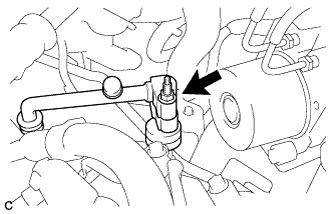
Connect the suction hose sub-assembly to the suction pipe sub-assembly with the nut.
- Torque:
- 9.8 N*m { 100 kgf*cm, 87 in.*lbf }
Note
Do not deform the piping.
-
-
INSTALL WIRE HARNESS (for 1AR-FE)
-
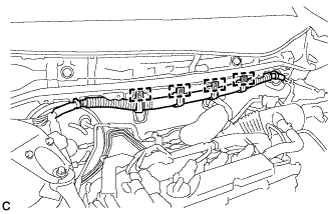
Engage the 4 clamps to install the wire harness.
-
-
INSTALL CYLINDER HEAD COVER SUB-ASSEMBLY (for 2GR-FE)
-
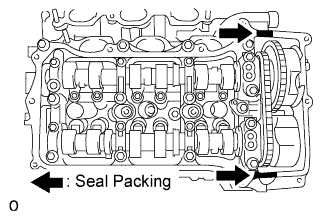
Apply seal packing as shown in the illustration.
Seal packing Toyota Genuine Seal Packing Black, Three Bond 1207B or equivalent Note
-
Remove any oil from the contact surface.
-
Install the head cover within 3 minutes after applying seal packing.
-
Do not start the engine for at least 2 hours after installing.
-
-
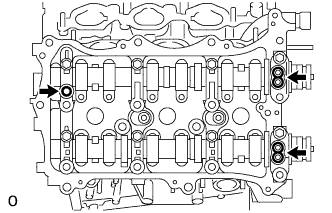
Install 3 new gaskets as shown in the illustration.
-
Install a new cylinder head cover gasket to the cylinder head cover sub-assembly.
-
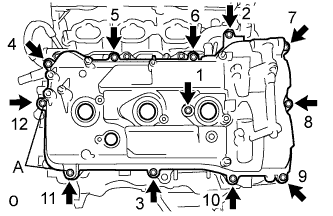
Install the head cover with the 12 bolts and a new seal washer.
- Torque:
- Bolts A
- 21 N*m { 214 kgf*cm, 15 ft.*lbf }
- Except bolts A
- 10 N*m { 102 kgf*cm, 7 ft.*lbf }
Tech Tips
After tightening all bolts, check the tightening torque of 1 and 11. Retighten the bolt if necessary.
-
-
INSTALL ENGINE WIRE (for 2GR-FE)
-
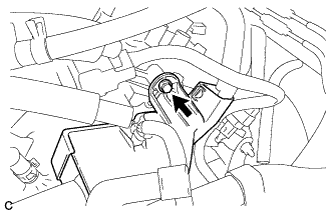
Install the wire harness protector with the bolt.
- Torque:
- 8.4 N*m { 86 kgf*cm, 74 in.*lbf }
-
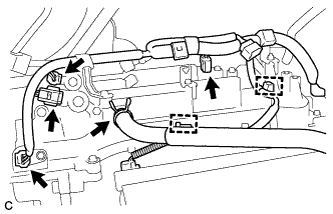
Connect the 4 connectors and ventilation hose, and engage the 2 clamps.
-
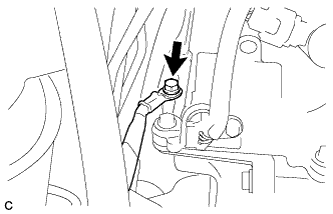
Install the ground cable with the bolt.
- Torque:
- 8.4 N*m { 86 kgf*cm, 74 in.*lbf }
-
-
INSTALL OIL PIPE (for 2GR-FE)
-
Make sure that there is no foreign matter on the mesh of the oil control valve filter RH.
Note
Do not touch the mesh when installing the oil control valve filter.
-
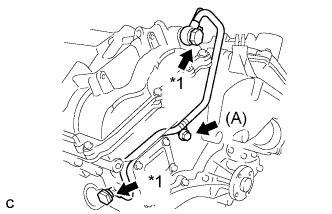
Text in Illustration *1 Oil Pipe Union Install the oil control valve filter RH to the oil pipe union. Install new gaskets and temporarily install the oil pipe (on the head cover side) with the union.
-
Install a new gasket and temporarily install the oil pipe (on the cylinder head side) with the union.
-
Install the bolt (A) to the cylinder head.
- Torque:
- 10 N*m { 102 kgf*cm, 7 ft.*lbf }
-
Tighten the oil pipe union (on the head cover side).
- Torque:
- 65 N*m { 663 kgf*cm, 48 ft.*lbf }
-
Tighten the oil pipe union (on the cylinder head side).
- Torque:
- 65 N*m { 663 kgf*cm, 48 ft.*lbf }
Note
If the link that connects the gaskets is broken, remove the connecting link by using side cutters or a similar tool.
-
-
INSTALL NO. 2 TIMING GEAR COVER (for 2GR-FE)
-
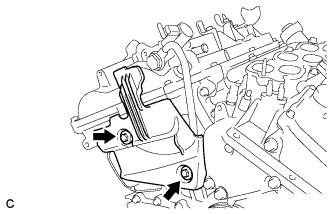
Install the No. 2 timing gear cover with the 2 bolts.
- Torque:
- 6.0 N*m { 61 kgf*cm, 53 in.*lbf }
-
-
INSTALL IGNITION COIL ASSEMBLY (for 2GR-FE)
-
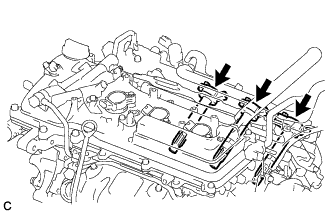
Install the 3 ignition coil assemblies with the 3 bolts.
- Torque:
- 10 N*m { 102 kgf*cm, 7 ft.*lbf }
-
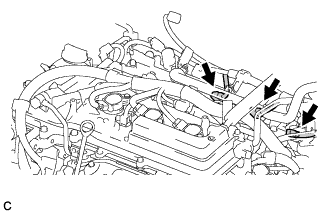
Connect the 3 connectors.
-
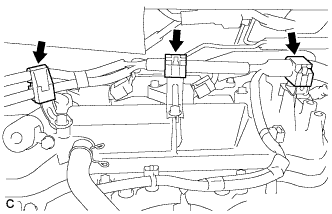
Engage the 3 clamps.
-
-
INSTALL NO. 1 SURGE TANK STAY (for 2GR-FE)
-
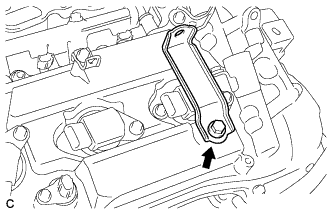
Install the No. 1 surge tank stay with the bolt.
- Torque:
- 21 N*m { 214 kgf*cm, 15 ft.*lbf }
-
-
INSTALL THROTTLE BODY BRACKET (for 2GR-FE)
-
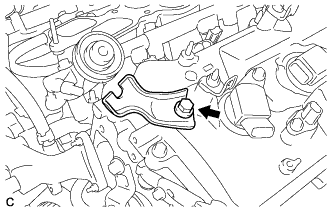
Install the throttle body bracket with the bolt.
- Torque:
- 21 N*m { 214 kgf*cm, 15 ft.*lbf }
-
-
INSTALL INTAKE AIR SURGE TANK ASSEMBLY (for 2GR-FE)
NOTICE DO NOT apply oil to the bolts listed below: Tightening Part Surge Tank and Intake Manifold No. 1 Surge Tank Stay and Surge Tank Throttle Body Bracket and Surge Tank
-
Install 3 new air surge tank to intake manifold gaskets to the intake air surge tank.
-
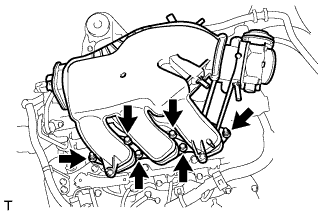
Using a 5 mm hexagon socket wrench, install the intake air surge tank assembly with the 4 bolts and 2 nuts.
- Torque:
- Bolt
- 18 N*m { 184 kgf*cm, 13 ft.*lbf }
- Nut
- 16 N*m { 163 kgf*cm, 12 ft.*lbf }
-
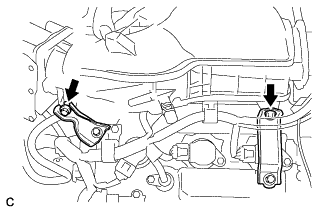
Install the throttle body bracket and No. 1 surge tank stay with the 2 bolts.
- Torque:
- 21 N*m { 214 kgf*cm, 15 ft.*lbf }
-
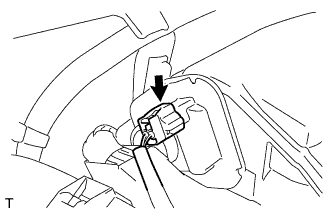
Connect the connector to the intake air control valve assembly.
-
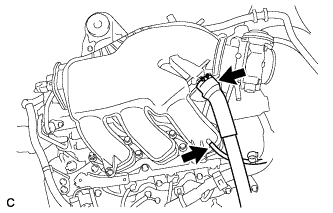
Connect the ventilation hose and vacuum hose.
-
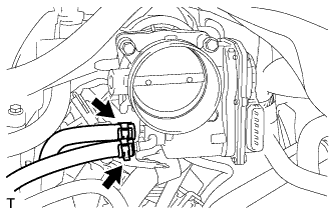
Connect the 2 water by-pass hoses to the throttle body assembly.
-
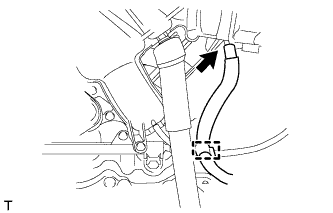
Connect the vacuum hose clamp and fuel vapor feed hose.
-
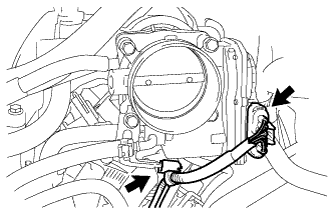
Connect the throttle body assembly connector and wire harness clamp to the throttle body assembly.
-
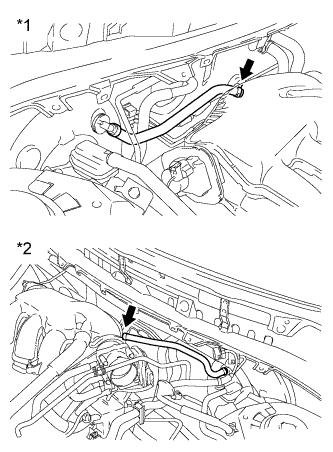
Text in Illustration *1 for RHD: *2 for LHD: Connect the union to check valve hose.
-
-
INSTALL AIR CLEANER ASSEMBLY (for 2GR-FE)
-
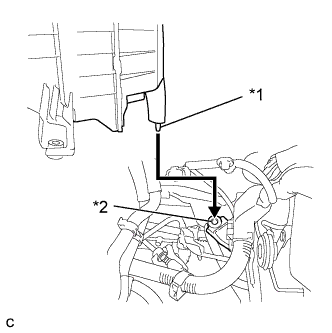
Text in Illustration *1 Tab *2 Hole Insert the tab of the air cleaner assembly to the hole of the vehicle body as shown in the illustration.
-
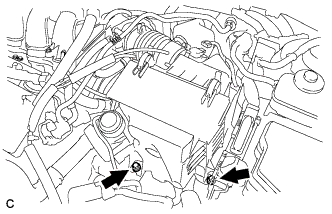
Install the air cleaner assembly with the 2 bolts.
- Torque:
- 5.5 N*m { 56 kgf*cm, 49 in.*lbf }
-
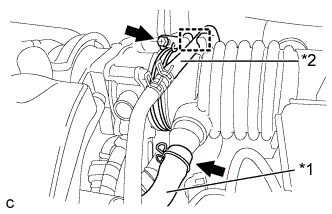
Text in Illustration *1 Ventilation Hose *2 Fuel Vapor Feed Hose Connect the air cleaner hose to the throttle body with the hose clamp.
-
Connect the ventilation hose and the fuel vapor feed hose.
-
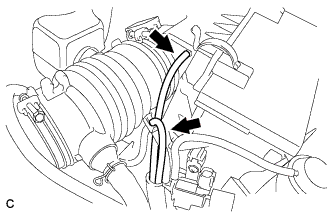
Connect the 2 vacuum hoses.
-
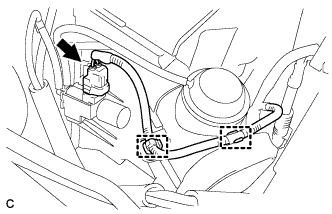
Connect the 2 wire harness clamps and vacuum switching valve connector.
-
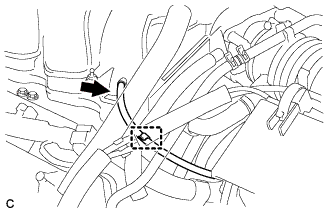
Connect the vacuum hose to the intake air surge tank assembly.
-
Install the hose to the hose clamp.
-
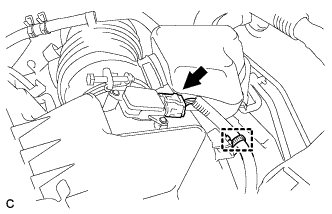
Connect the mass air flow meter connector and wire harness clamp.
-
-
INSTALL BATTERY (for 2GR-FE)
-
Install the battery and battery tray.
-
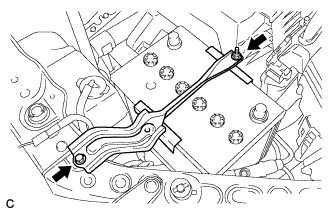
Install the battery clamp with the bolt and nut.
- Torque:
- 5.4 N*m { 55 kgf*cm, 48 in.*lbf }
-
Connect the positive (+) cable to the positive (+) battery terminal.
- Torque:
- 6.4 N*m { 65 kgf*cm, 57 in.*lbf }
-
-
INSTALL NO. 1 AIR CLEANER INLET (for 2GR-FE)
-
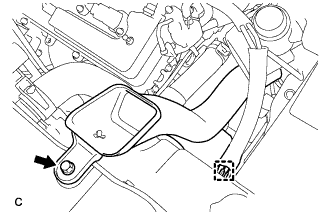
Install the No. 1 air cleaner inlet with the bolt.
- Torque:
- 8.0 N*m { 82 kgf*cm, 71 in.*lbf }
-
Connect the vacuum hose clamp to the No. 1 air cleaner inlet.
-
-
INSTALL NO. 2 AIR CLEANER INLET (for 2GR-FE)
-
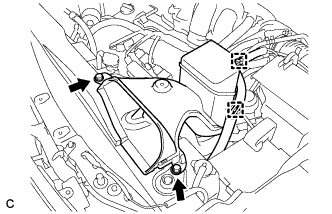
Install the No. 2 air cleaner inlet with the 2 bolts.
- Torque:
- 8.0 N*m { 82 kgf*cm, 71 in.*lbf }
-
Connect the 2 vacuum hose clamps to the No. 2 air cleaner inlet.
-
-
INSTALL V-BANK COVER SUB-ASSEMBLY (for 2GR-FE)
-
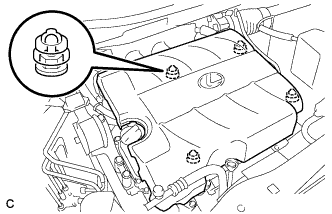
Fit the 4 retainers and install the V-bank cover sub-assembly.
-
-
INSTALL RESERVOIR BRACKET
-
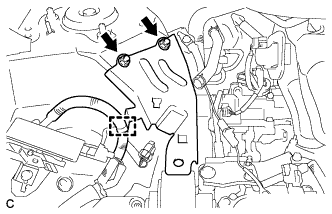
Install the reservoir bracket with the 2 nuts.
- Torque:
- 19 N*m { 194 kgf*cm, 14 ft.*lbf }
-
Engage the clamp.
-
-
INSTALL BRAKE MASTER CYLINDER RESERVOIR ASSEMBLY
-
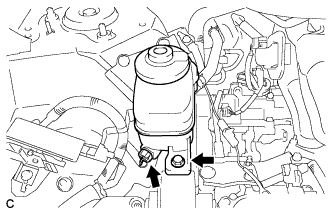
Install the brake master cylinder reservoir assembly with the bolt.
- Torque:
- 9.0 N*m { 92 kgf*cm, 80 in.*lbf }
-
Connect the connector.
-
-
INSTALL CHECK VALVE GROMMET
-
Install a new check valve grommet to the brake booster assembly.
-
-
INSTALL BRAKE VACUUM CHECK VALVE ASSEMBLY
-
Install the vacuum check valve assembly to the brake booster assembly.
-
-
INSTALL VACUUM SWITCHING VALVE ASSEMBLY (for 1AR-FE)
-
Install the vacuum switching valve assembly with the bolt.
- Torque:
- 9.0 N*m { 92 kgf*cm, 80 in.*lbf }
-
Connect the 2 vacuum hoses and connector.
-
Connect the union to connector tube hose and wire harness clamp.
-
-
CONNECT VACUUM HOSE (for 1AR-FE)
-
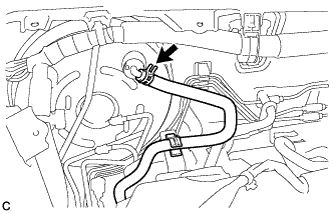
Connect the vacuum hose to the vacuum check valve assembly and slide the clip.
-
-
INSTALL NO. 1 ENGINE COVER SUB-ASSEMBLY (for 1AR-FE)
-
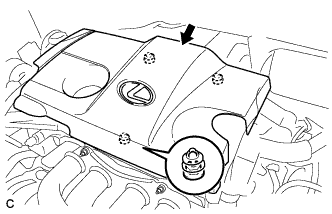
Fit the 3 retainers and install the No. 1 engine cover sub-assembly.
-
-
CONNECT VACUUM HOSE (for 2GR-FE)
-
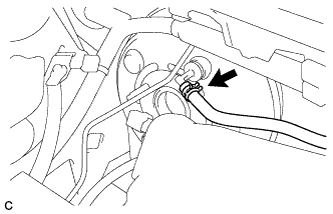
Connect the vacuum hose to the vacuum check valve assembly and slide the clip.
-
-
CONNECT CABLE TO NEGATIVE BATTERY TERMINAL
Note
When disconnecting the cable, some systems need to be initialized after the cable is reconnected Click here.
-
INSTALL BRAKE MASTER CYLINDER SUB-ASSEMBLY
-
ADD ENGINE COOLANT (for 2GR-FE)
-
Tighten the radiator drain cock plug by hand.
-
Tighten the 2 cylinder block drain cock plugs.
- Torque:
- 13 N*m { 130 kgf*cm, 9 ft.*lbf }
-
Remove the radiator cap.
-
Loosen the air drain cock plug on the water inlet housing.
-
Add TOYOTA Super Long Life Coolant (SLLC) to the radiator inlet opening until coolant overflows from the air drain cock hole. Then tighten the air drain cock plug to the water inlet housing.
- Torque:
- 13 N*m { 130 kgf*cm, 9 ft.*lbf }
-
Slowly fill the radiator with TOYOTA Super Long Life Coolant (SLLC).
Standard capacity 9.5 liters (10.0 US qts, 8.3 lmp. qts) Tech Tips
-
TOYOTA vehicles are filled with TOYOTA SLLC at the factory. In order to avoid damage to the engine cooling system and other technical problems, only use TOYOTA SLLC or similar high quality ethylene glycol based non-silicate, non-amine, non-nitrite, non-borate coolant with long-life hybrid organic acid technology (coolant with long-life hybrid organic acid technology is a combination of low phosphates and organic acids).
-
Contact your TOYOTA dealer for further details.
Note
Never use water as a substitute for engine coolant.
-
-
Tighten the air drain plug.
-
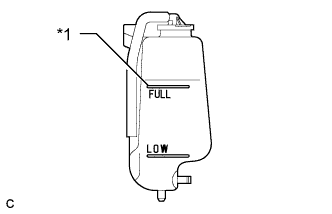
Text in Illustration *1 FULL Line Slowly pour coolant into the radiator reservoir tank until it reaches the FULL line.
-
Install the radiator cap.
-
Squeeze the No. 1 and No. 2 radiator hoses several times by hand, and then check the level of the coolant.
If the coolant level is low, add coolant.
-
Bleed air from the cooling system.
-
Warm up the engine until the thermostat opens. While the thermostat is open, circulate the coolant for several minutes.
Tech Tips
The thermostat open timing can be confirmed by squeezing the No. 2 radiator hose by hand, and checking when the engine coolant starts to flow inside the hose.
-
Maintain the engine speed at 2500 to 3000 rpm.
-
Squeeze the inlet and No. 1 and No. 2 radiator hoses several times by hand to bleed air.
CAUTION:
When squeezing the radiator hoses:
-
Wear protective gloves.
-
Be careful as the radiator hoses are hot.
-
Keep your hands away from the cooling fans.
Note
-
Make sure that the radiator reservoir still has some coolant in it.
-
If the coolant temperature gauge indicates an excessive temperature, turn off the engine and let it cool.
-
If there is not enough coolant, the engine may overheat or be seriously damaged.
-
If the radiator reservoir does not have enough coolant, perform the following: 1) stop the engine, 2) wait until the coolant has cooled down, and 3) add coolant until the reservoir is filled to the FULL line.
-
-
-
Stop the engine and wait until the engine coolant cools down.
-
Add engine coolant to the FULL line on the radiator reservoir.
-
-
CHARGE WITH REFRIGERANT
-
Perform vacuum purging using a vacuum pump.
-
Charge with refrigerant HFC-134a (R134a).
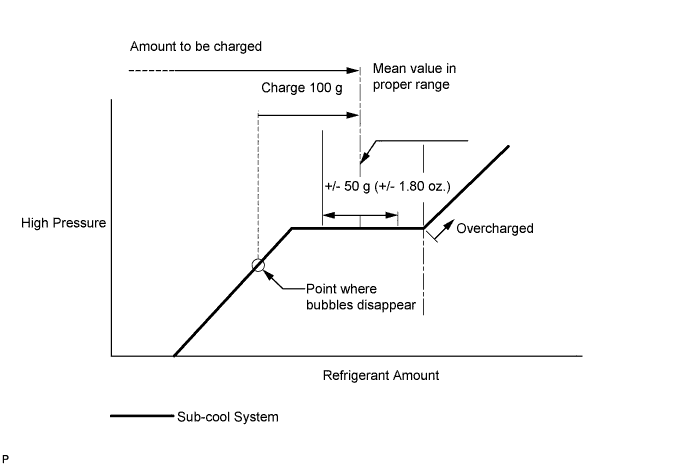
Standard (for Suction Pipe Separate Type) 450 to 550 g (15.9 to 19.4 oz.) Standard (except Suction Pipe Separate Type) 500 to 600 g (17.6 to 21.2 oz.) - SST
- 09985-20010 ( 09985-02010, 09985-02050, 09985-02060, 09985-02070, 09985-02080, 09985-02090, 09985-02110, 09985-02130, 09985-02140, 09985-02150 )
Note
-
Do not turn the A/C switch on before charging with refrigerant. Doing so will cause the compressor to work without refrigerant, resulting in overheating of the compressor.
-
Approximately 100 g (3.5 oz.) of refrigerant may need to be charged after bubbles disappear. The refrigerant amount should be checked by quantity, not with the sight glass.
Tech Tips
Ensure that sufficient refrigerant is available to recharge the system when using a refrigerant recovery unit. Refrigerant recovery units are not always able to recover 100% of the refrigerant from an A/C system.
-
-
WARM UP ENGINE
-
Keep the A/C switch on for at least 2 minutes to warm up the compressor.
Note
Be sure to warm up the compressor when turning the A/C switch on after removing and installing the cooler refrigerant lines (including the compressor), to prevent damage to the compressor.
-
-
INSPECT ENGINE OIL LEVEL (for 2GR-FE)
-
Warm up and stop the engine, then wait for 5 minutes. The oil level should be between the low level and full level marks on the engine oil level dipstick.
If the engine oil level is low, check for leakage and add oil up to the full level mark.
Note
Do not add engine oil to above the full level mark.
-
-
INSPECT FOR OIL LEAK (for 2GR-FE)
-
INSPECT FOR COOLANT LEAK (for 2GR-FE)
CAUTION:
Do not remove the radiator cap while the engine and radiator are still hot. Pressurized, hot engine coolant and steam may be released and cause serious burns.
Note
Before performing each inspection, turn the A/C switch off.
-
Remove the radiator cap.
-
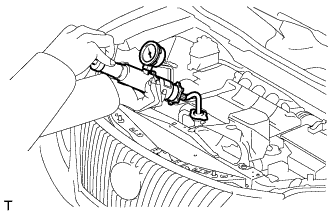
Fill the radiator with coolant and attach a radiator cap tester.
-
Warm up the engine.
-
Using the radiator cap tester, increase the pressure inside the radiator to 118 kPa (1.2 kgf/cm2, 17 psi), and check that the pressure does not drop.
If the pressure drops, check the hoses, radiator and water pump for leaks. If no external leaks are found, check the heater core, cylinder block and cylinder head.
-
Remove the radiator cap tester.
-
Install the radiator cap.
-
-
INSPECT FOR REFRIGERANT LEAK
-
After recharging with refrigerant, inspect for refrigerant leaks using a halogen leak detector.
-
Carry out the test under the following conditions:
-
Turn the engine switch off.
-
Secure good ventilation (the halogen leak detector may react to volatile gases which are not refrigerant, such as evaporated gasoline and exhaust gas).
-
Repeat the test 2 or 3 times.
-
Make sure that there is some refrigerant remaining in the refrigeration system.
When the compressor is off: approx. 392 to 588 kPa (4 to 6 kgf/cm2, 57 to 85 psi)
-
-
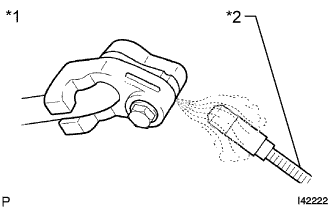
Text in Illustration *1 Inspect for Leak *2 Halogen Leak Detector Using a halogen leak detector, inspect for refrigerant leaks from the refrigerant lines.
-
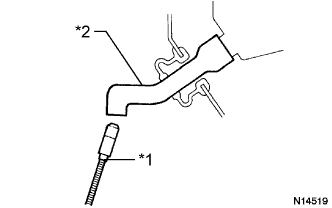
Text in Illustration *1 Halogen Leak Detector *2 Drain Hose Bring the halogen leak detector close to the drain hose with the detector's power off, and then turn the detector on.
Tech Tips
-
After the blower motor has stopped, let the cooling unit stand for more than 15 minutes.
-
Bring the halogen leak detector sensor under the drain hose.
-
When bringing the halogen leak detector close to the drain hose, make sure that the halogen leak detector does not react to volatile gases. If it is not possible to avoid interference from volatile gases, the vehicle should be lifted up to allow testing.
-
-
If a refrigerant leak is not detected from the drain hose, remove the blower motor control from the cooling unit. Insert the halogen leak detector sensor into the unit and perform the test.
-
Disconnect the pressure switch connector and leave it for approximately 20 minutes. Bring the halogen leak detector close to the pressure switch and perform the test.
-
-
INSTALL FRONT BUMPER COVER
for Standard: Click here
for Sport Package: Click here
-
INSPECT AND ADJUST BRAKE PEDAL
-
INSTALL FRONT WHEEL RH