If the wheel alignment has been adjusted, and if suspension or underbody components have been removed/installed or replaced, be sure to perform the following initialization procedure in order for the system to function normally:
-
Perform zero point calibration of the yaw rate and acceleration sensor and test mode inspection.
- Click here
PRECAUTION (w/ Air Suspension)
- Click here
INSPECT TIRES
- Click here
MEASURE VEHICLE HEIGHT
Note:
-
Before inspecting the wheel alignment, adjust the vehicle height to the specified value.
-
Be sure to perform measurement on a level surface.
-
If it is necessary to go under the vehicle for measurement, confirm that the parking brake is applied and the vehicle is secured with chocks.
-
Bounce the vehicle up and down at the corners to stabilize the suspension.
-
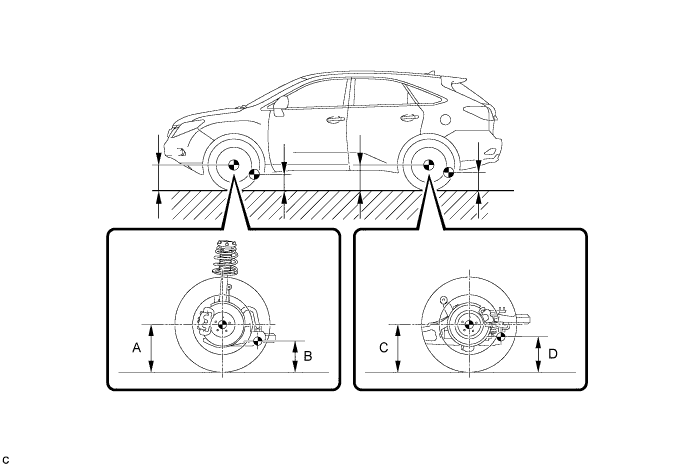
Measure the vehicle height.
- Measurement points:
-
A: Ground clearance of front wheel center
-
B: Ground clearance of front lower suspension arm bushing set bolt center
-
C: Ground clearance of rear wheel center
-
D: Ground clearance of rear No. 2 lower suspension arm adjust bolt center
Vehicle Height (Unloaded Vehicle) Model Front A - B Rear C - D 2WD 123.6 mm (4.87 in.) 50.6 mm (1.99 in.) AWD (w/o Air suspension) 124.6 mm (4.91 in.) 51.1 mm (2.01 in.) AWD (w/ Air suspension) 120 mm (4.72 in.) 58 mm (2.28 in.)
-
- Click here
INSPECT CAMBER
Camber (Unloaded Vehicle) Model Camber Inclination Right-left Difference w/o Air Suspension -0°35' +/- 45' (-0.58° +/- 0.75°) 45' (0.75°) or less w/ Air Suspension -0°49' +/- 45' (-0.82° +/- 0.75°) Tip:Camber is not adjustable. If the measurement is not within the specified range, inspect the suspension parts for damage and/or wear, and replace them if necessary.
-
Click here
INSPECT TOE-IN
Table 1. Text in Illustration *1 Front of the Vehicle Toe-in (Unloaded Vehicle) Model Specified Condition Right-left Difference w/o Air Suspension C + D: 0°05' +/- 0°10' (0.08° +/- 0.17°) 30' (0.50°) or less B - A: 1.0 +/- 2.0 mm (0.0394 +/- 0.0787 in.) - w/ Air Suspension C + D: 0°13' +/- 0°10' (0.21° +/- 0.17°) 30' (0.50°) or less B - A: 2.5 +/- 2.0 mm (0.0984 +/- 0.0787 in.) - If the toe-in is not within the specified range, adjust it at the rear No. 2 suspension arms.
Tip:Measure "B - A" only when "C + D" cannot be measured.
- Click here
ADJUST TOE-IN
-
Measure the distance between each wheel disc and the center of the toe-adjusting cam.
Difference in the distance between each wheel disc and the center of the toe-adjusting cam 1.0 mm (0.0394 in.) or less If the left-right difference is not within the specified range, adjust it by following the procedures below.
-
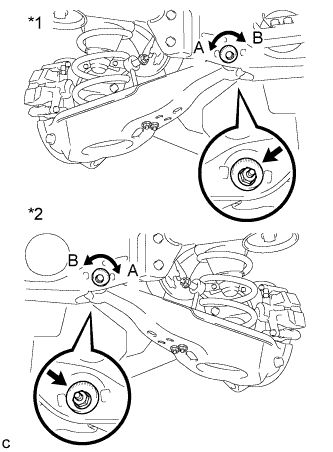
Loosen the toe-adjust cam set nuts.
Table 2. Text in Illustration *1 LH Side: *2 RH Side: -
If the distance between each wheel disc and the center of the toe-adjusting cam is not within the specified range, adjust it by following the procedures below.
-
If the toe-in measurement is greater than the specified range, extend the shorter rear No. 2 suspension arm assembly by rotating the adjust cams in the direction of arrow B in the illustration.
-
If the toe-in measurement is less than the specified range, shorten the longer rear No. 2 suspension arm assembly by rotating the adjust cams in the direction of arrow A in the illustration.
-
Measure the toe-in.
-
-
Turn the adjust cams by an equal amount to adjust the toe-in.
Tip:
-
Try to adjust the toe-in to the center of the specified range.
-
One graduation of each adjusting cam will adjust the toe-in by approximately 2.1 mm (0.0827 in.).
-
-
Tighten the toe-adjust cam set nuts.
100 N*m 1020 kgf*cm 74 ft.*lbf Note:The final torque must be applied under standard vehicle height conditions.
-
- Click here
PLACE FRONT WHEELS FACING STRAIGHT AHEAD
- Click here
PERFORM YAW RATE SENSOR ZERO POINT CALIBRATION
Tip:Perform the yaw rate sensor zero point calibration (Click here).
- Click here
PERFORM INITIALIZATION
Tip:Some systems need to be initialized after the wheel alignment is adjusted (Click here).