ACTIVE TORQUE CONTROL 4WD SYSTEM SYSTEM DESCRIPTION

-
GENERAL DESCRIPTION
-
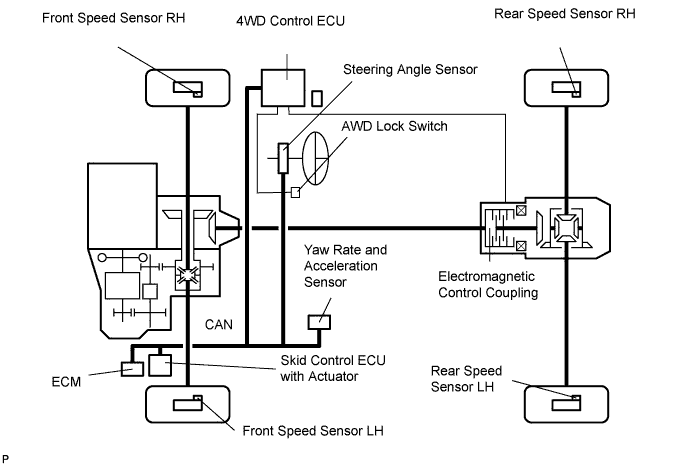
The active torque control 4WD system detects the driving conditions based on signals from each ECU, each switch, the steering angle sensor, the wheel speed sensor, and the yaw rate sensor. The system controls the electronic current passing through the linear solenoid of the electromagnetic control coupling, and performs electronic control to distribute the optimum torque to the rear wheels.
-
Main components and their functions.
Component Function Combination Meter Assembly Multi-information Display Displays a warning message to inform or warn the driver of the system condition in accordance with signals from the 4WD ECU assembly. Master Warning Light Illuminates to warn the driver if a malfunction occurs in the AWD system. AWD Lock Indicator Light Illuminates to inform the driver that AWD lock mode engaged. Speed Sensors (4) Detects the wheel speed of each wheel. Crankshaft Position Sensor Detects the engine speed and outputs it to the ECM. Throttle Position Sensor Detects the throttle valve position and outputs it to the ECM. Park/Neutral Position Switch Assembly Detects the shift position of the transaxle and outputs it to the ECM. Stop Light Switch Detects when the brake pedal is depressed. Parking Brake Switch Assembly Detects when the parking brake is applied. Steering Angle Sensor Detects turning of steering wheel Yaw Rate and Acceleration Sensor Assembly Detects the vehicle's yaw rate and the vehicle's longitudinal acceleration and deceleration. Transfer Drive force input into the differential is redirected 90 degrees and output to the propeller shaft by the transfer. Rear Differential Electromagnetic Control Coupling
- Electromagnetic Solenoid
Distributes drive torque in accordance with the amperage applied by the 4WD ECU assembly. 4WD Control ECU Assembly
-
Controls the amperage applied to the electromagnetic control coupling solenoid based on signals provided by the sensors in order to optimally distribute drive torque in accordance with driving conditions.
-
Turns AWD mode off when a parking brake ON signal is received from the main body ECU (instrument panel junction block).
-
Turns AWD mode off when a shift position signal (P or N) is received from the ECM.
ECM Outputs signals such as the shift position signal, throttle position signal, and crankshaft position signal to the 4WD ECU assembly. Skid Control ECU Outputs signals such as the vehicle speed signal and deceleration signal to the 4WD ECU assembly. Main Body ECU (Instrument Panel Junction Block) Outputs signals such as the parking brake signal to the 4WD ECU assembly. Ambient Temperature Detects external ambient temperature and inputs it into body ECU Electromagnetic Control Coupling Based on amount of current sent from 4WD control ECU, torque is distributed to rear wheels AWD Lock Switch (4 Wheel Drive Control Switch) Change of side auto mode for lock mode AWD Lock Indicator Light Lock mode control status is communicated to driver through indicator light illumination
When lock mode is turned ON, indicator light blinks twice and then remains illuminated.
When lock mode is turned OFF, indicator light turns OFF.
-
-
-
DRIVING FUNCTION
Vehicle Condition Status Control at Vehicle Startup This controls the amount of sideway sliding that occurs at rear of vehicles when accelerating from stop to improve acceleration and hill climbing capacity Slip Control at Vehicle Startup This helps prevent vehicle from sliding sideways. When accelerating a stopped vehicle with the steering wheel turned, it ensures steering stability Slip Control This ensures high turning performance and that stability is not affected by road surface conditions during mid and high speed running Control During Acceleration This controls straight-line running when accelerating during mid and high speeds to ensure straight-line stability of the vehicle -
OPERATION
-
AWD Mode
-
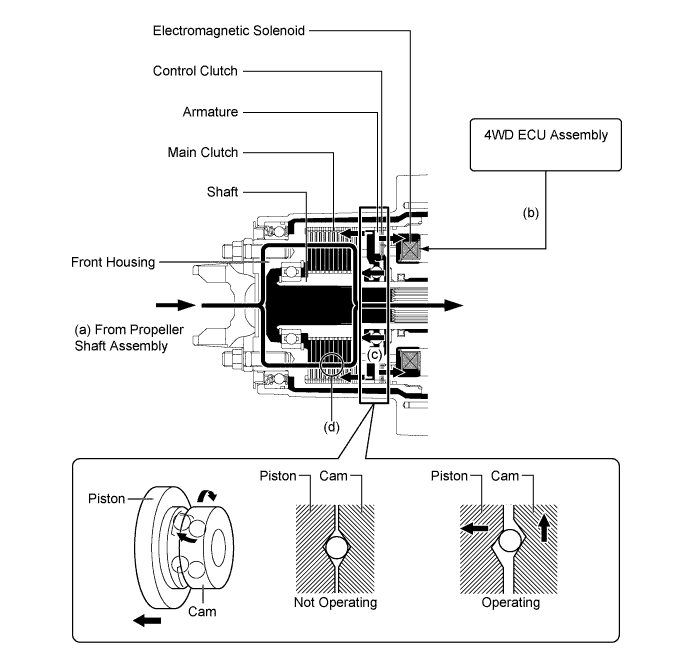
The drive force is transmitted from the propeller shaft to the front housing.
-
The 4WD ECU assembly judges whether it is necessary to send drive torque to the rear wheels based on input from various sensors. When it is necessary to send drive torque to the rear wheels, the electromagnetic solenoid is operated.
-
The electromagnetic solenoid attracts the armature to the control clutch side. This causes the control clutch to engage and the cam to rotate.
-
The rotational movement of the cam causes the piston to push on the main clutch, causing the main clutch to engage.
-
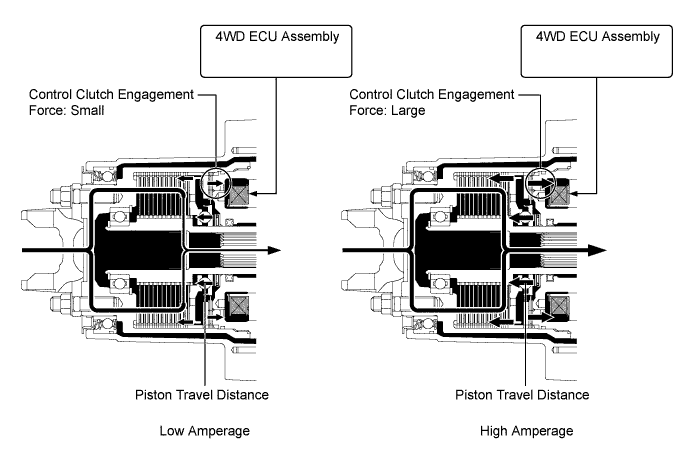
The amount of drive force that is transmitted to the rear wheels is controlled steplessly by controlling the amperage that is applied to the electromagnetic solenoid.
-
Accordingly, drive force from the propeller shaft is transmitted to the rear wheels.
-
-