DESCRIPTION
The room temperature sensor is installed in the instrument panel. It detects the cabin temperature to control the air conditioning AUTO mode. The resistance of the room temperature sensor changes in accordance with the cabin temperature. As the temperature decreases, the resistance increases. As the temperature increases, the resistance decreases.
The A/C amplifier applies voltage (5 V) to the room temperature sensor and reads voltage changes as the resistance of the room temperature sensor changes. This sensor also sends appropriate signals to the A/C amplifier. The room temperature sensor is integrated with the room humidity sensor.
| DTC No. | DTC Detection condition | Trouble Area |
|---|---|---|
| B1411/11 | Open or short in room temperature sensor circuit |
|
INSPECTION PROCEDURE
PROCEDURE
- Click here
READ VALUE USING INTELLIGENT TESTER
-
Connect the intelligent tester to the DLC3.
-
Turn the engine switch on (IG).
-
Turn the intelligent tester on.
-
Enter the following menus: Body / Air Conditioner / Data List.
-
Check the value(s) by referring to the table below.
Table 1. Air Conditioner Tester Display Measurement Item/Range Normal Condition Diagnostic Note Room Temperature Sensor Room temperature sensor /
Min.: -6.50°C (20.30°F)
Max.: 57.25°C (135.05°F)
Actual cabin temperature displayed - OK The display is as specified in the Normal Condition column. Result Result Proceed to NG A OK (When troubleshooting according to Problem Symptoms Table) B OK (When troubleshooting according to the DTC) C
-
- Click here
INSPECT ROOM TEMPERATURE SENSOR
-
Remove the room temperature sensor.
-
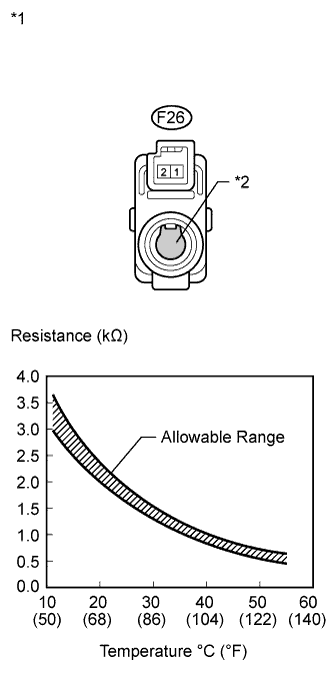
Disconnect the room temperature sensor connector.
-
Measure the resistance according to the value(s) in the table below.
Standard Resistance Tester Connection Condition Specified Condition F26-1 - F26-2 10°C (50°F) 3.00 to 3.73 kΩ F26-1 - F26-2 15°C (59°F) 2.45 to 2.88 kΩ F26-1 - F26-2 20°C (68°F) 1.95 to 2.30 kΩ F26-1 - F26-2 25°C (77°F) 1.60 to 1.80 kΩ F26-1 - F26-2 30°C (86°F) 1.28 to 1.47 kΩ F26-1 - F26-2 35°C (95°F) 1.00 to 1.22 kΩ F26-1 - F26-2 40°C (104°F) 0.80 to 1.00 kΩ F26-1 - F26-2 45°C (113°F) 0.65 to 0.85 kΩ F26-1 - F26-2 50°C (122°F) 0.50 to 0.70 kΩ F26-1 - F26-2 55°C (131°F) 0.44 to 0.60 kΩ F26-1 - F26-2 60°C (140°F) 0.36 to 0.50 kΩ Note:
-
Hold the sensor only by its connector. Touching the sensor may change the resistance value.
-
When measuring, the sensor temperature must be the same as the ambient temperature.
Tip:As the temperature increases, the resistance decreases (see the graph).
Table 2. Text in Illustration *1 Component without harness connected
(Room Temperature Sensor)
*2 Sensing Portion -
- OKClick here
- NGClick here
-
- Click here
CHECK HARNESS AND CONNECTOR (ROOM TEMPERATURE SENSOR - A/C AMPLIFIER)
-
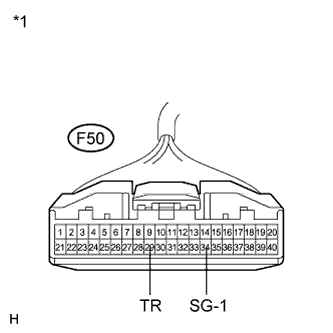
Disconnect the A/C amplifier connector.
-
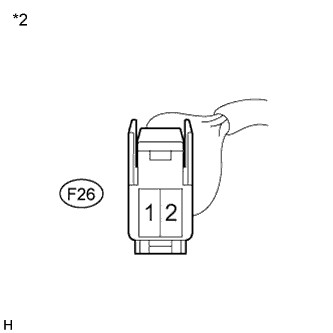
Measure the resistance according to the value(s) in the table below.
Standard Resistance Tester Connection Condition Specified Condition F50-29 (TR) - F26-1 Always Below 1 Ω F50-34 (SG-1) - F26-2 Always Below 1 Ω F50-29 (TR) - Body ground Always 10 kΩ or higher F50-34 (SG-1) - Body ground Always 10 kΩ or higher Table 3. Text in Illustration *1 Front view of wire harness connector
(to A/C Amplifier)
*2 Front view of wire harness connector
(to Room Temperature Sensor)
- OKClick here
- NGClick here
-
- Click here
PROCEED TO NEXT SUSPECTED AREA SHOWN IN PROBLEM SYMPTOMS TABLEClick here
- Click here
REPLACE A/C AMPLIFIERClick here
- Click here
REPLACE ROOM TEMPERATURE SENSORClick here
- Click here
REPAIR OR REPLACE HARNESS OR CONNECTOR