AIR CONDITIONING SYSTEM(for Manual Air Conditioning System) SYSTEM DESCRIPTION
-
GENERAL
-
The air conditioning system has the following controls.
Control Outline Air Inlet Control Drives the servo motor (for air inlet) according to the operation of the air inlet control switch and moves the dampers to the FRESH or RECIRC position.
-
-
MODE POSITION AND DAMPER OPERATION
-
Mode Position and Damper Operation
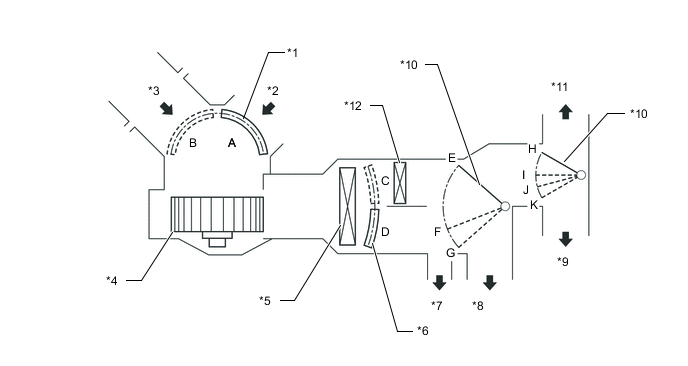
Functions of Main Dampers: Control Damper Operation Position Damper Position Operation Air Inlet Control Damper FRESH A Brings in fresh air. RECIRCULATION B Recirculates intermal air. Air Mix Control Damper MAX COLD to MAX HOT Temperature Setting C - D (C' - D') Varies the mixture ratio of warm air and cool air in order to regulate the temperature continuously between hot and cold. Mode Control Door 
FACE E, H, Air blows out of the center register and side register ducts. 
BI-LEVEL F, H, Air blows out of the center register, side register and footwell register ducts. 
FOOT G, I, Air blows out of the footwell register and side register ducts. In addition, air blows out slightly from the front defroster and side defroster. 
FOOT AND DEFROSTER G, J, Defrosts the windshield through the front defroster, side defroster and side register ducts, while air is also blown out from footwell register ducts. 
DEFROSTER G, K, Defrosts the windshield through the front defroster, side defroster and side register ducts.
-
-
AIR OUTLETS AND AIRFLOW VOLUME
-
Air Outlets and Airflow Volume
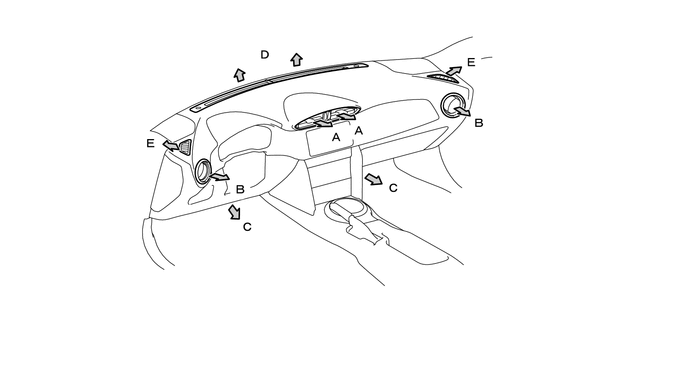
Indication MODE Face Footwell Defroster Center Side Front Side A B C D E FACE 

BI-LEVEL 
FOOT 

FOOT AND DEFROSTER F/D 
The size of each circle ○ indicates the ratio of airflow volume.
-
-
COMPRESSOR
-
General:
-
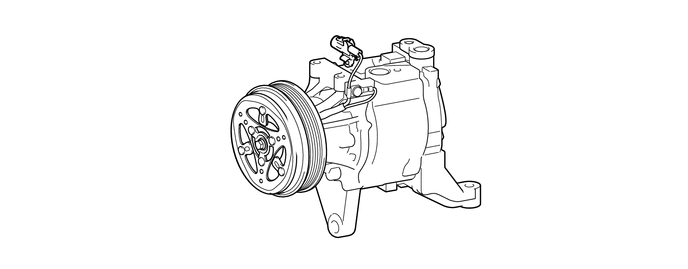
A compact and high performance scroll compressor with separator has been adopted.
-
The scroll compressor with oil separator consists of a spirally wound fixed scroll and rotating scroll that from a pair, and oil separator, and a magnetic clutch.
The fixed scroll is integrated with the housing. Because the rotation of the shaft causes the rotating scroll to revolve while maintaining the same posture, the volume of the space that is partitioned by both scrolls varies to perform the suction, compression, and the discharge of the refrigerant gas.
A pin is attached behind the rotating scroll to prevent the autorotation of the rotating scroll, allowing it only to revolve.
Locating the suction port directly above the scrolls enables direct suction, thus realizing improved suction efficiency.
Containing a built-in oil separator, this compressor is able to separate the compressor oil that is intermixed with the refrigerant and circulates in the refrigeration cycle, thus realizing a reduction in the oil circulation rate.
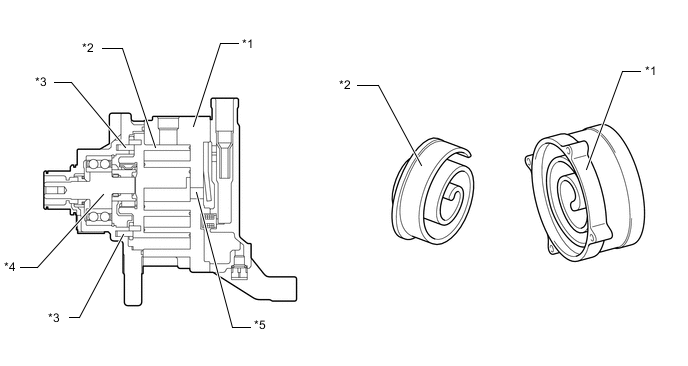
Text in Illustration *1 Fixed Scroll *2 Rotating Scroll *3 Pins *4 Shaft *5 Discharge Port - - -
A CS (Centrifugal with Shutter) type oil separator has been adopted to reduce the circulation rate of the compressor oil that is intermixed with the refrigerant and circulates in the refrigeration cycle.
This oil separator is provided with a cylindrical pipe in the separator case, enabling the refrigerant gas that has been discharged through the discharge gas inlet to be separated into refrigerant gas and oil through centrifugal force, and minimizing the outflow of the oil to the discharge service port. As a result, the oil circulation rate has been reduced and makes energy savings possible.
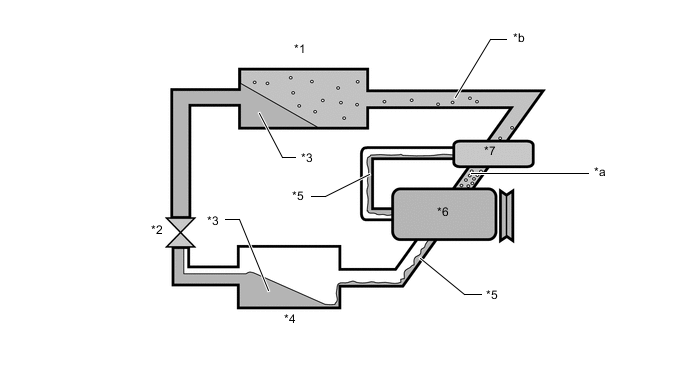
Text in Illustration *1 Cooler Condenser Assembly and Modulator *2 Cooler Expansion Valve *3 Refrigerant Gas + Compressor Oil *4 No. 1 Cooler Evaporator Sub-assembly *5 Oil *6 Compressor Assembly *7 Oil Separator - - *a Oil Circulation Ratio of 4% *b Oil Circulation Ratio of 1%
-
-
Compressor Operation:
-
As the capacity of the compression chamber, which is created between the rotating scroll and the fixed scroll, increases in accordance with the revolution of the rotating scroll, refrigerant gas is drawn in from the intake port.
-
From the state at which the suction process has been completed, as the revolution of the rotating scroll advances further, the capacity of the compression chamber decreases gradually. Consequently, the refrigerant gas that has been drawn in becomes compressed gradually and is sent to the center of the fixed scroll. The compression of the refrigerant gas is completed when the rotating scroll completes approximately 2 revolutions.
-
When the compression of the refrigerant gas is completed and the refrigerant pressure becomes high, the refrigerant gas discharges through the discharge port located in the center of the fixed scroll by pushing the discharge valve.
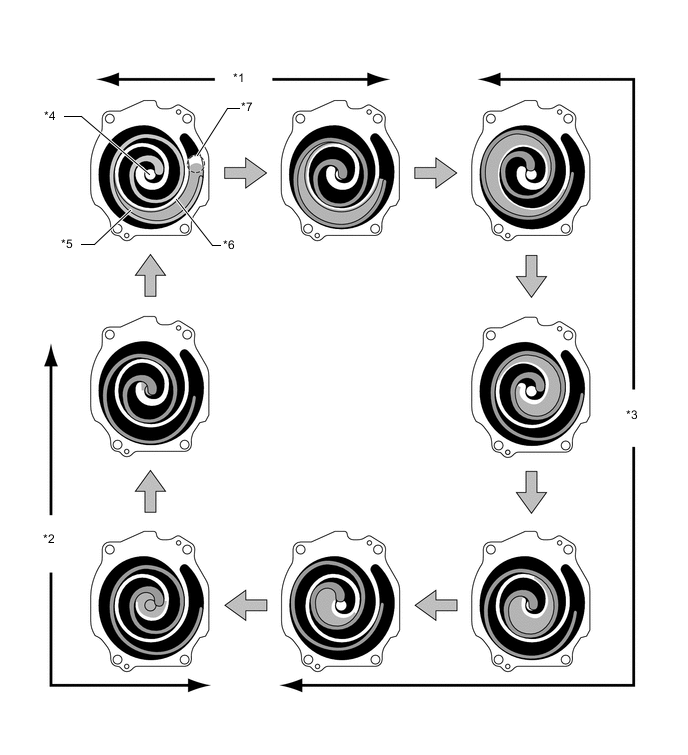
Text in Illustration *1 Suction *2 Discharge *3 Compression *4 Discharge Port *5 Rotating Scroll *6 Fixed Scroll *7 Intake Port - - -
The refrigerant gas that is discharged from the discharge port flows by rotating around the cylindrical pipe in the oil separator. At this time, the centrifugal force that is created during the rotation separates the refrigerant gas and the compressor oil due to the difference in their specific gravity. The refrigerant gas with the lighter specific gravity passes through the inside of the pipe and travels from the discharge service port to the outside of the compressor. The compressor oil with the heavier specific gravity is discharged through the oil discharge hole in the shutter and is stored in the oil storage chamber. Then, the compressor oil is fed again into the compressor and circulates inside the compressor.
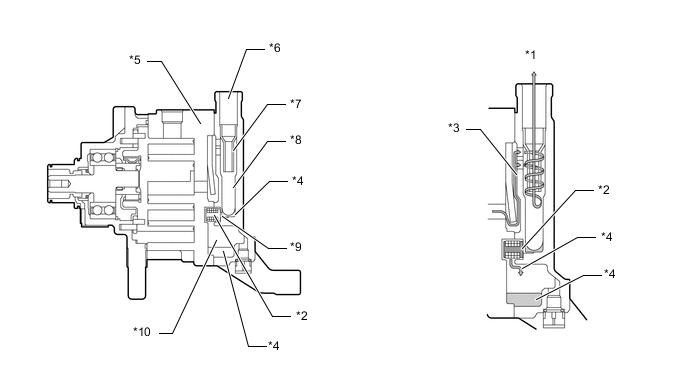
Text in Illustration *1 Refrigerant *2 Shutter *3 Refrigerant and Compressor Oil *4 Compressor Oil *5 Valve Chamber D *6 Service Port *7 Pipe *8 Case *9 Oil Discharge Hole *10 Oil Storage Chamber
-
-
-
EVAPORATOR TEMPERATURE SENSOR (NO. 1 COOLER THERMISTOR)
The evaporator temperature sensor (No. 1 cooler thermistor) detects the temperature of the cooled air immediately past the evaporator in the form of resistance changes, and outputs this data to the main body ECU (network gateway ECU).
-
AIR CONDITIONING PRESSURE SWITCH
The air conditioning pressure switch (airconditioner tube assembly) uses refrigerant pressure to output an on/off signal to the ECM to control the compressor with magnet clutch.