CYLINDER BLOCK INSPECTION

PROCEDURE
-
INSPECT CYLINDER BLOCK SUB-ASSEMBLY
-
Visually check that there are no cracks, scratches or other damage.
-
Using a dye penetrant, check the important sections for fissures.
-
Check that there are no signs of gas leak or water leak on gasket attachment surfaces.
-
Check the oil passages for clogging.
-
-
INSPECT CYLINDER BLOCK FOR WARPAGE
-
Using a precision straightedge and a feeler gauge, measure the surfaces that contact the cylinder head for warpage.
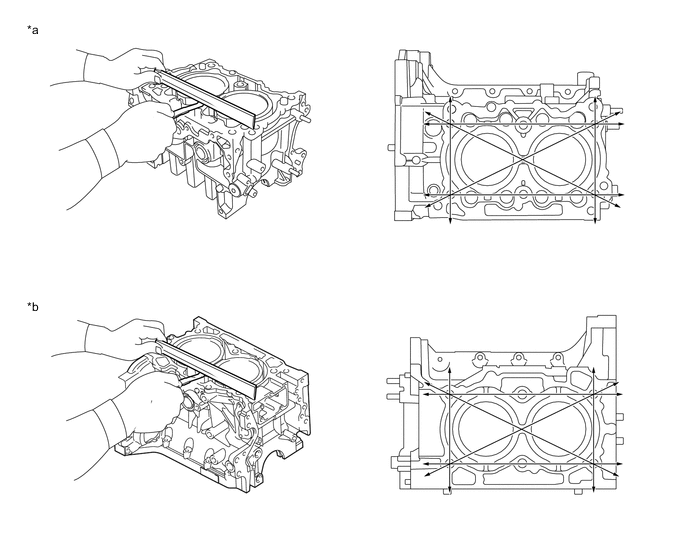
Text in Illustration *a for Bank 1 *b for Bank 2 Maximum warpage 0.025 mm (0.00098 in.) If the warpage is greater than the maximum, correct the surface by grinding it or replace the cylinder block.
Tech Tips
Measurement should be performed at a temperature of 20°C (68°F).
Allowable minimum cylinder block height 204.9 mm (8.067 in.) Standard cylinder block height 205.0 mm (8.071 in.)
-
-
INSPECT CYLINDER BORE
-
Using a cylinder gauge, measure the cylinder bore diameter at positions shown in the illustration and check for taper and out-of-round.
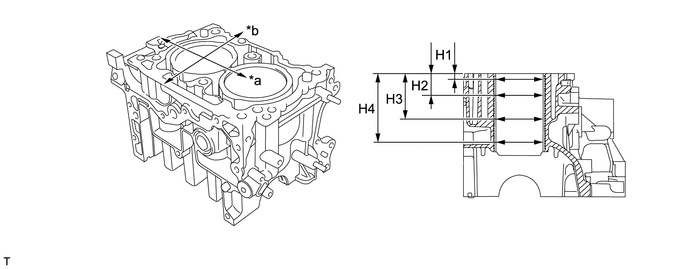
Text in Illustration *a Piston pin direction *b Thrust direction Standard Cylinder bore size A 86.005 to 86.015 mm (3.38602 to 3.38641 in.) Cylinder bore size B 85.995 to 86.005 mm (3.38562 to 3.38602 in.) Maximum Taper 0.030 mm (0.00118 in.) Out-of-runout 0.010 mm (0.00039 in.) Location H1 10.0 mm (0.394 in.) H2 45.0 mm (1.772 in.) H3 80.0 mm (3.150 in.) H4 115.0 mm (4.528 in.) If the result is not as specified, perform boring and honing, or replace the cylinder block and piston as a set.
Tech Tips
-
Measurement should be performed at a temperature of 20°C (68°F).
-
Measure the inside diameter of each cylinder bore in both the thrust and piston pin directions at the height shown in the illustration.
-
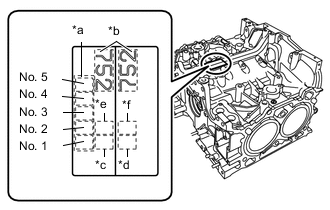
The cylinder bore size is stamped on the upper face of the cylinder block.
Text in Illustration *a Main journal size mark *b Cylinder block (for bank 1 / for bank 2) combination mark *c No. 1 cylinder bore size mark *d No. 2cylinder bore size mark *e No. 3 cylinder bore size mark *f No. 4 cylinder bore size mark -
-
-
INSPECT PISTON DIAMETER
-
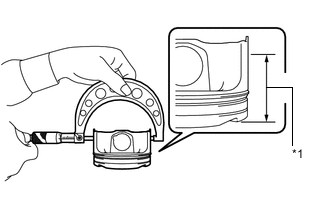
*1 39.4 mm Using a micrometer, measure the piston diameter at right angles to the piston pin hole, and at a point 39.4 mm (1.551 in.) from the top of the piston head.
Standard A grade 85.985 to 85.995 mm (3.38523 to 3.38562 in.) B grade 85.975 to 85.985 mm (3.38484 to 3.38523 in.) 0.25 mm (0.0098 in.) over size 86.225 to 86.245 mm (3.39468 to 3.39547 in.) 0.50 mm (0.0197 in.) over size 86.475 to 86.495 mm (3.40452 to 3.40531 in.) If the result is not as specified, replace the piston.
Tech Tips
-
Measurement should be performed at a temperature of 20°C (68°F).
-
Measure the outer diameter of each piston in thrust direction at the height shown in the illustration.
-
Standard sized pistons are classified into 2 grades, "A" and "B". These grades should be used as guide lines in selecting a standard piston diameter.
-
If the piston is replaced, check the piston oil clearance, and select a suitable sized piston diameter.
-
-
-
INSPECT PISTON OIL CLEARANCE
-
Subtract the piston diameter measurement from the cylinder bore diameter measurement.
Standard oil clearance 0.010 to 0.030 mm (0.00039 to 0.00118 in.) Tech Tips
-
Oil clearance = maximum cylinder bore diameter - piston diameter
-
If the result is not as specified, perform boring and honing, or replace the cylinder block and piston as a set.
-
-
-
REPAIR CYLINDER LINER
-
If any of the inside diameter, taper, out-of-round or piston oil clearance is out of standard, or if there is any damage on the cylinder liner, rebore it to replace with an oversized piston.
Allowable maximum cylinder liner diameter 86.505 mm (3.40570 in.) If the inside diameter of cylinder liner is more than the maximum after boring and honing, replace the cylinder block and piston as a set.
Tech Tips
-
When any of the cylinder liner needs to be rebored, all other cylinder bores must be rebored at the same time, and replaced with oversized pistons.
-
Immediately after reboring, the inside diameter of the cylinder liner may differ from its actual diameter due to high temperature. Thus, when measuring the inside diameter of the cylinder liner, wait until it has cooled to the normal temperature of 20°C (68°F).
-
-
-
INSPECT PISTON WITH PIN
-
Check the piston and piston pin for wear or cracks.
-
Check the piston pin hole snap ring for distortion or wear.
-
Check the piston ring groove for damage.
-
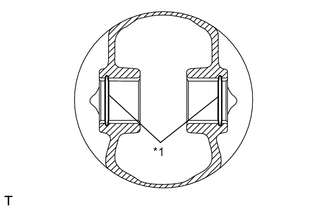
Text in Illustration *1 Piston Pin Hole Snap Ring Groove Check the piston pin hole snap ring groove for burr.
If any burr is found, remove the burr from the groove.
-
Check if the piston pin can be pushed into the piston pin hole with your thumb.
Tech Tips
Measurement should be performed at a temperature of 20°C (68°F).
-
-
INSPECT CONNECTING ROD SMALL END BUSH
-
Check the bushing at connecting rod small end bush for damage.
-
-
INSPECT PISTON PIN OIL CLEARANCE
-
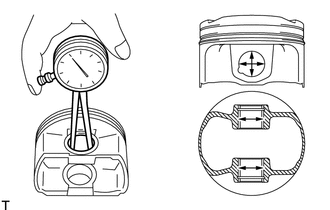
Using a caliper gauge, measure the inside diameter of the piston pin hole.
Tech Tips
-
Measurement should be performed at a temperature of 20°C (68°F).
-
Measure the inside diameter of the piston pin hole at the 4 locations shown in the illustration, and take the maximum value.
-
Record the measured value.
-
-
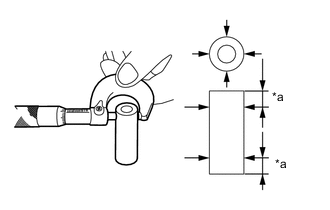
Text in Illustration *a 10.0 mm (0.394 in.) Using a micrometer, measure the outer diameter of the piston pin.
Tech Tips
-
Measurement should be performed at a temperature of 20°C (68°F).
-
Measure the outer diameter of the piston pin at the 4 locations shown in the illustration, and take the minimum value.
-
Record the measured value.
-
-
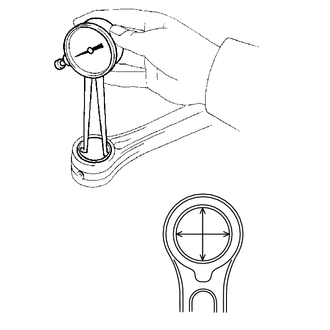
Using a caliper gauge, measure the inside diameter of bushing at connecting rod small end.
Tech Tips
-
Measurement should be performed at a temperature of 20°C (68°F).
-
Measure the inside diameter of the bushing at the 4 locations shown in the illustration, and take the minimum value.
-
Record the measured value.
-
-
Calculate the clearance between the piston pin hole and piston pin.
Standard oil clearance 0.004 to 0.008 mm (0.00016 to 0.00031 in.) If the clearance between the piston pin and piston pin hole is more than the maximum, replace the piston and piston pin as a set.
Tech Tips
Oil clearance = piston pin hole inside diameter - piston pin outer diameter
-
Calculate the clearance between piston pin and bushing at connecting rod small end.
Standard oil clearance 0.006 to 0.026 mm (0.00024 to 0.00102 in.) If the clearance between the piston pin and bushing at connecting rod small end is more than the maximum, replace the connecting rod and piston pin as a set.
Tech Tips
Oil clearance = connecting rod small end inside diameter - piston pin outer diameter
-
-
INSPECT PISTON RING
-
Make sure that the piston ring is not broken or damaged.
If the piston ring is broken or damaged, replace it with a new one.
Tech Tips
Use a piston ring of the same size as the piston to be used.
-
-
INSPECT PISTON RING END GAP
-
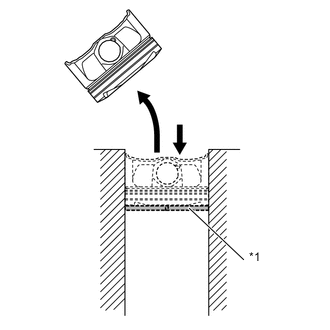
Text in Illustration *1 Piston ring Using a piston, push the piston ring into the cylinder.
Tech Tips
Push the piston ring until the entire piston is inserted into the cylinder.
-
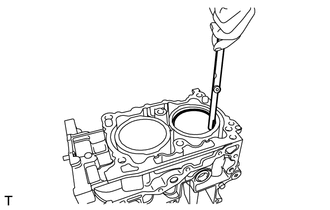
Using a feeler gauge, measure the end gap.
Maximum end gap No. 1 0.25 to 0.30 mm (0.00984 to 0.01181 in.) No. 2 0.60 to 0.70 mm (0.02362 to 0.02756 in.) Oil ring 0.10 to 0.35 mm (0.00394 to 0.01378 in.) If the end gap is more than the maximum, replace the piston ring with a new one.
Tech Tips
-
Measurement should be performed at a temperature of 20°C (68°F).
-
Use a piston ring of the same size as the piston to be used.
-
-
-
INSPECT RING GROOVE CLEARANCE
-
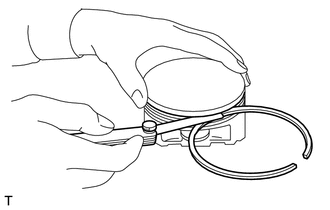
Using a feeler gauge, measure the clearance between the piston ring and the wall of the ring groove.
Maximum clearance No. 1 0.030 to 0.080 mm (0.00118 to 0.00315 in.) No. 2 0.030 to 0.070 mm (0.00118 to 0.00276 in.) If the clearance is more than the maximum, replace the piston ring with a new one.
Tech Tips
-
Measurement should be performed at a temperature of 20°C (68°F).
-
Before measuring the clearance, clean the piston ring groove and piston ring.
-
Use a same sized piston ring with the piston when replacing it.
-
-
-
INSPECT CONNECTING ROD ASSEMBLY
-
Check that the large or small end thrust surface is not damaged.
-
Check the connecting rod assembly bearing for scar, peeling, seizure, melting or wear, etc.
-
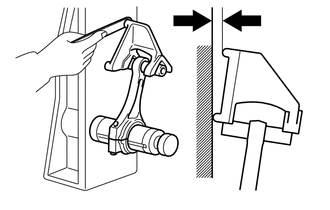
Using a rod aligner and feeler gauge, check the connecting rod assembly for bend.
Maximum bend 0.10 mm (0.0039 in.) per 100 mm (3.937 in.) in length If the bend is more than the maximum, replace the connecting rod assembly with a new one.
Tech Tips
Measurement should be performed at a temperature of 20°C (68°F).
-
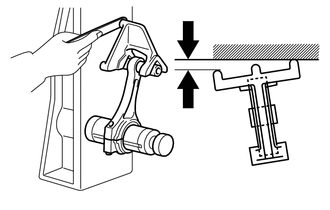
Using a rod aligner and feeler gauge, check the connecting rod assembly for twist.
Maximum twist 0.10 mm (0.0039 in.) per 100 mm (3.937 in.) in length If the twist is more than the maximum, replace the connecting rod assembly with a new one.
Tech Tips
Measurement should be performed at a temperature of 20°C (68°F).
-
-
INSPECT CONNECTING ROD THRUST CLEARANCE
-
Clean the connecting rod bearings and crank pins, and apply engine oil to the crank pins. <*1>
-
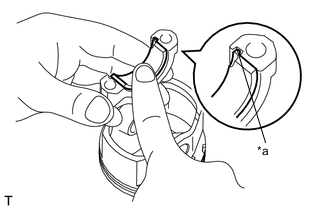
Text in Illustration *a Claw Align the claw and attach the connecting rod bearing to the connecting rod.
-
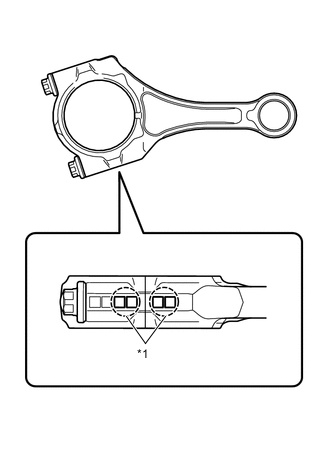
Text in Illustration *1 Matching Symbol Check the matching symbols and set the connecting rod, connecting rod cap and connecting rod cap bolts.
-
Tech Tips
-
Measurement should be performed at a temperature of 20°C (68°F).
-
Each connecting rod has its own mating cap. Make sure that they are assembled correctly by checking their matching symbol.
-
-
Apply engine oil to the threads of the connecting rod cap bolts.
-
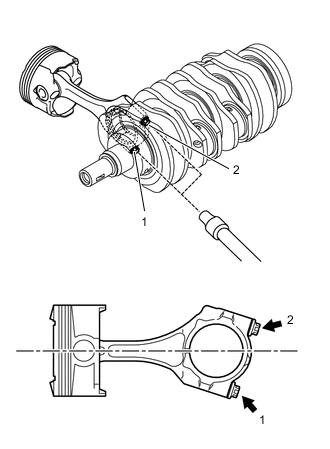
Using a "TORX" socket wrench E14, tighten the 2 connecting rod cup bolts in the order shown in the illustration.
- Torque:
- 10 N*m { 102 kgf*cm, 7 ft.*lbf }
Note
-
Securely hold the crankshaft during the operation.
-
Be sure not to damage the crankshaft when securing it.
-
Retighten the 2 connecting rod cup bolts in the same order as above. <*2>
- Torque:
- 25 N*m { 255 kgf*cm, 18 ft.*lbf }
Note
-
Securely hold the crankshaft during the operation.
-
Be sure not to damage the crankshaft when securing it.
-
In the same procedures from <*1> to <*2>, install the No. 2, No. 3 and No. 4 piston with connecting rods.
-
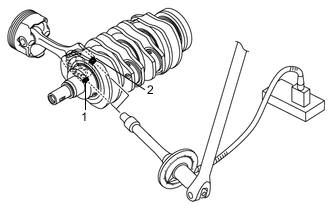
Using a "TORX" socket wrench E14 and an angle gauge, tighten the connecting rod cup bolts for the No. 1 to No. 4 piston with connecting rods by additional 92.5°.
Note
-
Securely hold the crankshaft during the operation.
-
Be sure not to damage the crankshaft when securing it.
-
-
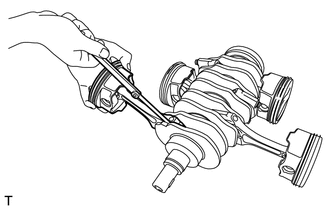
Using a feeler gauge, measure the thrust clearance for each connecting rod.
Standard thrust clearance 0.070 to 0.330 mm (0.00276 to 0.01299 in.) If the clearance is not within the standard, replace the connecting rod.
Tech Tips
Measure the thrust clearance for each connecting rod at several points, and replace the connecting rod if there is uneven wear.
-
-
INSPECT CONNECTING ROD OIL CLEARANCE
-
Clean the connecting rod bearings and crank pins, and apply engine oil to the crank pins. <*1>
-
Attach the connecting rod bearings to the connecting rod and connecting rod cap.
-
Text in Illustration *1 Matching Symbol Lay a strip of Plastigage across the crank pin, and set the connecting rod and the connecting rod cap with the 2 connecting rod cap bolts after checking the matching symbols.
Tech Tips
-
Measurement should be performed at a temperature of 20°C (68°F).
-
Each connecting rod has its own mating cap. Make sure that they are assembled correctly by checking their matching symbol.
-
-
Apply engine oil to the threads of the connecting rod cap bolts.
-
Using a "TORX" socket wrench E14, tighten the 2 connecting rod cup bolts in the order shown in the illustration.
- Torque:
- 10 N*m { 102 kgf*cm, 7 ft.*lbf }
Note
-
Do not turn the crankshaft.
-
Securely hold the crankshaft during the operation.
-
Be sure not to damage the crankshaft when securing it.
-
Retighten the 2 connecting rod cup bolts in the same order as above. <*2>
- Torque:
- 25 N*m { 255 kgf*cm, 18 ft.*lbf }
Note
-
Do not turn the crankshaft.
-
Securely hold the crankshaft during the operation.
-
Be sure not to damage the crankshaft when securing it.
-
In the same procedures from <*1> to <*2>, install the No. 2, No. 3 and No. 4 piston with connecting rods.
-
Using a "TORX" socket wrench E14 and an angle gauge, tighten the connecting rod cup bolts for the No. 1 to No. 4 piston with connecting rods by additional 92.5°.
-
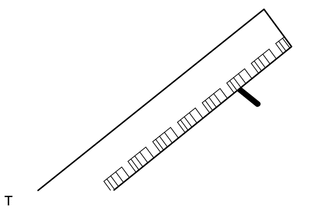
Remove the connecting rod cup and measure the Plastigage at its widest point.
Standard oil clearance 0.025 to 0.055 mm (0.00098 to 0.00217 in.) Note
Completely remove the Plastigage after the inspection.
If the oil clearance is more than the maximum, replace the bearings.
Tech Tips
Measure the outer diameter of the crank pin using a micrometer, and select a suitable size connecting rod bearing when replacing the connecting rod bearing.
Standard Bearing Bearing size (Thickness at center) Outer diameter of crank pin Standard 1.492 to 1.508 mm (0.05874 to 0.05937 in.) 49.976 to 50.000 mm (1.96756 to 1.96850 in.) 0.03 mm (0.0012 in.) Undersize 1.511 to 1.515 mm (0.05949 to 0.05965 in.) 49.946 to 49.970 mm (1.96637 to 1.96732 in.) 0.05 mm (0.0020 in.) Undersize 1.521 to 1.525 mm (0.05988 to 0.06004 in.) 49.926 to 49.950 mm (1.96559 to 1.96653 in.) 0.25 mm (0.0098 in.) Undersize 1.621 to 1.625 mm (0.06382 to 0.06398 in.) 49.726 to 49.750 mm (1.95771 to 1.95866 in.)
-
-
INSPECT CRANKSHAFT
-
Using a dye penetrant, check the important sections for fissures.
-
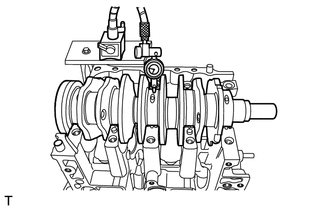
Using a dial indicator, measure the circle runout at the center journal.
Maximum circle runout 0.035 mm (0.00138 in.) If the circle runout is more than the maximum, grind to correct or replace the crankshaft.
Tech Tips
-
Measurement should be performed at a temperature of 20°C (68°F).
-
If a suitable V-block is not available, using just the No. 1 and No. 5 crankshaft bearings on the cylinder block, position the crankshaft on the cylinder block. Then, measure the crankshaft runout using a dial indicator.
-
-
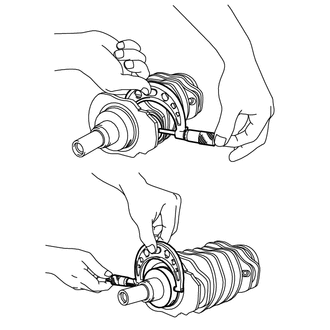
Using a micrometer, check the outer diameter of the crankshaft journal and crank pin for taper and out-of-round.
Maximum (Pin) Taper 0.006 mm (0.00024 in.) Out-of-runout 0.005 mm (0.00020 in.) Maximum (Journal) Taper 0.006 mm (0.00024 in.) Out-of-runout 0.005 mm (0.00020 in.) Allowable minimum diameter Pin 47.726 mm (1.87897 in.) Journal 67.735 mm (2.66673 in.) If taper or out-of-round is more than the maximum, replace the connecting rod bearing or crankshaft bearing, and grind to correct or replace the crankshaft as required.
Tech Tips
-
Measurement should be performed at a temperature of 20°C (68°F).
-
Select a suitable size connecting rod bearing or crankshaft bearing when replacing the connecting rod bearing or crankshaft bearing.
-
When grinding to correct the crank journal or crank pin, finish them to the suitable dimensions as shown in the table below according to the undersize bearing to be used.
Standard Bearing Connecting rod bearing thickness (at center) Crank pin outer diameter Crank bearing thickness (at center) Crankshaft journal diameter No. 1 to No. 4 No. 5 Standard 1.492 to 1.508 mm (0.05874 to 0.05937 in.) 49.976 to 50.000 mm (1.96756 to 1.96850 in.) 2.495 to 2.513 mm (0.09823 to 0.09894 in.) 2.493 to 2.511 mm (0.09815 to 0.09886 in.) 67.985 to 68.009 mm (2.67657 to 2.67751 in.) 0.03 mm (0.0012 in.) Undersize 1.511 to 1.515 mm (0.05949 to 0.05965 in.) 49.946 to 49.970 mm (1.96637 to 1.96734 in.) 2.519 to 2.522 mm (0.09917 to 0.09929 in.) 2.517 to 2.520 mm (0.09909 to 0.09921 in.) 67.955 to 67.979 mm (2.67539 to 2.67633 in.) 0.05 mm (0.0020 in.) Undersize 1.521 to 1.525 mm (0.05988 to 0.06004 in.) 49.926 to 49.950 mm (1.96559 to 1.96653 in.) 2.529 to 2.532 mm (0.09957 to 0.09968 in.) 2.527 to 2.530 mm (0.09949 to 0.09961 in.) 67.935 to 67.959 mm (2.67460 to 2.67555 in.) 0.25 mm (0.0098 in.) Undersize 1.621 to 1.625 mm (0.06382 to 0.06398 in.) 49.726 to 49.750 mm (1.95771 to 1.95866 in.) 2.629 to 2.632 mm (0.10350 to 0.10362 in.) 2.627 to 2.630 mm (0.10342 to 0.10354 in.) 67.735 to 67.759 mm (2.66673 to 2.66767 in.) -
-
-
INSPECT CRANKSHAFT BEARING
-
Inspect the crankshaft bearing for scar, peeling, seizure, melting or wear, etc.
-
-
INSPECT CRANKSHAFT THRUST CLEARANCE
-
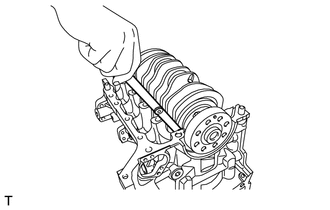
Using a feeler gauge, check the thrust clearance of the crankshaft at No. 5 crankshaft bearing.
Standard clearance 0.130 to 0.308 mm (0.00512 to 0.01213 in.) If the thrust clearance is not within the standard, replace the No. 5 crankshaft bearing.
-
-
INSPECT CRANKSHAFT OIL CLEARANCE
-
Remove the seal packing left on the cylinder block.
-
Clean the crankshaft bearings and crankshaft journals.
-
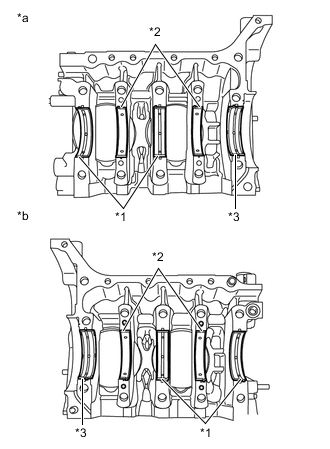
Text in Illustration *1 No. 1 and No. 3 crankshaft bearings (with grooves) *2 No. 2 and No. 4 crankshaft bearings (without grooves) *3 No. 5 crankshaft bearings *a for Bank 1 *b for Bank 2 Attach the crankshaft bearings to the cylinder block.
Note
-
Be careful not to damage the matching surface of the cylinder block.
-
The shapes of the No. 1 and No. 3 bearings are different from those of the No. 2 and No. 4 bearings. Be sure to attach them correctly.
-
-
Place the crankshaft on the cylinder block.
-
Lay a strip of Plastigage across each camshaft journal.
-
Place the cylinder block (for bank 1) on the cylinder block (for bank 2).
-
Apply engine oil to the washers and cylinder block bolt threads.
Note
To prevent engine oil from entering into the water jacket, do not apply a large amount.
-
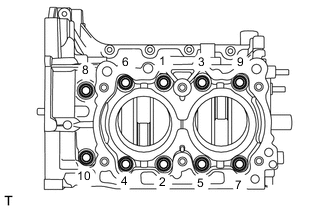
Using a 12 mm socket wrench, tighten the 10 bolts in the order shown in the illustration.
- Torque:
- 35 N*m { 357 kgf*cm, 26 ft.*lbf }
Note
When tightening the bolts, hold the cylinder block (for bank 2) while not holding the cylinder block (for bank 1) to ensure the joint accuracy of the cylinder blocks.
-
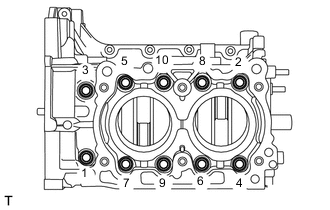
Using a 12 mm socket wrench, loosen the 10 bolts by 180 ° in the order shown in the illustration.
Note
When loosening the bolts, hold the cylinder block (for bank 2) while not holding the cylinder block (for bank 1) to ensure the joint accuracy of the cylinder blocks.
-
Using a 12 mm socket wrench, tighten the 10 bolts in the order shown in the illustration.
- Torque:
- 35 N*m { 357 kgf*cm, 26 ft.*lbf }
Note
When tightening the bolts, hold the cylinder block (for bank 2) while not holding the cylinder block (for bank 1) to ensure the joint accuracy of the cylinder blocks.
-
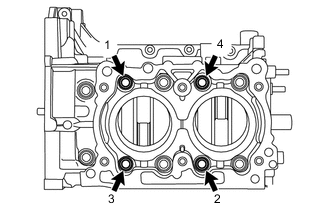
Using a 12 mm socket wrench, loosen the 4 bolts by 180 ° in the order shown in the illustration.
Note
When loosening the bolts, hold the cylinder block (for bank 2) while not holding the cylinder block (for bank 1) to ensure the joint accuracy of the cylinder blocks.
-
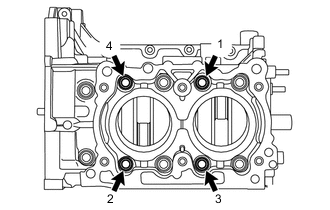
Using a 12 mm socket wrench, tighten the 4 bolts in the order shown in the illustration.
- Torque:
- 17 N*m { 173 kgf*cm, 13 ft.*lbf }
Note
When tightening the bolts, hold the cylinder block (for bank 2) while not holding the cylinder block (for bank 1) to ensure the joint accuracy of the cylinder blocks.
-
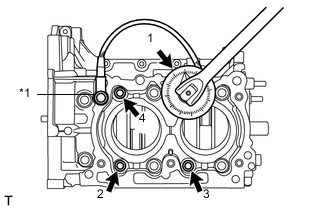
Text in Illustration *1 Temporary Bolt Using a 12 mm socket wrench and an angle gauge, tighten the 4 bolts by additional 60° in the order shown in the illustration.
Note
When tightening the bolts, hold the cylinder block (for bank 2) while not holding the cylinder block (for bank 1) to ensure the joint accuracy of the cylinder blocks.
Tech Tips
Temporarily install an appropriate bolt for the angle gauge if necessary.
-
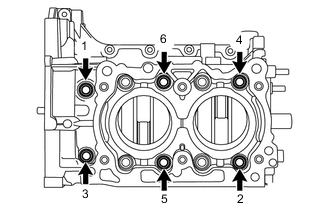
Using a 12 mm socket wrench, loosen the 6 bolts by 180 ° in the order shown in the illustration.
Note
When loosening the bolts, hold the cylinder block (for bank 2) while not holding the cylinder block (for bank 1) to ensure the joint accuracy of the cylinder blocks.
-
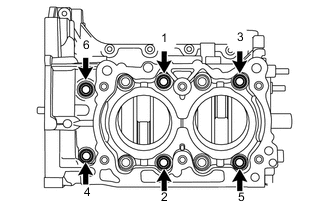
Using a 12 mm socket wrench, tighten the 6 bolts in the order shown in the illustration.
- Torque:
- 17 N*m { 173 kgf*cm, 13 ft.*lbf }
Note
When tightening the bolts, hold the cylinder block (for bank 2) while not holding the cylinder block (for bank 1) to ensure the joint accuracy of the cylinder blocks.
-
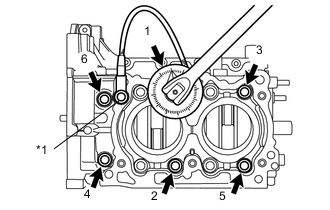
Text in Illustration *1 Temporary Bolt Using a 12 mm socket wrench and an angle gauge, tighten the 6 bolts by additional 60° in the order shown in the illustration.
Note
When tightening the bolts, hold the cylinder block (for bank 2) while not holding the cylinder block (for bank 1) to ensure the joint accuracy of the cylinder blocks.
Tech Tips
Temporarily install an appropriate bolt for the angle gauge if necessary.
-
Using a 12 mm socket wrench, loosen the 10 bolts in the order shown in the illustration.
-
Remove the 10 bolts and cylinder block (for bank 1).
Note
Lift the cylinder block (for bank 1) slightly, and confirm that the crankshaft remains on the cylinder block (for bank 2). If the cylinder block (for bank 1) is lifted carelessly when separating, the crankshaft may fall off as it may have stuck to the cylinder block (for bank 1).
-
Measure the Plastigage at its widest point.
Standard clearance 0.013 to 0.031 mm (0.00051 to 0.00122 in.) If the clearance is not within the standard, replace the crankshaft bearing, and grind to correct or replace the crankshaft as required.
Note
Completely remove the Plastigage after the inspection.
Tech Tips
-
Select the suitable size connecting rod bearing or crankshaft bearing when replacing the connecting rod bearing or crankshaft bearing.
-
When grinding to correct the crank journal or crank pin, finish them to the suitable dimensions as shown in the table below according to the undersize bearing to be used.
Standard Bearing Connecting rod bearing thickness (at center) Crank pin outer diameter Crank bearing thickness (at center) Crankshaft journal diameter No. 1 to No. 4 No. 5 Standard 1.492 to 1.508 mm (0.05874 to 0.05937 in.) 49.976 to 50.000 mm (1.96756 to 1.96850 in.) 2.495 to 2.513 mm (0.09823 to 0.09894 in.) 2.493 to 2.511 mm (0.09815 to 0.09886 in.) 67.985 to 68.009 mm (2.67657 to 2.67751 in.) 0.03 mm (0.0012 in.) Undersize 1.511 to 1.515 mm (0.05949 to 0.05965 in.) 49.946 to 49.970 mm (1.96637 to 1.96734 in.) 2.519 to 2.522 mm (0.09917 to 0.09929 in.) 2.517 to 2.520 mm (0.09909 to 0.09921 in.) 67.955 to 67.979 mm (2.67539 to 2.67633 in.) 0.05 mm (0.0020 in.) Undersize 1.521 to 1.525 mm (0.05988 to 0.06004 in.) 49.926 to 49.950 mm (1.96559 to 1.96653 in.) 2.529 to 2.532 mm (0.09957 to 0.09968 in.) 2.527 to 2.530 mm (0.09949 to 0.09961 in.) 67.935 to 67.959 mm (2.67460 to 2.67555 in.) 0.25 mm (0.0098 in.) Undersize 1.621 to 1.625 mm (0.06382 to 0.06398 in.) 49.726 to 49.750 mm (1.95771 to 1.95866 in.) 2.629 to 2.632 mm (0.10350 to 0.10362 in.) 2.627 to 2.630 mm (0.10342 to 0.10354 in.) 67.735 to 67.759 mm (2.66673 to 2.66767 in.) -
-