THEFT DETERRENT SYSTEM SYSTEM DESCRIPTION

-
OUTLINE OF THEFT DETERRENT SYSTEM
-
The theft deterrent system can be set by locking the doors using the transmitter, entry and start system or key, or by opening and closing the doors (for details, refer to Active Arming Mode or Passive Arming Mode).
-
The alarm function will be activated when someone attempts to forcibly unlock any of the doors or open any of the doors, engine hood or luggage door, or when the security courtesy switch circuit opens while the system is in the armed state.
-
In the alarm sounding state, the system illuminates the interior light and blinks the hazard warning lights, the headlights and taillights. At the same time, the system sounds the vehicle horns and security horn to deter break-in and theft as well as to warn people around the vehicle.
-
The alarm can be cancelled by unlocking the doors using the transmitter, entry and start system or key.
-
There are two arming modes for this system: one is active arming mode and the other is passive arming mode. When the active arming mode has been set, the theft deterrent system will be set after the user locks the doors via the transmitter, entry and start system or key. When the passive arming mode has been set, the theft deterrent system will be set the driver door is closed.
-
Disarmed state:
-
The alarm function is not operating.
-
The theft deterrent system is not operating.
-
-
Arming preparation state:
-
The time until the system goes into the armed state.
-
The theft deterrent system is not operating.
-
-
Armed state:
-
The theft deterrent system is operating.
-
-
Alarm sounding state:
-
The alarm function is operating.
Alarm Methods and Time Alarm Method Hazard Warning Lights Blinking Vehicle Horns Sounding
(approximately 0.4-second cycles)
Security Horn Sounding
(approximately 0.4-second cycles)
Alarm Time Approximately 27.5 seconds -
-
-
FUNCTION OF MAIN COMPONENTS
Component Function Security indicator light Informs driver of theft deterrent system status. Theft warning siren*1 Sounds when attempted break-in or theft is detected. Security horn*2 Sounds when attempted break-in or theft is detected. Hazard warning lights Blink when attempted break-in or theft is detected. Vehicle horns Sound when attempted break-in or theft is detected. Door courtesy light switch Detects door status (open or closed). Door unlock detection switch Detects door status (locked or unlocked). Engine hood courtesy switch Detects engine hood status (open or closed). Luggage compartment door courtesy light switch Detects luggage compartment door status (open or closed). Intrusion sensor (theft warning ultrasonic sensor)*3 Sends a signal to the main body ECU (multiplex network body ECU) to sound the alarm when detecting an intrusion. Tilt sensor (yaw rate sensor)*4 Sends a signal to the main body ECU (multiplex network body ECU) to sound the alarm when detecting pitch angle of vehicle inclination. Certification ECU (smart key ECU assembly)
-
Receives wireless door lock/unlock signal.
-
Receives entry door lock/unlock signal.
-
*1: w/ Theft Warning Siren
-
*2: w/ Security Horn Assembly
-
*3: w/ Intrusion Sensor
-
*4: w/ Tilt Sensor
-
-
ACTIVE ARMING MODE
Tech Tips
Active arming mode starts the alarm control immediately after the doors are locked.
-
Active arming mode:
This system operates as described in the diagram below when one of the items for each condition is met.
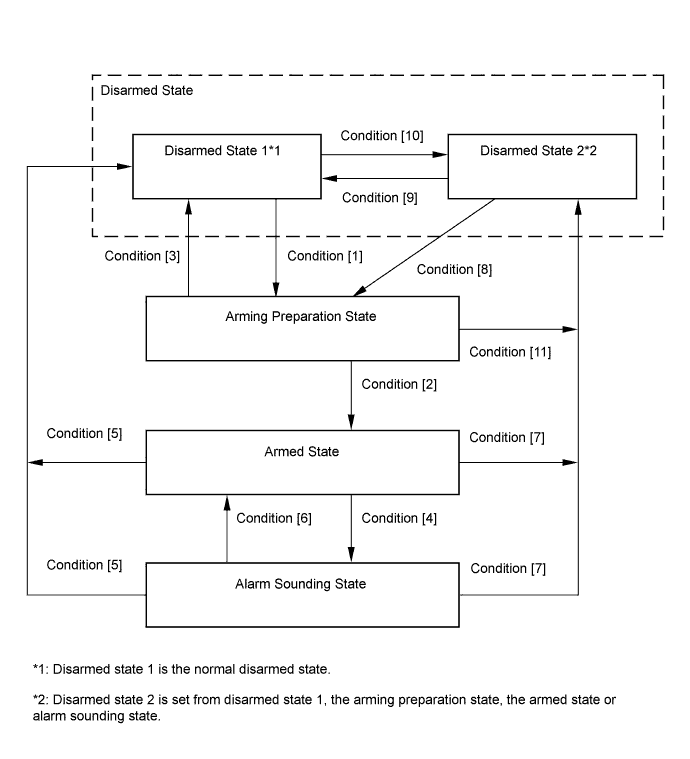
w/ Wireless Door Lock Buzzer Answer Back Function Condition Item Condition [1] In disarmed state 1, when the power switch is off, the system state is switched if the following condition is met:
-
With all doors, the engine hood and luggage compartment door closed, all doors are locked by wireless operation, the entry and start system or key linked power door lock operation.
In disarmed state 1, when the power switch is off, the engine hood and luggage compartment door are closed, and all doors are locked, the system state is switched if the following condition is met:
-
All doors are closed when any door is opened.
Condition [2] Allow approximately 30 seconds to elapse. Condition [3]
-
All doors are unlocked by wireless operation, the entry and start system or key linked power door lock operation.
-
Any door is unlocked.
-
Any door is opened.
-
The power switch is turned on (ACC) or on (IG).
-
The auxiliary battery is reconnected.
Condition [4]
-
The engine hood is opened when the engine hood is closed.
-
The luggage compartment door is opened when the luggage compartment door is closed.
-
The auxiliary battery is reconnected.
-
Any door is opened when all doors are closed.
-
Any door is unlocked when all doors are locked.
-
When 5 seconds or more have elapsed after the power switch is turned off, the power switch is turned on (IG).
Condition [5]
-
The power switch is turned on (IG) and the hybrid system is run for more than 2 seconds.
-
All doors are unlocked by wireless operation, the entry and start system or key linked power door lock operation.
-
The power switch is turned on (ACC) or on (IG) within 5 seconds after the power switch was turned off.
Condition [6] After approximately 27.5 seconds, alarm stops and system returns to armed state. Condition [7] The luggage compartment door is opened by wireless operation or the entry and start system. Condition [8]
-
The luggage compartment door is closed when the engine hood is closed.
-
The engine hood is closed when the luggage compartment door is closed.
Condition [9]
-
Any door is unlocked when all doors are locked.
-
Any door is opened.
-
The power switch is turned on (ACC) or on (IG).
-
The auxiliary battery is reconnected.
-
All doors are unlocked by wireless operation, the entry and start system or key linked power door lock operation.
Condition [10] In disarmed state 1, when the power switch is off, the system state is switched if the following condition is met:
-
With all doors closed, and the engine hood and luggage compartment door opened, all doors are locked by wireless operation, the entry and start system or key linked power door lock operation.
In disarmed state 1, when the power switch is off, all doors are locked, the engine hood and luggage compartment door are open, the system state is switched if the following condition is met:
-
All doors are closed when any door is opened.
Condition [11]
-
The engine hood is opened.
-
The luggage compartment door is opened.
-
The luggage compartment door is opened by wireless operation or the entry and start system.
w/o Wireless Door Lock Buzzer Answer Back Function Condition Item Condition [1] In disarmed state 1, when the power switch is off, the system state is switched if the following condition is met:
-
With all doors, the engine hood and luggage compartment door closed, all doors are locked by wireless operation or the entry and start system.
Condition [2] Allow approximately 30 seconds to elapse. Condition [3]
-
All doors are unlocked by wireless operation, the entry and start system or key linked power door lock operation.
-
Any door is unlocked.
-
Any door is opened.
-
The power switch is turned on (ACC) or on (IG).
-
The auxiliary battery is reconnected.
Condition [4]
-
The auxiliary battery is reconnected.
-
Any door is opened when all doors are closed.
-
Any door is unlocked when all doors are locked.
-
When 5 seconds or more have elapsed after the power switch is turned off, the power switch is turned on (IG).
-
The engine hood is opened.
-
The luggage compartment door is opened.
-
Any door is unlocked.
Condition [5]
-
The power switch is turned on (IG) and the hybrid system is run for more than 2 seconds.
-
All doors are unlocked by wireless operation, the entry and start system or key linked power door lock operation.
Condition [6] After approximately 27.5 seconds, alarm stops and 5 seconds later system returns to armed state. Condition [7] The luggage compartment door is opened by wireless operation or the entry and start system. Condition [8]
-
The luggage compartment door is closed when the engine hood is closed.
-
The engine hood is closed when the luggage compartment door is closed.
Condition [9]
-
Any door is unlocked when all doors are locked.
-
Any door is opened.
-
The power switch is turned on (ACC) or on (IG).
-
The auxiliary battery is reconnected.
-
All doors are unlocked by wireless operation, the entry and start system or key linked power door lock operation.
Condition [10] In disarmed state 1, when the power switch is off, the system state is switched if the following condition is met:
-
With all doors closed, and the engine hood and luggage compartment door opened, all doors are locked by wireless operation or the entry and start system.
Condition [11]
-
The engine hood is opened.
-
The luggage compartment door is opened.
-
The luggage compartment door is opened by wireless operation or the entry and start system.
-
-
-
FORCED DOOR LOCK CONTROL
-
The forced door lock control prevents the vehicle from being tampered with. Immediately after a door is unlocked (armed starts), all doors are forced to lock by a forced door lock signal.
-
If the following conditions are met, the forced door lock control is operated.
-
The theft deterrent system is in the armed state.
-
Any door is unlocked.
-
-
-
-
PANIC ALARM CONTROL (w/ Panic Switch)
Tech Tips
Security horn does not sound when the panic alarm control is operated.
-
The panic alarm control makes it possible to voluntarily set off the panic alarm by pressing the panic switch on the wireless transmitter.
-
Conditions that cause the panic alarm control to set off the panic alarm:
The panic switch on the wireless transmitter is pressed under the following conditions:
-
The power switch is off.
-
The theft deterrent system is not in the alarm sounding state.
-
-
Conditions that cause the panic alarm control to shut off the alarm:
Any of the following conditions is met during panic alarm operation:
-
The power switch is turned on (IG).
-
The panic switch is pressed again.
-
Any of the switches on the wireless transmitter (lock/unlock/luggage open) is pressed.
-
The panic alarm ends (approximately 27.5 seconds have elapsed).
-
The theft deterrent system switches to the alarm sounding state. Under this condition, the theft deterrent system is controlling the alarm rather than the panic alarm control. In order to cancel this alarm, refer to the theft deterrent system alarm sounding state cancellation procedure.
-
-
-
-
OPERATION OF INTRUSION SENSOR (w/ Intrusion Sensor)
Note
Ultrasonic waves are used to detect intrusion. Ultrasonic waves do not penetrate steel or glass. When any of the door glasses or sliding roof is left open, ultrasonic waves may escape. This may result in the detection of people in the surroundings, leaves or insects entering the vehicle, strong wind or other ultrasonic wave sources in the environment when the vehicle is parked with the door glasses or sliding roof open. When parking the vehicle with the door glasses or the sliding roof open for ventilation, turn off the intrusion sensor using the intrusion sensor cancel switch.
-
An intrusion sensor is provided in the map light assembly located in the front of the vehicle interior.
-
The main body ECU (multiplex network body ECU) activates the intrusion sensor when the system changes from the disarmed state to the armed preparation state. If an intrusion detection signal is input from the intrusion sensor during the armed state, the main body ECU (multiplex network body ECU) changes to the alarm state in order to output an alarm.
-
When the system is in the disarmed state, the function of the intrusion sensor can be disabled by pressing the intrusion sensor cancel switch.
-
The intrusion sensor may erroneously detect intrusion in the following states:
-
Persons or pets are in the vehicle.
-
The vehicle is parked in a place where extreme vibrations or noises occur, such as in a parking garage.
-
Ice or snow is removed from the vehicle, causing the vehicle to receive repeated impacts or vibrations.
-
The wind or something similar causes an externally mounted reflectively coated windshield cover to move.
-
The intrusion sensor may react to a hanger or other objects hanging in the cabin when they drop or swing.
-
The system changes to the armed state even when any of the door glasses or sliding roof is open. The intrusion sensor may react to objects moving outside the vehicle when any of the door glasses or sliding roof is open.
-
The vehicle is inside an automatic or high-pressure car wash.
-
The vehicle experiences impacts, such as hail, lightning strikes and other kinds of repeated impacts or vibrations.
-
-
-
OPERATION OF TILT SENSOR (w/ Tilt Sensor)
-
The tilt sensor detects pitch angle of vehicle inclination using the 2 deceleration sensors. When the tilt sensor detects a change in the pitch angle of vehicle inclination, such as a thief attempting to tow the vehicle, it transmits the warning signal to the main body ECU (multiplex network body ECU).
-
The main body ECU (multiplex network body ECU) activates the tilt sensor when the system changes from the armed preparation state to the armed state. If a warning signal is received from the tilt sensor when in the armed state, the main body ECU (multiplex network body ECU) changes to the alarm state in order to sound the alarm.
-
When the system is in the disarmed state, pressing the intrusion sensor cancel switch can disable the function of the tilt sensor. If the system changes to the armed state, the tilt sensor will not activate. This function is canceled each time all doors are unlocked with the entry and start system, and is reinstated when the tilt senor is on.
-
Under the following conditions, if the vehicle tilts or the acceleration of gravity in the vertical and horizontal directions of the vehicle is detected by the tilt sensor, an alarm may occur accidentally. To avoid accidental alarm activation, turn the tilt sensor off using the intrusion sensor cancel switch.
-
The vehicle is transported by a ferry, trailer or train.
-
The vehicle is parked in multi-story parking facilities.
-
The vehicle is washed by a conveyor type car washing machine.
-
A tire blew out.
-
The vehicle is jacked up for a tire or wheel change.
-
An earthquake occurs or road subsides.
-
Goods such as skis or snowboards are loaded or unloaded.
-
-
-
THEFT WARNING SIREN (w/ Theft Warning Siren)
-
The theft warning siren has an internal auxiliary battery. If power to the theft warning siren is interrupted or any of the communication lines are open, the theft warning siren detects it and sounds the alarm using the internal auxiliary battery.
-
The theft warning siren has the following alarm controls: normal alarm control and open circuit alarm control. Under normal alarm control, the alarm sounds based on instructions from the main body ECU (multiplex network body ECU) whereas under open circuit alarm control, the theft warning siren judges current security conditions and sounds the alarm by itself.
-
Normal alarm control
The theft warning siren sounds when the theft deterrent system is in the alarm sounding state and does not sound when the system is not in the alarm sounding state.
Tech Tips
If communication interruption between the theft warning siren and main body ECU (multiplex network body ECU) continues for 70 seconds or more while the theft deterrent system is in the alarm sounding state, the theft warning siren stops sounding.
-
Open circuit alarm control
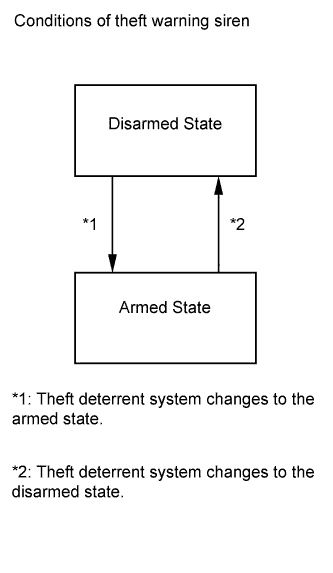
The theft warning siren changes between the disarmed state and armed state in accordance with the theft deterrent system change between the disarmed state and armed state. If +B, GND or the communication line is open while the theft warning siren is in the armed state, the theft warning siren sounds.
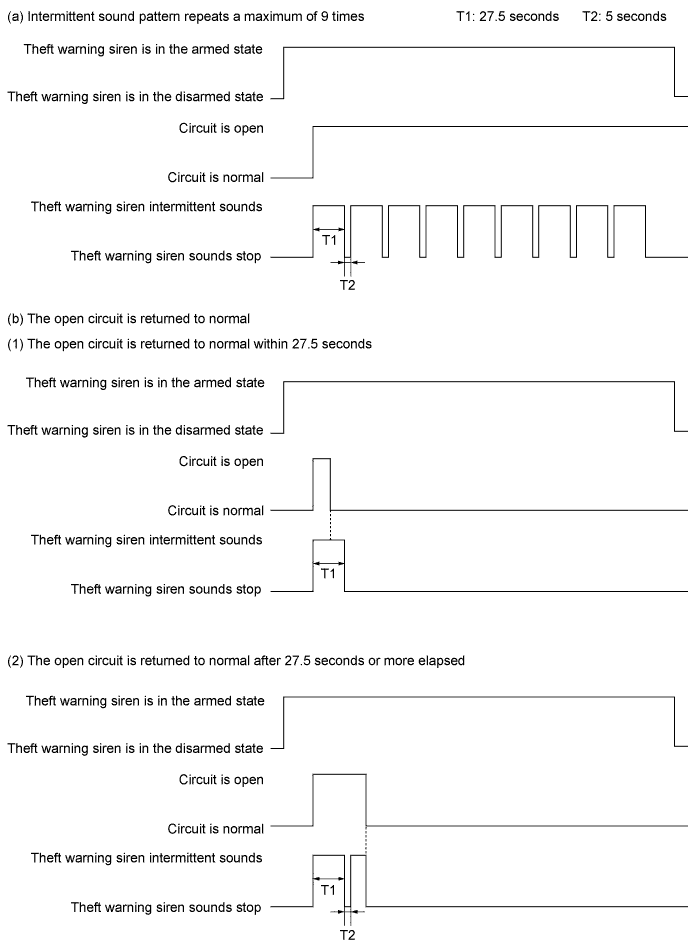
During the open circuit alarm sounding state, the theft warning siren sounds intermittently for 27.5 seconds and then stops for 5 seconds and this pattern repeats a maximum of 9 times.
The intermittent sound will stop when either condition is met:
1. The theft warning siren changes to the disarmed state.
2. The open circuit is returned to normal.
-
-
-
SECURITY INDICATOR LIGHT OUTPUT
-
According to the state of the theft deterrent system, the main body ECU (multiplex network body ECU) outputs a signal to turn the security indicator light on. However, some of the actual lighting conditions of the security indicator light are different from the output signals of the main body ECU (multiplex network body ECU).
Output State of Theft Deterrent System Security Indicator Light Output Signal from Main Body ECU (Multiplex Network Body ECU) Actual Lighting Condition Disarmed state (1), (2) OFF Off (Engine immobiliser system unset)
Blinking (Engine immobiliser system set)
Arming preparation state ON On Armed state OFF Blinking Alarm sounding state ON On Blinking Cycle Time Security Indicator Light 0.125 seconds On 1.875 seconds Off Tech Tips
When the engine immobiliser system is set, the security indicator light blinks during both the disarmed state and the armed state, due to output signals from the engine immobiliser system.
-