AUDIO AND VISUAL SYSTEM, Diagnostic DTC:B15D0

| DTC Code | DTC Name |
|---|---|
| B15D0 | MOST Communication Malfunction |
DESCRIPTION
This DTC is stored when the MOST network cannot be established after the master unit is activated.
Tech Tips
-
If a short occurs in a speaker circuit, the sound from the corresponding speaker will be low or almost impossible to hear. If the volume is turned up in this situation, to prevent excessive current flow due to the short circuit, the stereo component amplifier assembly stops operating when its output exceeds a certain level. When the operation of the stereo component amplifier assembly stops, the audio and visual system will not function normally. This is because MOST communication will stop due to the shut down of the amplifier causing an error in the MOST network. The stereo component amplifier assembly will start operating again when the engine switch is turned off and back on (ACC) again. However, the amplifier will stop operating again if its output exceeds a certain level.
-
When the stereo component amplifier assembly stops operating and a malfunction occurs in the audio and visual system due to a short in a speaker circuit, this DTC will be stored.
| DTC Code | DTC Detection Condition | Trouble Area |
|---|---|---|
| B15D0 | MOST network cannot be established. |
|
Tech Tips
-
For the MOST network, the multi-media module receiver assembly is the master unit.
-
Errors may occur in MOST communication between devices due to problems such as electrical noise.
WIRING DIAGRAM
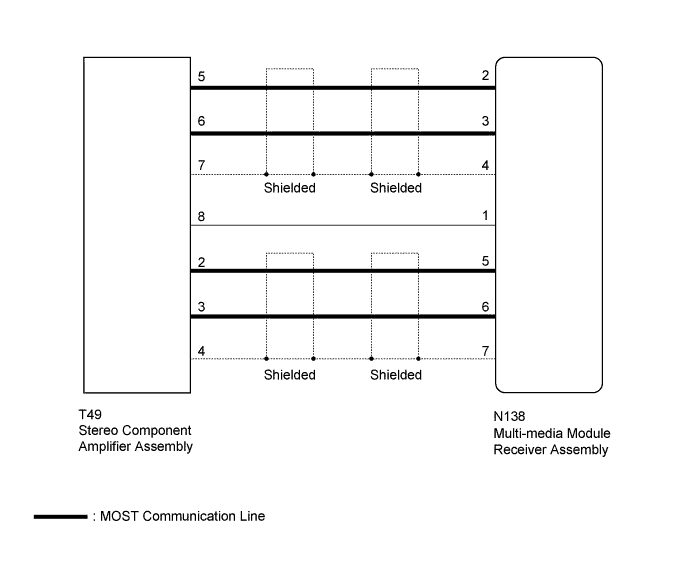
INSPECTION PROCEDURE
PROCEDURE
-
CHECK OPTIONAL COMPONENTS (INCLUDING ASSOCIATED WIRING)
-
Check that optional components (including associated wiring) which generate radio waves are not installed.
Result Result Proceed to Optional components (including associated wiring) are installed. A Optional components (including associated wiring) are installed.
DTCs are not output.
B Tech Tips
-
Electrical noise from radio waves generated by optional components or the wiring for those components may affect AVC-LAN communication.
-
These DTCs may be stored when an AVC-LAN communication error occurs due to electrical noise.
-
B 
CHECK MOST COMMUNICATION CONNECTORS Click here
A 
-
-
CONFIRM SYMPTOMS
-
Turn the engine switch off.
-
Turn the engine switch on (ACC) and check if the audio system activates and if the speakers operate.
Tech Tips
-
Choose a source such as radio so that sound can be output from the speakers.
-
If sound from the speakers is low, turn up the volume.
Result Result Proceed to Even after the engine switch is turned on (ACC), the audio system does not activate and sound is not output from the speakers. A The audio system activates when the engine switch is turned on (ACC) but the sound stops being output when the amplifier output exceeds a certain level. B Tech Tips
-
If a short occurs in a speaker circuit, the sound from the corresponding speaker will be low or almost impossible to hear. If the volume is turned up in this situation, to prevent excessive current flow due to the short circuit, the stereo component amplifier assembly stops operating when its output exceeds a certain level. When the operation of the stereo component amplifier assembly stops, the audio and visual system will not function normally. This is because MOST communication will stop due to the shut down of the amplifier causing an error in the MOST network. The stereo component amplifier assembly will start operating again when the engine switch is turned off and back on (ACC) again. However, the amplifier will stop operating again if its output exceeds a certain level.
-
When the stereo component amplifier assembly stops operating and a malfunction occurs in the audio and visual system due to a short in a speaker circuit, this DTC will be stored. In this case, check each speaker circuit and repair or replace malfunctioning parts, and then recheck for DTCs.
-
B 
GO TO PROBLEM SYMPTOMS TABLE Click here
A
-
-
CHECK MOST COMMUNICATION CONNECTORS
-
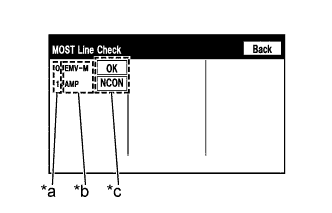
Text in Illustration *a Node position number for devices that use MOST communication *b Device name *c Result Display the "MOST Line Check" screen Click here.
-
Check the result on the "MOST Line Check" screen.
Result Result Proceed to "NCON" is displayed for "AMP". A "OK" is displayed for all items. B
-
When "NCON" is displayed for more than 1 item, proceed to the step for the device that has the smallest node position number.
-
The "MOST Line Check" screen can be displayed only when DTC B15D0 is stored.
-
B
CHECK HARNESS AND CONNECTOR (MULTI-MEDIA MODULE RECEIVER ASSEMBLY - STEREO COMPONENT AMPLIFIER ASSEMBLY) Click here
A
-
-
CONFIRM SYMPTOMS
-
Check the MOST communication line connectors.
-
Check if the MOST communication line connector between the multi-media module receiver assembly and stereo component amplifier assembly has any connection problems Click here.
-
-
Display the "MOST Line Check" screen and check the result Click here.
Result Result Proceed to "NCON" is displayed for "AMP". A The screen cannot be changed to the "MOST Line Check" screen. B Tech Tips
When the malfunction in the MOST network is repaired, the screen cannot be changed to the "MOST Line Check" screen.
B
USE SIMULATION METHOD TO CHECK Click here
A
-
-
CHECK HARNESS AND CONNECTOR (STEREO COMPONENT AMPLIFIER ASSEMBLY WAKE UP LINE)
-
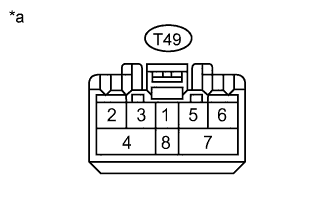
Text in Illustration *a Front view of wire harness connector
(to Stereo Component Amplifier Assembly)
Disconnect the stereo component amplifier assembly connector.
-
Measure the voltage according to the value(s) in the table below.
Standard Voltage Tester Connection Switch Condition Specified Condition T49-8 - Body ground Engine switch on (ACC) 4.5 V or higher
NG
CHECK HARNESS AND CONNECTOR (MULTI-MEDIA MODULE RECEIVER ASSEMBLY - STEREO COMPONENT AMPLIFIER ASSEMBLY) Click here
OK 
REPLACE MULTI-MEDIA MODULE RECEIVER ASSEMBLY Click here
-
-
CHECK HARNESS AND CONNECTOR (MULTI-MEDIA MODULE RECEIVER ASSEMBLY - STEREO COMPONENT AMPLIFIER ASSEMBLY)
-
Disconnect the N138 multi-media module receiver assembly connector.
-
Disconnect the T49 stereo component amplifier assembly connector.
-
Measure the resistance according to the value(s) in the table below.
Standard Resistance Tester Connection Condition Specified Condition N138-1 - T49-8 Always Below 1 Ω N138-1 - Body ground Always 10 kΩ or higher
NG
REPAIR OR REPLACE HARNESS OR CONNECTOR
OK
-
-
CHECK HARNESS AND CONNECTOR (MULTI-MEDIA MODULE RECEIVER ASSEMBLY - STEREO COMPONENT AMPLIFIER ASSEMBLY)
-
Disconnect the N138 multi-media module receiver assembly connector.
-
Disconnect the T49 stereo component amplifier assembly connector.
-
Measure the resistance according to the value(s) in the table below.
Standard Resistance Tester Connection Condition Specified Condition N138-2 - T48-5 Always Below 1 Ω N138-3 - T49-6 Always Below 1 Ω N138-4 - T49-7 Always Below 1 Ω N138-5 - T49-2 Always Below 1 Ω N138-6 - T49-3 Always Below 1 Ω N138-7 - T49-4 Always Below 1 Ω N138-2 - Body ground Always 10 kΩ or higher N138-3 - Body ground Always 10 kΩ or higher N138-4 - Body ground Always 10 kΩ or higher N138-5 - Body ground Always 10 kΩ or higher N138-6 - Body ground Always 10 kΩ or higher N138-7 - Body ground Always 10 kΩ or higher
NG
REPAIR OR REPLACE HARNESS OR CONNECTOR
OK
-
-
REPLACE STEREO COMPONENT AMPLIFIER ASSEMBLY
-
Replace the stereo component amplifier assembly with a new or normally functioning one Click here.
NEXT
-
-
CLEAR DTC
-
Clear the DTCs Click here.
NEXT
-
-
CHECK DTC
-
Recheck for DTCs and check if the same DTC is output again Click here.
OK No DTCs are output.
NG
REPLACE MULTI-MEDIA MODULE RECEIVER ASSEMBLY Click here
OK
END (STEREO COMPONENT AMPLIFIER ASSEMBLY IS DEFECTIVE)
-