POWER TILT AND POWER TELESCOPIC STEERING COLUMN SYSTEM, Diagnostic DTC:B2611

| DTC Code | DTC Name |
|---|---|
| B2611 | Telescopic Position Sensor or Telescopic Motor Circuit Malfunction |
DESCRIPTION
The telescopic motor is operated by voltage supplied from the multiplex tilt and telescopic ECU and slides the steering column forward and backward. The telescopic position sensor (Hall IC) in the telescopic motor detects the sliding position of the steering column in the forward and backward directions and sends a signal to the multiplex tilt and telescopic ECU based on that sliding amount.
| DTC No. | Detection Item | Trouble Area |
|---|---|---|
| B2611 | Telescopic operation stops within the operation range while operating. |
|
WIRING DIAGRAM
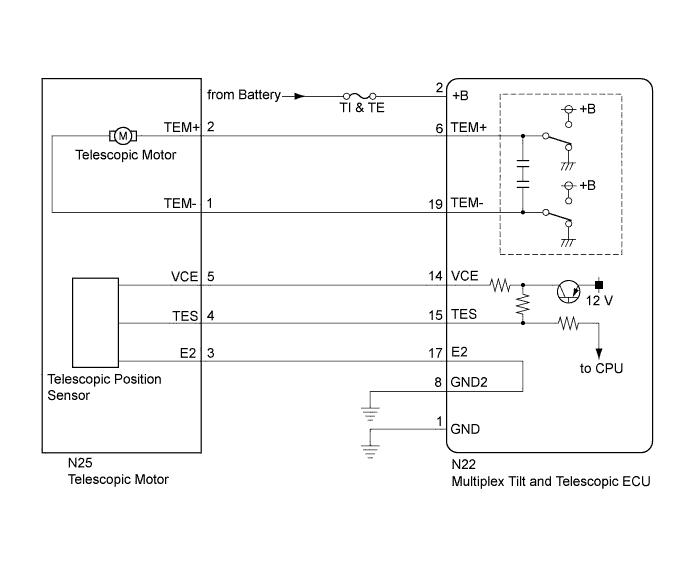
INSPECTION PROCEDURE
Tech Tips
Inspect the fuses for circuits related to this system before performing the following inspection procedure.
PROCEDURE
-
PERFORM ACTIVE TEST USING GTS (TELESCO OPERATION)
-
Turn the engine switch off.
-
Connect the GTS to the DLC3.
-
Turn the engine switch on (IG).
-
Turn the GTS on.
-
Check that the steering column contracts and extends. Enter the following menus: Body Electrical / Tilt & Telescopic / Active Test.
Tilt & Telescopic Tester Display Test Part Control Range Diagnostic Note Telesco Operation Telescopic operation LONG/SHORT - OK The steering column contracts and extends.
NG 
CHECK HARNESS AND CONNECTOR (MULTIPLEX TILT AND TELESCOPIC ECU - TELESCOPIC POSITION SENSOR) Click here
OK 
-
-
CHECK HARNESS AND CONNECTOR (MULTIPLEX TILT AND TELESCOPIC ECU - BATTERY)
-
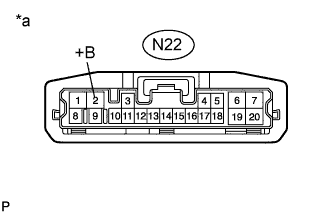
Text in Illustration *a Front view of wire harness connector
(to Multiplex Tilt and Telescopic ECU)
Disconnect the multiplex tilt and telescopic ECU connector.
-
Measure the voltage according to the value(s) in the table below.
Standard Voltage Tester Connection Condition Specified Condition N22-2 (+B) - Body ground Always 11 to 14 V
NG 
REPAIR OR REPLACE HARNESS OR CONNECTOR
OK
-
-
CHECK HARNESS AND CONNECTOR (MULTIPLEX TILT AND TELESCOPIC ECU - BODY GROUND)
-
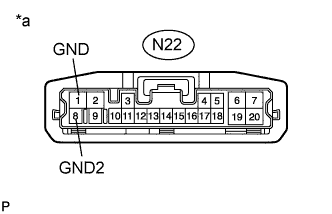
Text in Illustration *a Front view of wire harness connector
(to Multiplex Tilt and Telescopic ECU)
Disconnect the multiplex tilt and telescopic ECU connector.
-
Measure the resistance according to the value(s) in the table below.
Standard Resistance Tester Connection Condition Specified Condition N22-1 (GND) - Body ground Always Below 1 Ω N22-8 (GND2) - Body ground
NG
REPAIR OR REPLACE HARNESS OR CONNECTOR
OK
-
-
CHECK HARNESS AND CONNECTOR (MULTIPLEX TILT AND TELESCOPIC ECU - TELESCOPIC MOTOR)
-
Disconnect the N22 multiplex tilt and telescopic ECU connector.
-
Disconnect the N25 telescopic motor connector.
-
Measure the resistance according to the value(s) in the table below.
Standard Resistance Tester Connection Condition Specified Condition N22-6 (TEM+) - N25-2 (TEM+) Always Below 1 Ω N22-19 (TEM-) - N25-1 (TEM-) N22-6 (TEM+) - Body ground 10 kΩ or higher N22-19 (TEM-) - Body ground
NG
REPAIR OR REPLACE HARNESS OR CONNECTOR
OK
-
-
CHECK TELESCOPIC MOTOR
-
Disconnect the N25 telescopic motor connector.
-
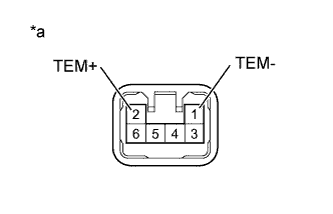
Text in Illustration *a Component without harness connected
(Telescopic Motor)
Apply 12 V battery voltage to the telescopic motor connector. Then check the steering column telescopic operation.
OK Measurement Condition Specified Condition
-
12 V battery positive (+) lead → Terminal 2 (TEM+)
-
12 V battery negative (-) lead → Terminal 1 (TEM-)
The steering column contracts.
-
12 V battery positive (+) lead → Terminal 1 (TEM-)
-
12 V battery negative (-) lead → Terminal 2 (TEM+)
The steering column extends. -
NG
REPLACE TILT STEERING GEAR ASSEMBLY WITH MOTOR Click here
OK 
REPLACE MULTIPLEX TILT AND TELESCOPIC ECU Click here
-
-
CHECK HARNESS AND CONNECTOR (MULTIPLEX TILT AND TELESCOPIC ECU - TELESCOPIC POSITION SENSOR)
-
Disconnect the N22 multiplex tilt and telescopic ECU connector.
-
Disconnect the N25 telescopic motor connector.
-
Measure the resistance according to the value(s) in the table below.
Standard Resistance Tester Connection Condition Specified Condition N22-14 (VCE) - N25-5 (VCE) Always Below 1 Ω N22-15 (TES) - N25-4 (TES) N22-17 (E2) - N25-3 (E2) N22-14 (VCE) - Body ground 10 kΩ or higher N22-15 (TES) - Body ground N22-17 (E2) - Body ground
NG
REPAIR OR REPLACE HARNESS OR CONNECTOR
OK
-
-
CHECK HARNESS AND CONNECTOR (MULTIPLEX TILT AND TELESCOPIC ECU - BODY GROUND)
-
Text in Illustration *a Front view of wire harness connector
(to Multiplex Tilt and Telescopic ECU)
Disconnect the multiplex tilt and telescopic ECU connector.
-
Measure the resistance according to the value(s) in the table below.
Standard Resistance Tester Connection Condition Specified Condition N22-1 (GND) - Body ground Always Below 1 Ω N22-8 (GND2) - Body ground
NG
REPAIR OR REPLACE HARNESS OR CONNECTOR
OK
-
-
CHECK MULTIPLEX TILT AND TELESCOPIC ECU (VCE TERMINAL VOLTAGE)
-
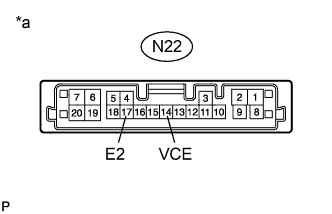
Text in Illustration *a Component with harness connected
(Multiplex Tilt and Telescopic ECU)
Reconnect the multiplex tilt and telescopic ECU connector.
-
Disconnect the N25 telescopic motor connector.
-
Measure the voltage according to the value(s) in the table below.
Standard Voltage Tester Connection Switch Condition Specified Condition N22-14 (VCE) - N22-17 (E2) Engine switch on (IG) 8 to 14 V
NG
REPLACE MULTIPLEX TILT AND TELESCOPIC ECU Click here
OK
-
-
CHECK TELESCOPIC POSITION SENSOR
-
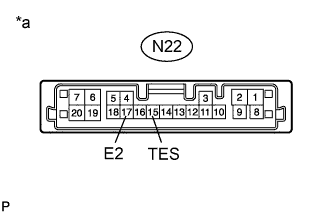
Text in Illustration *a Component with harness connected
(Multiplex Tilt and Telescopic ECU)
Reconnect the multiplex tilt and telescopic ECU connector.
-
Reconnect the N25 telescopic motor connector.
-
Measure the voltage according to the value(s) in the table below.
Standard Voltage Tester Connection Condition Specified Condition N22-15 (TES) - N22-17 (E2) Steering column contracting or extending Pulse generation
High: 8 to 14 V
Low: Below 1 V
NG
REPLACE TILT STEERING GEAR ASSEMBLY WITH MOTOR Click here
OK
REPLACE MULTIPLEX TILT AND TELESCOPIC ECU Click here
-