FRONT BRAKE (for 18 inch Front Disc Brake) INSPECTION

-
CHECK BRAKE CYLINDER AND PISTON
-
Check the cylinder bore and piston for rust or scoring.
If necessary, replace the cylinder and piston.
-
-
CHECK PAD LINING THICKNESS
-
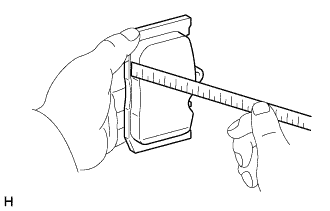
Using a ruler, measure the pad lining thickness.
Standard thickness 12.5 mm (0.492 in.) Minimum thickness 1.0 mm (0.0394 in.) If the pad lining thickness is less than the minimum, replace the pad.
-
-
CHECK FRONT DISC BRAKE ANTI-RATTLE SPRING
-
Use brake cleaner to clean the front disc brake anti-rattle spring. Check for deformation and cracks.
-
When installing the front disc brake anti-rattle spring to the front disc brake cylinder, check that the spring force is applied to the hole pin and brake pad.
-
-
CHECK DISC THICKNESS
-
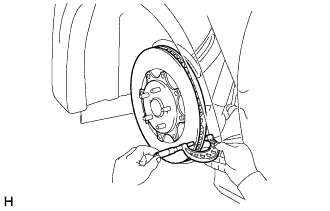
Using a micrometer, measure the disc thickness.
Standard Thickness 30.0 mm (1.18 in.) Minimum Thickness 27.0 mm (1.06 in.) If the disc thickness is less than the minimum, replace the disc.
-
-
CHECK DISC RUNOUT
-
Check the front axle hub bearing looseness Click here and front axle hub runout Click here.
-
Install the disc with the 5 hub nuts.
- Torque:
- 103 N*m { 1050 kgf*cm, 76 ft.*lbf }
Tech Tips
The hub nuts may leave a mark on the front disc, but this does not affect its functionality.
-
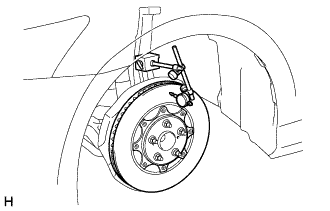
Using a dial indicator, measure the disc runout 10 mm (0.394 in.) inside the outer edge of the disc.
Maximum disc runout 0.05 mm (0.00197 in.) Note
-
Do not place the magnetic portion of the dial indicator near the axle hub or speed sensor.
-
Place the dial indicator on the shock absorber.
If the runout is more than the maximum, change the installation position of the disc to minimize runout.
If the runout is more than the maximum even when the installation position is changed, grind the disc.
If the disc thickness is less than the minimum, replace the front disc.
-
-
Remove the 5 hub nuts and disc.
-