AIR CONDITIONING SYSTEM, Diagnostic DTC:B1423/23

| DTC Code | DTC Name |
|---|---|
| B1423/23 | Pressure Sensor Circuit |
DESCRIPTION
This DTC is stored if refrigerant pressure on the high pressure side is extremely low (0.19 MPa [2.0 kgf/cm2, 28 psi] or less) or extremely high (3.14 MPa [32.0 kgf/cm2, 455 psi] or more). The air conditioner pressure sensor, which is installed on the pipe on the high pressure side to detect refrigerant pressure, sends a refrigerant pressure signal to the air conditioning amplifier assembly. The air conditioning amplifier assembly converts this signal to a pressure value according to the sensor characteristics and uses it to control the compressor.
| DTC No. | DTC Detection Condition | Trouble Area |
|---|---|---|
| B1423/23 |
|
|
WIRING DIAGRAM
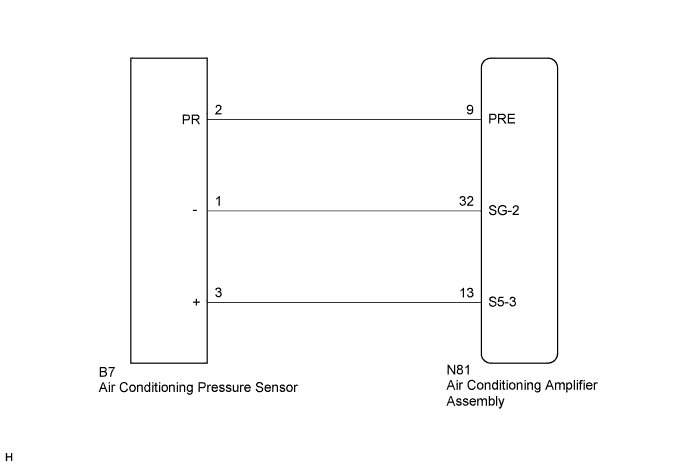
INSPECTION PROCEDURE
Note
-
This DTC is stored when there is no refrigerant in the system, when DTC B1423, B14B8 and B1479 are output simultaneously, perform troubleshooting for DTC B14B8 first.
-
When the battery is disconnected or the air conditioning amplifier assembly is replaced, be sure to perform servo motor initialization Click here.
-
Before disconnecting the cable form the negative (-) battery terminal or replacing the air conditioning amplifier assembly, record the last operation state of the air conditioning for each transmitter. After replacement, it is necessary to perform memory registration for each transmitter Click here.
PROCEDURE
-
CHECK HARNESS AND CONNECTOR (POWER SOURCE CIRCUIT)
-
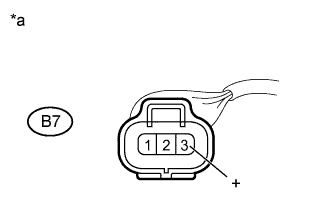
Text in Illustration *a Front view of harness connector
(to Air Conditioner Pressure Sensor)
Disconnect the air conditioner pressure sensor connector.
-
Measure the voltage according to the value(s) in the table below.
Standard Voltage Tester Connection Switch Condition Specified Condition B7-3 (+) - Body ground Engine switch on (IG) 4.75 to 5.25 V
NG 
CHECK HARNESS AND CONNECTOR (AIR CONDITIONING AMPLIFIER ASSEMBLY - AIR CONDITIONER PRESSURE SENSOR) Click here
OK 
-
-
CHECK HARNESS AND CONNECTOR (GROUND CIRCUIT)
-
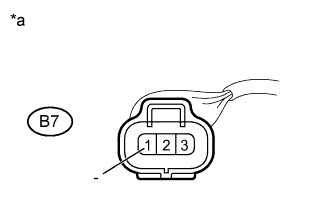
Text in Illustration *a Front view of harness connector
(to Air Conditioner Pressure Sensor)
Measure the resistance according to the value(s) in the table below.
Standard Resistance Tester Connection Condition Specified Condition B7-1 (-) - Body ground Always Below 1 Ω
NG
CHECK HARNESS AND CONNECTOR (AIR CONDITIONING AMPLIFIER ASSEMBLY - AIR CONDITIONER PRESSURE SENSOR) Click here
OK
-
-
CHECK AIR CONDITIONER PRESSURE SENSOR (SENSOR SIGNAL CIRCUIT)
-
Reconnect the B7 air conditioner pressure sensor connector.
-
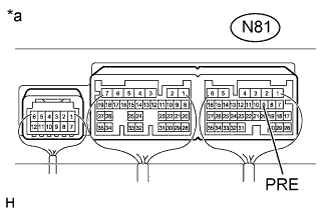
Text in Illustration *a Component with harness connected
(Air Conditioning Amplifier Assembly)
Remove the air conditioning amplifier assembly with connectors still connected Click here.
-
Measure the voltage according to the value(s) in the table below.
Standard Voltage Tester Connection Switch Condition Specified Condition N81-9 (PRE) - Body ground Engine switch on (IG) 0.63 to 4.73 V Tech Tips
If the measured voltage is not within the normal range, there may be a malfunction in the air conditioning amplifier assembly, air conditioner pressure sensor or wire harness. It is also possible that amount of refrigerant may not be appropriate.
NG
CHECK HARNESS AND CONNECTOR (AIR CONDITIONING AMPLIFIER ASSEMBLY - AIR CONDITIONER PRESSURE SENSOR) Click here
OK
-
-
CHECK AIR CONDITIONER PRESSURE SENSOR (SENSOR SIGNAL CIRCUIT)
-
Measure the voltage when the following conditions are satisfied.
Item Condition Vehicle Doors Fully open Temperature Setting LO Blower Speed Hi A/C Switch On R/F Switch Recirculation Interior Temperature 25 to 35°C (77 to 95°F) Engine Speed 1500 rpm Note
-
If refrigerant pressure on the high pressure side becomes extremely high during the inspection (if the voltage exceeds 4.8 V), the fail-safe function stops compressor operation. Therefore, measure the voltage before the fail-safe operation.
-
It is necessary to measure the voltage for a certain amount of time (approximately 10 minutes) because the problem symptom may recur after a while.
Tech Tips
When the outside air temperature is low (below -1.5°C [29.3°F]), the compressor stops due to operation of the ambient temperature sensor and the evaporator temperature sensor to prevent the evaporator from freezing. In this case, perform the inspection in a warm indoor environment.
-
Text in Illustration *a Component with harness connected
(Air Conditioning Amplifier Assembly)
Measure the voltage according to the value(s) in the table below.
Standard Voltage Tester Connection Condition Specified Condition N81-9 (PRE) - Body ground Conditions in "Measurement Condition" chart above are met 0.63 to 4.73 V Result Result Proceed to OK (When troubleshooting according to the DTC) A OK (When troubleshooting according to Problem Symptoms Table) B NG C
-
B 
PROCEED TO NEXT SUSPECTED AREA SHOWN IN PROBLEM SYMPTOMS TABLE Click here
C
CHECK COOLING FAN SYSTEM Click here
A 
REPLACE AIR CONDITIONING AMPLIFIER ASSEMBLY Click here
-
-
CHECK HARNESS AND CONNECTOR (AIR CONDITIONING AMPLIFIER ASSEMBLY - AIR CONDITIONER PRESSURE SENSOR)
-
Disconnect the N81 air conditioning amplifier assembly connector.
-
Measure the resistance according to the value(s) in the table below.
Standard Resistance Tester Connection Condition Specified Condition B7-3 (+) - N81-13 (S5-3) Always Below 1 Ω N81-13 (S5-3) - Body ground Always 10 kΩ or higher
NG
REPAIR OR REPLACE HARNESS OR CONNECTOR
OK
REPLACE AIR CONDITIONING AMPLIFIER ASSEMBLY Click here
-
-
CHECK HARNESS AND CONNECTOR (AIR CONDITIONING AMPLIFIER ASSEMBLY - AIR CONDITIONER PRESSURE SENSOR)
-
Disconnect the N81 air conditioning amplifier assembly connector.
-
Measure the resistance according to the value(s) in the table below.
Standard Resistance Tester Connection Condition Specified Condition B7-1 (-) - N81-32 (SG-2) Always Below 1 Ω N81-32 (SG-2) - Body ground Always 10 kΩ or higher
NG
REPAIR OR REPLACE HARNESS OR CONNECTOR
OK
REPLACE AIR CONDITIONING AMPLIFIER ASSEMBLY Click here
-
-
CHECK HARNESS AND CONNECTOR (AIR CONDITIONING AMPLIFIER ASSEMBLY - AIR CONDITIONER PRESSURE SENSOR)
-
Disconnect the N81 air conditioning amplifier assembly connector.
-
Disconnect the B7 air conditioner pressure sensor connector.
-
Measure the resistance according to the value(s) in the table below.
Standard Resistance Tester Connection Condition Specified Condition B7-2 (PR) - N81-9 (PRE) Always Below 1 Ω N81-9 (PRE) - Body ground Always 10 kΩ or higher
NG
REPAIR OR REPLACE HARNESS OR CONNECTOR
OK
-
-
CHECK FOR A/C SYSTEM LEAK
-
Install the manifold gauge set.
-
Recover the refrigerant from the A/C system using a refrigerant recovery unit Click here.
-
Evacuate the A/C system and check that vacuum can be maintained in it.
OK Vacuum can be maintained in the A/C system. Tech Tips
If vacuum cannot be maintained in the A/C system, refrigerant may be leaking from it. In this case, it is necessary to repair or replace the leaking part of the A/C system.
NG
REPAIR A/C SYSTEM LEAK Click here
OK
-
-
CHARGE SYSTEM WITH REFRIGERANT
-
Use a refrigerant recovery unit to recover refrigerant.
-
Evacuate the A/C system.
-
Add an appropriate amount of refrigerant Click here.
Tech Tips
If refrigerant is added and the system has not been properly evacuated (insufficient vacuum time), moisture in the air remaining in the system will freeze in the expansion valve, blocking the flow on the high pressure side. Therefore, in order to confirm the problem, recover the refrigerant and properly evacuate the system. Add an appropriate amount of refrigerant, and check for DTCs.
NEXT
-
-
RECHECK FOR DTC
-
Recheck for DTCs when the following conditions are satisfied Click here.
Item Condition Vehicle Doors Fully open Temperature Setting LO Blower Speed Hi A/C Switch On R/F Switch Recirculation Interior Temperature 25 to 35°C (77 to 95°F) Engine Speed 1500 rpm Note
If refrigerant pressure on the high pressure side becomes high, the DTC will be set. It is necessary to measure the voltage for a certain amount of time (approximately 10 minutes) because the DTC may be set after the A/C operates for a while.
Tech Tips
When the outside air temperature is low (below -1.5°C [29.3°F]), the compressor stops due to operation of the ambient temperature sensor and the evaporator temperature sensor to prevent the evaporator from freezing. In this case, perform the inspection in a warm indoor environment.
Result Result Proceed to DTC B1423/23 is output A DTC B1423/23 is not output B Note
If the DTC was set due to an insufficient or excessive amount of refrigerant, the problem may have been solved after performing the previous step. However, the root cause of insufficient refrigerant may be refrigerant leaks. The root cause of excessive refrigerant may be adding refrigerant when the level was insufficient. Therefore, identify and repair the area where refrigerant leaks from as necessary.
B
END (AMOUNT OF REFRIGERANT WAS DEFECTIVE)
A
-
-
CHECK AIR CONDITIONER PRESSURE SENSOR
-
Install the manifold gauge set.
-
Reconnect the air conditioner pressure sensor connector.
-
Text in Illustration *a Component with harness connected
(Air Conditioning Amplifier Assembly)
Measure the voltage according to the value(s) in the table below.
Standard Voltage Tester Connection Condition Specified Condition N81-9 (PRE) - Body ground Engine running
Blower switch: Lo
A/C switch: on (magnet clutch on)
0.63 to 4.73 V
NG
REPLACE AIR CONDITIONER PRESSURE SENSOR Click here
OK
REPLACE AIR CONDITIONING AMPLIFIER ASSEMBLY Click here
-
-
REPAIR A/C SYSTEM LEAK
-
Identify the area where refrigerant leaks from Click here.
-
Repair the identified area of the A/C system.
-
Evacuate the A/C system.
NEXT
CHARGE SYSTEM WITH REFRIGERANT Click here
-
-
CHECK COOLING FAN SYSTEM
-
Check that the cooling fan(s) operates normally.
-
for 2GR-FSE: Click here.
-
for 4GR-FSE: Click here.
Result Result Proceed to OK A NG (for 2GR-FSE) B NG (for 4GR-FSE) C -
B
GO TO COOLING FAN SYSTEM Click here
C
GO TO COOLING FAN SYSTEM Click here
A
-
-
CHARGE SYSTEM WITH REFRIGERANT
-
Use a refrigerant recovery unit to recover refrigerant.
-
Evacuate the A/C system.
-
Add an appropriate amount of refrigerant Click here.
Tech Tips
If refrigerant is added and the system has not been properly evacuated (insufficient vacuum time), moisture in the air remaining in the system will freeze in the expansion valve, blocking the flow on the high pressure side. Therefore, in order to confirm the problem, recover the refrigerant and properly evacuate the system. Add an appropriate amount of refrigerant, and check for DTCs.
NEXT
-
-
RECHECK FOR DTC
-
Recheck for DTCs when the following conditions are satisfied Click here.
Item Condition Vehicle Doors Fully open Temperature Setting LO Blower Speed Hi A/C Switch On R/F Switch Recirculation Interior Temperature 25 to 35°C (77 to 95°F) Engine Speed 1500 rpm Note
If refrigerant pressure on the high pressure side becomes high, the DTC will be set. It is necessary to measure the voltage for a certain amount of time (approximately 10 minutes) because the DTC may be set after the air conditioning operates for a while.
Tech Tips
-
When the outside air temperature is low (below -1.5°C [29.3°F]), the compressor stops due to operation of the ambient temperature sensor and the evaporator temperature sensor to prevent the evaporator from freezing. In this case, perform the inspection in a warm indoor environment.
-
If refrigerant is added and the system has not been properly evacuated (insufficient vacuum time), moisture in the air remaining in the system will freeze in the expansion valve, blocking the flow on the high pressure side. Therefore, in order to confirm the problem, recover the refrigerant and properly evacuate the system. Add an appropriate amount of refrigerant, and check for DTCs. If the DTC is not output after this work, it indicates that the cooler dryer in the condenser is not able to absorb moisture in the refrigerant cycle. It is necessary to replace the cooler dryer in order to complete the repair.
Result Result Proceed to DTC B1423/23 is output A DTC B1423/23 is not output B -
B
REPLACE COOLER CONDENSER ASSEMBLY Click here
A
-
-
CHECK COOLER EXPANSION VALVE
-
Replace the cooler expansion valve with a new or normally functioning one Click here.
Tech Tips
Replace the cooler expansion valve with a new one because the cooler expansion valve is either stuck or clogged.
NEXT
-
-
CHARGE SYSTEM WITH REFRIGERANT
-
Use a refrigerant recovery unit to recover refrigerant.
-
Evacuate the A/C system.
-
Add an appropriate amount of refrigerant Click here.
Tech Tips
If refrigerant is added and the system has not been properly evacuated (insufficient vacuum time), moisture in the air remaining in the system will freeze in the expansion valve, blocking the flow on the high pressure side. Therefore, in order to confirm the problem, recover the refrigerant and properly evacuate the system. Add an appropriate amount of refrigerant, and check for DTCs.
NEXT
-
-
RECHECK FOR DTC
-
Recheck for DTCs when the following conditions are satisfied Click here.
Item Condition Vehicle Doors Fully open Temperature Setting LO Blower Speed Hi A/C Switch On R/F Switch Recirculation Interior Temperature 25 to 35°C (77 to 95°F) Engine Speed 1500 rpm Note
If refrigerant pressure on the high pressure side becomes high, the DTC will be set. It is necessary to measure the voltage for a certain amount of time (approximately 10 minutes) because the DTC may be set after the air conditioning operates for a while.
Tech Tips
-
When the outside air temperature is low (below -1.5°C [29.3°F]), the compressor stops due to operation of the ambient temperature sensor and the evaporator temperature sensor to prevent the evaporator from freezing. In this case, perform the inspection in a warm indoor environment.
-
If refrigerant pressure is not normal after replacing the expansion valve with a normal one, the condenser or pipes may be clogged due to dirt, dust or other foreign matter. In this case, clean or replace the condenser or pipes.
Result Result Proceed to DTC B1423/23 is output A DTC B1423/23 is not output B -
B
CLEAN OR REPLACE CONDENSER OR PIPE
A
END (COOLER EXPANSION VALVE WAS DEFECTIVE)
-